


Pound Sterling juggles as investors seek fresh BoE’s interest rate guidance
- The Pound Sterling trades sideways amid uncertainty over the BoE’s interest-rate outlook.
- BoE officials see expectations of two or three rate cuts for this year as appropriate.
- Investors await the US and UK Manufacturing PMI for fresh guidance on the economic outlook.
The Pound Sterling (GBP) struggles to make a decisive move in Monday’s London session as investors are yet to return to the FX domain after a holiday-stretched weekend on account of Good Friday and Easter Monday. The GBP/USD pair consolidates slightly above the round-level support of 1.2600 as investors await fresh guidance on when the Bank of England (BoE) and the Federal Reserve (Fed) will pivot to rate cuts.
Earlier this year, the Fed was expected to start reducing interest rates sooner than the BoE, supporting the Pound Sterling’s valuation against the US Dollar. However, the BoE is currently anticipated to follow the Fed’s footprints and start rate cuts from June. Two BoE policymakers, Catherine Mann and Jonathan Haskel, who were described as hawks, see no need for more rate hikes as higher interest rates are impacting labor market conditions and consumer spending.
Catherine Mann said in an interview with Bloomberg last week that she dropped her rate hike call after observing that consumers are reluctant to pay higher prices on services such as travel and hospitality. Mann added that firms are cutting working hours in times when more employment is required. She further added that the number of workers in the labor market will increase due to the government's cuts to social security rates.
The Pound Sterling is expected to depreciate if the BoE reduces key borrowing rates earlier than expected after consistently raising them for more than two years.
Meanwhile, the US Dollar Index (DXY) is broadly sideways around 104.50 as investors await the crucial United States Nonfarm Payrolls (NFP) report for March, which will be published on Friday. The official labor market data is one of the main economic data releases that influences the Fed’s rate cut expectations.
Daily digest market movers: Pound Sterling follows US Dollar’s footprints
- The Pound Sterling trades in a tight range slightly above 1.2600 as investors look for fresh cues about when the Bank of England will start reducing interest rates. The market expectations for the BoE pivoting to rate cuts have come forward to the June meeting as the central bank was seen as slightly dovish in its latest monetary policy statement.
- The BoE sounded dovish as none of the policymakers voted for a rate hike. This indicates that BoE policymakers see current interest rates as restrictive. Policymakers do not see more interest rate hikes appropriate when they are worried that further policy tightening could dampen the economic outlook or they see progress in inflation declining to the 2% target.
- In addition, BoE Governor Andrew Bailey said in its latest monetary policy statement that market expectations for two or three rate cuts this year are “appropriate,” boosting expectations for the BoE to cut interest rates from June.
- On the economic front, investors will focus on the United Kingdom’s S&P Global/CIPS Manufacturing PMI final data for March, which will be published on Tuesday. The factory data is forecasted to have remained unchanged from its preliminary reading of 49.9, which came in marginally below the 50.0 threshold that separates expansion from contraction. Investors will keenly focus on the agency’s commentary on businesses’ expectations for the domestic and global demand outlook.
- Meanwhile, the appeal for risk-perceived assets is quite upbeat as S&P 500 futures are positive. Market sentiment has turned cheerful as expectations for the Federal Reserve to begin to reduce interest rates from the June meeting have recently increased.
- In today’s session, investors will focus on the United States ISM Manufacturing PMI for March, which will be published at 14:00 GMT. The PMI is estimated to increase to 48.4 from 47.8 in February.
Technical Analysis: Pound Sterling consolidates around 1.2600
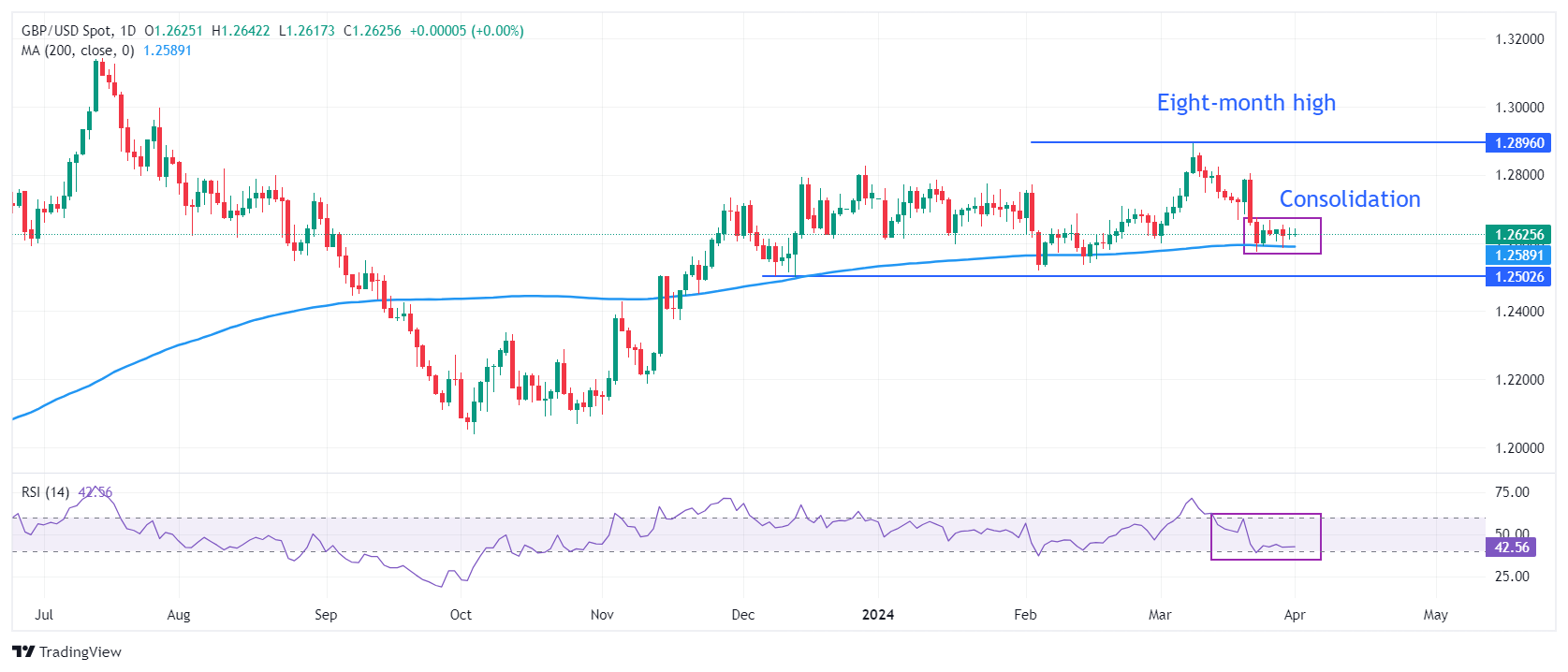
The Pound Sterling trades back and forth above 1.2600 against the US Dollar. The GBP/USD pair is expected to remain sideways as investors await a fresh trigger for the interest rate guidance. The Cable has been trading in the 1.2575-1.2675 range for the past six trading sessions. The 200-day Exponential Moving Average (EMA) near 1.2590 provides support to the Pound Sterling bulls.
On a broader time frame, the horizontal support from December 8 low at 1.2500 would provide further cushion to the Pound Sterling. Meanwhile, the upside is expected to remain limited near an eight-month high of around 1.2900.
The 14-period Relative Strength Index (RSI) hovers near 40.00. If it dips below this level, bearish momentum will trigger.
Pound Sterling FAQs
The Pound Sterling (GBP) is the oldest currency in the world (886 AD) and the official currency of the United Kingdom. It is the fourth most traded unit for foreign exchange (FX) in the world, accounting for 12% of all transactions, averaging $630 billion a day, according to 2022 data. Its key trading pairs are GBP/USD, aka ‘Cable’, which accounts for 11% of FX, GBP/JPY, or the ‘Dragon’ as it is known by traders (3%), and EUR/GBP (2%). The Pound Sterling is issued by the Bank of England (BoE).
The single most important factor influencing the value of the Pound Sterling is monetary policy decided by the Bank of England. The BoE bases its decisions on whether it has achieved its primary goal of “price stability” – a steady inflation rate of around 2%. Its primary tool for achieving this is the adjustment of interest rates. When inflation is too high, the BoE will try to rein it in by raising interest rates, making it more expensive for people and businesses to access credit. This is generally positive for GBP, as higher interest rates make the UK a more attractive place for global investors to park their money. When inflation falls too low it is a sign economic growth is slowing. In this scenario, the BoE will consider lowering interest rates to cheapen credit so businesses will borrow more to invest in growth-generating projects.
Data releases gauge the health of the economy and can impact the value of the Pound Sterling. Indicators such as GDP, Manufacturing and Services PMIs, and employment can all influence the direction of the GBP. A strong economy is good for Sterling. Not only does it attract more foreign investment but it may encourage the BoE to put up interest rates, which will directly strengthen GBP. Otherwise, if economic data is weak, the Pound Sterling is likely to fall.
Another significant data release for the Pound Sterling is the Trade Balance. This indicator measures the difference between what a country earns from its exports and what it spends on imports over a given period. If a country produces highly sought-after exports, its currency will benefit purely from the extra demand created from foreign buyers seeking to purchase these goods. Therefore, a positive net Trade Balance strengthens a currency and vice versa for a negative balance.
Empfohlene Artikel


