


Gold Price plunges as solid US PMIs dim rate cut hopes
- Gold reverses gains after hitting daily high of $2,368, down more than 1.70%.
- Strong US S&P Global PMI data boosts the US Dollar, with the DXY rising 0.14% to 105.80.
- Mixed US economic data keeps Fed rate cut speculation alive.
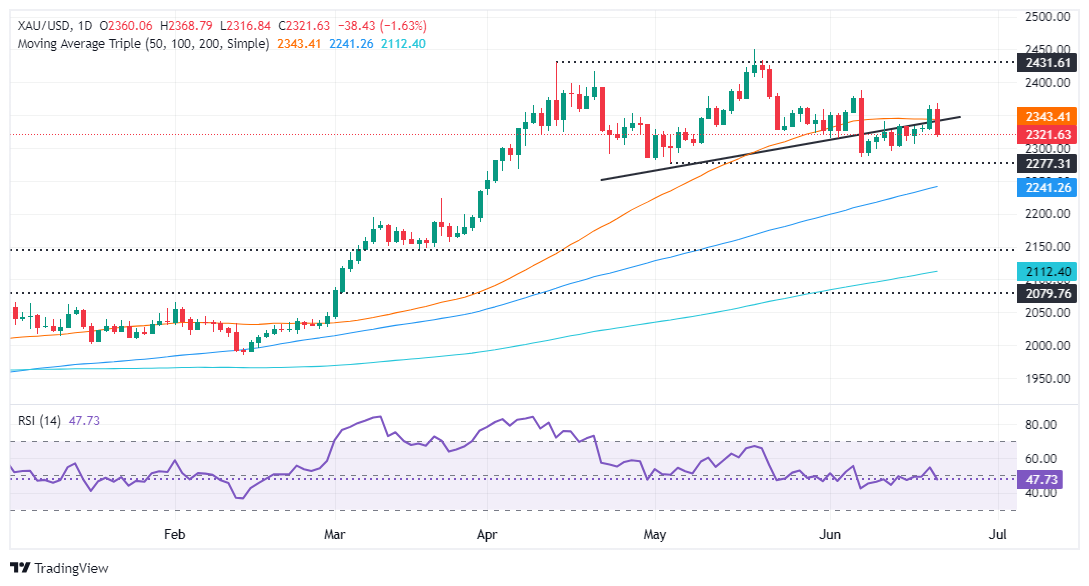
Gold prices reversed course on Friday, moving down more than 1.70%. Economic data from the United States (US) spurred investors' reaction to pricing out fewer interest rate cuts by the Federal Reserve (Fed) due to the solid state of the economy. The XAU/USD trades at $2,317, below its opening price after hitting a daily high of $2,368.
The US economy continued to give mixed signals regarding its robustness. S&P Global revealed June’s Purchasing Managers Index (PMI) readings, which exceeded estimates and topped May’s data. However, the US housing sector continued to deteriorate after Existing Home Sales for May missed the mark and fell compared to April’s data.
On the PMI release, investors ditched Gold and bought the Greenback, which, according to the US Dollar Index (DXY), rose 0.14% at 105.80.
US data revealed during the week highlights uncertainty as some economic indicators reiterate that the economy is still solid. On the positive side, Industrial Production, S&P Flash PMIs, and Retail Sales advanced, though the latter were lower than the previous month.
Conversely, housing continued to deteriorate, while the jobs market, as measured by Americans filing unemployment claims, came in worse than expected. The data kept investors' chances of a September Fed rate cut alive.
Given the backdrop, Gold prices continued to drop, along with technical indicators, pointing to a correction following a three-month rally that began in March and lifted XAU/USD to its all-time high of $2,450.
The CME FedWatch Tool shows odds for a 25-basis-point Fed rate cut in September at 59.5%, up from 57.5% on Thursday. In the meantime, the December 2024 fed funds rate futures contract implies the Fed will cut 36 bps toward the end of the year.
Daily digest market movers: Gold price drops due to strong US Dollar
- US Treasury bond yields are firm, with the 10-year Treasury note yield flat at 4.261%.
- S&P Global Manufacturing and Services Flash PMIs in June expanded above estimates. The Manufacturing PMI rose to 51.7, up from 51.3 and exceeding the estimate of 51. The Services PMI increased from 54.8 to 55.1, surpassing the forecast of 53.7.
- US Existing Home Sales in May were lower than expected, falling to 4.11 million from 4.14 million in April, representing a contraction of -0.7%.
- Fed officials advised patience regarding interest rate cuts, emphasizing that their decisions would remain data-dependent. Despite last week's positive CPI report, policymakers reiterated the need to see more data similar to May's before considering any changes.
- Despite the US CPI report showing that the disinflation process continues, Fed Chair Jerome Powell commented that they remain “less confident” about the progress on inflation.
Technical analysis: Gold price drops below Head-and-Shoulders neckline, eyes $2,300
Gold’s downtrend resumed on Friday after buyers tested the Head-and-Shoulders pattern, dragging the XAU/USD price above the pattern’s neckline. Despite achieving a daily close above the latter, sellers defended the neckline and pushed the spot price to a new three-day low of $2,316.
That said, the path of least resistance is to the downside. The next support would be $2,300. Once cleared, XAU/USD would fall to $2,277, the May 3 low, followed by the March 21 high of $2,222. Further losses lie underneath, with sellers eyeing the Head-and-Shoulders chart pattern objective from $2,170 to $2,160.
Conversely, if Gold reclaims $2,350, that will expose additional key resistance levels like the June 7 cycle high of $2,387, ahead of challenging the $2,400 figure.
Gold FAQs
Gold has played a key role in human’s history as it has been widely used as a store of value and medium of exchange. Currently, apart from its shine and usage for jewelry, the precious metal is widely seen as a safe-haven asset, meaning that it is considered a good investment during turbulent times. Gold is also widely seen as a hedge against inflation and against depreciating currencies as it doesn’t rely on any specific issuer or government.
Central banks are the biggest Gold holders. In their aim to support their currencies in turbulent times, central banks tend to diversify their reserves and buy Gold to improve the perceived strength of the economy and the currency. High Gold reserves can be a source of trust for a country’s solvency. Central banks added 1,136 tonnes of Gold worth around $70 billion to their reserves in 2022, according to data from the World Gold Council. This is the highest yearly purchase since records began. Central banks from emerging economies such as China, India and Turkey are quickly increasing their Gold reserves.
Gold has an inverse correlation with the US Dollar and US Treasuries, which are both major reserve and safe-haven assets. When the Dollar depreciates, Gold tends to rise, enabling investors and central banks to diversify their assets in turbulent times. Gold is also inversely correlated with risk assets. A rally in the stock market tends to weaken Gold price, while sell-offs in riskier markets tend to favor the precious metal.
The price can move due to a wide range of factors. Geopolitical instability or fears of a deep recession can quickly make Gold price escalate due to its safe-haven status. As a yield-less asset, Gold tends to rise with lower interest rates, while higher cost of money usually weighs down on the yellow metal. Still, most moves depend on how the US Dollar (USD) behaves as the asset is priced in dollars (XAU/USD). A strong Dollar tends to keep the price of Gold controlled, whereas a weaker Dollar is likely to push Gold prices up.
Empfohlene Artikel


