




Dow Jones Industrial Average struggles to recover from recent backslide as Fed rounds corner
- Dow Jones stuck near recent lows as Fed looms.
- Equities are mixed as markets await Fed policy guidance.
- NFP Friday will solidify market outlook on US labor market.
After this week's backslide, the Dow Jones Industrial Average (DJIA) is stuck in a rut, dragging the index below 38,000.00 as investors buckle down for another rate call from the US Federal Reserve (Fed). With rates broadly expected to hold steady this week, investors will be looking for firmer clues about when the Fed could be expected to begin cutting interest rates.
US Interest Rate Decision: Fed set to keep policy steady as markets reassess timing of rate cuts
The US ISM Manufacturing Purchasing Managers Index (PMI) for April came in softer than expected, but Wednesday morning’s April ADP Employment Change came in above forecasts. Despite a declining US economic outlook, a tight labor market makes it difficult for the Fed to adjust policy rates without drastic knock-on effects that could include re-igniting inflation, which still remains higher than many hoped.
Read more:
- US ADP Employment Change increases above consensus in April
- US ISM Manufacturing PMI drops to 49.2 in April vs 50.0 expected
Dow Jones news
Of the 30 securities that comprise the Dow Jones, around half of them are trading in the red on Wednesday as markets pull into the midrange ahead of the latest Federal Open Market Committee (FOMC) appearance. Nike Inc. (NKE) is down around 1.8% on the day, with Johnson & Johnson (JNJ) and 3M Co. (MMM) dragging the index higher, up 4.3% and 2.5%, respectively.
Dow Jones technical outlook
The Dow Jones continues to struggle with the 38,000.00 handle, kicking Wednesday off with a dip to 37,708.46 before recovering into the previous day’s closing bids. The major equity index continues to trade into the low side, eating away at chart paper as the Dow Jones heads back towards the 200-day Exponential Moving Average (EMA) at 36,780.70.
Dow Jones five-minute chart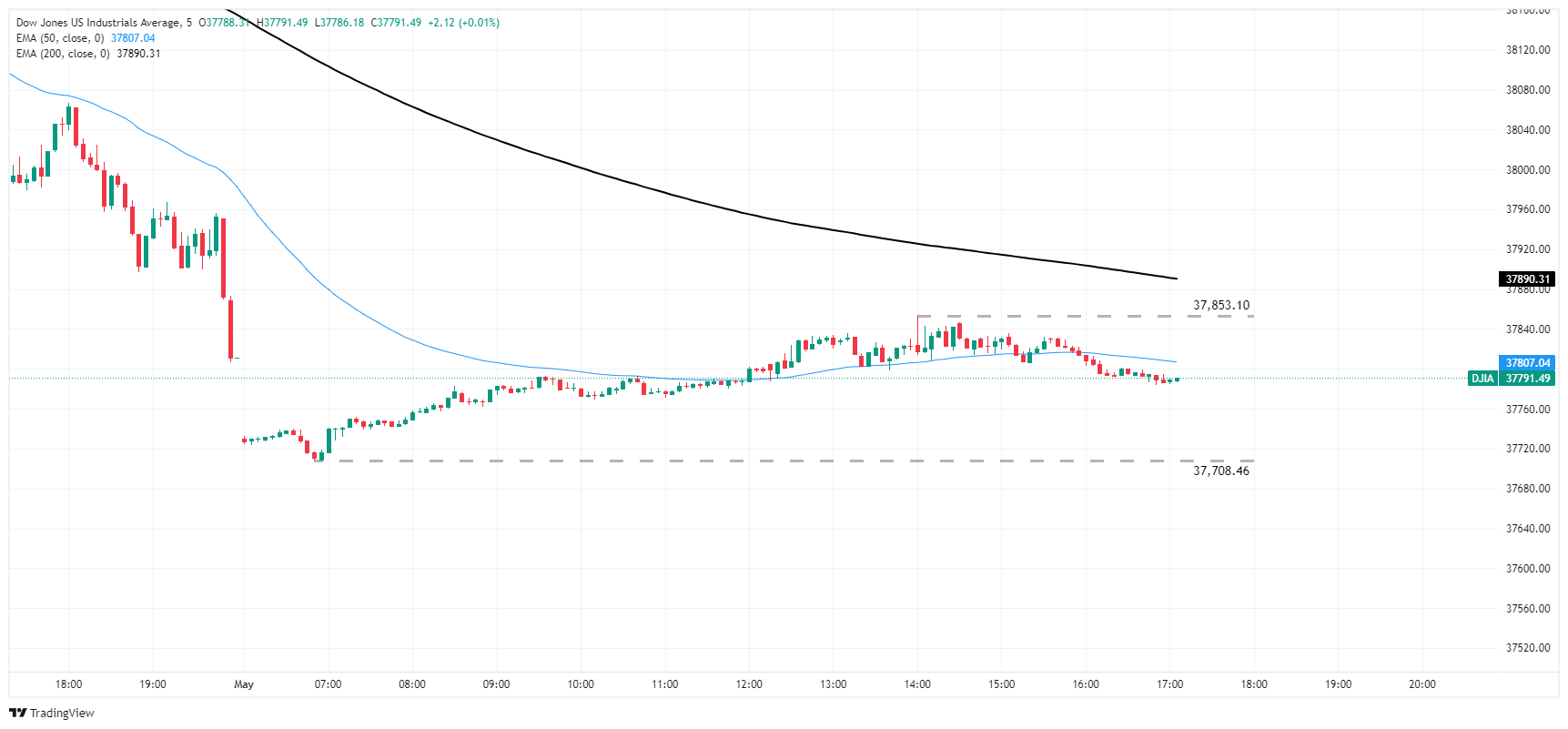
Dow Jones daily chart
Dow Jones FAQs
The Dow Jones Industrial Average, one of the oldest stock market indices in the world, is compiled of the 30 most traded stocks in the US. The index is price-weighted rather than weighted by capitalization. It is calculated by summing the prices of the constituent stocks and dividing them by a factor, currently 0.152. The index was founded by Charles Dow, who also founded the Wall Street Journal. In later years it has been criticized for not being broadly representative enough because it only tracks 30 conglomerates, unlike broader indices such as the S&P 500.
Many different factors drive the Dow Jones Industrial Average (DJIA). The aggregate performance of the component companies revealed in quarterly company earnings reports is the main one. US and global macroeconomic data also contributes as it impacts on investor sentiment. The level of interest rates, set by the Federal Reserve (Fed), also influences the DJIA as it affects the cost of credit, on which many corporations are heavily reliant. Therefore, inflation can be a major driver as well as other metrics which impact the Fed decisions.
Dow Theory is a method for identifying the primary trend of the stock market developed by Charles Dow. A key step is to compare the direction of the Dow Jones Industrial Average (DJIA) and the Dow Jones Transportation Average (DJTA) and only follow trends where both are moving in the same direction. Volume is a confirmatory criteria. The theory uses elements of peak and trough analysis. Dow’s theory posits three trend phases: accumulation, when smart money starts buying or selling; public participation, when the wider public joins in; and distribution, when the smart money exits.
There are a number of ways to trade the DJIA. One is to use ETFs which allow investors to trade the DJIA as a single security, rather than having to buy shares in all 30 constituent companies. A leading example is the SPDR Dow Jones Industrial Average ETF (DIA). DJIA futures contracts enable traders to speculate on the future value of the index and Options provide the right, but not the obligation, to buy or sell the index at a predetermined price in the future. Mutual funds enable investors to buy a share of a diversified portfolio of DJIA stocks thus providing exposure to the overall index.
Empfohlene Artikel


