



Artificial intelligence has moved beyond experimental chatbots. In 2026, it is driving semiconductor demand, cloud contracts, data center construction and enterprise software spending. An AI stock can therefore provide exposure to several parts of the same growth cycle, but the strongest company is not always the best investment at any price.
🎯 This guide explains how the AI value chain works, reviews ten leading AI stocks available to UAE traders, and provides a practical framework for evaluating growth, cash flow, valuation and risk.
What Is an AI Stock and Why Should You Invest in 2026?
An AI stock is a listed company share issued by a business that earns, or is positioned to earn, a meaningful portion of its revenue from artificial intelligence infrastructure, platforms or applications. Merely announcing an AI feature does not qualify a stock as a genuine AI investment.
AI stocks can be grouped into three broad types:
AI infrastructure stocks: These businesses provide GPUs, custom accelerators, networking, servers, data centers, cooling and computing capacity. NVIDIA, AMD, Broadcom and CoreWeave are closely exposed to AI capital expenditure.
AI model and cloud-platform stocks: These businesses develop AI models and provide the cloud infrastructure, developer tools and platforms needed to train and deploy them. Microsoft, Alphabet and Amazon belong primarily to this category.
AI application stocks: These businesses use AI models and enterprise data to create software, automation and decision-making tools. Palantir, Snowflake and ServiceNow depend more on adoption, usage and recurring subscriptions.
Why Invest in AI Stocks in 2026?
1. AI-Exposed Businesses Are Reporting Measurable Growth
NVIDIA’s latest quarterly revenue rose 85% year over year, Palantir’s increased 85%, and Microsoft’s Azure revenue grew 40%. These are reported results rather than only long-term forecasts.
2. AI Adoption Is Supporting Infrastructure Investment
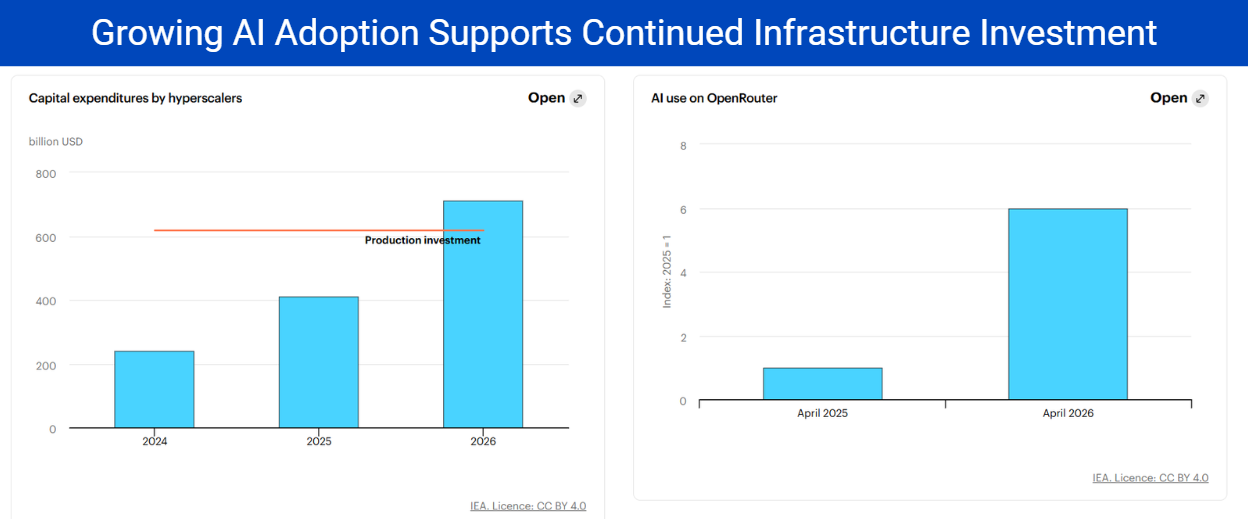
More AI usage requires chips, servers, cloud capacity and data centers. The IEA estimates that hyperscaler capital expenditure will rise sharply again in 2026 as computing demand expands.
3. Opportunities Extend Across the AI Value Chain
Investors can gain exposure through semiconductors, cloud platforms, data centers and enterprise software rather than depending on a single AI business model.
Source: International Energy Agency (IEA), Key Questions on Energy and AI (2026), CC BY 4.0.
The IEA charts show that rising AI adoption is being accompanied by substantial infrastructure investment. Hyperscaler capital expenditure increased from around $250 billion in 2024 to more than $400 billion in 2025 and is estimated to exceed $600 billion in 2026.
In parallel, the OpenRouter AI-use index rose from approximately 1 in April 2025 to 6 in April 2026, indicating that measured activity on the platform increased roughly sixfold.
Together, the charts show how expanding AI usage is supporting higher investment in chips, servers, cloud capacity and data centers.
Crucial Sectors Driving AI Stock Price Trends
AI stock prices are driven by three main areas: chips and hardware, power and data centers, and software services. Investors look at these sectors to see which companies are turning AI demand into real profits.
First, chips and hardware power all AI tools. Companies like NVIDIA and AMD make the advanced chips, while partners build the physical servers. When chip makers report higher sales and strong production capacity, their stock prices usually go up.
Second, AI data centers require huge amounts of electricity. Companies that supply power, grid equipment, and physical space play a critical role. If a data center gets fast access to the power grid, it can start making money sooner, boosting its stock price.
Finally, cloud and software companies turn AI into daily tools. They make money through monthly subscriptions or usage fees. Investors closely watch their revenue growth and cash flow to make sure these companies are truly profiting from their AI investments.
The 10 Best AI Stocks Recommended for Your 2026 Portfolio
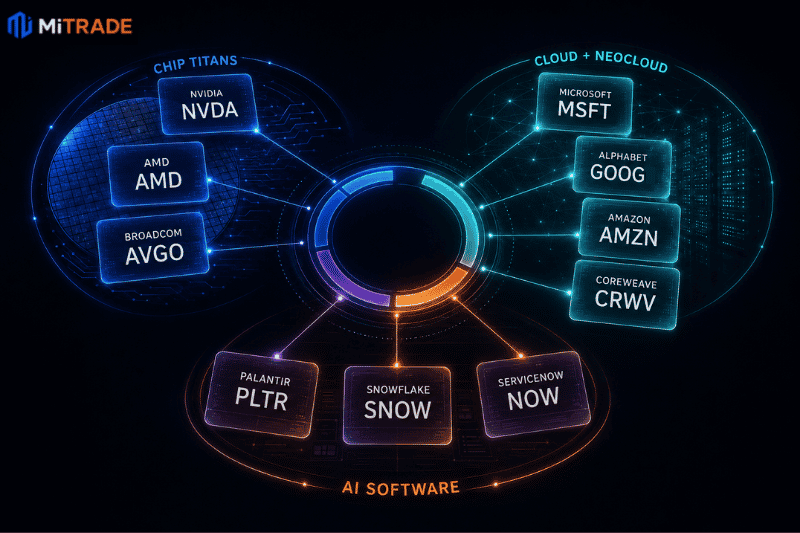
This watchlist features a balanced mix of top AI companies, though the right choice for you depends on your budget, risk tolerance, and time horizon.
Instead of ranking them, we selected these companies based on key strengths like competitive edge, revenue growth, solid finances, and their specific role in the AI market.
Category 1: Chip Titans
1. NVIDIA (NVDA): Full-Stack AI Leader
Founded in 1993, NVIDIA develops GPUs, networking and AI software. Q1 fiscal 2027 revenue reached $81.6 billion, up 85%.
Recommended Reason: Blackwell and Vera Rubin extend its leadership into agentic inference, although high expectations, export restrictions and custom-chip competition increase execution risk.
2. AMD (AMD): Accelerator Challenger
Founded in 1969, AMD develops server CPUs and AI accelerators. Q1 2026 data center revenue rose 57% to $5.8 billion, driven by EPYC demand and the continued ramp of Instinct GPU shipments.
Recommended Reason: AMD offers a credible second source, but NVIDIA’s software ecosystem, product timing and gross margins remain risks.
3. Broadcom (AVGO): Custom Chips and Networking
Broadcom traces its roots to 1961 and supplies custom accelerators and Ethernet networking. Fiscal Q2 AI semiconductor revenue reached $10.8 billion, up 143%.
Recommended Reason: Custom accelerators and Ethernet networking provide direct exposure to hyperscaler AI spending, although dependence on a limited number of large customers and AI-chip programs creates concentration risk.
Category 2: Cloud and Neocloud Giants
4. Microsoft (MSFT): Enterprise AI
Founded in 1975, Microsoft combines Azure, Microsoft 365 Copilot, GitHub and enterprise distribution. Fiscal Q3 Azure revenue grew 40%, while commercial RPO reached $627 billion.
Recommended Reason: Its ecosystem supports monetization, although heavy AI investment has reduced cloud gross margins, making capex efficiency more important.
5. Alphabet (GOOG): Models and Cloud
Google was founded in 1998 and reorganized under Alphabet in 2015; Alphabet controls Gemini, TPUs, Google Cloud and consumer distribution. Q1 2026 Cloud revenue exceeded $20 billion, rising 63%, while backlog surpassed $460 billion.
Recommended Reason: Gemini, TPUs, Google Cloud and Search distribution create an integrated AI stack with several monetization channels, although rising infrastructure commitments and uncertainty over the long-term economics of AI-powered search require monitoring.
6. Amazon (AMZN): AWS AI Stack
Founded in 1994, Amazon offers Bedrock, Trainium, Inferentia and multiple foundation models through AWS. Q1 AWS sales rose 28% to $37.6 billion, with operating income of $14.2 billion.
Recommended Reason: AWS provides broad exposure, though capital requirements and competition from Azure and Google Cloud may constrain returns.
7. CoreWeave (CRWV): Pure Neocloud Exposure
Founded in 2017, CoreWeave provides GPU cloud capacity to developers. Q1 revenue grew 112% to $2.08 billion, while backlog reached $99.4 billion.
Recommended Reason: Its AI-cloud exposure stands out, but debt, interest costs, customer concentration and $31–$35 billion in planned 2026 capex create substantial risk.
You might be interested in the following article >>> CoreWeave Stock Analysis: Is CRWV a Buy or Sell?
Category 3: AI Software and Applications
8. Palantir (PLTR): Operational AI
Founded in 2003, Palantir connects models with operational data through its AI platform. According to Palantir’s Q1 2026 results, revenue rose 85% to $1.63 billion, with a 60% adjusted operating margin.
Recommended Reason: Rapid growth and strong adjusted margins support its operational-AI position, but its demanding valuation and significant exposure to government revenue increase risk.
9. Snowflake (SNOW): Enterprise Data
Founded in 2012, Snowflake provides a governed data layer for AI applications. RPO reached $9.21 billion and net revenue retention was 126% as of April 2026.
Recommended Reason: Its governed data platform can benefit as enterprises build AI applications around proprietary data, although GAAP losses, strong competition and the need to sustain customer expansion remain concerns.
10. ServiceNow (NOW): Workflow AI Agents
Founded in 2004, ServiceNow embeds AI agents into enterprise workflows. Q1 subscription revenue grew 22% to $3.67 billion, supported by recurring contracts.
Recommended Reason: Embedding AI agents into established enterprise workflows supports adoption and recurring revenue, although intensifying competition and the need to demonstrate measurable productivity gains may affect future expansion.
Before investing, you need to analyze each company and its stock properly and look for the right time and price to enter. Diversify across AI, technology, and sectors less directly affected by AI, while managing risk by limiting each stock to 2–5% of your portfolio.
Looking to trade these AI stocks? Mitrade gives you access to all ten, plus a wider range of stock and ETF CFDs, with zero commission, highly competitive spreads, and the ability to open both Buy and Sell positions.

How to Spot Winning AI Opportunities?

Not every AI company is a strong investment. This practical framework highlights the key metrics and business fundamentals retail investors should assess before adding an AI stock to their portfolio.
1. Test the Contracted Backlog
Backlog or remaining performance obligations indicate future revenue visibility, helping investors distinguish contracted demand from management forecasts. Compare backlog growth with current revenue and determine how much is non-cancellable and expected within 12 months.
A $100 billion multi-year backlog does not equal $100 billion in near-term sales. Check customer concentration and whether the company has sufficient power, chips and facilities to convert contracts into revenue.
2. Calculate Free-Cash-Flow Yield
Free-cash-flow yield equals trailing free cash flow divided by market capitalization. It helps investors determine whether a stock’s valuation is supported by the cash its business generates.
A low yield may be acceptable during rapid expansion if future margins justify it. However, persistent cash burn funded through debt or share issuance increases financing and dilution risk, especially when growth slows.
3. Measure AI Revenue Purity
AI revenue purity shows whether investors are gaining direct exposure to AI demand or merely buying a company that uses AI internally. NVIDIA, Broadcom and CoreWeave disclose relatively direct AI demand.
For diversified companies, examine cloud growth, AI usage, customer spending and quantitative disclosures. This prevents investors from overvaluing companies simply because management frequently mentions AI.
4. Connect Growth With Economics
Rapid revenue growth does not necessarily create shareholder value. Track gross margin, operating margin, capex, return on invested capital and stock-based compensation to determine whether expansion is improving the underlying economics.
Compare valuation with expected growth and monitor retention, product roadmaps, export controls, energy availability and dilution. A winning AI company should eventually convert technical leadership into durable revenue and shareholder cash flow.
Pros and Cons of Investing in AI Stocks
AI stocks can deliver exceptional long-term growth, but they also come with higher volatility and execution risk. Understanding both the opportunities and the potential challenges helps investors make more balanced investment decisions.
Pros of investing in AI stocks
✅Long growth runway: AI is expanding across cloud computing, software, healthcare, industry and consumer services.
✅Measurable enterprise demand: Backlog, cloud consumption and accelerator sales increasingly demonstrate real customer spending.
✅Liquidity and access: Leading AI stocks, ETFs and indices trade actively and are accessible to UAE investors.
✅Multiple profit pools: Investors can diversify among chips, networking, cloud capacity, data platforms and applications.
Cons of investing in AI stocks
❌Extreme volatility: High expectations can produce large intraday moves even after apparently strong results.
❌Valuation risk: A profitable company can still underperform when its stock price assumes flawless execution.
❌Capital-intensity risk: Heavy spending on data centers, chips, electricity and cooling can reduce free cash flow and increase debt or shareholder dilution.
❌Regulatory and geopolitical pressure: Antitrust cases, copyright disputes and chip-export controls can change expected growth.
❌Shared-cycle exposure: Owning ten AI names is not true diversification if all depend on the same hyperscaler capex budgets.
How to Invest Efficiently in AI Stocks in the UAE
UAE investors have three practical routes to invest in AI stocks:
1. Buy AI stocks directly
A broker offering US markets provides direct ownership. Fractional shares can reduce the capital required for high-priced stocks. Investors should compare custody, currency-conversion and market-data fees.
Best for: Long-term investors seeking ownership.
2. Invest in AI ETFs
Investors may consider BOTZ for robotics and AI exposure, SOXX for semiconductor stocks, or QQQ for broader exposure to major Nasdaq-listed companies.
Best for: Those wanting diversified exposure.
3. Trade AI stock CFDs
CFDs track stock prices without transferring ownership. They use margin and allow traders to open both Buy and Sell positions, although leverage can magnify losses.
Best for: Experienced, active traders seeking short-term opportunities in rising or falling markets.

 $0 Commission, Tight Spreads, Min. Deposit $50Fexible leverage with AED deposit support24*5 customer support serviceOne account to acess global markets
Is Investing in AI Stocks Halal?
Investing in AI stocks is generally permissible (Halal) as long as the company's core business complies with Islamic principles.
Beyond core activities, investors must also perform financial screening. For a stock to remain Shariah-compliant, interest-bearing debt usually cannot exceed 30–33% of its total assets or market cap. Because financial metrics change over time, investors should re-check a company's compliance after every quarterly earnings report.
How to Judge the Current Stage of the AI Stock Market Cycle
AI stocks move through different phases as adoption, corporate spending, earnings expectations, interest rates and valuations change. Investors can judge the current stage by examining whether market momentum and underlying business indicators are improving, weakening or moving in different directions.
The Nasdaq CTA Artificial Intelligence Index (NQINTEL) tracks companies engaged in AI across the technology, industrial, medical and other economic sectors. Because it represents a broad group of AI-related companies, investors can use it to assess the overall direction of the AI theme rather than relying on the performance of a single stock.
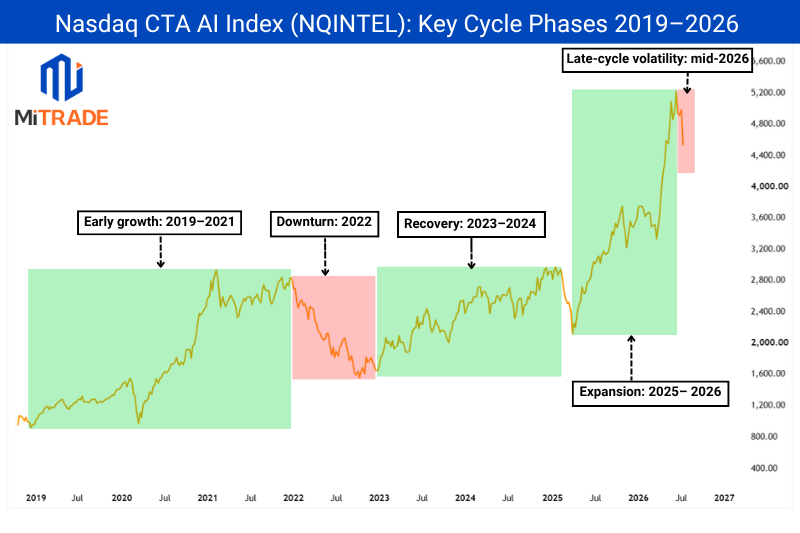
The chart illustrates the AI market’s development since 2019 through five phases. The following indicators can help investors recognize similar conditions as they develop:
How investors can use the AI cycle?
The AI cycle is not designed to predict the exact top or bottom. Instead, it helps investors understand whether the broader AI theme is strengthening or weakening, allowing them to adjust position sizing, portfolio risk and expectations as market conditions change.
When to consider entering?
Recovery phases often provide attractive long-term opportunities because prices usually begin improving before earnings fully confirm the turnaround. Investors may also consider adding exposure during healthy pullbacks within an expansion, provided the long-term trend remains intact and company fundamentals continue improving.
When to consider trimming or hedging?
Late-cycle phases deserve greater caution. When valuations become stretched, strong earnings no longer drive higher prices, or the index begins losing momentum and breaking major support levels, investors may consider taking partial profits, reducing exposure or selectively hedging existing positions.
Finally, combine market-cycle analysis with company fundamentals such as revenue growth, backlog, margins, cash flow and valuation. The strongest investment decisions come from aligning both the company's fundamentals and the broader AI market cycle, rather than relying on either one alone.
Golden Tips for Building Your AI Stock Investment Strategy
Successful AI investing is not only about selecting strong companies. It also requires careful research, valuation discipline, diversification and regular portfolio reviews. The following practical tips can help investors apply these principles and manage risk throughout the AI market cycle.
1. Use Gradual Entries and Position Limits
Divide investments into tranches and add only when earnings, guidance and price action support your thesis. Set a maximum allocation for each stock and avoid uncontrolled averaging down.
2. Diversify Beyond AI
Balance AI and technology holdings with cash and assets driven by different factors, such as gold, healthcare or consumer staples. This reduces exposure to technology-led corrections.
3. Separate Investing From Trading
Base investments on earnings, cash flow, competitive advantages and valuation. Manage short-term trades separately using predefined entry, exit and risk levels.
4. Hedge Selectively
Experienced traders may use a Sell CFD on the NAS100 or an AI-related stock during technology pullbacks. Define the hedge size and exit conditions beforehand, as leverage magnifies losses.
5. Review the Investment Thesis
After earnings, reassess revenue, margins, backlog, capex guidance and customer concentration. Favor companies reporting measurable AI revenue, contracts or customer growth over those relying mainly on market narratives.
Conclusion
AI stocks offer substantial long-term growth potential due to massive, multi-industry demand. However, the AI sector is fast-moving and marked by high volatility, supply chain shifts, and rapid market cycles. To capture these fast-paced market moves without locking up large amounts of capital, investors can trade AI stock CFDs on Mitrade.
Trading CFDs through Mitrade allows you to:
✅Go long during AI rallies or short-sell to hedge against sudden sector pullbacks.
✅Use flexible leverage to gain exposure to leading tech giants with a smaller upfront deposit.
$0 Commission, Tight Spreads, Min. Deposit $50Fexible leverage with AED deposit support24*5 customer support serviceOne account to acess global marketsIs It Too Late to Enter the Market for AI Stocks in 2026?
Not necessarily. AI adoption and infrastructure investment remain long-term trends, but returns will become more selective.
Instead of chasing recent winners, compare valuation with revenue growth, margins, backlog conversion and free cash flow. Investors can then enter gradually when the risk-to-reward profile is acceptable.
What Are “AI-Concept Stocks,” and How Do They Differ From Genuine AI Stocks?
AI-concept stocks gain attention mainly because management associates the business with AI. Genuine AI stocks can demonstrate material AI-related revenue, contracted demand, product usage or margin contribution.
How Can UAE Retail Investors Start Investing in High-Priced AI Stocks With Limited Capital?
They can use fractional shares through an eligible stockbroker, obtain diversified exposure through ETFs, or trade CFDs that require less upfront capital than full-share purchases.
On Mitrade, UAE traders can access CFDs on the individual AI stocks reviewed in this guide and choose a position size according to their strategy and risk tolerance.
* The content presented above, whether from a third party or not, is considered as general advice only. This article should not be construed as containing investment advice, investment recommendations, an offer of or solicitation for any transactions in financial instruments.


