


Semiconductors are essential electronic components at the center of the AI, cloud-computing, smartphone, automotive and other industries. As demand accelerated, the PHLX Semiconductor Index (SOX), which tracks 30 major U.S.-listed chip companies, gained approximately 104% over the 12 months through July 2026, highlighting the sector’s exceptional market performance.
This guide identifies 10 of the best semiconductor stocks to watch in 2026, explains their competitive advantages and risks, and shows UAE investors how to evaluate entry timing without assuming that the AI rally can only move higher.
Key takeaways
AI infrastructure and memory are driving exceptional growth, but valuations have also risen sharply.
Combining foundries, equipment, architecture, analog and edge exposure reduces dependence on one AI theme.
A great company is not always a good entry; margins, valuation and cycle position still matter.
What Are Semiconductor Stocks and How Do They Power the Global Economy?
Semiconductor stocks are listed companies that design or manufacture chips, supply production equipment, license processor architecture, or provide packaging and testing. Their products enable computation, memory, connectivity, power management and sensing.
Semiconductors are economic multipliers across cloud services, robotics, telecommunications, vehicles and consumer devices. Governments also treat leading-edge manufacturing and chip-design access as economic and national-security priorities.
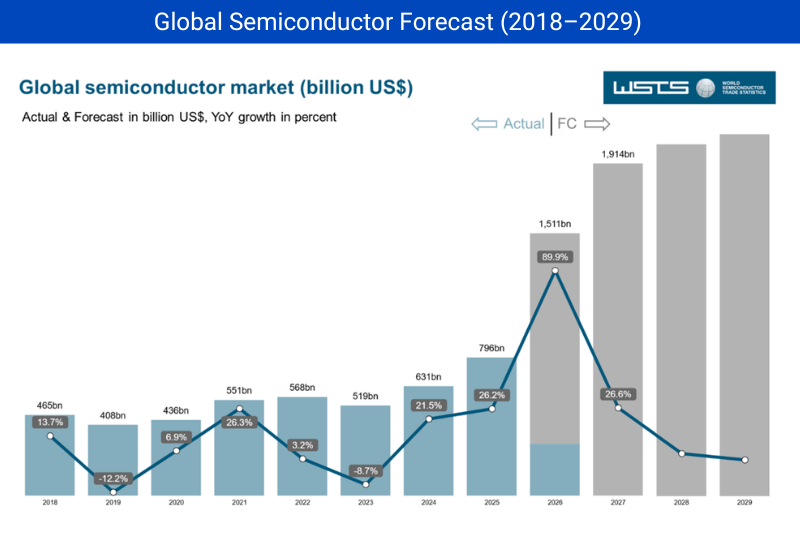
Source: WSTS Spring 2026 Forecast, June 2026
The current expansion is unusually strong. SIA reported that global semiconductor sales, measured on a three-month moving-average basis, reached $120.6 billion in May 2026, up 104.1% year over year.
The latest WSTS forecast projects the global market to reach approximately $1.51 trillion in 2026 and $1.9 trillion in 2027, led by memory, logic and AI infrastructure. These figures demonstrate strong industry demand.
What Are the Sectors Within the Semiconductor Industry?
The semiconductor industry contains specialized sectors with different business models and earnings drivers.
Memory deserves particular attention in 2026. Readers wanting a deeper example can review this SK Hynix stock analysis, which explains how HBM demand, constrained supply and rising memory prices translated into margins and share-price performance.
Is It Still Worthwhile to Enter the Semiconductor Sector?
It is not automatically too late, because AI inference, HBM, advanced packaging and 2nm investment can support multi-year earnings growth. WSTS still expects 2027 industry sales to rise approximately 27% after the exceptional 2026 expansion.
However, the easiest re-rating may already have occurred in several AI leaders. Earnings can keep growing while share prices fall if results fail to exceed aggressive expectations.
A practical approach separates exposure:
Core positions: Profitable companies with durable moats and strong cash generation, such as TSMC or ASML.
Growth positions: NVIDIA, AMD and Broadcom, where upside depends heavily on AI execution and valuation.
Recovery positions: Texas Instruments, Qualcomm and Intel, where cycle improvement or turnaround evidence matters more.
Favor gradual entries and diversified supply-chain exposure over buying after a vertical rally.

The Best 10 Semiconductor Stocks to Watch Now, Categorized by Supply Chain
These companies combine strong competitive positions with relevance to the 2026 cycle. “Best” means worth watching, not buying at any price.
Selection method: The companies were assessed by supply-chain moat, relevance to the 2026 cycle, earnings conversion, financial resilience, valuation and company-specific risk. They are categorized by role, not ranked from best to worst.
Category 1: Critical Infrastructure and Foundry Leaders
1. TSMC (TSM): Leading advanced nodes and foundry execution
Founded in 1987, TSMC is a pure-play semiconductor foundry that manufactures chips for companies worldwide based on their designs. In Q2 2026, it generated $40.2 billion in revenue, with gross and operating margins of 67.7% and 60.3%.
Recommended Reason: TSMC’s leadership in 3nm and 2nm manufacturing and CoWoS packaging, providing diversified exposure to AI demand.
Bullish: Advanced-node demand and packaging expansion could sustain strong growth.
Bearish: Taiwan geopolitics, customer concentration and overexpansion remain major risks.
2. ASML Holding (ASML): The essential EUV supplier
Founded in 1984, ASML supplies lithography systems, software and services to chipmakers. Q2 2026 sales reached €9.33 billion, while net income was approximately €2.92 billion.
Recommended Reason: The only commercial EUV supplier, giving it an essential role in producing increasingly advanced chips.
Bullish: Rising EUV intensity and AI-related fab investment support demand.
Bearish: Export controls, customer spending delays and valuation create downside risk.
3. Applied Materials (AMAT): Broad wafer-fab equipment exposure
Founded in 1967, Applied Materials supplies deposition, inspection and materials-engineering equipment. Q2 fiscal 2026 revenue reached $7.91 billion, with operating income of $2.52 billion.
Recommended Reason: Broad exposure to logic, foundry, memory and advanced packaging rather than dependence on one chip category.
Bullish: AI, HBM and 2nm manufacturing require more equipment and process steps.
Bearish: Export restrictions and semiconductor capital-spending cycles could pressure sales.
Category 2: The AI and Hyperscale Architecture Leaders
4. NVIDIA (NVDA): Rubin and the full-stack AI platform
Founded in 1993, NVIDIA develops GPUs, AI accelerators, networking products and computing software. Q1 fiscal 2027 revenue reached $81.6 billion, with a GAAP gross margin of 74.9%.
Recommended Reason: CUDA, networking and rack-scale systems create an integrated AI platform that is difficult for customers to replace.
Bullish: AI infrastructure spending and Rubin adoption could extend its leadership.
Bearish: Export restrictions, custom chips and high expectations increase downside risk.
5. AMD (AMD): The strongest broad challenger
Founded in 1969, AMD develops server and PC processors, GPUs, AI accelerators and adaptive chips. Q1 2026 revenue reached $10.3 billion, with net income of $1.4 billion.
Recommended Reason: A credible NVIDIA alternative through its EPYC processors, Instinct accelerators and expanding rack-scale AI strategy.
Bullish: Server share gains and new Instinct systems could accelerate growth.
Bearish: Software maturity, supply execution and NVIDIA’s scale remain challenges.
6. Broadcom (AVGO): Custom AI accelerators and networking
Broadcom traces its roots to 1961 and supplies semiconductors and infrastructure software, including custom AI accelerators, networking and VMware. Q2 fiscal 2026 revenue reached $22.2 billion, with net income of $9.31 billion.
Recommended Reason: Its combination of custom AI chips, cluster networking and recurring infrastructure-software revenue.
Bullish: Hyperscaler demand could drive further AI accelerator and networking growth.
Bearish: Customer concentration, internal chip programs and VMware integration create risks.
Category 3: Edge AI, Mobile and Automotive Pioneers
7. Qualcomm (QCOM): Edge AI with smartphone-cycle risk
Founded in 1985, Qualcomm supplies mobile processors, connectivity chips and wireless technology licences while expanding into PCs, automotive and IoT. Q2 fiscal 2026 revenue was $10.6 billion, with non-GAAP net income of $2.84 billion.
Recommended Reason: Automotive, edge AI and computing could gradually reduce its dependence on smartphone demand.
Bullish: Automotive, IoT and AI-PC growth could improve revenue diversification.
Bearish: Handset weakness, Apple’s modem development and PC competition remain risks.
8. Texas Instruments (TXN): Analog scale and cycle recovery
Founded in 1930, Texas Instruments designs analog and embedded chips for industrial, automotive and data-center applications. Q1 2026 revenue reached $4.83 billion, with net income of $1.55 billion.
Recommended Reason: Its broad, long-life product portfolio and cost-efficient in-house 300mm manufacturing.
Bullish: Industrial recovery and higher factory utilization could expand margins.
Bearish: Automotive weakness, Chinese competition and underutilized capacity could pressure returns.
9. Arm Holdings (ARM): Power-efficient architecture royalties
Founded in 1990, Arm licenses processor architectures and collects royalties when customers ship Arm-based chips. Fiscal 2026 revenue reached $4.92 billion, while GAAP net income was $904 million.
Recommended Reason: Asset-light exposure to smartphones, cloud servers, vehicles and edge devices without financing semiconductor factories.
Bullish: Armv9 and Compute Subsystems could increase royalties per chip.
Bearish: RISC-V, customer-designed technology and a demanding valuation create risks.
10. Intel (INTC): The 2026 turnaround wildcard
Founded in 1968, Intel develops PC and server processors while building an external foundry business. Its Q1 filing showed $13.6 billion in revenue and a $3.7 billion GAAP net loss.
Recommended Reason: A high-risk turnaround rather than a current industry leader. Its case depends on Intel 18A yields, foundry economics and meaningful external customers.
Bullish: Better yields and major foundry customers could improve profitability.
Bearish: Heavy foundry losses, cash requirements and execution problems could continue.
Valuation Snapshot: Price Still Matters
Forward P/E provides only a starting point because share prices and analyst estimates change. The valuation data below are approximate as of July 17, 2026.
📌 Qualcomm, NVIDIA and TSMC have lower forward multiples for different reasons: Qualcomm’s reflects slower growth, while NVIDIA’s benefits from rapidly expanding earnings. Intel’s high ratio reflects very low expected earnings, not quality. Valuation must be read beside growth, margins and execution.
Factors Influencing Future Semiconductor Stock Prices
Several industry and economic forces can influence future semiconductor stock prices:
AI Spending by Large Cloud Providers: Higher investment increases demand for accelerators, networking, HBM and foundry capacity. This supports NVIDIA, AMD, Broadcom, TSMC and equipment suppliers.
Memory Prices: Tight supply can raise memory revenue and margins, while excessive new capacity can eventually reverse the cycle. Memory companies and equipment suppliers are the most exposed.
Manufacturing Transitions: Technologies such as 2nm chips, High-NA EUV and advanced packaging require more complex equipment. TSMC, ASML and Applied Materials could benefit if customers continue spending.
Smartphone, PC and Automotive Demand: Recovering device sales increase demand for processors, analog chips and connectivity products. This can support Qualcomm, Arm, Texas Instruments and Intel.
Export Controls: Restrictions can reduce access to important customers and force companies to modify their products. Advanced-chip designers and equipment suppliers face the greatest exposure.
Interest Rates and Valuation: Higher interest rates reduce the present value of expected future earnings. Richly valued growth stocks generally face the greatest pressure.
Risks of Investing in Semiconductor Stocks
While the semiconductor sector offers compelling growth, navigating it requires a clear eye on the underlying market risks.
❌Cyclicality: Investment triggered by shortages can eventually create excess supply and pressure margins.
❌AI-spending concentration: A small group of hyperscalers controls much of accelerator and custom-chip demand.
❌Geopolitics: Taiwan concentration and U.S.–China restrictions can interrupt sales or production.
❌Execution: Delayed nodes, weak yields, software problems or packaging bottlenecks can erase an advantage.
❌Valuation: A strong company can still be a weak investment if its price assumes flawless growth.
❌Technology substitution: Custom ASICs, RISC-V and efficient models may change where profits accumulate.
Investors can reduce (not eliminate) these risks through smaller position sizes, gradual entries and diversification across business models rather than tickers dependent on the same AI spending cycle.
How to Invest Efficiently in Semiconductor Stocks in the UAE?
UAE investors can choose direct shares, semiconductor ETFs or stock CFDs, depending on their objectives, available capital and risk tolerance.
1. Traditional Stocks and Sector ETFs (Long-Term Capital Appreciation)
Purchasing underlying shares of semiconductor companies or thematic ETFs through international brokerages regulated by UAE authorities, such as the DFSA or FSRA.
Key Advantages:
✅Direct Ownership: Investors own the underlying shares and may receive dividends.
✅Diversification: Sector ETFs spread exposure across several semiconductor companies.
🎯Best For: Long-term portfolios. Since the UAE levies zero personal capital gains tax, holding growth-oriented semiconductor assets long-term maximizes compounding efficiency without tax drag.
2. Semiconductor Stock CFDs (Short-Term Active Trading)
Speculating purely on the price fluctuations of semiconductor stocks and ETFs without taking physical ownership of the underlying assets.
Key Advantages:
✅Two-Way Trading: The semiconductor sector is highly sensitive to macroeconomic shifts and earnings reports, leading to sharp price swings. CFDs enable traders to short-sell during cyclical downturns or technology sell-offs, as well as buy during rallies.
✅Flexible Leverage: Traders can use leverage to gain larger exposure to high-priced technology stocks with a fraction of the upfront capital.
🎯Best For: Active traders looking to capitalize on volatility, AI infrastructure news or rapid macroeconomic developments.
When trading CFDs, choosing a trusted and strictly regulated broker is essential. Authorized and regulated by the UAE Securities and Commodities Authority (SCA under license 20200000397), Mitrade offers traders with ultra-low spreads, zero commissions, fast execution, and integrated risk controls—all on an easy-to-use, multi-asset platform.
4 Core Strategies for Trading Semiconductors Efficiently
1. Breakout Momentum: Identify resistance using price action, then confirm the breakout with expanding volume and momentum indicators such as RSI, MACD or rate of change. Enter after a confirmed close or successful retest and place the stop below the broken level.
2. Retracement Trading: In an established uptrend, wait for price to return to a discount zone. Fibonacci retracement levels, supply and demand zones, previous support or resistance and moving averages can help identify potential entries, but bullish price confirmation is still required.
3. Mean Reversion: Bollinger Bands set at two or three standard deviations can identify unusually extended prices. Traders may enter when price rejects an outer band and begins returning toward a moving average, provided that earnings or news have not caused a permanent repricing.
4. Relative-Momentum Pairs Trading: Compare two semiconductor stocks and buy the stronger performer while shorting the weaker one. For example, if NVIDIA continues to outperform Intel in price momentum, earnings and guidance, a trader could buy NVIDIA and short Intel, expecting the performance gap to widen.
💡Suggestions from Experts: 🔹Every trade should be supported by fundamentals, including financial results, management forecasts, product launches and company news. Industry developments can affect semiconductor prices heavily, so traders should also monitor sector indices such as the SOX to understand the broader market direction. 🔹Risk management is crucial, especially if you are a short-term trader. Risk no more than 1% to 3% of your capital per trade, and always use stop-loss and take-profit orders to protect capital and secure gains. |
With Mitrade’s one-stop multi-asset trading platform, UAE investors can trade global semiconductor stock and ETF CFDs with zero commission and highly competitive spreads. Whether the chip industry is entering a bull market or experiencing an inventory correction, traders can navigate both directions with flexible leverage.

 $0 Commission, Tight Spreads, Min. Deposit $50Fexible leverage with AED deposit support24*5 customer support serviceOne account to acess global markets
How to Evaluate and Screen the Best Semiconductor Stocks?
Use the same five-part framework for every company, adjusting the metrics for its business model:
🔸Moat: Does it have process-node leadership, proprietary IP or software, switching costs, scarce capacity or entrenched customer relationships?
🔸Earnings conversion: Are revenue growth and margins converting into free cash flow, or being absorbed by capex and working capital?
🔸Balance sheet: Compare net cash or debt, operating cash flow and planned capex to determine whether the company can withstand a downturn without dilution.
🔸Valuation: Compare forward P/E, EV-to-sales and free-cash-flow yield with the company’s history, close peers and expected growth. Use normalized earnings where cyclicality distorts the P/E.
🔸Cycle position: Track inventory days, fab utilization, contract prices or ASPs, bookings, book-to-bill ratios and customer capex.
Investors should compare companies with similar business models. Chip manufacturers such as TSMC should be evaluated through factory utilization and capital spending. Arm licenses processor architectures and should be evaluated through licensing revenue and royalties per chip. Memory-chip companies should be evaluated through contract prices.
How to Find the Best Time to Trade Semiconductor Stocks
Semiconductor stocks are highly cyclical because customers alternate between shortages, inventory accumulation, oversupply and production cuts. Prices usually move before reported earnings, so waiting for profits to peak can mean entering too late.
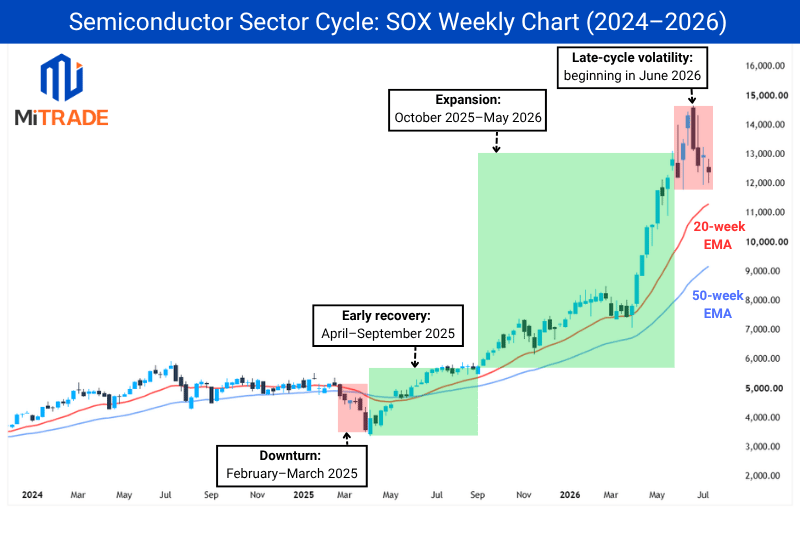
To track the broader sector and identify changes in market momentum, traders can use the PHLX Semiconductor Sector Index (SOX). It tracks 30 major U.S.-listed semiconductor designers, manufacturers and equipment suppliers, including all 10 stocks analyzed in this guide as of July 2026. Individual stocks may move earlier or later than the index.
Based on the historical performance of the SOX, the chart summarizes the development cycle of the semiconductor industry through four phases: downturn, early recovery, expansion and late-cycle volatility.
Conclusion
The best semiconductor stocks combine a defensible supply-chain position with measurable earnings conversion. TSMC, ASML, and Applied Materials offer infrastructure and equipment exposure; NVIDIA, AMD, and Broadcom provide direct AI exposure; while Qualcomm, Texas Instruments, Arm, and Intel offer edge, analog, licensing, and recovery opportunities.
The sector may continue growing through 2027, but industry growth does not guarantee stock returns. Investors should still consider entry price, valuation, cycle position, and individual company fundamentals.
Given the semiconductor sector's inherent volatility and sharp cyclical swings, trading CFDs on Mitrade allows you to stay flexible in any market environment. With zero commissions, tight spreads, and flexible leverage, Mitrade empowers you to capitalize on AI rallies by going long or hedge against tech pullbacks by short-selling—helping you trade every phase of the chip cycle with confidence.
Why Are Semiconductor Stocks Highly Cyclical?
Chip capacity takes years to build. When demand exceeds supply, prices and margins rise, encouraging investment. New capacity can then arrive after demand slows, creating excess inventory, falling prices and production cuts. Share prices often anticipate these changes before financial statements show them.
What Is Memory Inflation, and How Does It Affect Related Stocks?
Memory inflation means contract or spot prices for DRAM, NAND or HBM are rising. Producers can generate more revenue and margin per bit, while device makers face higher costs. It can benefit memory companies and equipment suppliers but pressure device volumes if costs reach consumers.
What Should Beginners Do if They Cannot Afford High-Priced Stocks Like NVIDIA or ASML?
A high share price does not necessarily mean an expensive valuation. Beginners can consider fractional shares, a diversified semiconductor ETF or CFDs. Before using leverage, you can practice with a UAE demo account, learn position sizing and avoid concentrating limited capital in one volatile stock.
* The content presented above, whether from a third party or not, is considered as general advice only. This article should not be construed as containing investment advice, investment recommendations, an offer of or solicitation for any transactions in financial instruments.


