


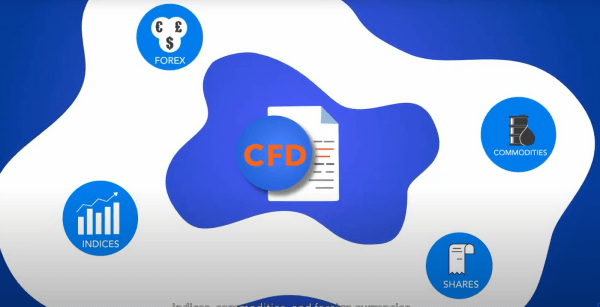
CFD trading has become popular because it gives traders access to different financial markets with lower starting capital. Through CFDs, traders can trade price movements in markets such as forex, stocks, commodities, and cryptocurrencies without directly buying the assets.
Before starting CFD trading, it is important to understand what CFDs are, and how it works, their risks, advantages, and trading costs.
What Are CFDs?
CFDs are simply a trading method where instead of buying an asset itself, you trade on its price movement in markets such as forex, cryptocurrencies, commodities, and stocks.
For example:
A trader may predict that Apple stock will rise and open a Buy position. If the prediction is correct and the price rises, the trader may make a profit from the price difference. However, if the prediction is wrong and the price falls instead, the trader may experience a loss.
This is called CFD trading, which stands for Contract for Difference.
How Do CFDs Work?
With Contracts For Difference (CFDs) trading, traders do not need to purchase the underlying asset to participate in market movements. Positions can be opened by depositing an initial margin, which is a fraction of the total trade value. Through leverage, this smaller investment provides exposure to a larger market position, increasing potential profits.
Leverage and margin are important parts of CFD trading.
Leverage: allows traders to control a larger position with a smaller amount of capital. While it can increase potential returns, it can also amplify potential losses if the market moves against the trader.
Initial Margin: is the amount required to open a leveraged CFD position. For example, with 1:10 leverage, a trader may control a $1,000 position with only $100 as the initial margin. While leverage can increase potential profits, it can also increase potential losses if the market moves in the opposite direction.
This is why many traders prefer to use leverage carefully, especially when starting CFD trading.
Buy Position Example:
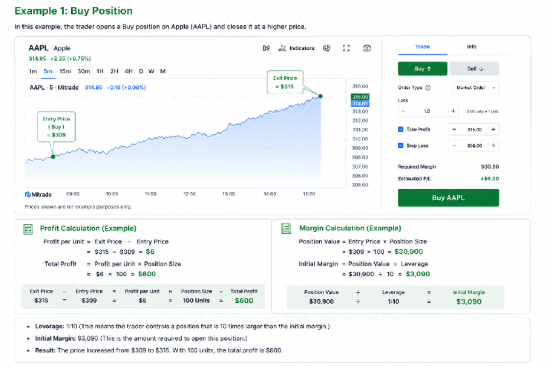
In this example, a trader opens a Buy position on Apple (AAPL) at approximately $309 with a position size of 100 units using 1:10 leverage. The total position value is $30,900, while the required initial margin is $3,090. If the price rises to $315, the profit per unit is $6. With a position size of 100 units, the total profit would be $600. This example shows how leverage, margin, position size, and market movement can affect CFD trading results.
Sell Position Example:
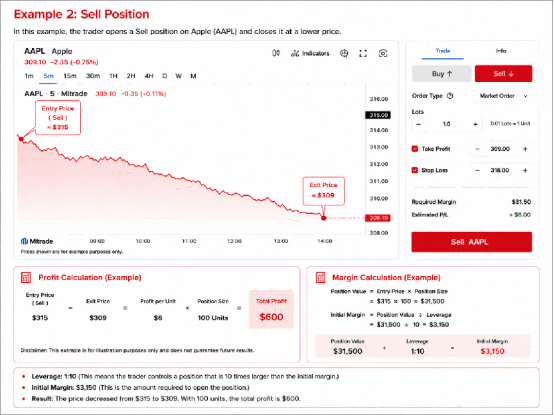
In this example, a trader opens a Sell position on Apple (AAPL) at approximately $315 with a position size of 100 units using 1:10 leverage. The total position value is $31,500, while the required initial margin is $3,150. If the price falls to $309, the profit per unit is $6. With a position size of 100 units, the total profit would be $600. This example shows how traders can potentially profit from falling markets when trading CFDs.
CFDs vs. Traditional Investment
CFDs and traditional investing are both related to financial markets, but they work in different ways.
In traditional investing, investors usually buy and own actual assets such as stocks, ETFs, or commodities. Investors may hold these assets for a longer period of time and can sometimes receive benefits such as dividends or voting rights.
With CFDs, traders do not directly own the asset. Instead, they trade based on price movements in markets such as forex, stocks, commodities, and cryptocurrencies. CFD trading also allows traders to profit from both rising and falling markets through Buy and Sell positions.
Another important difference is leverage. CFD trading allows traders to open larger positions with smaller capital through margin trading. While leverage may increase potential profits, it can also increase potential losses.
Because of these differences, CFDs are often used for short-term trading, while traditional investing is more commonly associated with long-term investment goals.
Beginners can also start with a demo account to practice CFD trading without risking real money. Mitrade provides a demo account with virtual funds valued at $50,000 for practice trading.


Which Assets Can Be Traded by CFDs?
CFDs allow traders to access different financial markets by trading price movements. Some commonly traded CFD assets include:
Forex (Currencies): Such as EUR/USD and GBP/USD. Forex is one of the most actively traded financial markets in the world.
Commodities: Including gold, silver, crude oil, and natural gas.
Cryptocurrencies: Bitcoin and Ethereum. Crypto CFDs are popular because of their high price volatility.
ETFs (Exchange Traded Funds): Funds that track sectors, commodities, or indices.
The Costs of CFDs
CFD trading may involve different types of costs depending on the platform and the assets being traded. Some common CFD trading costs include:
Spread: The difference between the buy and sell price. Example: Buy = 100, Sell = 99.8. This difference (0.2) is the spread.
Overnight fees: Charges that may apply when positions remain open overnight.
Commission fees: Some platforms charge commissions on certain assets or trades.
Currency conversion fees: May apply when trading assets in different currencies.
Note: Before trading CFDs, it is important to review the platform’s fee structure and understand all potential trading costs. Platforms like Mitrade provide detailed information about trading conditions and fees. |
The Advantages of CFDs
CFD trading has become popular for several reasons. Some of the main advantages include:
✅ Easy market access: Many platforms offer mobile and web trading access. This allows traders to monitor markets and manage trades more easily.
✅ Access to multiple markets: Including forex, stocks, commodities, cryptocurrencies, and indices.
✅ Trading in both directions: Potential opportunities in rising and falling markets.
✅ Lower starting capital: CFDs often require less capital than traditional investing.
✅ Leverage opportunities: Larger positions can be opened with smaller capital. And leverage may increase profits, it can also increase losses if the market moves in the opposite direction.
The Risks of CFDs
CFD trading also comes with risks that traders should understand before entering the market. Some common CFD trading risks include:
❌ Leverage risk: Leverage can increase both profits and losses.
❌ Market volatility: Prices may move quickly and unexpectedly. Sudden market movements can sometimes lead to rapid losses.
❌ Fast losses: Traders may lose money within a short time.
❌ Poor risk management: Trading without stop-loss or planning may increase losses.
❌ Emotional decisions: Fear and greed can affect trading decisions.
Because of these risks, beginners may feel more comfortable starting with a demo account before trading with real money. Platforms like Mitrade also offer demo accounts with virtual funds, allowing beginners to practice CFD trading in a more flexible and lower-risk way.
How to manage the risks during using CFDs?
Risk management is an important part of CFD trading, especially for beginners. Here are some practical ways to reduce trading risks:
1. Use leverage carefully: High leverage can increase both profits and losses, so many traders prefer lower leverage when starting.
2. Set stop-loss orders: Stop-loss tools may help limit potential losses during market volatility.
3. Avoid overtrading: Opening too many positions at the same time can increase risk for exposure.
4. Start with a demo account: Demo trading helps beginners practice strategies without risking real money.
5. Have a trading plan: Setting clear entry, exit, and risk limits may help traders make more disciplined decisions.
How to choose a CFD trading platform?
Choosing a CFD trading platform depends on several factors, especially for beginners. Some important things to consider include:
1. Regulation and security: Choose a platform regulated by recognized financial authorities.
2. Trading fees: Check spreads, commissions, and other possible costs.
3. Available markets: Some platforms provide access to forex, stocks, commodities, and cryptocurrencies may give traders more flexibility and trading opportunities.
4. Mobile access: It may be helpful to choose a platform that supports both mobile and web trading for easier market access.
5. Ease of use: A simple platform interface may make trading easier for beginners.
6. Demo account: Demo accounts can help users practice before trading with real money.
The most suitable CFDs trading platform for beginners: Mitrade
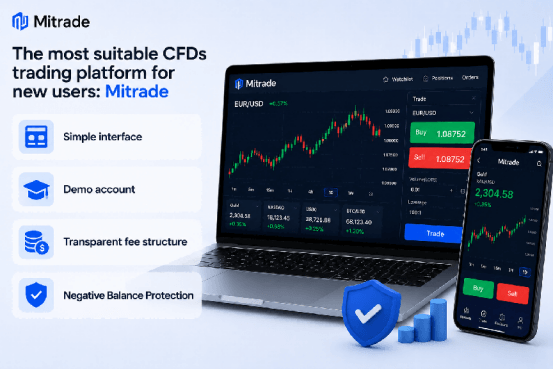
Many beginners prefer platforms that are simple and easy to use when starting CFD trading. Mitrade offers several features that can help beginners start CFD trading more easily.
🔹Simple interface: The platform provides a clean and beginner-friendly interface for both app and web users without the complexity of traditional MT4/MT5 platforms.
🔹Demo account: Users can practice CFD trading with virtual funds before trading with real money.
🔹Transparent fee structure: Mitrade offers zero commission trading with a low entry barrier for beginners.
🔹Negative Balance Protection: This feature helps prevent traders from losing more than their account balance.
🔹Regulation and fund protection: Client funds are kept separate from company funds under regulated trading conditions.
How to start trading CFDs on Mitrade?
Starting CFD trading usually involves a few simple steps:
Step 1: Create a Mitrade account.

Enter your email address and password, then click Sign Up to create your Mitrade account.
Step 2: Complete your account setup.
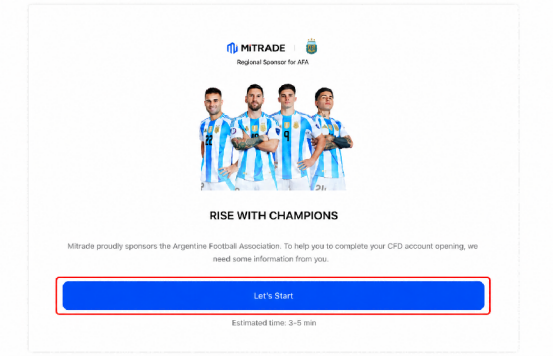
Click “Let’s Start” to continue setting up your Mitrade account.
Note: Beginners can start with a demo account before trading with real money.
Step3: Access the Market section.
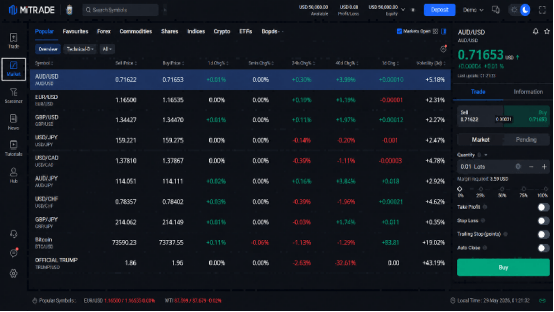
Click Market to view the available trading markets and asset categories.
Step 4: Choose a market category.
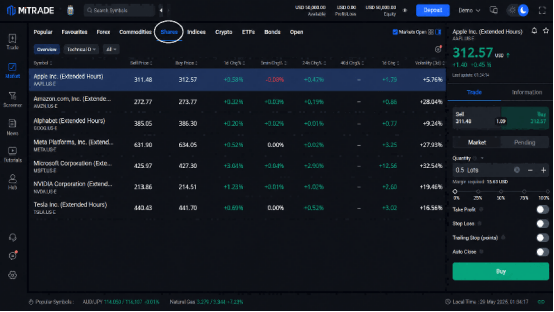
Select a market category based on the type of asset you want to trade. In this example, the Shares market is selected, and AAPL (Apple) is one of the available assets.
Step 5: Select a Buy or Sell position.
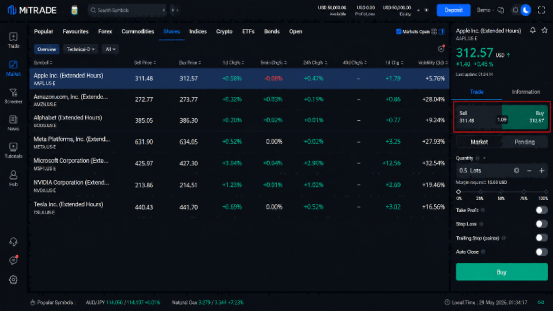
Choose the trading direction based on your market expectation. In this example, a Buy position is selected.
Step 6: Set the trade size.
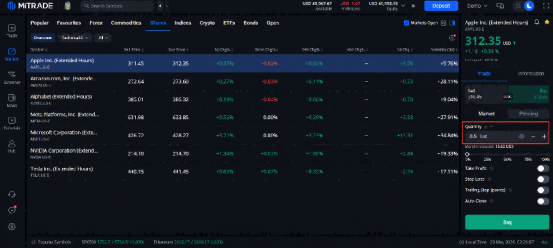
Enter the trade size before opening the position. In this example, a trade size of 0.5 lots is selected. Traders can adjust the trade size according to their trading strategy and risk tolerance.
Step 7: Set risk management tools.
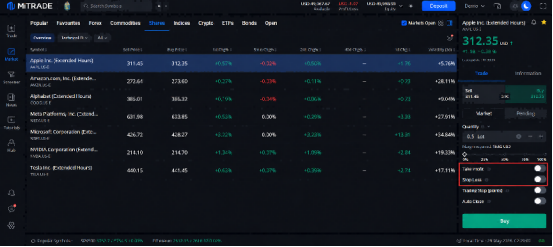
Use Take Profit and Stop Loss settings to help manage potential profits and limit potential losses.
Step 8: Finally open the trade.
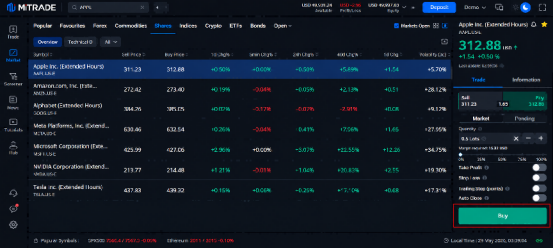
After reviewing the trade details, click Buy to open the CFD position.
Conclusion
CFD trading gives traders access to different financial markets through price speculation rather than direct ownership of assets. Although CFDs offer advantages such as leverage, lower starting capital, and access to multiple markets, they also involve risks that require proper risk management and careful trading decisions.
For beginners, it is often a good idea to start with a demo account and take time to learn how the market works before trading with real money. Mitrade is a suitable platform for beginners because it offers demo trading, an easy-to-use interface, and access to multiple CFD markets.
 Forex 丨 Futures 丨 US Shares 丨 Gold 丨 MoreStrictly regulated 0 commission, low spreads Attractive leverage of up to 1:200 & tight spreads Exclusive market analysis from Trading Central First hand tips and insights 5/24 multilingual customer service support Trade on web or app
FAQs
1. What’s the difference between CFDs and Futures?
Futures contracts usually have a fixed expiration date, while CFDs generally do not have an expiry date.
2. What is leverage in CFD trading?
Leverage allows traders to open larger positions with a smaller amount of capital. While leverage can increase potential profits, it can also increase potential losses, so it should be used carefully.
3. Can I make money when prices are falling?
Yes. CFD trading allows traders to take a Sell position if they expect prices to fall. If the market moves in the expected direction, traders may be able to profit from the price decline.
4. What is a "Margin Call" and how do I avoid it?
A Margin Call occurs when account funds are insufficient to support open positions. Using lower leverage and risk management tools may help reduce the risk.
* The content presented above, whether from a third party or not, is considered as general advice only. This article should not be construed as containing investment advice, investment recommendations, an offer of or solicitation for any transactions in financial instruments.


