


When Does the Gold Market Open? Global Open/Close Times, Peak Sessions, and Weekday Strategies

In gold trading, timing is equally as important as market direction since gold is traded in different global sessions, and Having knowledge about the precise opening times for each market and overlap sessions—especially those involving London and New York—helps in maximizing the advantages of high liquidity, narrow spreads, and momentum in the market prices.
🎯In this guide, we will break down global trading hours (summer/winter sessions), opening time differences depending on gold investment type, the most liquid sessions, and risk management tips when trading during high-volatility periods.
What time does the gold market open and close?
Unlike traditional stock exchanges, the international gold market is a decentralized over the counter (OTC) system that works almost 24 hours a day for 5 days a week—from Sunday night to Friday night (GMT). Nevertheless, the intensity of market operation differs greatly throughout the day, depending on whether it is one of the international centers that is operating now.
To navigate these hours effectively, it can be useful to split the trading day into two main periods:
The Asian-Pacific Sessions (Sydney & Tokyo): A low-volatility period with a stable price range, which creates calm conditions for the Asian market players.
The Western Sessions (London & New York): The driving force of global gold liquidity, where heavy institutional trading and economic data releases trigger the highest price movements.
Since a lot of financial capitals use the time-shift regime known as Daylight Saving Time (DST), there are two different trading schedules per year—Summer and Winter ones. The following table represents official working hours for main sessions, taking into account regional adjustments for UAE Time.
Gold Market Trading Hours: Summer Schedule (Daylight Saving Time)
Gold Market Trading Hours: Winter Schedule (Standard Time)
Daily Maintenance Shutdown: CME/COMEX gold futures have a daily maintenance break. The UAE-time schedule shifts by approximately one hour between U.S. daylight-saving and standard-time periods.
Daylight Saving Time (DST): Trading hours change due to the implementation of DST in Europe and the USA, changing the trading hours in the Arab world and the UAE. Be sure to confirm your time zone on your trading platform.
Does the Gold Market Opening Time Vary by Investment Type?
Absolutely, the market opening times for gold vary widely based on the specific investment medium that you decide to utilize. Whereas spot and leveraged derivatives trade almost round the clock, there are others such as exchange traded funds and physical gold that trade under strict market timings.
Below are the 5 most common mediums through which gold is traded along with their market hours:
1. Spot Gold (XAU/USD)
Spot gold (XAU/USD) is generally available for trading nearly 24 hours a day, five days a week, but exact opening, closing and daily maintenance times vary by broker and platform.
2. Gold CFDs
Trading Gold CFDs allows traders to trade on gold price changes without having any physical gold, using leverage. This can be accessed using trading platforms such as Mitrade, which allows for CFD trading with close similarity to the spot market (24/5 trading from Sunday evenings until Friday evenings). The trader is provided with zero commission, low spreads, and risk management features. Moreover, risk-free practice through virtual money, such as a $50,000 demo account, is available on Mitrade platforms.
3. Gold Futures (COMEX)
Futures contracts refer to agreements to purchase or sell gold at a prearranged price on a specified date in the future. Gold futures are traded on centralized exchanges such as CME/COMEX. Futures trading operates from Sunday evening through Friday afternoon (U.S. time) with a daily maintenance break, though exact UAE-time schedules shift slightly between U.S. daylight-saving and standard-time periods.
Please be advised that the trading of futures ceases entirely during the weekends (Saturday morning to Monday morning, UAE Time) and on the US holidays.
4. Gold ETFs (Exchange-Traded Funds)
Gold ETFs, including GLD (SPDR Gold Shares) or IAU (iShares Gold Trust), mirror the price of physical gold and trade on stock exchanges, such as the NYSE (New York Stock Exchange). Therefore, trading times are limited to the usual stock market operating hours, normally Monday to Friday between 18:30 and 01:00 UAE Time in winter time (and 17:30 to 00:00 UAE Time in summer time). Thus, gold ETFs cannot be traded overnight or during Asian sessions when the exchange is closed.
5. Gold Mining Stocks
Gold mining stocks are an example of investments where trading hours for the stock directly depend on the time frame in which the local stock exchange is operating. The trading of these stocks is conducted only on regular trading days at the stock exchange.
Global Gold Trading Sessions
Even though gold can be traded 24 hours a day, there are variations in terms of liquidity and volatility depending on which part of the world’s major markets are trading at that time. Knowledge of these important factors for each trading session will help traders choose the best time to trade.
When Is the Best Time to Trade Gold?
The best time to trade XAU/USD is based on liquidity and volatility in the market. From the charts provided for the Summer and Winter sessions below, the best times to make profits from trading within 24 hours:
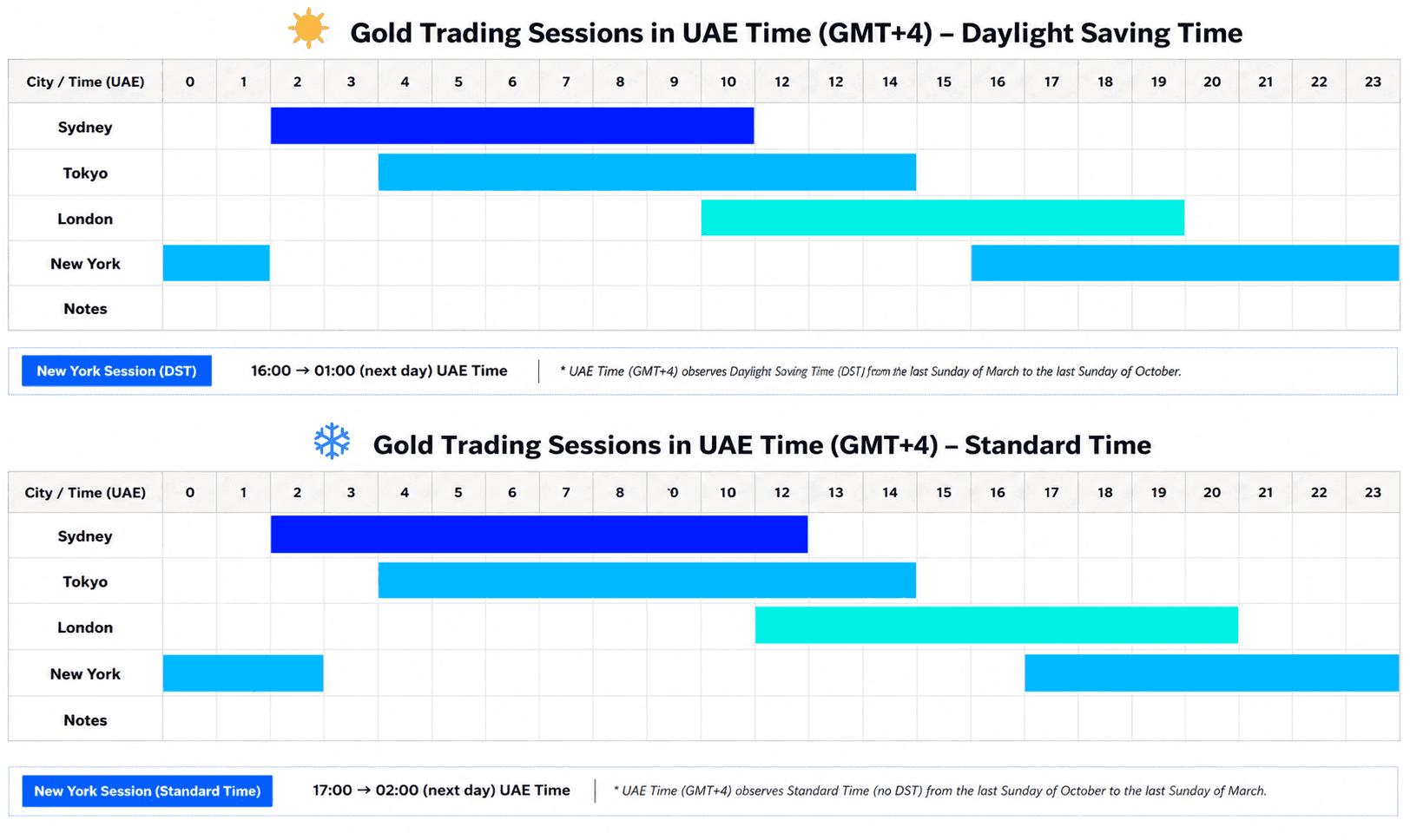
Note: Session times are based on UAE Time during the summer schedule. During the winter schedule, session times may shift by 1 hour due to Daylight Saving Time changes in the UK, US, and Australia. The UAE does not observe Daylight Saving Time.
1. London Session (11:00 – 20:00 UAE Time)
London is where the trading volume becomes high on a day-to-day basis due to the commencement of the wholesale London bullion market. This time frame ensures that traders get consistent liquidity and smooth price movements, hence offering the best time for traders to trade their initial trends.
2- London & New York Overlapping Session (16:00 – 20:00 UAE Time)
Representing the peak trading window of the 24/5 market, this overlap occurs when the London physical gold market and the US COMEX futures market operate simultaneously. It features maximum liquidity, the tightest bid-ask spreads, and key US economic data releases (such as CPI and NFP at 16:30 UAE Time during winter time), offering the most lucrative breakout conditions.
3. US Session (16:00 – 01:00 UAE Time )
After the London market closure, there is heavy price action during the US session that is driven by the Fed’s interest rate decisions and dollar dynamics. Liquidity stays high into the afternoon until it starts to thin out as the New York session nears closure.
What factors influence the price of gold during trading sessions?
Inflation figures and economic releases directly shape gold price movement by shifting investor expectations around Federal Reserve interest rates and the U.S. dollar strength. How the market reacts initially relies heavily on how the actual data compares to market forecasts.
The following are the main intraday catalysts moving gold prices:
✅Rate decisions made by the US and Fed policies: Rate increases cause a strengthening of the USD and an increased opportunity cost of holding non-yielding gold, hence reducing its price levels, while rate decreases create bull runs.
✅Inflation figures in the US (CPI and PPI): High inflation levels make gold attractive as a safe-haven investment that protects against currency depreciation, resulting in price surges upon publication of the figures.
✅US Non-Farm Payrolls (NFP): This is a monthly report published in the New York session, causing intraday volatility that moves the prices of gold by several dollars.
✅Movements in the US Dollar Index (DXY): Gold has an inverse correlation with the USD, implying that whenever the dollar appreciates, gold falls, while any depreciation of the dollar results in rising gold prices.
✅Geopolitical Risk & Demand Safety Asset: Surprising wars or a financial crisis may lead to a rapid outflow of money into gold and result in sharp breakouts or weekly gap-ups.
✅Gold Accumulation by Central Banks: Continuous and substantial accumulation of gold by central banks offers solid support for long-term price levels.
★ Suggestion: Before you open your trading position on the London and New York sessions, look at the economic calendar of Mitrade to know the important economic news. With the release of high impact news, there will be huge volatility in the market, which will help you identify trading opportunities through Mitrade's real-time data. |

Trade XAU/USD with Tight Spreads
Is the Gold Market Open on Weekends and Holidays?
Although gold is traded around the clock throughout the week, there is never a time when it trades non-stop all day. Market closings and holidays play a major role in trading gold without suffering gap risk.
1. Weekend Trading Rules
Closure During the Weekend: Closes for all traders at 1:00 AM Saturday (UAE time) and reopens at 2:00 AM Monday (UAE time). Note that these weekend opening and closing times shift by one hour depending on U.S. Daylight Saving Time changes.
Weekend and Gap Risks: Since high-impact geopolitical events, changes in economic policies, and central bank announcements can happen even when the markets are closed over the weekends, there can be a price gap at the opening of the gold market on Sundays.
2. Major Market Holidays (When Gold Trading Stops or Slows)
During major international holidays, liquidity disappears or trading activity stops completely on international exchanges (COMEX, the London Bullion Market, and Asian markets).
3. Early Closures & Low Liquidity Holidays
US Federal Holidays: Independence Day (July 4), Thanksgiving, and Labor Day (US markets close early, causing thin trading volume).
Lunar New Year: China and other major Asian centers are closed for several days, resulting in low trading volumes in the Asia session.
⚠️Risk Notice: Trading and holding open positions in gold just before the close of weekends or holiday periods results in the risk of price slippage and increased spreads due to a lack of liquidity.
How Gold Trading Hours Impact Your Trading Strategy?
Knowing market open times is only half the battle, but the real advantage comes from adjusting your method of trading based on changes in liquidity and volatility for that particular session. There are different patterns of price action in gold based on the time of the trading session.
Here is how you can optimize your trading execution across different market phases:
1. Peak Volatility & High-Liquidity Windows (Best for Trend & Breakout Trades)
London Session : As European financial hubs open, institutional volume surges following the calmer Asian session. Traders should monitor initial breakout setups beyond the high or low ranges established during the Asian session.
London–New York Overlap: This overlap represents the highest liquidity period of the day with the narrowest bid-ask spreads. Technical patterns, trend continuations, and momentum strategies perform with maximum reliability during these hours.
2. High-Impact Macroeconomic Announcements (Managing Event Risk & Slippage)
US Macroeconomic Data Releases: Essential economic data such as NFP, CPI, and Retail Sales usually cause abrupt and steep price movements in just a few seconds.
Federal Reserve Monetary Policy & FOMC Meetings: Changes in interest rates and news conferences by the Federal Open Market Committee often lead to drastic changes in intraday trends.
💡Strategic Execution Tip: It is wise not to place market orders right before or after the release of key economic data to avoid slippage and false breakouts. Wait 5 to 15 minutes instead.
3. Low-Liquidity Transition Hours (Caution Required)
US Close to Asian Open Transition: With Wall Street closed and ahead of full action in key Asian centers, the volume falls off substantially, resulting in widening of spreads.
💡Strategic Execution Tip: Do not employ breakout techniques at such a time as the liquidity in the market will be low. Choose range trading approaches and use wider stop loss positions or simply stay out of the market.
How to Plan Your Gold Trading Strategy for Weekdays and Weekends?
The environment for trading gold changes according to liquidity conditions during the trading week, primarily driven by the release of key economic reports. Aligning your trading approach with these daily liquidity patterns will help you execute your trades more effectively.
The table below outlines how gold market dynamics shift throughout the week and the optimal strategies to manage risk for each session:
How Do You Manage Risk During the Most Volatile Periods of Gold Trading?
Risk Management in Times of High Volatility Should Be Executed Rigorously for the Safeguarding of Trading Capital from Heavy Slippage and Market Spikes.
- Enforce Strict Position Sizing: Limit risk to 1%–2% of total account capital per trade, and reduce contract lot sizes during volatile periods to cushion market swings without increasing total financial exposure.
- Mandatory Stop-Loss Placement: Always set a stop-loss order simultaneously upon opening a position. Widen the stop distance using ATR during high volatility, and never hold onto losing positions emotionally.
- Avoid High-Impact Data Releases: Stay out of the market 3 to 5 minutes before and after top-tier economic releases (like NFP and CPI) to prevent extreme spread expansion and costly execution slippage.
- Partial Profit-Taking & Trailing Stops: Secure partial gains as the price moves in your favor, then shift the stop-loss on the remaining position to breakeven to lock in a risk-free trade.
- Close Open Positions Before the Weekend: Liquidate all intraday trades prior to Friday's market close to eliminate overnight gap risks triggered by unexpected weekend geopolitical events.
Conclusion
Trading success in the 24/5 gold market depends largely on the fact that traders trade during high volumes of trading to gain liquidity and low costs of transactions. Mitrade makes your trades easy through live market analysis, tight spreads, and $0 commission gold CFDs. Take control of your gold trading journey today—start risk-free with a $50,000 practice account or open a live Mitrade account to trade global sessions with precision.


* The content presented above, whether from a third party or not, is considered as general advice only. This article should not be construed as containing investment advice, investment recommendations, an offer of or solicitation for any transactions in financial instruments.


