


The Hang Seng Index tracks large and liquid companies listed in Hong Kong, including many businesses closely connected to mainland China. UAE investors can gain exposure through funds, individual shares, CFDs, futures, or options, depending on their objectives and risk tolerance.
🎯 This guide explains the main ways to invest in or trade the HSI from the UAE, how each method works, and the key advantages and risks to consider.
For more details, read our guide: Understanding the Hang Seng Index: Calculation, Sectors & Constituent Stocks.
Can You Buy the Hang Seng Index Directly?
No, the Hang Seng Index cannot be bought in the same way as a company share or ETF because it is only a benchmark used to measure the performance of selected Hong Kong-listed companies. It does not issue shares, hold assets, or pay dividends, so investors cannot own the HSI itself.
Instead, investors can buy shares or units in HSI-tracking funds or trade derivatives linked to the index. They can also buy individual HSI constituent shares, but returns will depend on how each share performs.
How to Invest in the Hang Seng Index in the UAE? 4 Best Ways for Beginners
The index itself cannot be purchased because it is a calculated benchmark. UAE residents can instead obtain exposure through HSI-tracking funds, constituent shares, CFDs, futures, or options. Choose the method that best suits your goals and risk tolerance.
Way 1: Buy Hang Seng ETFs or Index Funds
An exchange-traded fund (ETF) is a fund bought and sold on a stock exchange, while an index fund is designed to track a particular market index. The two can overlap: an HSI-tracking ETF is both an ETF and an index fund. An HSI-tracking fund aims to follow the index, providing exposure to its constituent companies through one fund.
Advantages:
✅Broad and convenient exposure: One fund provides exposure across numerous HSI constituents, while the portfolio is adjusted when the index is rebalanced.
✅Trading flexibility and potential income: HSI ETFs can be traded during exchange hours, and distributing funds may pass dividend income to investors.
Disadvantages:
❌Market and concentration risk: The fund loses value when the HSI declines and remains exposed to the index’s concentration in certain sectors and heavyweight companies.
❌Tracking difference and costs: Fees, expenses, and rebalancing may cause returns to differ from the HSI. Brokerage, spreads, and currency conversion may create additional costs.
👥Suitable for: Long-term investors seeking HSI exposure and diversification across multiple leading Hong Kong-listed companies without managing each share individually.
Where to invest: Brokers or bank securities accounts offering HKEX-listed HSI ETFs, or fund platforms providing access to HSI index funds.
Way 2: Buy Core Component Stocks
Buying core component stocks means purchasing individual shares from among the HSI’s major constituents, such as HSBC, Tencent, or Alibaba. Unlike an HSI-tracking fund, this approach lets investors choose each company’s shares and decide how much to invest in each one.
Advantages:
✅Ownership and potential returns: Investors can benefit directly from increases in each company’s share price and may receive dividends when declared.
✅Greater portfolio control: Investors choose the companies and allocations themselves without paying an ETF or index fund management fee.
Disadvantages:
❌Limited diversification: Holding only a few constituents increases company-specific risk and will not reproduce the full HSI’s performance.
❌More research and management: Each company requires separate analysis and monitoring, while buying and rebalancing several shares may generate additional brokerage and currency-conversion costs.
👥Suitable for: Investors who want control over company selection and are prepared to research individual HSI stocks and accept company-specific risk.
Where to invest: International brokers or bank securities accounts providing UAE residents with access to HKEX-listed shares.
Way 3: Trade HK50 CFDs
An HK50 CFD is a derivative linked to the Hang Seng Index. It allows traders to speculate on HSI price movements without owning constituent shares. A Buy position may profit if the index rises, while a Sell position may profit if it falls.
Advantages:
✅Two-way and flexible trading: Traders can open Buy or Sell positions and adjust their position size without purchasing the individual HSI constituents.
✅Margin-based exposure: Leverage allows traders to control a larger position while depositing only a portion of its total value as margin.
Disadvantages:
❌Magnified losses and margin risk: Leverage amplifies adverse price movements, so losses can accumulate quickly and positions may be closed if margin becomes insufficient.
❌Trading and holding costs: Spreads, overnight financing, and other broker charges can reduce returns, particularly when positions remain open longer.
👥Suitable for: Short-term traders who understand leverage, can monitor their positions, and follow strict margin and risk controls.
Where to invest: CFD brokers regulated by the UAE CMA that offer an HSI-linked HK50 market to UAE residents, such as Mitrade.
“Trade HK50 CFDs with an CMA-regulated broker. Fast AED funding via local payments. ”
Way 4: Hang Seng Index Futures and Options
HSI futures are standardized, cash-settled contracts that track the index and expire on specified dates. Standard HSI index options give buyers the right, but not the obligation, to gain exposure to index movements through calls or puts.
Both products trade on Hong Kong Exchanges and Clearing Limited (HKEX), which operates Hong Kong’s securities and derivatives markets, and settle in cash without exchanging constituent shares.
Advantages:
✅Hedging and strategy choice: Futures can hedge broad HSI exposure, while calls and puts support bullish, bearish, and downside-protection strategies.
✅Exchange-traded access: HSI futures and options are standardized, cash-settled, and centrally cleared on HKEX, providing index exposure without trading every constituent share.
Disadvantages:
❌Different loss risks: Futures leverage can magnify losses and trigger margin calls. Option buyers may lose the entire premium, while option sellers can face substantially larger losses.
❌Expiry and valuation complexity: Futures may need to be closed or rolled before expiry. Options require careful strike and expiry selection, lose time value, and may expire worthless.
👥Suitable for: Experienced traders and professional investors seeking leveraged exposure, portfolio hedging, or advanced strategies and who understand margin and expiry risks.
Where to invest: Derivatives brokers providing UAE residents with access to HKEX-listed HSI futures and options.
How to Buy the Hang Seng Index Step by Step?
On Mitrade, traders can access the HSI index through the HK50 CFD and trade its price movements by opening Buy or Sell positions. Beginners can practice with a free demo account containing USD 50,000 in virtual funds before trading with real money.
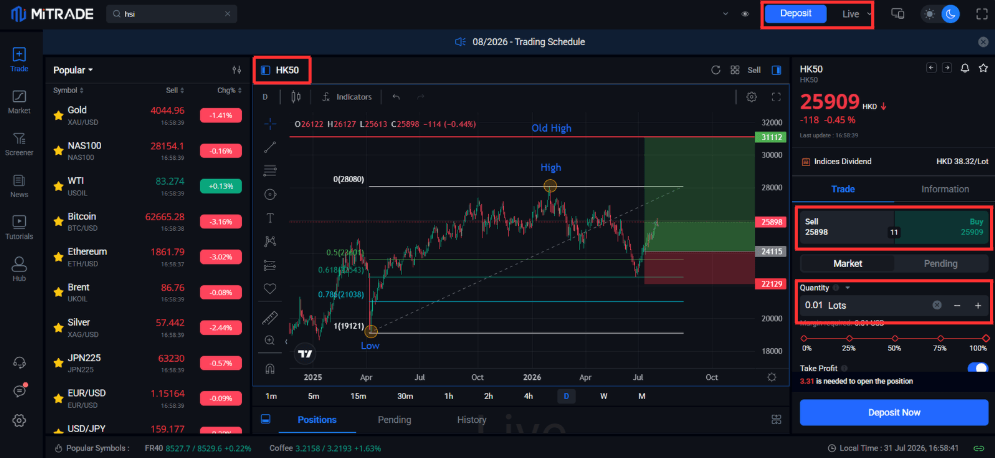
Step 1: Open a Live Account
Create a Mitrade account and complete the required identity-verification process. Once the account is approved, switch from the demo environment to the live account.
Step 2: Deposit Funds
Select Deposit from the live-account interface and choose one of the available funding methods. Mitrade’s minimum deposit starts at $50. As a beginner, start with an amount you can comfortably afford to risk while gaining real market experience.
Step 3: Place an Order and Manage Risk
Search for HK50 and assess the broader trend, support and resistance levels, and events affecting Hong Kong and Chinese equities. Select Buy if you expect the index to rise or Sell if you expect it to fall, then choose a market or pending order.
Choose an appropriate position size, review the required margin, and use risk controls such as stop loss, take profit, and trailing stop. Before confirming, check the direction, entry price, quantity, margin, and exit levels. Monitor the trade, as volatility or market gaps may cause stop-loss execution at a different price from the selected level.


Hang Seng Index Trading Hours
Trading hours depend on the product. On normal full trading days, the underlying Hong Kong securities market operates Monday to Friday, excluding public holidays.
What Is the Best Time to Trade HK50?
The best time to trade HK50 is generally from 5:30 to 6:00 a.m. UAE time (GST), when Hong Kong’s continuous morning session opens. Trading activity and liquidity are typically higher as HSI constituent shares respond to overnight developments and opening orders.
Key Risks to Consider Before Trading HK50 in the UAE
Before trading HK50, traders should be aware of the potential risks involved. Understanding these risks in advance can help them prepare for volatility, choose an appropriate position size, and manage their trades and trading accounts more effectively.
Leverage and margin risk: Leverage magnifies both gains and losses. Strong adverse moves may trigger margin close-outs or rapid account losses.
China policy sensitivity: Stimulus, technology regulation, property measures, and other policy decisions can cause sudden changes in market expectations.
Index concentration: Financials account for around one-third of the HSI, while heavyweight stocks can strongly influence its direction.
Volatility and gap risk: Economic releases, geopolitical news, or overnight developments may produce sharp moves and execution away from selected stop levels.
Tips for Beginners Trading HK50
Trading HK50 offers high potential, but navigating its fast-moving market requires a solid strategy. Use these key trading tips to manage risk and build consistency from day one:
- Follow HSI-specific drivers: Monitor Chinese policy, economic data, property conditions, major constituent earnings, and Hong Kong and US interest rates.
- Use an economic calendar: Check upcoming Chinese, Hong Kong, and US releases before entering positions, as major announcements can increase volatility. You can use Mitrade’s economic calendar to track events that may affect HK50.
- Backtest your strategy: Test entry, stop-loss, and exit rules across trending, ranging, and volatile conditions while accounting for spreads and slippage.
- Control risk per trade: A common guideline is to risk around 1–2% of the account on one trade and always use a stop-loss order to help protect your account.
- Plan a positive risk-to-reward ratio: The potential reward should exceed the planned loss, but only when the target is realistic and supported by the setup.
- Keep a trading journal: Record the setup, market conditions, entry, stop loss, target, result, and whether the trading plan was followed.
- Practise through a demo account: Use realistic position sizes to test the strategy, platform tools, and order execution before moving to live trading. Mitrade provides a demo environment with virtual funds for strategy and platform practice.
- Avoid chasing the opening move: HK50 can move sharply around the Hong Kong market open, so wait for confirmation rather than entering solely because the first candle is large.
Conclusion
For UAE investors who want to trade Chinese stocks or follow China’s economic and market trends, the HSI is a useful benchmark for major Hong Kong-listed companies.
Investors can gain broad HSI exposure through tracking funds, CFDs, futures, or options, while purchasing selected constituent shares provides only partial exposure. The appropriate method depends on the investor’s objectives, preferred ownership structure, time horizon, and tolerance for leverage and volatility.
For active traders, Mitrade’s HK50 CFD allows Buy and Sell positions without ownership of the underlying shares. Before investing real money, beginners can practice risk-free with a demo account or start small with a minimum deposit of just $50.
Risk-Free Demo Account
CMA-regulated | 24х5 | T+0 | low spreads. Enjoy limit and stop loss for every trade!
How can beginners in the UAE start investing in the Hang Seng Index?
Beginners can use an HSI-tracking fund for diversified, longer-term exposure or trade HK50 CFDs for short-term price speculation.
What is the minimum deposit required to trade HK50 in the UAE?
Minimum deposits vary between platforms. On Mitrade, the minimum deposit is $50.
Do UAE residents need to pay taxes on Hang Seng Index profits?
UAE residents generally pay no tax on profits that come from investing in or trading HSI or other financial instruments. Business or company investing may be taxed differently.
Does the Hang Seng Index pay dividends?
The HSI itself does not pay dividends because it is an index. Its constituent companies may pay dividends, while HSI-tracking funds may distribute or reinvest that income according to their policies.
* The content presented above, whether from a third party or not, is considered as general advice only. This article should not be construed as containing investment advice, investment recommendations, an offer of or solicitation for any transactions in financial instruments.


