



With gold prices recovering and buyers gaining strength, the outlook has become more bullish. This suggests that gold is more likely to continue rising toward its historical high. As geopolitical turbulence intensifies, countless investors are asking: Is now the right time to buy gold?
Determining the right moment to buy gold requires more than intuition or following the crowd. Investors must also consider their objectives, risk tolerance, and preferred way to gain exposure.
🎯 This article provides an in-depth analysis of recent price trends, key drivers, strategies for different investors, market-timing techniques, investment channels, and potential risks. Together, these factors can support more informed capital allocation in the current macroeconomic environment.
Review of Gold Prices for the Past Year
Gold’s trajectory over the past year highlights how rapidly market momentum can shift, moving through four distinct phases:
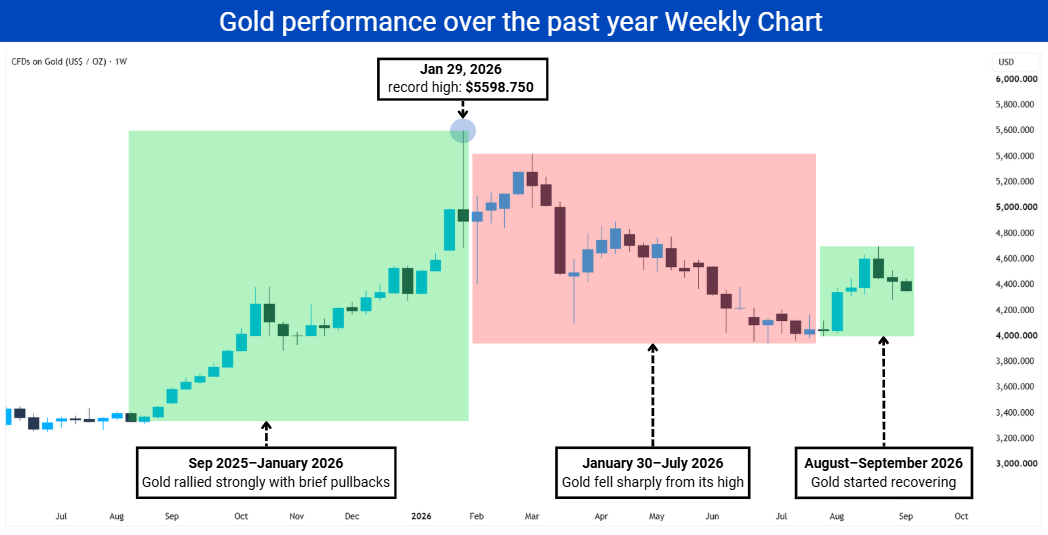
September 2025 – January 2026 (Strong Rally): Gold surged approximately 69%, driven by rate-cut expectations, a softening US dollar, geopolitical friction, and sustained central bank accumulation. Minor pullbacks were swiftly bought.
January 29, 2026 (All-Time High & Reversal): Gold reached a record peak near $5,598.75 before dropping ~16% shortly after. The reversal followed Kevin Warsh’s nomination as Fed Chair—which bolstered the US dollar—alongside hotter-than-expected inflation metrics that raised "higher-for-longer" rate concerns.
Late January – July 2026 (Broad Correction): Rising real yields, a surging greenback, and persistent ETF outflows dragged gold down roughly 29.5% from its peak, unwinding a substantial portion of its previous gains.
August – September 2026 (Recovery Underway): Gold mounted a 17.5% rebound. Resurgent rate-cut expectations, a softer dollar, fresh geopolitical safe-haven flows, and robust central bank purchases reignited bullish momentum.
Key Factors Driving Gold Prices Recently
While recent price action reflects shifting market sentiment, gold's broader trajectory is ultimately shaped by core macroeconomic fundamentals. To evaluate where prices may head next, it is essential to examine the primary drivers currently competing for influence: official sector demand, interest rate dynamics, and geopolitical energy shocks.
1. Central-Bank Purchases vs. ETF Flows
Central banks bought approximately 289 tonnes of gold in Q2 2026, five times the revised Q1 total, as reserve diversification and geopolitical risk supported demand. However, 45 tonnes of ETF outflows showed that higher rate expectations and dollar strength weakened private investment and limited immediate price support.
2. Real Rates, Inflation, and the US Dollar
Elevated real yields remain a headwind for gold. As the chart shows, the broad US dollar index fell from above 121 in early July to near 118 in late August, supporting gold’s recovery. It then started reversing upward toward 118.6, indicating renewed dollar strength that could pressure gold if the rebound continues.
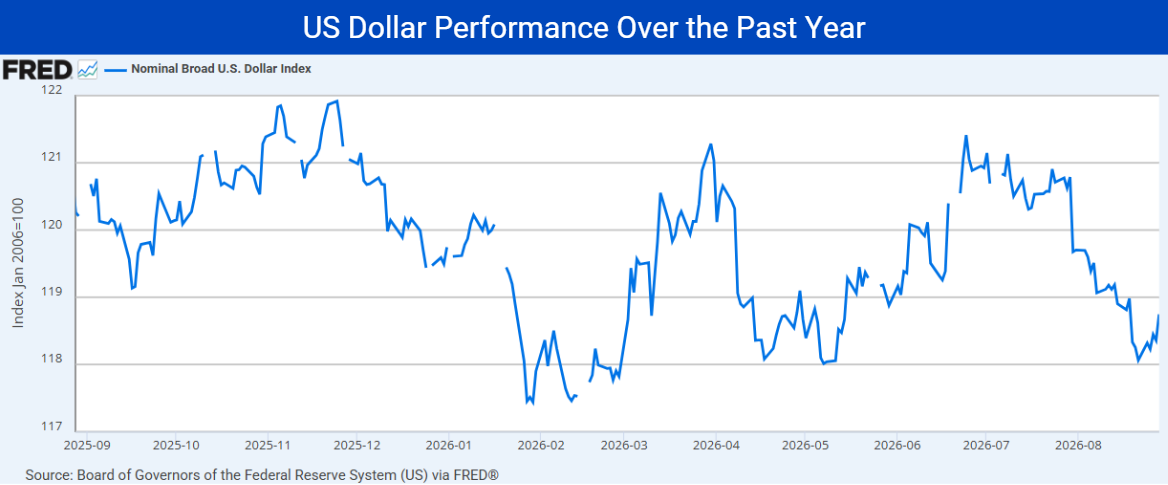
Source: FRED, Dollar Index
3. Geopolitical Uncertainty and Energy Prices
Escalating Middle East attacks recently pushed Brent crude above $100 and increased demand for gold as a safe haven. However, higher oil prices also raised inflation and interest rate expectations, so the resulting monetary pressure could limit gold’s gains.
Is It a Good Time to Buy Gold?
Because every investor operates on a unique timeline and risk profile, there is no single answer to whether now is the right time to buy gold. The optimal strategy depends entirely on your primary investment objective—whether you are protecting long-term purchasing power, trading short-term momentum, or balancing a multi-asset portfolio:
★ For Wealth Preservation & Inflation Defense: Favorable window for gradual accumulation.
For 5-to-10-year horizons aimed at preserving purchasing power against fiat debasement, short-term price timing is secondary. Build positions systematically via Dollar-Cost Averaging (DCA)—investing fixed dollar amounts monthly or quarterly—while keeping core liquidity intact.
★ For Short-Term Tactical Traders: Wait for pullback confirmation; avoid chasing.
Daily price structure has turned bullish, with gold bouncing off demand zones, breaking dual swing highs, and printing a 50-day EMA cross above the 200-day EMA. However, buying into rapid vertical moves carries high risk. Wait for a pullback to key support or a clean breakout-and-retest pattern. Use wider stops paired with reduced position sizes to account for volatility.
★ For Portfolio Risk Hedging: Allocate if currently underweight.
World Gold Council research demonstrates that a 2.5% to 10% allocation to gold significantly enhances risk-adjusted returns for multi-asset portfolios. Calculate the gap between your current exposure and target weighting, then scale in gradually. If you are already at your target allocation, further buying is unnecessary.

When Is the Best Time to Buy Gold? How to Time Your Gold Purchase?
Rather than buying blindly, disciplined investors focus on specific structural catalysts:
During Gold Price Pullbacks
In a bull market, the biggest mistake is chasing gold when its price is rising rapidly. Investors can watch for a 3% to 8% pullback toward the EMA 50, EMA 200, previous support or the discount area of a major price swing.
Premium and discount divide the measured swing around its 50% equilibrium. The area below this midpoint is considered the discount area, which often attracts buyers and provides a more favorable place to buy.
These indicators show potential buying areas, not automatic entries. Investors can wait for a bullish candle, a reaction from support or a lower-timeframe break of structure before building positions in stages to lower their average purchase price.
When Real Interest Rates Are Falling
Falling real interest rates make gold more attractive by reducing the opportunity cost of holding a non-interest-bearing asset. The signal becomes stronger when real yields decline for several weeks while gold holds support or continues rising.
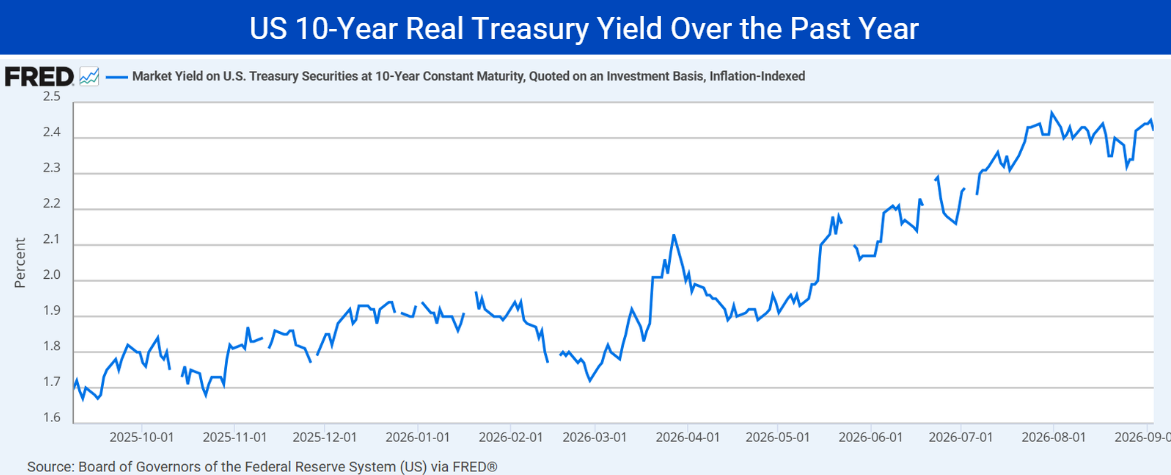
Source: FRED, US 10-Year Real Yield
Investors can gradually increase their gold exposure when both signals appear instead of reacting to a single daily movement in yields.
When the US Dollar Is Weakening
A sustained decline in the US dollar can support gold by making it less expensive for buyers using other currencies. Key signals include a weaker Dollar Index combined with gold holding support or breaking above resistance.
Investors can buy gradually when both signals align. Short-term traders can wait for a breakout and retest followed by a bullish reaction before entering.
During Economic or Geopolitical Uncertainty
Economic stress, financial instability and geopolitical conflict can increase demand for gold as a safe-haven asset. However, a sharp news-driven rise can indicate that prices and volatility are already elevated.
Long-term investors can build exposure through smaller scheduled purchases. Short-term traders can wait for a pullback and clear bullish confirmation while using smaller position sizes.
When Gold Is Underallocated in Your Portfolio
The main signal is that gold represents less than the investor’s chosen portfolio allocation. This can happen when other assets rise in value or when the portfolio has little exposure to assets that behave differently from equities and property.
Investors can calculate the difference between their current and target allocations, fill the gap gradually and rebalance periodically. Additional buying may be unnecessary when gold already represents the intended share.
Pros and Cons of Buying Gold Now
Buying gold now offers potential upside because price and demand conditions have improved. However, gold has already advanced from lower levels and still faces technical and macroeconomic risks.
Pros of Buying Gold Now
✅Several bullish price signals: Gold reacted strongly from the demand zone, formed large bullish candles, broke two previous highs and established a new higher high, shifting the daily structure from bearish to bullish.
✅Positive moving-average signal: The EMA 50 crossed above the EMA 200, providing further confirmation that buyers have regained strength.
✅Recovery remains supported by central banks: Central banks purchased approximately 289 tonnes in the second quarter, providing underlying demand despite weaker private investment flows.
✅Geopolitical demand is increasing: Escalating Middle East conflict and higher oil prices have strengthened gold’s current appeal as a safe-haven asset.
✅ETF demand has started recovering: After Q2 outflows, global gold ETFs added 23 tonnes in July, showing renewed private investment support.
Cons of Buying Gold Now
❌Gold is already trading in the premium area: Based on the rise from 3942.710 to 4697.070, the 50% midpoint is 4319.890. Gold is currently above this level, meaning buyers entering now are paying a relatively higher price within the measured range than those buying in the discount area.
❌Major resistance remains overhead: Gold has not yet broken 4697, while additional resistance at 4773 and 4890 could slow the recovery or cause another pullback.
❌Real yields remain elevated: High inflation-adjusted bond yields increase the opportunity cost of holding gold and could limit further gains.
❌The US dollar has started recovering: After falling near 118, the broad dollar index reversed toward 118.6. Continued dollar strength could pressure gold.
❌Monetary-policy risk has increased: Strong US employment data and higher oil prices have raised expectations of tighter Federal Reserve policy, which could support yields and the dollar at gold’s expense.
The current setup remains bullish, but gold is no longer trading in the cheapest part of the measured range. Buying after a pullback or building the position gradually can reduce the risk of entering at a premium price before resistance.
5 Ways to Invest in Gold for Different Types of Investors
Gold exposure can be obtained through physical assets, investment funds, company shares or derivatives. Each method differs in ownership, liquidity, costs and risk.
1- Physical Gold (Coins & Bars)
Purchasing physical gold that the investor owns and stores personally or through a professional vault.
Representative underlying assets: Investment-grade gold coins and minted or cast gold bars.
Advantages: Direct ownership, no fund management fees and the ability to hold a tangible asset outside a brokerage account.
Disadvantages: Dealer premiums, buyback discounts, storage and insurance costs, and potential theft or authenticity risks.
Best for: Long-term investors seeking wealth preservation and direct ownership of gold.
2- Gold ETFs & Mutual Funds
Investment funds that provide gold-related exposure through a brokerage or investment account without requiring personal storage.
Representative underlying assets: Physical bullion through gold-backed ETFs such as SPDR Gold Shares (GLD) and iShares Gold Trust (IAU)
Advantages: Convenient access, high liquidity, smaller minimum investments and no personal storage requirements.
Disadvantages: Management fees, possible tracking differences and no direct possession of the gold held by the fund.
Best for: Investors seeking convenient and liquid medium-term or long-term gold exposure.
You might be interested in these articles >>> |
3- Gold Mining Stocks
Shares in companies involved in gold exploration, production, royalties or streaming activities.
Representative stocks: Newmont Corporation (NEM), Agnico Eagle Mines (AEM), alongside mining developers and royalty businesses.
Advantages: Potential to outperform gold when prices and mining profits rise, with some companies also paying dividends.
Disadvantages: Exposure to management, production, operating-cost, political and company-specific risks.
Best for: Growth-oriented investors willing to accept greater volatility and risks beyond changes in the gold price.
4- Gold CFD
A contract with a broker that settles the difference between gold’s opening and closing prices without transferring ownership of the metal.
Representative underlying assets: Spot gold prices, commonly quoted as XAU/USD, or gold futures prices, depending on the contract.
Advantages: Ability to trade rising or falling prices, use leverage and access short-term gold movements.
Disadvantages: Amplified losses, spreads, overnight financing costs, counterparty exposure and no ownership of gold.
Best for: Active short-term traders experienced in using leverage and managing risk.

Trade XAU/USD with Tight Spreads
5- Gold Futures & Options
Futures create an obligation to transact under predefined terms, while options provide the right, but not the obligation, to take a position.
Representative underlying assets: Exchange-traded gold futures and options based on gold futures contracts.
Advantages: Transparent exchange pricing, leverage, hedging flexibility and the ability to trade different market scenarios.
Disadvantages: Margin calls, expiry dates, contract complexity and time decay for options, while option sellers can face substantial losses.
Best for: Experienced traders, professional investors and businesses seeking to hedge gold-price exposure.
How Much Gold Should You Own?
Gold serves as an essential multi-asset tool—enhancing portfolio diversification, preserving long-term purchasing power, and providing a reliable safe haven during macro uncertainty. A 5% to 10% target allocation remains a prudent baseline for most portfolios.
Long-Term Holders: Accumulate gradually using discretionary capital reserved for extended investment horizons.
Short- to Medium-Term Traders: Exercise patience—wait for a technical pullback into value support or a confirmed bullish breakout before taking new positions.
Portfolio Hedgers: Establish a target weighting, calculate any deficit relative to current holdings, and systematically close the gap through periodic rebalancing.
Given current price levels, a staged, dollar-cost-averaging approach is vastly superior to deploying a full allocation in a single lump sum. Whether you're hedging or tactical trading, Mitrade provides intuitive tools, competitive spreads, and flexible contract sizes to help you execute your gold strategy with precision.

Is physical gold better than a gold ETF?
It depends on your objectives. Physical gold provides direct ownership without counterparty risk, making it ideal for systemic risk protection despite storage costs and dealer premiums. Gold ETFs offer instant liquidity and lower transaction friction for standard brokerage accounts.
Do gold prices always fall after central bank rate cuts?
Not necessarily. Gold can soften if rate cuts were already fully priced into the market or if cuts coincide with dollar strength. However, if rate cuts drive real yields down significantly, gold typically experiences strong upward momentum.
How does gold perform during a recession?
Gold generally serves as a strong diversifier during recessions, particularly when central banks slash rates or geopolitical stress triggers safe-haven demand. However, during acute liquidity crises, gold can temporarily sell off alongside equities as investors liquidate liquid assets to raise cash.
* The content presented above, whether from a third party or not, is considered as general advice only. This article should not be construed as containing investment advice, investment recommendations, an offer of or solicitation for any transactions in financial instruments.


