


SK Hynix Stock Analysis: Will the AI Giant Keep Surging After Its Historic Nasdaq ADR Listing?
SK Hynix stock has become one of the strongest AI-related stock stories in the market. Over the past year, the South Korean memory-chip maker surged more than 600%, driven by booming demand for high-bandwidth memory, stronger AI-chip orders, and rising investor interest in semiconductor stocks.
But after such a sharp rally, the key question is no longer just why SK Hynix rose. It is whether the stock can keep climbing, or whether high expectations now make it vulnerable to deeper pullbacks.
🎯This SK Hynix stock analysis explains what drove the surge, what could affect its 2026 outlook, and how Arab and UAE investors can access the stock.
* Access the US stock market from just $50 with $0 commission and low spreads.
The Past Performance of SK Hynix Stock
The move in the SK Hynix share price from 2024 to 2026 was not one straight line. It happened in phases, and each phase tells you something about how the market's view of the company changed.
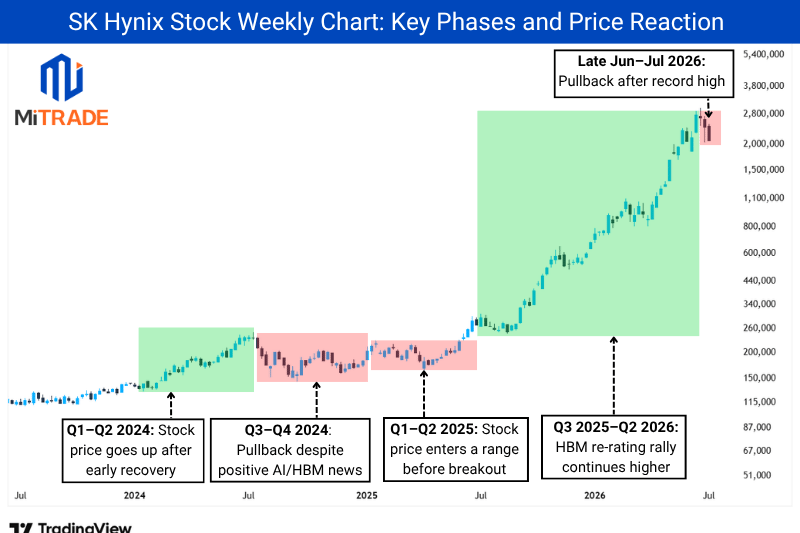
Q1–Q2 2024: Recovery after the memory downturn
SK Hynix entered 2024 after a difficult memory downturn. In 2023, the company posted an operating loss of around 7.7 trillion won as memory prices collapsed. Producers cut output and froze investment, which quietly set the stage for the next shortage.
As memory conditions began to improve in early 2024, investors started pricing in a recovery from the bottom of the cycle.
Q3–Q4 2024: Pullback despite positive AI/HBM news
The recovery was not smooth. In the second half of 2024, the stock pulled back even though AI and HBM-related news remained positive. This showed that investors were still cautious and that SK Hynix was not yet fully priced as an AI infrastructure leader.
Q1–Q2 2025: Range before breakout
In the first half of 2025, the stock traded in a range before breaking higher. During this period, AI data-center spending continued to grow, and SK Hynix’s HBM position became more important to the market.
Q3 2025–Q2 2026: HBM re-rating rally
From the second half of 2025 into mid-2026, investors stopped pricing SK Hynix as only a cyclical chip maker and started pricing it as core AI infrastructure. That re-rating explains the size of the rally more than any single earnings report.
Full-year 2025 revenue reached a record 97.1 trillion won, up about 47%, while operating profit nearly doubled to 47.2 trillion won with a 49% margin. SK Hynix’s 2025 operating profit was also reported to exceed Samsung Electronics’ provisional figure, showing how strongly the AI memory cycle shifted in its favor.
First-quarter 2026 revenue jumped 198% year on year to 52.6 trillion won, while operating profit reached 37.6 trillion won, giving SK Hynix an operating margin of about 72%.
The stock surged sharply in 2026, hitting an all-time high of 2,987,000 won on June 25, 2026, against a 52-week low near 245,000 won.
Late June–July 2026: Pullback after record high
After reaching its record high, the stock fell roughly 30%, trading near 2 million won in early July 2026 amid a broad chip-stock selloff. A re-rated stock, it turns out, can also de-rate quickly when expectations become too high.
Why Has SK Hynix's Stock Price Surged So Significantly Recently?
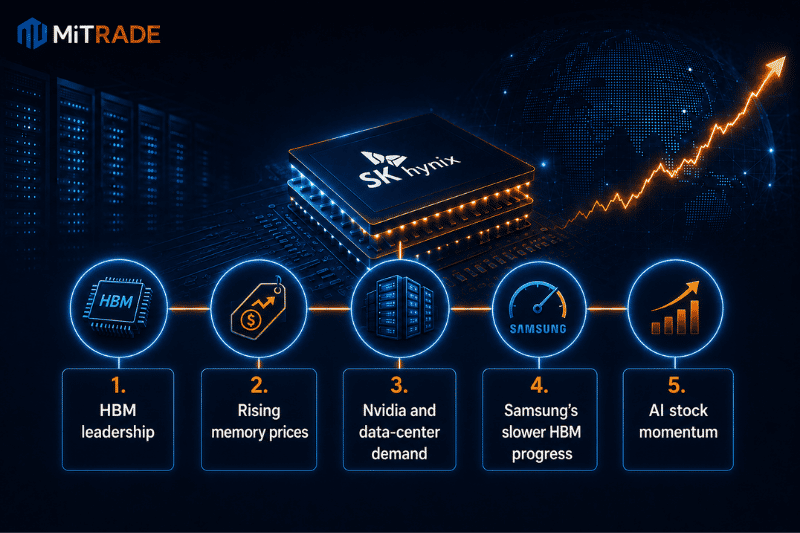
The drivers are not equal in importance, and each matters only through its effect on earnings and valuation.
1. HBM leadership
AI accelerators such as Nvidia's GPUs process far more data per second than ordinary DRAM can supply. High-Bandwidth Memory (HBM), which stacks DRAM layers to multiply data throughput, solves that bottleneck.
SK Hynix moved into advanced HBM earlier than rivals and remains the clear HBM market leader, with recent research estimates placing its share around 60%. Because HBM carries far higher margins than standard DRAM, this leadership converted directly into record profits and drove the re-rating.
⚠️The risk: if Samsung or Micron closes the gap, that pricing power, and the valuation built on it, could narrow.
2. Rising memory prices
Producers shifted capacity from ordinary DRAM and NAND toward HBM just as AI buyers began ordering aggressively, creating a severe shortage across memory types. TrendForce reported conventional DRAM contract prices rising 45-50% in a single quarter in late 2025.
Higher prices on tight supply widen margins on every chip sold, which is why SK Hynix's operating margin reached levels rarely seen in hardware.
⚠️The risk: memory pricing is cyclical, and new capacity eventually reverses the mechanism.
3. Nvidia and data-center demand
SK Hynix is widely reported as one of Nvidia’s key HBM suppliers, and several analyst reports expect it to keep a leading position in next-generation HBM supply for Nvidia’s future AI platforms.
By late 2025, SK Hynix said its 2026 DRAM, HBM, and NAND output had already sold out. Pre-sold demand reduces earnings uncertainty, and lower uncertainty supports a higher valuation multiple.
⚠️The risk: reliance on a few large AI customers means any slowdown in their spending hits hard.
4. Samsung’s slower HBM progress
Samsung faced delays qualifying its advanced HBM with key customers, allowing SK Hynix to capture premium orders first. That head start is real but not permanent, as Samsung's HBM4 push is gaining ground.
5. AI stock momentum
Global enthusiasm for AI semiconductor stocks, plus heavy leveraged-ETF activity in Korea, pushed the move further in both directions, which partly explains the sharp June-July swings.
Why Has It Attracted Attention From Investors?
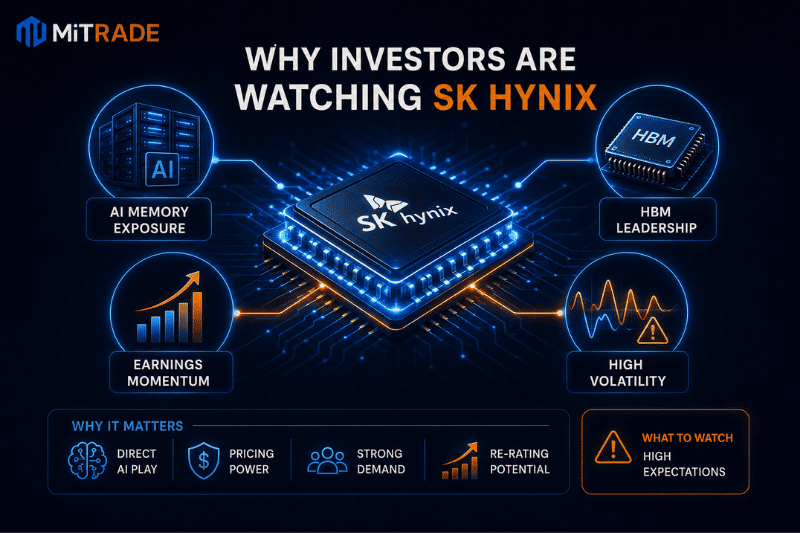
SK Hynix has attracted investors because it offers direct exposure to AI memory demand, while its earnings and margins have improved sharply during the HBM boom. The company is no longer viewed only as a cyclical memory-chip maker; many investors now see it as a key supplier in the AI infrastructure chain.
Its investment value comes from several points:
Direct AI memory exposure: Nearly all of SK Hynix’s revenue comes from DRAM and NAND, so stronger AI memory demand can quickly translate into higher sales and profits.
HBM leadership: SK Hynix is a leading supplier of high-bandwidth memory, which is essential for AI accelerators and data-center servers.
Pricing power: Strong HBM demand and tight memory supply give the company more room to charge premium prices compared with standard memory chips.
Strong margin expansion: Higher-value HBM products have helped SK Hynix achieve record profitability, showing that the AI cycle is improving business quality, not only revenue growth.
AI infrastructure growth: Morgan Stanley has estimated global AI infrastructure spending could reach 2.9 trillion dollars by 2028, with memory taking a meaningful share of every AI server built.
Re-rating potential: If investors continue to value SK Hynix as an AI infrastructure leader rather than only a cyclical chip stock, the company may continue to trade at higher valuation multiples.
SK Hynix vs. Samsung: Which Is Suitable for You?
The practical decision logic is simple:
For long-term investors: Samsung may be more suitable if you want broader technology exposure, steadier movement, and less dependence on one product cycle.
For short-term traders: SK Hynix is more suitable for trading earnings momentum, HBM news, Nvidia-related sentiment, and sharp AI-chip moves. CFDs can be considered for short-term trading because they allow traders to speculate on both rising and falling prices without owning the shares. However, CFDs use leverage, so risk management, smaller position sizes, and stop-loss orders are essential.
Will It Continue to Rise? The Future Trends Forecast
The honest starting point for any SK Hynix stock forecast in 2026 is this: the easy part of the rally is probably over. The re-rating has already happened. From here, the stock needs earnings to keep beating expectations that are now very high.
Analyst consensus remains strongly positive, with most tracked analysts rating the stock positively and average targets above the recent share price. But that optimism also shows how much future growth investors already expect.
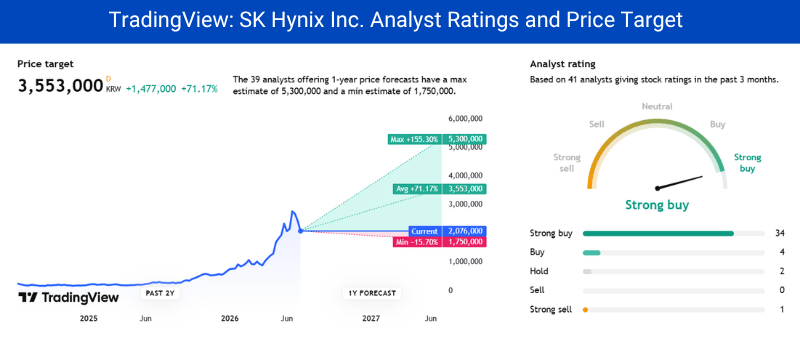
According to TradingView analyst data, with the stock near KRW 2,076,000,the average 1 year price target stands at KRW 3,553,000. The high estimate is KRW 5,300,000, while the low estimate is KRW 1,750,000. The analyst rating remains Strong Buy, although the wide forecast range shows that uncertainty is still high after the stock’s sharp rally.
SK Hynix 2026 Outlook: Bullish, Base, and Bearish Scenarios
Based on this analyst target range, SK Hynix’s 12 month price forecast can be divided into three practical scenarios:
These levels are not guaranteed price predictions. They are scenario based forecast zones built from TradingView’s analyst target range and the main business drivers that could affect SK Hynix in 2026.
Bullish Scenario
HBM demand stays above supply, Nvidia and other AI customers keep ordering, DRAM and NAND prices stay firm, and SK Hynix defends its lead through the HBM4 generation. In this case, earnings could keep beating estimates, and the stock could move toward the KRW 3,553,000 to KRW 5,300,000 forecast zone.
🔷What to watch: the next quarterly results, HBM4 supply updates, and memory contract prices. A single weak quarter would challenge this case.
Consolidation Scenario
Growth stays strong, but investors become more selective after the sharp rally. Results are good without being surprising, and memory prices rise more slowly. In this case, the stock could trade between the current price and the average analyst target, around the KRW 2,076,000 to KRW 3,553,000 forecast zone.
🔷What to watch: whether the price stabilizes after the pullback, how the Nasdaq ADR trades in its first weeks, and whether earnings continue to support the valuation.
Bearish Scenario
Memory prices peak, Samsung and Micron close the HBM gap, AI capital spending slows, or semiconductor stocks correct broadly. Because the valuation already reflects strong growth, the downside could be significant if expectations reset. In this case, the stock could fall toward the KRW 1,750,000 to KRW 2,076,000 forecast zone.
🔷What to watch: hyperscaler capex guidance, Chinese memory capacity, and Nvidia related sentiment. Continued sold out capacity into 2027 would weaken this bearish case.
What Factors Will Influence SK Hynix's Future Stock Price?
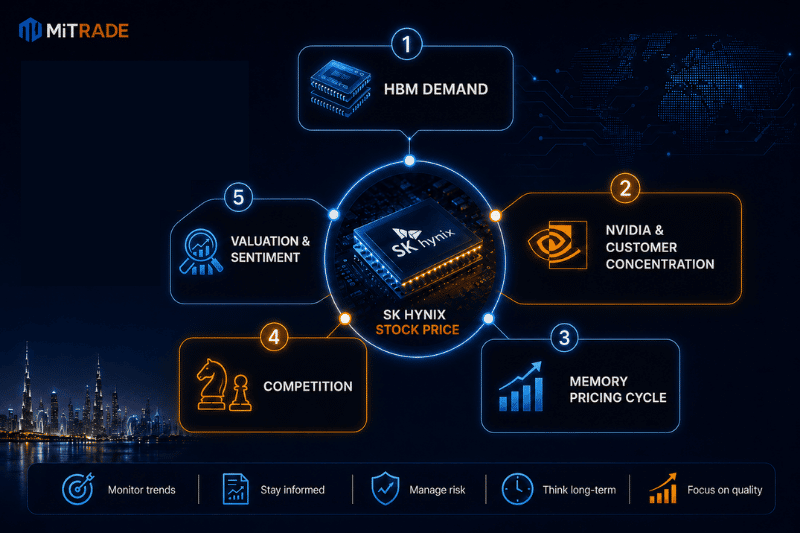
1. HBM demand and AI data-center spending
Every AI server needs large amounts of high-bandwidth memory, so data-center capex translates almost mechanically into HBM orders, revenue, and margin. If AI spending is cut, the same chain works downward, and the stock would likely reprice before earnings even decline.
2. Nvidia and customer concentration
Supplying the dominant AI-chip maker is a huge advantage while orders grow. But concentration cuts both ways: a change in Nvidia's product mix, qualifications, or demand would hit SK Hynix harder than a diversified supplier.
3. The memory pricing cycle
Memory is historically cyclical. Today's shortage exists because producers cut capacity in 2023 just before AI demand exploded. SK Hynix is raising roughly $28 billion through its U.S. ADR sale, with proceeds expected to support new chip factories and advanced semiconductor equipment. That capacity is needed, but industry-wide expansion is also how every previous memory boom eventually ended.
4. Competition from Samsung, Micron, and Chinese producers
SK Hynix's premium valuation rests on its HBM lead. Samsung's recovery in HBM4 and aggressive capacity growth from Micron and Chinese memory makers could compress pricing and market share over time.
5. Valuation and semiconductor sentiment
After a rally of this size, even good news may not lift the stock if it is already expected. Broad AI-stock corrections, Nasdaq weakness, or Nvidia selloffs tend to hit SK Hynix harder than the wider market, as July 2026 has shown.
How to Invest in SK Hynix Stock in the UAE and Other Arab Regions?
UAE and Arab investors have two main routes to SK Hynix exposure, suiting different profiles.
Way 1: Direct Buying
SK Hynix trades on the Korea Exchange under ticker 000660, so access requires an international broker supporting the South Korean market, plus currency conversion into Korean won.
Access is expected to become easier through the company’s planned Nasdaq ADR listing under the expected ticker SKHY, with trading anticipated in July 2026. Investors should confirm the final listing status, ticker, and availability with their broker before acting.
CFDs, or contracts for difference, let traders speculate on the SK Hynix share price without owning the shares. It allows traders to use leverage, meaning a small deposit can control a larger position. Traders can open Buy positions if they expect the price to rise or Sell positions if they expect it to fall, but profits and losses are calculated on the full position size, so strict risk management is essential.
In the UAE and other Arab regions, traders can turn to Mitrade, a CFD broker offering access to U.S. stock CFDs and other markets. The platform allows traders to open positions with a small amount of capital and provides a streamlined account opening process, demo trading. And it also offers commission-free trading with low spreads.
Open a CFDs Account to Trade US Stocks
A practical tip on choosing your route
For long-term value investors, the U.S. listing under SKHY offers an excellent avenue for direct shareholding.
For short-to-medium-term traders or retail investors with smaller capital, CFDs or Contracts for Difference, provide a more flexible approach. CFDs can be used for two-way intraday trading or hedging to lock in profits, allowing traders to capitalize on price spreads driven by SK Hynix’s high volatility and tendency to fluctuate at elevated levels.
💡Tips for Beginners: You should be careful with both routes, especially after a rally of this size. A practical approach is to start with research, practice on a demo account with virtual funds, use small position sizes, and set a stop-loss before entering. These tools can help manage risk. |

Conclusion
SK Hynix is one of the strongest AI-memory stories in the market. Its HBM leadership has transformed earnings and pushed investors to value the company as part of the AI infrastructure cycle, not just as a traditional memory-chip maker.
The stock can still rise if HBM demand, sold-out capacity, and firm memory prices keep supporting earnings. But after such a sharp rally, expectations are high and volatility is extreme. Long-term investors should wait for earnings confirmation and watch HBM market share, while active traders should use smaller positions, follow key news events, and set stop-loss levels before entering.

 $0 Commission, Tight Spreads, Min. Deposit $50Fexible leverage with AED deposit support24*5 customer support serviceOne account to acess global markets
* The content presented above, whether from a third party or not, is considered as general advice only. This article should not be construed as containing investment advice, investment recommendations, an offer of or solicitation for any transactions in financial instruments.


