


CoreWeave is a specialized AI cloud provider serving major technology companies such as NVIDIA, Microsoft and OpenAI. Since its 2025 Nasdaq listing, CRWV surged to more than 4 times its IPO price before experiencing several sharp pullbacks, and it currently trades at around $80.
In this guide, you will explore CRWV’s performance, forecast and technical outlook, the factors that could affect its price, and whether CoreWeave stock is a buy or sell.
CoreWeave Stock at a Glance
The Historical Stages of CRWV Stock Prices
CoreWeave’s short trading history already contains several distinct cycles. Reading them separately is more useful than describing CRWV stock as simply rising or falling.
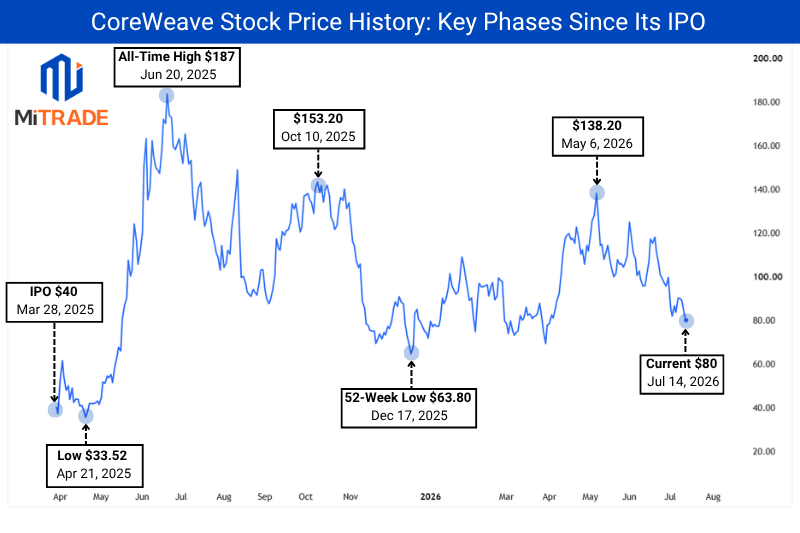
March–April 2025: Difficult IPO: CRWV was Priced at $40 before falling to $33.52. The downsized IPO reflected concerns about debt, customer concentration and AI valuations.
May–June 2025: AI re-rating: The stock surged to an all-time high of $187. OpenAI demand, NVIDIA backing and a limited public float accelerated the rally, taking CRWV to 4.68 times its IPO price.
July–October 2025: Volatile recovery: CRWV later reached a 52-week high of $153.20. Large AI contracts supported the stock, including a $14.2 billion Meta agreement that initially lifted CRWV by 15%.
October–December 2025: De-rating: The stock fell to a 52-week low of $63.80 as financing, construction and customer-concentration risks replaced scarcity-driven enthusiasm.
January–April 2026: Contract-led rebound: CRWV recovered above $100 after NVIDIA invested another $2 billion, while commitments from Meta, Anthropic and Jane Street strengthened demand visibility.
May–July 2026: Renewed pullback: The stock fell from around $120–$130 to approximately $80 amid rising capital expenditure, widening losses and concerns that Meta could sell its excess AI capacity.
What Caused CRWV’s Stock Price to Pull Back Sharply From Above $150?
The decline was not caused by one weak contract or a collapse in AI demand. It was a multi-stage reassessment of how much capital CoreWeave must spend, and how much financing risk shareholders must accept to deliver its contracted capacity.
Capital Expenditure: CoreWeave plans to spend $31–$35 billion in 2026, more than twice its 2025 capital expenditure, to buy GPUs, secure power and build data centers. The announcement triggered a 15% decline amid concerns about funding, margins and returns.
Widening Net Losses: Q1 2026 revenue rose 112% to $2.08 billion, but CoreWeave remained unprofitable: its net loss widened to $740 million and net interest expense reached $536 million. Adjusted EBITDA was $1.16 billion, but depreciation and financing costs continued to weigh on profitability.
Backlog Delivery Risk: CoreWeave’s backlog reached $99.4 billion, including a new $21 billion Meta commitment. However, it becomes revenue only when the required capacity is financed, built and delivered, making construction and power delays important risks.
Meta Competition: Reports that Meta may sell excess AI computing capacity triggered a 13.9% CRWV decline on July 1. If major customers sell their excess capacity, CoreWeave could face stronger competition and weaker pricing power.
Where Will CRWV Head? CoreWeave Stock Forecast and Price Targets
Wall Street remains broadly positive on CoreWeave stock. Other sources, such as MarketBeat’s CRWV forecast, support this outlook: the platform records 21 Buy, 12 Hold and 2 Sell ratings, resulting in a “Moderate Buy” consensus and an average 12-month price target of $136.73.
The average should not be treated as a guaranteed stock prediction. Depending on the dataset, targets extend from approximately $32–$36 to as high as $250–$303 because small changes in financing costs, delivery schedules and long-term margins produce different valuations.
The Bull Case: $150–$250
The broader bullish target range extends from $150 to $250. Analysts at Rosenblatt Securities maintain a Buy rating and a $250 price target, arguing that CoreWeave could become an essential operating layer for AI infrastructure. This scenario requires the backlog to convert on schedule, active power capacity to expand and revenue growth to outpace depreciation and interest expense.
The fundamental case is supported by more than 1 GW of active power, over 3.5 GW of contracted power and management’s target of more than 8 GW by 2030. NVIDIA’s investment and CoreWeave’s early access to advanced GPU systems also strengthen its competitive position.
The Bear Case: $63–$75
Analysts at Bernstein maintain an Underperform rating and a $67 price target. Their outlook reflects concerns that hyperscalers may build or sell more capacity themselves, potentially weakening CoreWeave’s pricing power and long-term margins.
As of March 31, 2026, CoreWeave’s balance sheet reported approximately $24.9 billion of current and long-term debt, plus around $10.3 billion of operating and finance lease liabilities. This distinction explains why some sources describe its total obligations as approximately $35 billion.
If financing becomes more expensive, deployments are delayed or customers renegotiate commitments, CRWV could retest the major $63.80 low. A sustained break below this level would increase downside risk and make the more pessimistic targets near $32–$36 increasingly relevant.
CRWV 2026–2027 Short-Term Projection
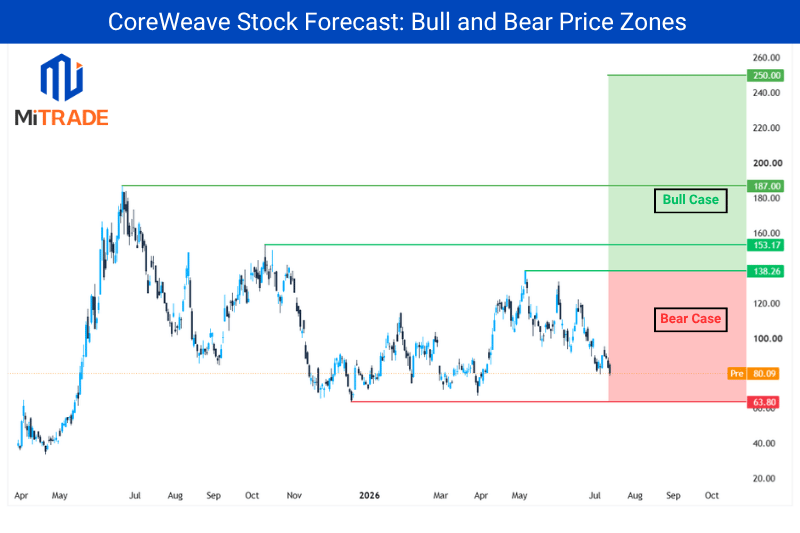
At approximately $80, CRWV remains within the bearish price zone. An initial recovery above $95–$100 would strengthen the short-term bullish case, while a break and hold above $138.26 would confirm a broader bullish reversal over the next 12–18 months.
Technical Analysis of CoreWeave Stock (CRWV)
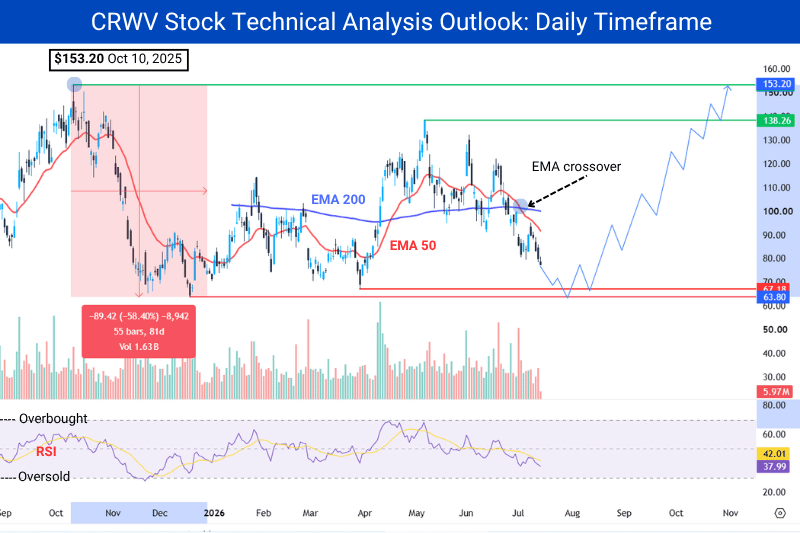
After its IPO, CRWV fell 58.4% from its October 10, 2025 52-week high of $153.20 to $63.80 amid concerns about capital expenditure, financing, losses and customer concentration.
From December 2025 to early April 2026, CRWV traded within a range. In mid-April, the price broke above its descending trendline with large bullish candles and strong volume. The 20-day EMA also crossed above the 50-day EMA, signaling bullish momentum.
The price later pulled back, while the 20-day EMA crossed back below the 50-day EMA, indicating temporary bearish momentum. The primary scenario is a possible reaction from the $67.18–$63.80 support area. A retest of the broken descending trendline within this area would create additional confluence and strengthen the possibility of a bullish reversal.
Three key support levels for looking for a trade:
$67.18: The upper boundary of the primary support area.
$63.80: The lower boundary and main invalidation level for the bullish scenario.
$33.66: The next major support if $63.80 breaks and a potential area for future buying opportunities.
Traders or investors considering buying around $67.18–$63.80 should remain patient and wait for confirmation from the chart and CoreWeave’s fundamentals.
Technical confirmations could include:
🔺A clear rejection from the area, such as a candle with a long lower wick or a strong bullish reversal candle.
🔺Increasing bullish volume as the price begins to recover.
🔺RSI reaching the oversold level of 30 and then turning upward.
🔺The 20-day EMA crossing back above the 50-day EMA, although this would be a later confirmation signal.
Fundamental confirmation could include stronger backlog conversion, on-schedule capacity delivery, improving margins, lower financing pressure and continued demand from major customers.
Three key resistance areas that can be used as targets:
$122–$132.15: The internal highs can be used as the first target area.
$138.26–$153.17: The external highs can be used as the second target area.
$187: The all-time high can be used as the next major target.
Traders may take partial profits as the price reaches each target. Alternatively, they could monitor RSI until it enters overbought territory and begins reversing, or use a bearish crossover of the 20-day and 50-day EMAs as an exit signal. If CRWV breaks above $187, the more ambitious $250 analyst target could become the final objective.
Alternative Bearish Scenario
A confirmed break below $63.80 would invalidate the primary bullish scenario. Traders could then consider short positions targeting $33.66. This lower support could also create new buying opportunities, but only if the price shows clear technical and fundamental confirmation.
Buy or Sell CoreWeave Stock?
CoreWeave offers strong exposure to AI infrastructure growth, but its debt, losses and execution risks make CRWV highly speculative. The following factors summarize the bull and bear cases.
Reasons to Buy: The Bull Case 📈
✅Exceptional contracted demand: The $99.4 billion backlog gives CoreWeave more revenue visibility than most young cloud companies.
✅Strategic NVIDIA relationship: NVIDIA supplies the GPUs, owns a significant stake and collaborates with CoreWeave on next-generation AI infrastructure.
✅Rapid operating scale: Q1 revenue more than doubled, active power exceeded 1 GW and the customer base is expanding beyond Microsoft.
✅Lower entry price: CRWV trades far below its $187 peak and below the $136.73 analyst average, although this does not guarantee that the stock is undervalued.
Reasons to Sell or Avoid: The Bear Case 📉
❌Heavy leverage: Debt and lease liabilities reduce financial flexibility, while Q1 net interest expense reached $536 million.
❌Weak bottom-line economics: Adjusted EBITDA is positive, but depreciation, interest and expansion costs continue to produce large net losses.
❌Concentration and competition: Microsoft generated approximately 67% of 2025 revenue, while hyperscalers can expand their own AI infrastructure.
❌Execution and dilution risk: Power, chips and data centers must arrive on schedule. Additional equity financing could also dilute existing shareholders.
★ An Investment Suggestion CRWV is more suitable for aggressive investors than conservative or income-focused investors. Prices around $80 could offer a buying opportunity, while long-term investors may enter gradually and monitor backlog conversion, operating margins and debt. For greater precision, investors could wait for the price to reach the $67.18–$63.80 zone and look for confirmation from both technical and fundamental analysis. A confirmed break below $63.80 would strengthen the bearish scenario. |

Why Does the CoreWeave Stock Price Rise or Drop?
CoreWeave stock trades on future capacity and financing expectations, not only its current earnings. To track CRWV stock trends like a professional and identify the direction independently, monitor the following key factors:
1. AI capital spending: More demand for GPU computing could expand contracts and backlog, while slower hyperscaler spending could reduce future bookings.
2. NVIDIA product roadmap: Access to Blackwell, Rubin and later systems could improve performance and demand, while supply delays or alternative chips could weaken deployments.
3. Capacity delivery: More active power could convert backlog into recognized revenue, while construction, grid or equipment delays could postpone revenue.
Financing: Cheaper debt could improve project returns and valuation, while higher yields could increase interest expense and refinancing risk.
4. Customer mix: New customers and software, storage and inference services could reduce dependence on Microsoft and Meta and improve margins, while concentration, contract changes or competition could turn GPU capacity into a lower-margin commodity.
Beyond These Factors, What Else Should Investors Monitor?
Beyond the 5 primary factors, investors should follow a smaller set of company disclosures and market signals that can confirm whether CRWV’s outlook is improving or deteriorating.
Earnings and regulatory filings: Watch for guidance revisions, debt obligations, equity issuance and potential shareholder dilution.
Contract and delivery updates: Monitor new agreements, contract changes, data-center openings and project delays.
Credit-market conditions: Lower financing costs could improve expected returns, while wider credit spreads could increase margin and dilution risks.
Market signals: Follow analyst revisions and CRWV’s price and volume reactions around key support and resistance levels.
How to Buy or Trade CoreWeave Stock
UAE investors can either purchase Nasdaq-listed CRWV shares through a stockbroker like Interactive Brokers or trade CRWV.US CFDs on Mitrade. Buying shares provides ownership, whereas CFDs track CRWV’s price without transferring ownership.
If you want to know more about how to invest in US stocks from the UAE, you might be interested in the article>>> How to Invest in the Stock Market in the UAE: 7 Steps to Start Investing in US Stocks
Why Use CFDs to Trade CRWV?
✅ Seize Two-Way Opportunities & Hedge Volatility
Despite its massive $43.6 billion market cap, CoreWeave carries $25.15 billion in debt and is planning a colossal $31 billion to $35 billion in capital expenditures. This heavy-spending profile makes the stock highly volatile. Trading CFDs gives you the flexibility to profit from both upward rallies and downward swings, or easily hedge your tech portfolio against sudden market pullbacks.
✅ Boost Capital Efficiency with Flexible Leverage
CoreWeave’s $40 billion+ valuation and sharp price swings present prime trading opportunities. CFDs allow you to gain larger market exposure to this high-growth AI giant without tying up your entire capital upfront. (Note: Leverage is a double-edged sword that amplifies both potential gains and losses.)

 $0 Commission, Tight Spreads, Min. Deposit $50Fexible leverage with AED deposit support24*5 customer support serviceOne account to acess global markets
Conclusion
CoreWeave stock has performed strongly since its IPO, rising from $40 to $187 before falling to around $80. Its growth potential remains supported by AI demand, a $99.4 billion backlog and its collaboration with NVIDIA, although investors should consider its debt, capital expenditure and execution risks.
On Mitrade, traders can access CRWV.US CFDs and open Buy or Sell positions based on their market outlook while applying appropriate risk management.
FAQs
What Is CoreWeave’s Core Business?
CoreWeave operates a purpose-built AI cloud platform. It provides GPU computing, networking, storage and software used to train AI models, run inference and manage other high-performance workloads.
Why Is NVIDIA Crucial to CoreWeave’s Prospects?
NVIDIA supplies the advanced GPUs on which CoreWeave’s services depend, has invested in the company and collaborates on large AI-factory deployments. This can improve access to new hardware, but it also creates supplier concentration.
How Can Retail Investors Currently Buy CRWV Stock?
Retail investors can buy Nasdaq-listed CRWV shares through a broker offering US equities. Traders can also use CRWV.US CFDs on Mitrade to speculate on upward or downward price movements without owning the underlying shares.
* The content presented above, whether from a third party or not, is considered as general advice only. This article should not be construed as containing investment advice, investment recommendations, an offer of or solicitation for any transactions in financial instruments.


