


Markets on a Wire: Imminent US Inflation Data Threatens to Lock In Fed Rate Hikes


The global financial complex faces an aggressive volatility trigger this week as back-to-back inflation reports threaten to definitively cement a hawkish Federal Reserve interest rate hike cycle.
The U.S. Bureau of Labor Statistics is scheduled to release the May Consumer Price Index (CPI) on June 10, followed immediately by the Producer Price Index (PPI) on June 11. These dual macro metrics serve as the primary gauge for underlying inflationary pressures and will heavily dictate the Federal Open Market Committee's (FOMC) upcoming interest rate projections.
Wall Street consensus expectations suggest that rebounding energy prices will push the headline May CPI to an annualized rate of 4.2% from the previous 3.8% reading, translating to a .5% month-on-month advance. The core CPI component—which strips out volatile food and energy costs—is projected to tick up to 2.9% year-on-year from 2.8% prior, with a .3% monthly increase. On the wholesale front, headline May PPI is anticipated to come in at a hot 6.4% annualized rate, with core PPI hovering at 5.3%.
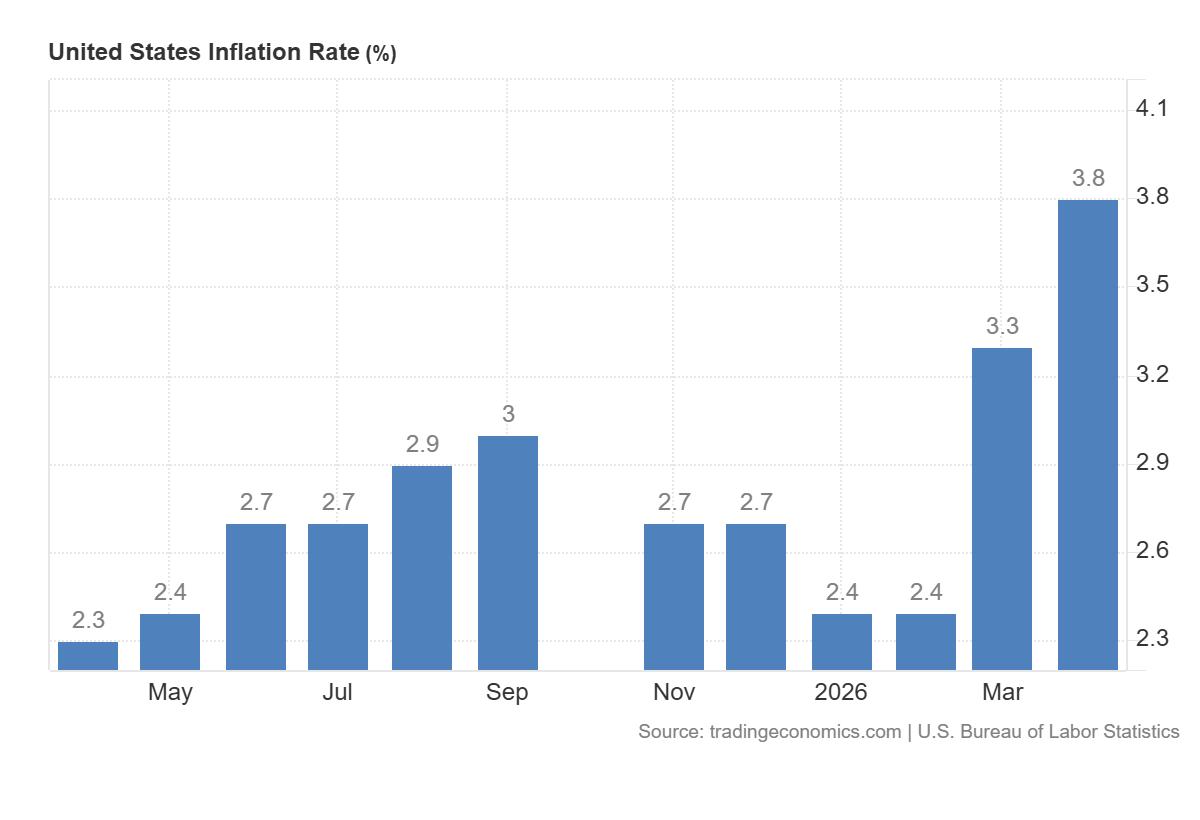 Market Takeaway: Any upside surprise across these figures will likely cause traders to aggressively price in terminal rate hikes. This vulnerability comes on the heels of a blowout May nonfarm payrolls report that has already dismantled the disinflation narrative.
Consequently, Tier-1 investment banks are rapidly capitulating on their previous expectations for monetary easing. Goldman Sachs has pushed its projected timeline for a Fed rate cut back to June 2027 while doubling its implied probability of an imminent rate hike from 10% to 20%. Similarly, BNP Paribas strategists now forecast that the Fed will initiate an initial rate hike in December, followed by sequential tightening in early 2027.
According to data from the CME FedWatch Tool, the fixed-income market is currently pricing in a greater than 70% probability of a rate hike by the December FOMC meeting.
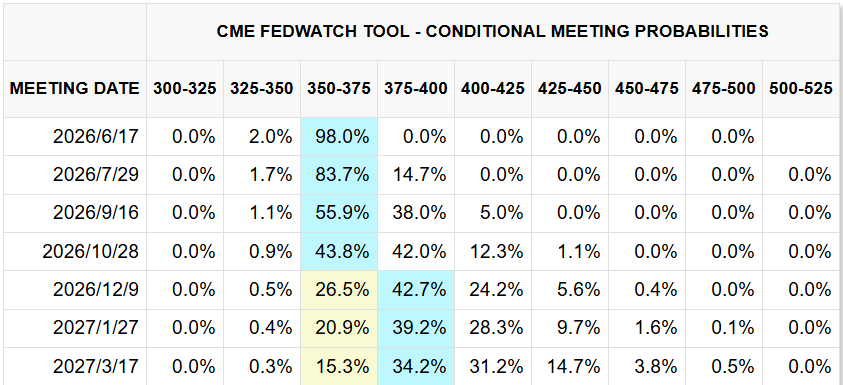
*Soure: CME FedWatch Tool
Multi-Asset Impact: The Dollar, Bullion, Equities, and Crypto
The relentless shift toward higher-for-longer monetary policy has already reverberated across the global asset matrix. The U.S. Dollar Index (DXY) recently recaptured the psychological 100 handle. Conversely, spot gold has surrendered the $4,300 per ounce threshold, Bitcoin has repeatedly violated its $60,000 support floor, and the broader tech-led equity rally has ground to a halt.
Market analysts warn that another hot inflation print will act as a structural tailwind for greenback strength while exacerbating the liquidations across gold, digital assets, and equities. Conversely, a noticeable downside miss remains the only near-term catalyst capable of deflating the dollar and sparking a relief rally across risk assets.
"An upside surprise in the upcoming inflation data will serve as a direct trigger for a programmatic sell-off in risk assets," warned Michael Hartnett, chief investment strategist at Bank of America. Hartnett added that a massive wave of mega-IPOs, including the highly anticipated SpaceX listing, is poised to drain record amounts of liquidity from the system. Coupled with a coordinated hawkish pivot from global central banks, Hartnett believes the prevailing technology bubble is entering a phase of extreme vulnerability.
From a currency perspective, ING notes that the greenback will likely maintain a strong institutional bid ahead of the FOMC decision. The bank anticipates the current dollar rally will persist, with the DXY poised to challenge immediate overhead resistance between the 100.25 and 100.65 bands.
In precious metals, FOREX.com senior analyst Fiona Cincotta highlights that spot gold has definitively broken beneath the lower boundary of a multi-month symmetrical triangle pattern. Bullion has simultaneously lost its 200-day simple moving average (SMA), while the Relative Strength Index (RSI) has plunged below the 50 neutral line, signaling that bearish momentum is accelerating.
Consequently, macro traders should prepare to watch support levels at $4,100, followed by the major psychological $4,000 baseline. For gold to stage a meaningful structural recovery, bulls must first reclaim a secure footing above $4,375 before attempting to mount a challenge against the 200-day SMA at $4,430.
Risk-Free Demo Account
CMA-regulated | 24х5 | T+0 | low spreads. Enjoy limit and stop loss for every trade!
* The content presented above, whether from a third party or not, is considered as general advice only. This article should not be construed as containing investment advice, investment recommendations, an offer of or solicitation for any transactions in financial instruments.


