


The foreign exchange market, commonly known as the forex market, is the largest and most liquid financial market in the world. Every day, trillions of dollars worth of currencies are exchanged by banks, corporations, governments, hedge funds, and retail traders.
For beginners, forex trading can appear complex. Terms like pips, leverage, spreads, and currency pairs may seem overwhelming at first. However, understanding the basics can help you navigate the market with greater confidence and avoid common mistakes.
🎯 This guide explains what forex trading is, how the market works, the terminology every beginner should know, and the steps needed to start trading safely in the UAE.
*Go Small with Mitrade Forex—Low Deposit from $50 USD!
What is Forex Trading?
Forex trading is the process of buying one currency while simultaneously selling another. Traders participate in the market to profit from changes in exchange rates between currencies.
For example:
when a trader believes the euro will strengthen against the US dollar, they can buy the EUR/USD currency pair. If the euro rises in value relative to the dollar, they may be able to sell the position later at a profit.
Unlike stock markets that focus on company shares, forex trading revolves around national currencies. The forex market operates globally and connects participants across different countries and time zones.
Key Characteristics of Forex Trading
🔹24-Hour Market: The forex market operates 24 hours a day, five days a week. Trading begins in Asia on Monday morning and continues through Europe and North America until the market closes on Friday evening in the United States.
🔹High Liquidity: Forex is considered the most liquid market in the world. Liquidity refers to how easily assets can be bought and sold without causing significant price movements. Major currency pairs such as EUR/USD and USD/JPY typically have abundant liquidity. The forex market is worth around $9.6 trillion, making it the most liquid financial market in the world.
🔹Decentralized Market: Unlike stock exchanges that operate through centralized exchanges, forex trading takes place through a global network of banks, brokers, and financial institutions. There is no single central exchange that controls all forex transactions.
🔹Accessibility: Modern trading platforms allow retail traders to access the forex market with relatively small amounts of capital. However, access is provided through regulated brokers rather than directly through the interbank market.
What is a Currency Pair?
Currencies are always traded in pairs. A currency pair represents the value of one currency relative to another.
The first currency in the pair is known as the base currency. The second currency is called the quote currency. The value of the quote currency is quoted in relation to the base currency. Base currency and quote currency play a crucial role in determining the value of a currency pair and calculating profits and losses in forex trading.
The exchange rate of a currency pair represents how much of the quote currency is needed to purchase one unit of the base currency.
For example:
EUR/USD = 1.1000
EUR is the Base currency while USD is the Quote currency. This means one euro can be exchanged for 1.10 US dollars.
Types of Currency Pairs
Currency pairs in the forex market are categorized into three primary classes based on popularity, liquidity, and the specific currencies involved: Majors, Minors (Crosses), and Exotics.
1. Major Currency Pairs
The first class is the Major Pairs as they are the most traded currency pairs in the world. Major pairs include the US dollar and are among the most actively traded currencies worldwide. Major pairs generally offer high liquidity and lower trading costs. These currency pairs are based on a list of popular currencies that are paired with USD.
The basket of major currencies comprises 7 currency pairs. These pairs account for most of the turnover of the entire Forex market — for instance, the EURUSD pair alone accounts for about 30% of trading volume.
Examples include:
2. Minor Currency Pairs
The second group is often called "crosses." These pairs do not include the U.S. Dollar. They usually feature other major currencies like the Euro, British Pound, or Japanese Yen. Because they lack the USD, they generally have slightly lower liquidity and wider spreads than the majors, but they still have highly active markets.
Examples include:
★ Please Note: These pairs may have slightly wider spreads than major pairs.
3. Exotic Currency Pairs
The final group consists of the Exotic pairs. These pairs combine a major currency with a currency from an emerging market. Exotic currencies represent the currencies of both developing countries and a select few developed countries. This group of exotic currency pairs was informed by economic statistics from global organizations like the IMF.
Examples include:
★ Please Note: Exotic currency pairs are usually highly volatile and lack liquidity, resulting in a higher cost of trading and abnormal price movements. Be careful with these.
How Does the Forex Market Work?
The forex market functions through a global network of participants exchanging currencies based on supply and demand. When buyers outnumber sellers, prices tend to rise. When sellers outnumber buyers, prices generally fall. Economic data, interest rates, geopolitical events, and market sentiment all influence these buying and selling decisions.
Large financial institutions form the interbank market, where currencies are traded directly between banks. Retail traders do not have direct access to this market. Instead, they trade through brokers who provide pricing, execution services, and trading platforms.
Types of Forex Trading
1. Spot Forex Trading
This is the first major different forex market. This market involves buying or selling currencies at the current market price. It is the most common type of forex market for retail traders.
2. Forex CFDs Trading
The second type of forex market is Contracts for Difference (CFDs). This market allows traders to speculate on currency price movements without owning the underlying currencies. All CFDs are traded using leverage, which means traders only need to put up a small deposit (called margin) to open a larger position.
CFDs are popular because they enable traders to profit from both rising and falling markets.
However, as the total profit or loss is based on the full size of a trader’s position, either could significantly outweigh their margin amount. Traders should always take appropriate risk management steps when trading CFDs.
3. Forex Futures Trading
Finally, forex futures is another major forex market. Forex futures are standardized contracts that obligate traders to buy or sell a currency at a predetermined price on a future date. These contracts are commonly used by institutions and professional traders.
When Does the Forex Market Open in UAE Time?
Operating 24 hours a day, five days a week, the forex market shifts dynamically across the globe's major financial hubs. For traders in the UAE, staying ahead means knowing exactly when these international sessions open and close locally. Below is the essential breakdown of forex market hours in UAE time for both summer and winter schedules.
During the UAE Summer Time
During the UAE Winter Time
The Best Forex Trading Time in the UAE
The absolute "best" time to trade is when the market has the highest trading volume (liquidity) and sharpest price movements (volatility). This happens when two major global sessions overlap. High liquidity means tighter spreads (lower trading costs) and faster execution.
1. The Prime Window: London & New York Overlap
Summer: 4:00 PM – 8:00 PM GST
Winter: 5:00 PM – 9:00 PM GST
Why it's the best: London (the largest Forex hub, driving over 40% of global volume) and New York (handling the almighty USD) are open simultaneously. The market experiences massive price swings, major US economic data releases, and peak liquidity.
Best Pairs: EUR/USD, GBP/USD, USD/CHF, USD/CAD.
2. The Secondary Window: Tokyo & London Overlap
Summer: 11:00 AM – 12:00 PM GST
Winter: 12:00 PM – 1:00 PM GST
Why it's good: A brief one-hour crossover where the tail-end of Asian institutional trading collides with the European morning rush.
Best Pairs: EUR/JPY, GBP/JPY.
⚠️ Hours to Avoid for Day Traders: Try to avoid trading between 2:00 AM and 4:00 AM GST. During this window, New York has closed and only Sydney/Tokyo are open. Volatility drops dramatically, volume dries up, and brokers often widen their spreads significantly, making it expensive to enter or exit positions. |
Commonly Used Terms in Forex Trading
Understanding forex terminology is essential before placing your first trade.
1. Pips
A pip is the smallest standard price movement in a currency pair. Currency prices typically move in such tiny increments that they are quoted in pips or percentage points. In most cases, a pip refers to the fourth decimal point of a price that is equal to 1/100th of 1%. For most pairs, one pip equals 0.0001.
For example: If EUR/USD moves from 1.1000 to 1.1001, it has moved one pip.
2. Lots
A lot represents the size of a trade. It is a standardized unit of measurement representing the volume or amount of currency you are buying or selling. Beginners often start with micro lots to reduce risk.
Standard lot = 100,000 units
Mini lot = 10,000 units
Micro lot = 1,000 units
3. Leverage
Leverage allows traders to control larger positions with a smaller deposit. It is a loan provided by a broker that allows traders to control large market positions with a small amount of their own capital. For example, 1:100 leverage allows a trader to control $10,000 with only $100.
★ Please Note: While leverage can increase profits, it can also magnify losses.
4. Margin
Margin is the amount of money required to open and maintain a leveraged position.
★ Please Note: It acts as a security deposit rather than a transaction fee.
5. Spread
The spread is the difference between the buy price and the sell price. It is a small cost built into the buy (bid) and sell (ask) price of every currency pair trade. When you look at the price that’s quoted for a currency pair, you will see there is a difference between the buy and sell prices – this is the spread or the bid/ask spread.
It represents one of the primary costs of forex trading. Major currency pairs generally have lower spreads than exotic pairs.
6. Swap or Rollover
Swap refers to the interest charged or earned when a position remains open overnight. The amount depends on the interest rate differential between the two currencies involved.
What Moves the Forex Markets?
Forex prices don’t fluctuate by chance; they respond to a constant stream of global economic data and policy shifts. Understanding these underlying forces is crucial for any trader looking to look past the charts and decode market sentiment. Below are the primary catalysts that dictate supply and demand in the forex market.
1. Interest Rates
Interest rates set by central banks are among the most powerful drivers of exchange rates. Higher interest rates often attract foreign investment, increasing demand for a currency.
2. Inflation
Countries with lower inflation rates generally experience stronger currencies over time because purchasing power remains more stable.
3. Economic Growth
Strong GDP growth often supports a country's currency by attracting investment and boosting confidence.
4. Employment Data
Reports such as the US Non-Farm Payrolls (NFP) can significantly affect currency markets because they provide insight into economic health.
5. Political Events
Elections, policy changes, geopolitical tensions, and international conflicts can create volatility in forex markets.
6. Central Bank Decisions
Statements and policy announcements from institutions such as the Federal Reserve, the European Central Bank, and the Bank of England often influence currency prices.
How to Choose Suitable Currency Pairs for Beginners?
Learning how to choose a currency pair is one of the most critical steps in forex trading for beginners. Ultimately, the main focus should be on reducing risk and keeping your trading costs as low as possible. To find the perfect starting point, beginners should look for currency pairs that meet the following criteria:
✅Easy access: The ideal currency pairs for beginners should be easily accessible. These are pairs that can be traded on virtually all trading platforms.
✅Liquidity: Beginners should also focus on trading pairs with high liquidity. Currency pairs with high liquidity are always active and provide excellent price action at all times.
✅Low transaction costs: Beginners should focus on currency pairs with low transaction costs (usually the major pairs). Exotic and minor currency pairs usually have higher spreads, which results in higher transaction costs and eats into a trader’s profit.
The Best Currency Pairs for Beginners
Based on these exact standards, here are the best trading pairs for beginners to watch.
💡Tips: Stick strictly to these Major pairs when starting out. Their massive trading volumes ensure your orders fill instantly and keep your transaction costs (spreads) to an absolute minimum.
*Go Small with Mitrade Forex—Low Deposit from $50 USD!
Why Avoid Exotic Pairs Initially?
Exotic pairs often have wider spreads, lower liquidity, greater volatility, and higher trading costs. All these factors make exotic pairs more expensive to trade. Hence, making them not ideal for beginners. For beginners, major currency pairs typically provide a smoother learning experience.
How Can You Profit from Forex Trading?
Forex traders attempt to profit from changes in exchange rates by taking one of two strategic directions: going long or going short.
Going Long (Buying): You open a long position when you expect the currency pair's value to increase. This means you predict the base currency will strengthen against the quote currency. You buy low now to sell high later.
Going Short (Selling): You open a short position when you expect the pair's value to decline. This means you anticipate the quote currency will rise against the base currency. You sell high now to buy back lower later.
But how do you decide whether to go long or short? Professional traders rely on two primary methods to predict market directions and find the right entry points: Technical Analysis and Fundamental Analysis.
1. Technical Analysis: Reading the Charts
Before entering any trade, checking the price charts is essential. Technical analysis focuses entirely on historical price data, volume, and visual chart patterns to predict future price movements.
Traders use a wide range of specialized tools, including:
Trend lines: To identify if the market is moving up (bullish), down (bearish), or sideways (consolidating).
Support and Resistance levels: Key price floors and ceilings where the market tends to bounce or reverse.
Indicators: Tools like Moving Averages or the Relative Strength Index (RSI) to measure market momentum and overbought or oversold conditions.
Technical traders look for patterns that may indicate future price movements. Technical analysis helps you determine if the general trend of the market is bullish, bearish, or consolidating. If the market is bullish, you should be looking for long positions, while bearish market conditions mean you need to look for short positions.
2. Fundamental Analysis: Tracking Economic Health
While technical analysis handles the charts, fundamental analysis focuses on the real-world economic and political forces driving a currency's intrinsic value.
Fundamental traders closely monitor major economic data and global news schedules, looking for catalysts like:
Central bank announcements and interest rate decisions.
Inflation reports (CPI) and GDP growth data.
Employment data, such as the highly volatile US Non-Farm Payrolls (NFP) report.
Depending on the economic outcome, these financial releases can trigger sudden, powerful bullish or bearish trends.
💡Tips: Many successful retail traders combine both approaches—using fundamental analysis to pick the right direction (long or short) and technical analysis to pinpoint the exact time to enter and exit the trade. Platforms like Mitrade offer an integrated economic calendar, making it easy to track upcoming news events and plan your trades accordingly.
*Go Small with Mitrade Forex—Low Deposit from $50 USD!
The Risks of Forex Trading You Need to Know Before Starting
Forex trading offers opportunities, but it also carries significant risks.
1. Counterparty Risk
Using unregulated brokers can expose traders to fraud and poor execution practices. The regulated brokers have licenses from various financial regulators, including the ASIC, CMA (from the UAE), FCA (from the UK), CFTC, The Swiss Financial Market Supervisory Authority (FINMA), The Monetary Authority of Singapore (MAS), The Cyprus Securities and Exchange Commission (CySEC), and several others.
2. The Double-Edged Sword of Leverage
Leverage amplifies both gains and losses. A small market movement can produce substantial profits, but it can also quickly deplete trading capital if the market moves against a position.
This is one of the primary reasons many new traders lose money. Hence, as traders, it is advisable to keep the risk within a range you can tolerate.
3. Market Volatility Risk
Currency markets can react sharply to unexpected news.
Events such as interest rate decisions, geopolitical tensions, or economic surprises can create rapid price movements. During volatile market conditions, it is advisable to limit exposure or completely stay away from the market to avoid liquidation.
4. Emotional Trading
Fear and greed often lead traders to abandon their strategies and make impulsive decisions. Maintaining discipline is essential for long-term success.
How to Start Forex Trading Safely? Step-by-Step for Beginners
Many new traders mistakenly believe they can trade directly with global banks. In reality, retail investors cannot directly access the interbank market. Instead, they must trade through regulated brokers such as Mitrade and other licensed providers.
Step 1: Choose a Regulated and Safe Broker
A regulated broker provides a safer trading environment and helps protect client funds. When evaluating a broker, consider:
Regulatory oversight
Transparent pricing
Customer support
Educational resources
Risk management tools
Step 2: Practice with a Demo Account
A demo account allows traders to practice using virtual funds. Benefits include:
Learning platform features
Testing trading strategies
Understanding market movements
Building confidence before risking real money
You might be interested in the article >>> How to Open a Risk-Free Demo Account in the UAE? Get a Free Demo Account Valued $50,000 Now!
Step 3: Master Risk Management
Risk management is arguably more important than finding winning trades.
Use Stop Loss Orders: A stop loss automatically closes a trade if the market moves against you beyond a predefined level. This helps limit losses.
Use Take Profit Orders: A take-profit order automatically locks in gains when a target price is reached.
Risk Only a Small Percentage Per Trade: Many experienced traders risk no more than 1% to 2% of their account balance on a single trade.This approach helps preserve capital during losing streaks.
Why choose Mitrade to start your first trade?
✅Fully Regulated & Safe: Mitrade is a globally recognized, licensed broker that provides a secure trading environment and protects your funds.
Licenses including:
Mitrade Global Pty Ltd – AFSL 398528 (Learn how to check)
Mitrade EU Limited – CIF 438/23 (Learn how to check)
Mitrade Holding Ltd – SIB 1612446 (Learn how to check)
Mitrade International Ltd – GB20025791 (Learn how to check)
Mitrade Markets Pty Ltd – FSP 54842 (Learn how to check)
Mitrade Financial Services LLC - CMA 20200000397 (Learn how to check)
✅Zero Commissions: You pay $0 in trading commissions. All costs are built into transparent, highly competitive buy-sell spreads.
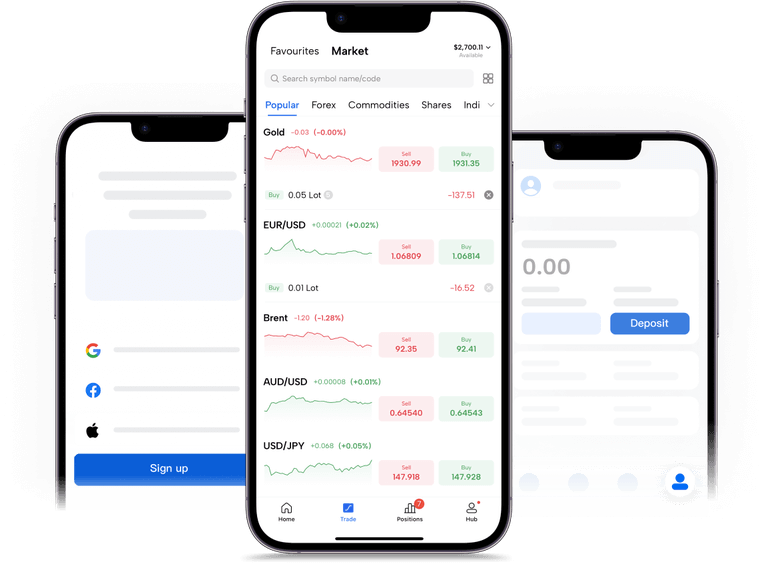
✅Perfect for Beginners: The platform features an award-winning, user-friendly design with highly responsive mobile and desktop apps.
✅All-in-One Dashboard: Charting, market analysis, and risk management tools are bundled into one clean, easy-to-navigate interface.
✅Risk-Free $50,000 Demo Account: You can practice trading, test strategies, and build confidence using a free $50,000 virtual fund before risking real money.


Conclusion
Forex trading offers incredible access to the world's largest financial market, but consistent profitability requires proper education and strict risk management. It is a skill that takes time to develop, not a shortcut to quick riches.
To set yourself up for success, it is crucial to choose a platform built for your growth. Regulated brokers like Mitrade streamline this learning curve by combining transparent pricing, intuitive charting, and responsive mobile and desktop trading apps into one clean interface. Before risking real capital, you can master forex terminology and test strategies using Mitrade’s risk-free demo account.
Risk-Free Demo Account
CMA-regulated | 24х5 | T+0 | low spreads. Enjoy limit and stop loss for every trade!
Is Forex trading legal in the UAE?
Yes. Forex trading is legal in the UAE. Retail traders can participate in the market through regulated brokers that comply with relevant regulatory requirements. Investors should verify a broker's licensing status before opening an account.
What is the minimum amount needed to start trading Forex in the UAE?
The minimum deposit varies depending on the broker, Mitrade allows accounts to be opened with $50. Beginners should start with an amount they can afford to lose and focus on learning rather than maximizing leverage.
How can retail investors in the UAE avoid Forex scams?
Retail investors can reduce scam risk by choosing regulated brokers, verifying licenses with recognized authorities, avoiding unrealistic profit promises, researching broker reviews, and never sending funds to unverified entities. Using a demo account and understanding the broker's fee structure can also help identify potential red flags before committing real capital.
* The content presented above, whether from a third party or not, is considered as general advice only. This article should not be construed as containing investment advice, investment recommendations, an offer of or solicitation for any transactions in financial instruments.


