


Gold trades volatile but range bound after US Nonfarm Payrolls
- Gold trades up and down within a range under its record highs.
- US labor market data caused some volatile moves, but the sideways trend holds.
- US inflation data this week could impact Gold as the next Federal Reserve meeting nears.
Gold (XAU/USD) pulls back down to just below $2,500 per troy ounce on Monday after retesting its all-time highs on Friday, amid market volatility following the release of a mixed US Nonfarm Payrolls (NFP) employment report.
Gold rises then falls after US Nonfarm Payrolls
Gold rose immediately after the NFP release on Friday, as the headline figure showed the US economy added fewer jobs than expected in August, and July and June’s figures were revised down. The data indicated that the labor market was softening overall and that, therefore, there was a greater chance the Federal Reserve (Fed) would need to make a larger 0.50% cut to interest rates rather than the standard 0.25% in September. Lower interest rates are positive for Gold as they reduce the opportunity cost of holding non-interest-bearing assets.
The precious metal failed to hold its gains, however, as traders processed the rest of the data in the report and its implications for interest rates going forward. The Unemployment Rate, for example, was shown to have actually fallen to 4.2% from 4.3% as anticipated, and wage growth increased by 0.4% in the month, exceeding the forecasted 0.3%. This suggested the labor market was not in as bad shape as first thought and that wage inflation was rising. As a result of the report, the market-based probabilities of the Fed cutting interest rates by 0.50% actually ended up falling from around 40% to about 30%.
As a result, Gold eventually rolled over and ended the week back down at around the $2,500 mark, before inching slightly lower into the $2,490s on Monday.
Gold remains supported, however, by persistent concerns about the outlook for the US economy. Fed Governor Christopher Waller said on Friday that it was now appropriate to start cutting interest rates to keep the economy’s “forward momentum” intact and because the labor market was showing signs of “softening” but – he added – not “deteriorating”. Waller also said he would be in favor of “front-loading cuts”, keeping alive the possibility of a non-standard 0.50% reduction.
US Consumer Price Index (CPI) and Producer Price Index (PPI) data out this week could further color the outlook for interest rates, although analysts are mixed as to how much, with some, such as Deutsche Bank’s Head of Macro Research, Jim Reid, playing down the importance of inflation compared to employment data.
“Wednesday's US CPI and Thursday's PPI will probably help move that debate on, but it seems employment is more important at the moment and Friday's mixed employment report had arguments for both sides, so the swing factor is probably how the committee view labor markets rather than inflation,” said Reid in his “Early Morning Reid” macro note.
Data from the People’s Bank of China (PBoC) continued to show no increase in the bank’s Gold reserves as it has continued its halt on buying since May.
On the geopolitical front, a ceasefire deal between Israel and Hamas seems even less likely after a gunman from Jordan shot dead three Israelis at a border crossing in the West Bank, in the first such killing since the October 7 terrorist attack.
In Ukraine, Russia continues its advance towards the key strategic hub city of Pokrovsk. If successful, it could dramatically impact the war on the eastern front and threaten Ukraine’s whole defensive line in the Donbass. Such an outcome, though still unlikely to occur soon, would nevertheless ratchet up tensions in the region and increase demand for Gold. The Central Bank of Poland (NBP), for example, has been hoarding Gold since the war began, according to data from the World Gold Council (WGC).
Technical Analysis: Continues trading within a range
Gold (XAU/USD) continues trading in a sideways range between the all-time highs of $2,531 and a floor at around the $2,475 level. It is currently plum in the centre of the range.
XAU/USD 4-hour Chart
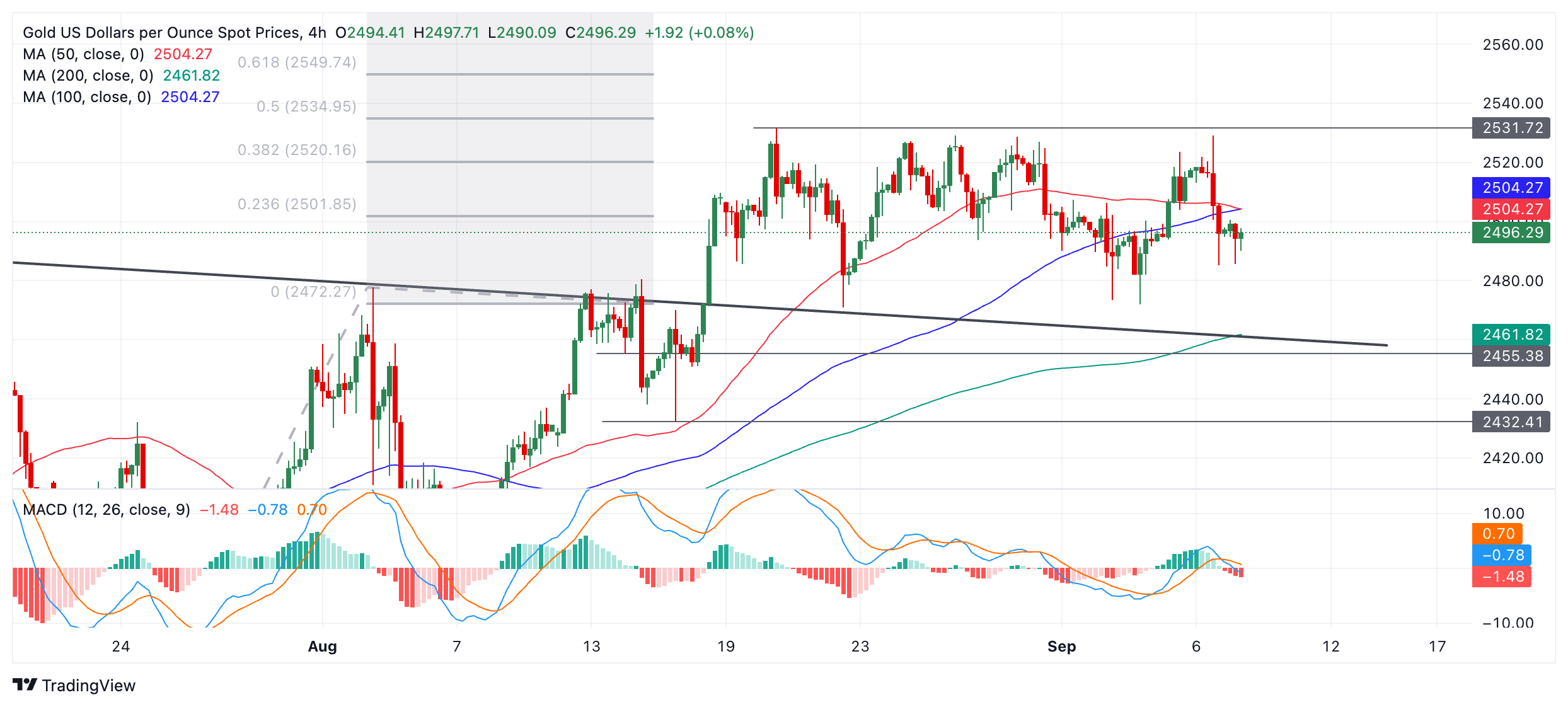
The yellow metal will probably continue trading up and down within this range until it breaks decisively out of one side or another.
A decisive break would be one accompanied by a long green or red candle that broke clearly through the level and closed near its highs or lows, or three candles in a row of the same candle that pierced the level.
However, the longer-term trend of Gold is bullish, slightly enhancing the odds of an upside breakout. Gold has an as-yet unreached bullish target at $2,550, generated after the original breakout from the July-August range on August 14. It will probably finally reach its goal in the end, assuming the uptrend resumes.
A break above the August 20 all-time high of $2,531 would provide more confirmation of a continuation higher toward the $2,550 target.
If Gold continues steadily weakening, however, a decisive break below the range floor and a close below $2,460 would change the picture and suggest that the commodity might be starting a more pronounced downtrend.
Economic Indicator
Consumer Price Index (YoY)
Inflationary or deflationary tendencies are measured by periodically summing the prices of a basket of representative goods and services and presenting the data as The Consumer Price Index (CPI). CPI data is compiled on a monthly basis and released by the US Department of Labor Statistics. The YoY reading compares the prices of goods in the reference month to the same month a year earlier.The CPI is a key indicator to measure inflation and changes in purchasing trends. Generally speaking, a high reading is seen as bullish for the US Dollar (USD), while a low reading is seen as bearish.
Read more.Next release: Wed Sep 11, 2024 12:30
Frequency: Monthly
Consensus: 2.6%
Previous: 2.9%
Source: US Bureau of Labor Statistics
The US Federal Reserve has a dual mandate of maintaining price stability and maximum employment. According to such mandate, inflation should be at around 2% YoY and has become the weakest pillar of the central bank’s directive ever since the world suffered a pandemic, which extends to these days. Price pressures keep rising amid supply-chain issues and bottlenecks, with the Consumer Price Index (CPI) hanging at multi-decade highs. The Fed has already taken measures to tame inflation and is expected to maintain an aggressive stance in the foreseeable future.
Empfohlene Artikel


