


Zakat on Gold: A Complete Guide to Nisab, Purities, and How to Calculate Zakat on Gold

Gold remains one of the most common stores of wealth, held as jewelry, savings, bullion, and modern investment instruments. For Muslim gold owners, fulfilling this pillar of Islam requires clear answers to fundamental questions: When does zakat on gold become due? What threshold triggers the obligation? How do you account for different karat purities and investment structures?
This comprehensive guide clarifies how to calculate zakat on gold at the standard 2.5% rate after holding it for one full lunar year (hawl). We cover purity adjustments, personal jewelry exemptions, modern financial products with step-by-step practical examples.
What Is Zakat on Gold?
Zakat is one of the five pillars of Islam and a mandatory religious obligation for qualifying Muslims. It requires individuals who meet specific wealth conditions to distribute a set proportion of their qualifying assets to designated categories of recipients.
Beyond its religious duty, zakat facilitates wealth redistribution, supports those in need, and fosters social cohesion. When held as savings, investments, or business inventory, gold becomes subject to zakat as soon as all qualifying conditions are fulfilled.
What Is Nisab?
Nisab is the minimum threshold of wealth a Muslim must possess before zakat becomes obligatory. For gold, the universal baseline nisab is 85 grams of pure (24K) gold.
Zakat becomes mandatory on your gold holding if:
1. Your pure gold equivalent meets or exceeds 85 grams.
2. You have held ownership of this minimum threshold for one full lunar year (hawl).
Zakat on Different Types of Gold
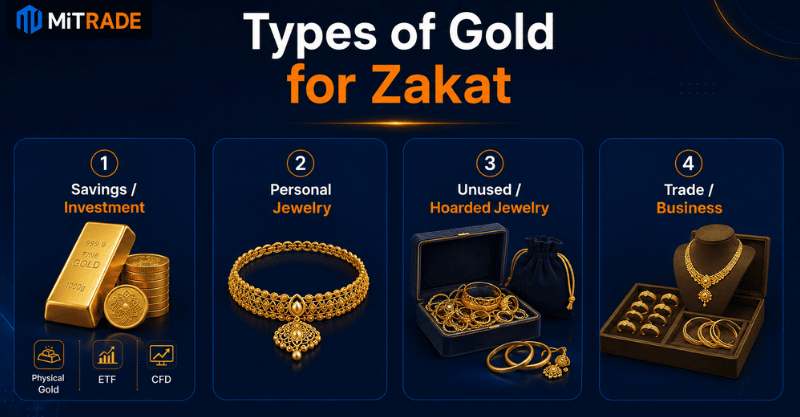
The exact zakat treatment of gold depends on its purpose, form, and how it is used.
1. Gold Held for Investment or Savings
Gold bars, coins, or bullion deliberately set aside as savings or investments are subject to zakat once they meet the nisab and hawl criteria. If gold jewelry originally acquired for personal wear is later repurposed strictly as a long-term store of value, its classification shifts to savings, making it subject to zakat.
(Note: Paper gold, ETFs, and mining equities follow distinct rules detailed further below.)
2. Gold Jewelry for Personal Use
Zakat on gold jewelry worn genuinely for personal adornment is an area of recognized scholarly difference (ikhtilaf):
The Shafi'i, Maliki, and Hanbali schools (as highlighted by Jordan's General Iftaa Department) generally exempt permissible personal-use jewelry from zakat.
The Hanafi school generally holds that all qualifying gold jewelry remains subject to zakat once it reaches the nisab.
Recommendation: Follow the trusted religious authority or school of thought (madhhab) you regularly adhere to.
3. Unused or Hoarded Gold Jewelry
Jewelry kept intentionally without any plan to wear it is treated differently from personal adornments. According to Jordan's General Iftaa Department, gold jewelry intended for hoarding or passive accumulation becomes fully subject to zakat upon meeting the nisab and hawl requirements.
Intent matters for damaged jewelry:
Items kept temporarily while awaiting repair for active wear retain their status as personal jewelry.
Items left damaged and permanently unused transition into hoarded wealth and become subject to zakat.
4. Gold Held for Trade or Business (Inventory)
Gold acquired specifically as inventory for resale—such as stock held by retail jewelers or bullion dealers—is classified as trade merchandise rather than personal asset holdings. Business inventory is assessed for zakat at its current commercial value once the nisab and hawl criteria are met.
How to Calculate Zakat on Gold
The standardized baseline for zakat is 85 grams of pure (24K) gold. Because lower-karat gold contains a lower concentration of pure gold, the total physical weight of lower-karat items must be adjusted to find its pure-gold equivalent before evaluating it against the 85g nisab threshold.
Nisab Thresholds by Karat Purity
The Calculation Process
When your holdings satisfy both the nisab and hawl conditions, calculate your zakat based on the asset's weight, purity, and prevailing market value on the exact date zakat is due (not its original purchase price).
Core Workflow:
Verify Nisab → Confirm Hawl → Determine Pure Weight → Apply Current Market Price → Calculate 2.5%
How Can Zakat on Gold Be Paid?
According to recognized scholarly consensus, zakat on gold can be settled in two ways:
1. In Physical Gold: Give 2.5% of the total physical gold weight on which zakat is due.
2. In Cash Equivalent: Pay 2.5% of the total market monetary value of the qualifying gold evaluated on the due date.
Formula for Gold Zakat Calculations
Step 1: Calculate Pure Gold Weight

Step 2: Calculate Cash Value or Gold Weight Due
Monetary Zakat Due:

Physical Gold Zakat Due:

Step-by-Step Calculation Examples
The following examples use an illustrative benchmark price of $140 per gram of pure gold to demonstrate the mechanics.
Example 1: 24K Investment Gold
Asset: 100g of 24K physical gold bars held for over one lunar year.
Pure Gold Content: 100g × (24 ÷ 24) = 100g (Exceeds the 85g nisab)
Asset Valuation: 100g × $140/g = $14,000
Zakat Payable: $14,000 × 2.5% = $350 (Alternatively payable as 2.5g of pure gold)
Example 2: 21K Savings Gold
Asset: 100g of 21K gold held as long-term savings.
Pure Gold Content: 100g × (21 ÷ 24) = 87.5g (Exceeds the 85g pure gold nisab)
Asset Valuation: 87.5g × $140/g = $12,250
Zakat Payable: $12,250 × 2.5% = $306.25
Example 3: 18K Gold Below Nisab
Asset: 100g of 18K gold held as investment.
Pure Gold Content: 100g × (18 ÷ 24) = 75g
Assessment: At 75g of pure gold, this standalone holding is below the 85g nisab threshold. Therefore, no zakat is due on this asset alone.
⚠️Crucial Distinction:
Simply calculating 2.5% of an asset's market value is incorrect if the baseline nisab threshold has not been met first. However, if you hold other qualifying liquid assets (such as cash or other metal holdings), they may be combined depending on the religious jurisprudence methodology you follow.
Who Must Pay Zakat on Gold and Who Can Receive It?
Zakat is mandatory for every Muslim who possesses qualifying wealth equal to or exceeding the nisab for a full lunar year. According to Surah At-Tawbah (Qur'an 9:60), zakat distributions must be allocated specifically among eight eligible categories:

The Poor (Al-Fuqara'): Individuals without sufficient assets or income to meet basic essential needs.
The Needy (Al-Masakin): Individuals in financial hardship whose earnings fall short of minimum livelihood requirements.
Zakat Administrators (Al-'Amilina 'Alayha): Authorized entities responsible for collecting and distributing zakat.
Reconciling Hearts (Al-Mu'allafatu Qulubuhum): Individuals whose hearts are to be softened or reconciled toward Islam under legitimate rulings.
Freeing Captives (Fir-Riqab): Assisting individuals in escaping bondage or servitude.
Debtors (Al-Gharimin): Individuals overwhelmed by unmanageable, legitimate debts.
In the Cause of Allah (Fi Sabillillah): Undertaking efforts that serve the broader path of God according to qualified legal interpretations.
Stranded Travelers (Ibn Al-Sabil): Travelers who find themselves stranded without access to necessary funds.
Because zakat is a prescribed obligation distinct from voluntary charity (Sadaqah), recipient eligibility must be verified prior to payment.
Zakat Rules for Modern Gold Investments
Modern financial markets offer diverse ways to gain exposure to gold. The zakat framework differs significantly depending on whether you own physical metal, paper claims, business shares, or price derivatives.
1. Gold Bars and Coins
Physical bars and coins represent direct legal ownership of physical gold. They are evaluated using standard weight, purity, and current spot price rules once the 85g nisab and hawl criteria are met.
2. Gold ETFs and Gold Funds
The zakat treatment of Exchange-Traded Funds depends entirely on the fund's underlying structure:
Physically-Backed, Allocated ETFs: If the ETF grants beneficial ownership of physical, allocated gold held in vaults, zakat is calculated at 2.5% of the total market value of your holdings, provided your share meets the nisab threshold.
Synthetic or Derivative-Based ETFs: Funds that do not hold physical bullion must be evaluated using general financial investment rules rather than direct gold rules.
3. Gold-Mining Shares
Shares in gold-mining companies represent equity in an operational business, not direct ownership of refined physical bullion.
Shares held for short-term trading: Subject to zakat at 2.5% of their full market value at the end of the hawl.
Shares held for long-term investment: Subject to zakat based on the company's underlying zakat-eligible liquid and tradeable assets, or standard dividend/equity rules as advised by qualified scholars.
4. Gold CFDs and Financial Derivatives
Contracts for Difference (CFDs), futures, and options provide exposure to gold price movements without granting physical ownership of gold.
Because no physical gold is owned, no gold zakat is calculated on the contract's gross or leverage-backed nominal value.
Zakat applies only to your actual liquid cash balances and realized earnings when combined with your overall personal wealth at the end of your lunar year.
Important Calculations Rules of Zakat on Gold
Avoid common calculation errors by adhering to these core principles:
Verify Purity Ratings: Always adjust physical weights for karats (22K, 21K, 18K) to determine the actual weight of pure gold.
Confirm Nisab Before Calculating: Ensure your total pure gold weight meets or exceeds 85 grams before calculating payable zakat.
Use Precise Conversions: Avoid rounding down karat-conversion figures when verifying nisab thresholds.
Distinguish Personal Jewelry from Savings: Apply scholarly rules consistently based on the intended use and condition of personal jewelry.
Use Current Market Spot Rates: Value your holdings using current spot prices on the day zakat is calculated, not original purchase prices.
Differentiate Financial Instruments: Never treat paper instruments, derivative contracts, or equity shares as physical bullion.
Maintain Consistency: Adhere to one recognized methodology or school of jurisprudence (madhhab) consistently.
Conclusion
Calculating zakat on gold requires clear identification of what you own, its purity, its underlying purpose, and the precise legal structure of your investment. Whether handling personal jewelry or navigating modern financial instruments like ETFs and mining shares, maintaining consistency and applying accurate market valuations ensures your religious obligations are fulfilled correctly.


Is zakat due on inherited gold?
Inherited gold can become subject to zakat if the heir’s share reaches the applicable nisab. According to Egypt’s Dar Al-Ifta, the heir’s ownership begins from the date of death, even if the inheritance is distributed later.
Can zakat on gold be paid before the hawl ends?
Yes. Zakat may be paid in advance once the nisab has already been reached, even before the full lunar year is completed, according to recognized scholarly guidance.
What if I did not pay zakat on gold in previous years?
If zakat was due but was not paid, the obligation does not disappear. The unpaid zakat should be calculated and paid for the previous years in which it was due.
* The content presented above, whether from a third party or not, is considered as general advice only. This article should not be construed as containing investment advice, investment recommendations, an offer of or solicitation for any transactions in financial instruments.


