



Have you ever thought about investing in gold, but felt unsure where to start?
That is normal. Gold is one of the most familiar precious metals in the world. People use it for jewellery, saving, gifting, and investing because it is widely seen as a store of value.
In simple terms, gold investing means buying gold because you expect its value to rise over time.
But choosing the right way to invest is not always simple. Each option works differently, so the best choice depends on your capital, availability, risk tolerance, and goal.
🎯In this guide, you will learn what affects gold prices, the main ways to invest in gold in the UAE, and how to choose the approach that fits you.
Key Takeaways
People in the UAE can access gold in different ways, including physical gold, ETFs, digital gold, mining stocks, futures, options, and gold CFDs.
Physical gold may suit people who want to hold gold for the long term, while gold CFDs may suit active traders who focus on XAU/USD price movements.
Gold can help diversify a portfolio and may act as a hedge against inflation, but its price can still go through periods of decline.
Why Is Gold Popular Among UAE Residents?
Gold has a strong place in the UAE. It is used for saving, gifting, jewellery, trading, and long-term investing. Dubai is also widely known as the “City of Gold” with active gold markets, bullion dealers, vaulting services, and precious metals infrastructure.
For many people, gold feels easier to understand than stocks or complex financial products. You do not need to study company earnings or business models. Gold’s value is mainly linked to global demand, investor sentiment, inflation expectations, central bank activity, and movements in the US dollar.
UAE residents usually look at gold for three reasons:
Store of value: gold is often used during uncertain periods.
Portfolio diversification: gold can reduce dependence on one asset.
Easy access: UAE residents can buy physical gold, invest through gold-linked products, or trade gold prices online.
Still, gold is not guaranteed to rise. It can fall, move sideways, or underperform other assets for long periods. Past performance does not guarantee future results.
A Brief History of Gold Prices Over Time
Gold has been used as a store of value for centuries. Today, it is mainly priced in US dollars and followed in global markets through the XAU/USD symbol.
In simple terms, XAU/USD shows how many US dollars are needed to buy one ounce of gold. One ounce equals about 31.1 grams, which is the standard unit used for gold pricing in global precious metals markets.
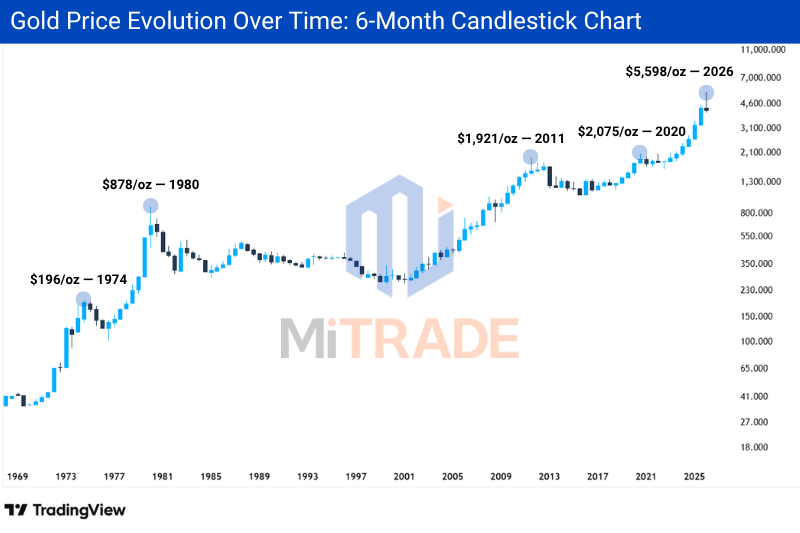
The chart above shows that the price of gold has made several important peaks over time. It rose strongly in some periods, then went through corrections or sideways phases before rising again. Overall, its price has moved higher over the long term.
Recently, in 2026, gold reached a new peak near $5,598 per ounce, showing how far the price has moved compared with previous decades.
This is why gold attracts different types of market participants. A long-term investor may hold gold as part of a wider portfolio, while a day trader may focus on shorter price fluctuations using technical and fundamental analysis.
What Drives the Price of Gold?

Before buying or trading gold, it helps to understand what moves its price.
1 The US dollar strength
Gold is priced globally in US dollars. When the dollar becomes stronger, gold can become more expensive for buyers using other currencies. This can reduce demand, and the gold price may drop.
When the dollar becomes weaker, gold can become more attractive for international buyers, and the gold price may rise.
For UAE residents, this matters because the UAE dirham is closely linked to the US dollar. Even if you think in AED, global gold pricing is still connected to USD movements.
2 Interest rates and real yields
Gold does not pay interest or dividends. This makes interest rates important.
When interest rates rise, some investors may prefer cash, bonds, or other assets that can generate income. In this case, the gold price may drop.
When real yields fall, gold can become more attractive because investors give up less income by holding gold. In this case, the gold price may rise.
3 Inflation expectations
Gold is often viewed as an inflation hedge. When investors worry that cash is losing purchasing power, demand for gold may increase, and the gold price may rise.
However, gold does not always rise immediately when inflation is high. Markets also look at interest rates, the US dollar, bond yields, and overall investor sentiment.
4 Geopolitical risk and market stress
Gold often receives attention during wars, political uncertainty, banking stress, major crises, or sharp stock market sell-offs.
This is because some investors use gold as a defensive asset. However, this is not guaranteed. Gold can still drop during stressful periods, especially if investors move strongly into cash or the US dollar.
5 Central bank demand and investor flows
Central banks, large funds, and gold ETF investors can also affect the price of gold. When demand from these groups rises, the gold price may rise. When investment flows weaken, the gold price may drop.
Main Ways to Invest in Gold in the UAE

There is no single best way to invest in gold. The right method depends on whether you want direct ownership, long-term exposure, or short-term trading opportunities.
The table below gives a quick comparison before we explain each method in more detail.
Let’s take a closer look at each method and how it works:
1. Physical Gold Bars and Coins
Physical gold means buying real gold, such as gold bars, bullion coins, or other investment-grade gold products. It is one of the most traditional ways to invest in gold.
You own the asset directly, which may suit long-term holders.
You need to consider storage, insurance, resale value, verification, and premiums above the live gold price.
🎯Where to Invest in? You can buy physical gold through trusted gold dealers, jewellery stores, or banks.
2. Gold ETFs
Gold ETFs are exchange-traded funds that track the price of gold or gold-related assets. They allow investors to gain gold exposure through a brokerage account without storing physical bars or coins.
They may be easier for beginners because investors do not need to handle storage, insurance, or gold verification themselves.
They may include fund fees, tracking error, and market risk, so investors should check the fund structure before investing.
🎯Where to Invest in? You can invest in gold ETFs through licensed brokers, banks, or investment platforms that offer ETF access.
3. Digital Gold and Bank Gold Accounts
Digital gold and bank gold accounts allow investors to buy gold electronically without storing it at home. Some providers may also offer physical delivery, depending on their terms.
They can be convenient for small or regular gold purchases.
You should check custody, fees, insurance, redemption terms, and whether physical delivery is available.
🎯Where to Invest in? These products are usually available through selected banks, fintech platforms, or gold investment providers.
4. Gold Mining Stocks
Gold mining stocks are shares of companies involved in gold mining or gold production. They do not give direct ownership of gold, but their performance can be influenced by gold prices.
They may benefit when gold prices rise and can offer exposure to the gold industry.
They also carry company-specific risks, such as production costs, debt, management issues, and stock market volatility.
🎯Where to Invest in? You can buy gold mining stocks through brokers or trading platforms that provide access to international stock markets.
5. Short-Term Trading Through CFDs
Gold CFDs allow traders to speculate on XAU/USD price movements without owning physical gold. Traders can go long if they expect gold to rise or go short if they expect gold to fall.
They offer online access, buy and sell flexibility, leverage, and short-term trading opportunities.
CFDs are leveraged products, so both profits and losses can be magnified.
🎯Where to Invest in? You can trade gold as a CFD through regulated online brokers (like Mitrade) that offer access to XAU/USD markets.
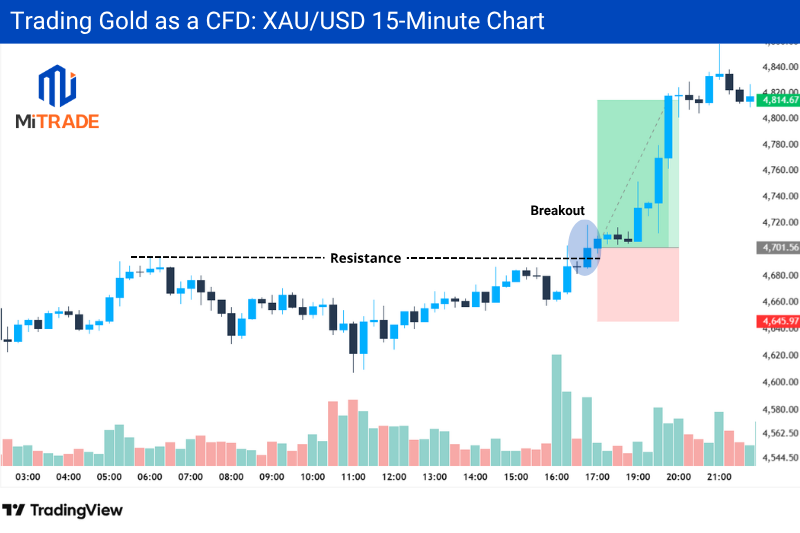
The chart above shows an example of a gold CFD trade setup on the 15-minute timeframe. Price breaks above a resistance area, and a trader may enter a buy position expecting the price to move higher.
For traders interested in gold CFD trading, Mitrade offers access to XAU/USD CFDs with low spreads and commissions, charting tools, risk management tools, and a demo account with $50,000 in virtual funds. Traders can also access educational resources designed for different experience levels, from beginners to more advanced traders.
*Invest in gold with Mitrade—start your portfolio with as little as $50.
6. Gold Futures and Options
Gold futures and options are advanced financial contracts used to trade or hedge gold price movements. Futures involve an agreement to buy or sell gold at a future date, while options give the buyer the right, but not the obligation, to buy or sell gold at a specific price before expiry.
They can be useful for experienced traders who want hedging tools or advanced market exposure.
They are more complex and require understanding contract sizes, expiry dates, margin requirements, and market volatility.
🎯Where to Invest in? You can access gold futures and options through specialised brokers or platforms that provide access to futures and options markets.
How to Invest in Gold in the UAE?

Whether your goal is to hedge against inflation or capitalize on short-term XAU/USD price swings, maximizing your returns requires a clear alignment of your budget, strategy, and risk tolerance. To trade or invest profitably in the UAE’s vibrant precious metals market, you must master four foundational pillars:
1. Choose a Suitable Gold Investment Method
The right method depends on your goal. Physical gold may suit people who want direct ownership. Gold ETFs or digital gold may suit investors who want easier exposure. Gold CFDs, futures, and options may suit active traders, but they involve higher risk and require more market knowledge.
2. Choose a Trusted Broker or Provider
After choosing the method, check the provider carefully. Look at regulation, fees, platform tools, product terms, customer support, and risk warnings.
If you want to trade gold online, choose a regulated platform that offers clear product terms, transparent costs, useful tools, and proper risk warnings. Reliable brokers should hold prestigious licenses from local or top-tier global regulators. These include:
DFSA (Dubai Financial Services Authority)
CMA (UAE Capital Market Athority)
ASIC (Australian Securities and Investments Commission)
CIMA (Cayman Islands Monetary Authority)
FCA (UK Financial Conduct Authority)
Take Mitrade as an example:
Mitrade stands out as a highly trusted, multi-regulated platform. It complies with strict international financial standards and operates under several reputable authorities, including:
Mitrade Financial Services LLC - CMA 20200000397 (Learn how to check)
Mitrade Global Pty Ltd – AFSL 398528 (Learn how to check)
Mitrade EU Limited – CIF 438/23 (Learn how to check)
Mitrade Holding Ltd – SIB 1612446 (Learn how to check)
Mitrade International Ltd – GB20025791 (Learn how to check)
Mitrade Markets Pty Ltd – FSP 54842 (Learn how to check)
If you want to trade gold online, always choose a platform like Mitrade that balances secure regulatory backing with clear product terms, low costs, and professional risk-management tools.
3. Understand the Costs Before Investing or Trading
Before choosing any gold product, compare the full cost, not only the buying price. Important costs may include premiums above the spot price, bid-ask spreads, storage and insurance, fund fees, tracking error, overnight fees for CFDs, and platform or custody fees.
These costs can affect your final return, especially if you buy and sell often or hold the product for a long time.
4. Develop a Basic Trading or Investing Strategy
A simple plan should define when to enter, when to exit, how much capital to use, and how much risk to take.
For long-term investors, this may include allocation, holding period, and rebalancing. For active traders, this may include technical analysis, news awareness, stop-loss use, and position sizing.
Before moving to a live account, traders can build a strategy, backtest it, and practise through a demo account. This helps them see whether the strategy has consistent results before using real money.


Advantages and Disadvantages of Investing in Gold
Gold can be useful for investors and traders, but it is important to understand both its strengths and risks before choosing a method.
Advantages of Investing in Gold
✅Portfolio diversification: Gold can reduce dependence on one asset class. This may help investors who already hold cash, property, stocks, or other assets.
✅Store of value: Gold is often viewed as a store of value during uncertain periods. It is not linked to one company, one earnings report, or one business model.
✅High liquidity: Gold is traded globally. Physical gold can be sold through dealers, while ETFs, CFDs, and other gold-linked products can be traded through financial platforms.
✅Many access methods: UAE residents can buy physical gold, invest through ETFs, use digital gold, buy mining stocks, or trade gold CFDs online.
Disadvantages of Investing in Gold
❌No income: Gold does not pay dividends or interest. If the price does not rise, returns may be limited.
❌Can be expensive to buy: Gold can require more capital than some other assets, especially when buying physical gold in meaningful quantities.
❌Price volatility: Gold can move sharply after inflation data, interest rate decisions, geopolitical news, or US dollar movements.
❌Opportunity cost: If gold moves sideways for a long time, investors may miss returns from other assets such as stocks, bonds, or income-generating investments.
❌No guaranteed return: Gold is often seen as a defensive asset, but its price can still fall or underperform for long periods.
Suggestions of Investing in Gold for Beginners
Gold can be useful for beginners, but it should be approached with a clear plan and proper risk awareness.
1. Start with a clear goal: Decide whether you want to hold gold for the long term, trade short-term price movements, or use it for portfolio diversification.
2. Choose a method you understand: Physical gold, ETFs, digital gold, CFDs, futures, and options all work differently. Avoid products you do not fully understand.
3. Check the provider carefully: Before buying or trading gold, check the provider’s reputation, regulation, fees, product terms, and risk warnings.
4. Practise before trading with real money: If you want to trade gold online, build a strategy, backtest it, and practise on a demo account before moving to a live account.
5. Compare the full cost: Do not only look at the gold price. Check the main fees and costs linked to your chosen method.
6. Avoid putting all your money into gold: Gold can help diversify a portfolio, but it should not be your only investment. Balance matters.
7. Understand what moves gold prices: Gold prices can react to the US dollar, interest rates, inflation, central bank demand, geopolitical risk, and market sentiment.
8. Risk only what you can afford to lose: Financial markets can be risky, especially during uncertain events or sharp price movements. Avoid using money you may need for essential expenses.
9. Use risk management when trading: For gold CFDs or other leveraged products, control position size, use stop-loss tools, and avoid risking too much on one trade.
10. Review your gold exposure regularly: Gold prices can rise, fall, or move sideways for long periods. Review your position from time to time to make sure it still fits your goal.
Conclusion
Gold remains popular in the UAE because it is familiar, liquid, and widely seen as a store of value. However, the right way to invest in gold depends on your goal, experience, and risk tolerance. Before choosing a method, keep three points in mind:
Gold can help diversify a portfolio, but it does not guarantee returns.
Each method has different costs, risks, and levels of complexity.
Beginners can start with Mitrade's free demo account valued $50,000 before using real money.
In the end, whether you are a beginner looking to explore short-term gold trading or an experienced investor seeking lower transactional costs, Mitrade provides the perfect gateway. With its highly intuitive platform, strict regulatory compliance, competitive spreads, and a risk-free demo account, Mitrade empowers you to execute your trading strategies seamlessly.<
What is the best way to invest in gold in the UAE?
It depends on your goal. Physical gold may suit long-term ownership, ETFs or digital gold may suit easier exposure, while gold CFDs may suit active traders who want to trade price movements.
Can I trade gold online in the UAE?
Yes, eligible UAE residents can trade gold online through regulated platforms that offer products such as gold CFDs, ETFs, or other gold-linked instruments. Always check regulation, fees, product terms, and risk warnings.
Is it better to buy physical gold or trade gold CFDs?
For Long-Term Investors: Traditional physical gold or asset-backed instruments remain excellent choices to anchor and diversify your portfolio.
For Active Traders Seeking Agility: Compared to physical gold—which often comes with high premiums and storage headaches—CFDs (Contracts for Difference) offer a modern, highly flexible alternative. CFDs allow you to trade gold price movements in both directions (buying long or selling short) without owning the physical asset, maximizing your capital efficiency through leverage.
What moves the gold price?
Gold prices are influenced by the US dollar, interest rates, inflation expectations, geopolitical risk, central bank demand, investor flows, and overall market volatility.
Are gold CFDs risky?
Yes. Gold CFDs are leveraged products, so both profits and losses can be magnified. Traders should understand margin, use risk management tools, control position size, and avoid overexposure.
* The content presented above, whether from a third party or not, is considered as general advice only. This article should not be construed as containing investment advice, investment recommendations, an offer of or solicitation for any transactions in financial instruments.


