


Silver Trading in the UAE: How to Start Trading or Investing in Silver
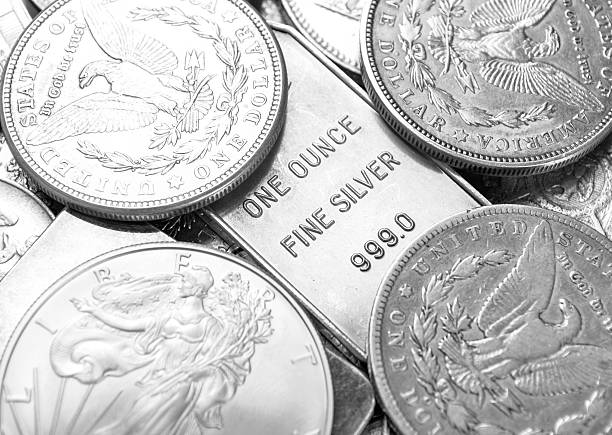
Silver sits at the intersection of industrial demand and precious-metal investment. Its use in manufacturing makes it sensitive to economic activity, while its role as an investment attracts buyers looking for exposure to precious metals. Together, these forces can create significant price movements.
If you are exploring silver trading in the UAE, start by deciding how you want to participate. Buying a silver bar, purchasing a silver-backed fund and opening a leveraged trade involve different ownership rights, costs and risks.
🎯This guide explains the main options, the factors that influence prices, and the practical steps involved in planning an investment or trade.
Silver Trading vs. Investing: What Is the Difference?
Trading and investing both provide exposure to silver, but they usually serve different goals. Your preferred approach will influence the product you choose, how long you hold it and how closely you need to monitor it.
Investing generally means building exposure over months or years. An investor might buy bullion or a silver-backed exchange-traded product to participate in longer-term price movements.
Trading usually focuses on shorter-term opportunities. Traders may enter and exit positions over minutes, days or weeks, sometimes using derivatives to trade rising or falling prices.
Different participants also have different priorities:
Bullion buyers may value direct ownership, secure storage and straightforward resale.
Long-term investors may prefer exchange-traded products that avoid the need to arrange personal storage.
Active traders may need flexible position sizes, short-selling access and reliable order execution.
Commercial users may use silver contracts to hedge future purchases or production.
Before choosing a product, ask yourself: Do I want to own silver, hold an investment linked to it, or trade changes in its price?
How Silver Prices Work?
Understanding a silver quotation makes it easier to compare products and calculate your exposure. The price displayed on a trading platform is not necessarily the price you will pay for physical bullion.
Understanding XAG/USD
XAG/USD expresses the price of one troy ounce of silver in US dollars. A troy ounce equals approximately 31.1035 grams, compared with approximately 28.3495 grams for an ordinary ounce.
For example, a hypothetical platform quotation might show:
The spread is one component of trading costs. Other charges depend on the product and provider.
Spot Prices, Bullion Prices and Futures Prices
- Different silver products can carry different prices because they involve different delivery arrangements and costs.
- The spot price is a reference for silver available for near-term delivery. A retail silver bar usually costs more than its underlying metal value because the dealer’s price includes fabrication, distribution and a margin.
- Futures prices refer to delivery or settlement at a specified future date. They can differ from spot prices because of financing, storage and market conditions.
Why Silver Attracts Active Traders?
Silver’s price movements can appeal to traders looking for short-term opportunities. However, the same volatility that creates opportunities can also produce rapid losses.
Silver often experiences larger percentage swings than gold. Its industrial uses also make it sensitive to changes in manufacturing activity, alongside the investment flows that affect precious metals.
The Silver Institute estimates that industrial silver demand reached 657.4 million ounces in 2025, down 3% from the previous year. This illustrates why industrial demand should be assessed using current evidence rather than assumed to rise continuously.
Traders also watch the gold–silver ratio, which measures how many ounces of silver are needed to buy one ounce of gold. A rising ratio means gold is becoming more expensive relative to silver; a falling ratio means silver is becoming more expensive relative to gold.
A high ratio does not automatically mean silver is undervalued. Relative prices can remain elevated or depressed for extended periods, particularly when economic conditions change.
What Moves Silver Prices?
Silver responds to both financial conditions and demand for the metal itself. These forces can reinforce one another or pull prices in opposite directions.
★ Interest Rates, Inflation and the US Dollar
Interest rates influence the appeal of holding an asset that does not generate income. Higher real interest rates can reduce silver’s appeal relative to interest-bearing assets, while lower real rates may support investment demand.
The US dollar also matters because silver is commonly priced in dollars. A weaker dollar can make silver less expensive for buyers using other currencies, but the relationship is not consistent enough to use as a standalone trading signal.
Inflation expectations should be considered alongside interest rates, currency movements and economic growth.
★ Industrial Demand and Technology
Industrial applications connect silver to manufacturing and technological change. Solar panels, electronics and electrical equipment are important areas to watch.
Growth in these industries does not necessarily translate into proportionate growth in silver consumption. Manufacturers may reduce the amount of silver used per product or substitute other materials. The World Silver Survey 2026 identifies reduced silver use and substitution in solar cells as factors affecting photovoltaic demand in 2025.
★ Mine Supply and Recycling
Supply depends on mine output, recycling and the availability of existing stocks. Much silver is produced alongside other metals, so production decisions do not depend on silver prices alone.
Higher prices can encourage recycling, although collection and processing take time. A reported supply deficit also does not guarantee an immediate price increase: inventories and changes in investor holdings can help meet demand.
★ Geopolitical Events and Investor Sentiment
Political uncertainty and financial stress can increase interest in precious metals. Silver’s industrial role, however, makes its response less straightforward.
An event that supports demand for defensive assets may simultaneously weaken expectations for manufacturing. Prices can also fall during a broad market sell-off if investors sell holdings to raise cash.
Ways to Trade or Invest in Silver in the UAE
There are several ways to gain exposure to silver, from owning bullion to trading financial contracts. The right choice depends on your objective, holding period and ability to manage the product’s risks.
Approach 1: Silver CFDs
Contracts for Difference (CFDs) allow traders to speculate on the price movements of XAGUSD without owning the underlying asset.
Pros & Cons: Offer high flexibility, leverage, and short-selling capabilities, but incur overnight financing costs (swaps) and carry high risk of margin calls if improperly managed.
Approach 2: Exchange-Traded Futures and Options Contracts
Standardized contracts traded on regulated exchanges like COMEX.
Pros & Cons: Ideal for institutional or advanced retail traders seeking transparent pricing and capital efficiency, though they require substantial capital maintenance and strict expiration date management.
EApproach 3: xchange-Traded Funds (ETFs)
Funds like the iShares Silver Trust (SLV) track the physical price of silver on traditional stock exchanges.
Pros & Cons: Highly convenient for long-term investors avoiding physical storage issues, though management expense ratios (ERs) apply.
Approach 4: Physical Bullion (Bars and Coins)
Purchasing physical silver through accredited local bullion dealers (e.g., in the Dubai Gold Souq or via certified regional distributors).
Pros & Cons: Tangible ownership with zero counterparty risk; Subject to local consumption taxes such as the 5% UAE VAT on investment-grade precious metals, along with ongoing secure vault storage fees, insurance costs, and wider bid-ask spreads upon liquidation.
Approach 5: Mining Equities and Junior Explorers
Buying shares of silver mining companies or mining ETFs (e.g., SIL).
Pros & Cons: Provides leveraged exposure because successful mining companies can outperform the underlying metal during bull markets, but adds operational, management, and geopolitical risks.
So Many Approaches, Which Approach Is Suitable for Me? Start with your goal, then consider which product fits your experience and risk tolerance. - “I want to own silver directly.” Consider physical bars or coins, allowing for secure storage, insurance and resale costs. - “I want long-term exposure without storing silver.” Consider physically backed silver ETFs or other exchange-traded products, comparing their structure and fees. - “I want to trade short-term price movements in either direction.” Consider silver CFDs if you understand leverage and can manage the risks and financing costs. - “I want to hedge silver prices or use advanced strategies.” Consider futures and options if you understand their margin requirements, expiry dates and settlement terms. - “I want to invest in businesses that could benefit from rising silver prices.” Consider mining shares or mining ETFs, recognising that company performance also affects returns. |
What Does Silver Trading Cost?
Costs vary widely between products, and the cheapest option for a short trade may be expensive to hold for several months. Compare the same market exposure and holding period before deciding.
Do not compare the full price of a bullion purchase with only a CFD’s margin deposit. Margin is the deposit supporting the trade, not its total economic exposure.
Fixed transaction charges can weigh heavily on small recurring purchases. Meanwhile, overnight financing can make a leveraged position increasingly expensive as the holding period grows.


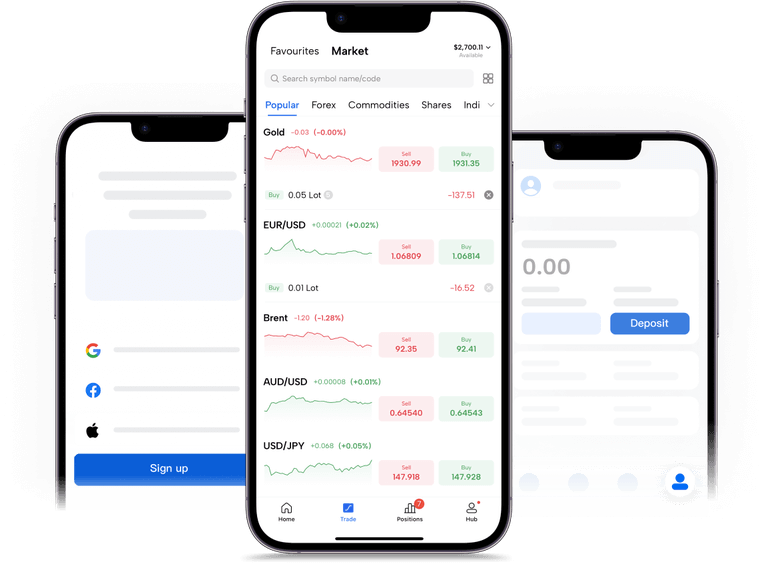
How to Get Started with Silver Trading
Getting started involves more than opening an account. A clear objective, a verified provider and a written risk plan help you make decisions consistently.
Common Strategies to Silver Trading
Traders use different methods to interpret price movements and plan positions. Each approach needs clear rules and risk controls; no indicator or pattern guarantees a profitable outcome.
Strategy 1: Technical Analysis for XAGUSD
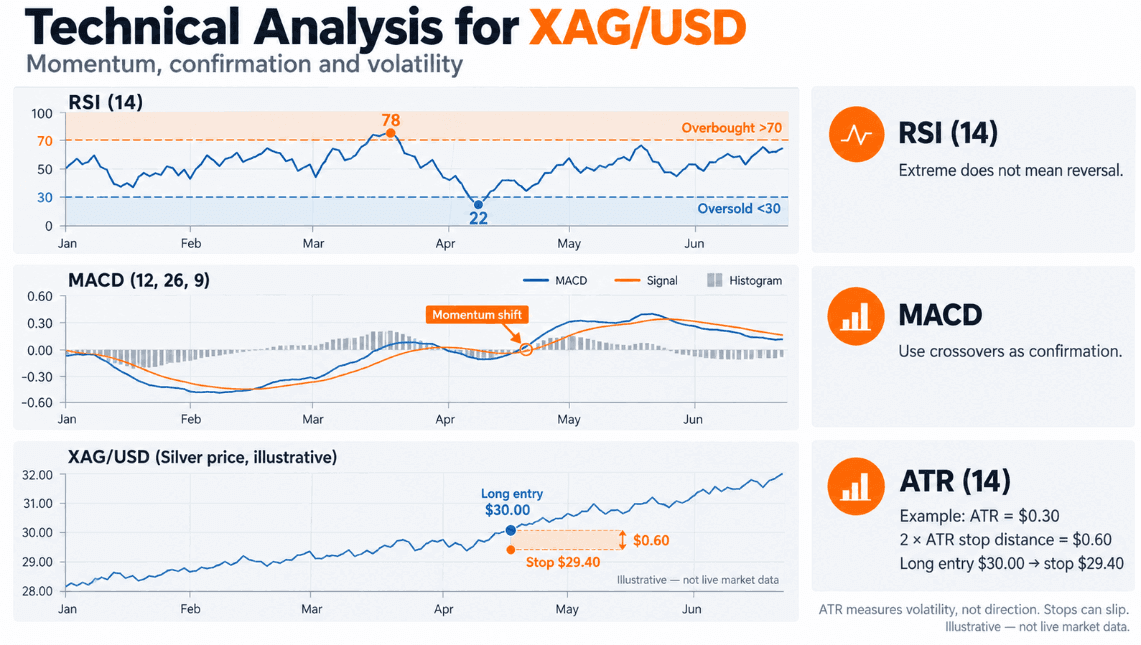
Utilize key indicators such as the Relative Strength Index (RSI) to identify overbought (>70) and oversold (<30) conditions, MACD for momentum shifts, and the Average True Range (ATR) to calculate appropriate volatility-based stop-loss levels.
Strategy 2: Trading the Gold-Silver Ratio (GSR)
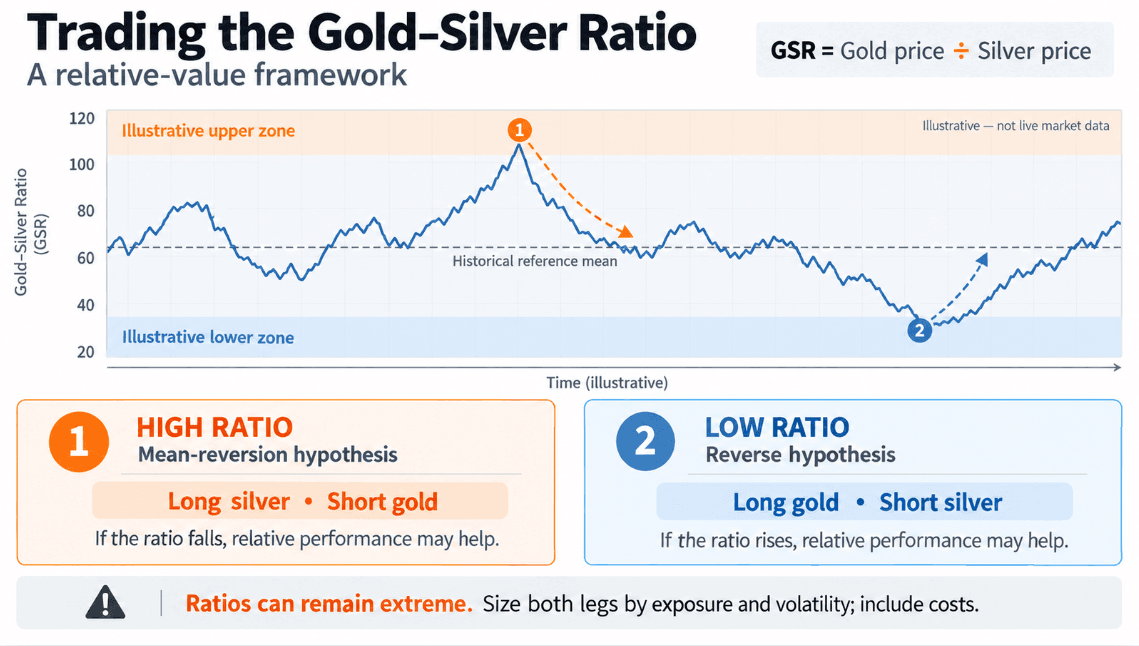
Implement mean-reversion strategies: buy silver and short gold when the ratio spikes to historical resistance levels, reversing the trade when historical support is reached.
Strategy 3: Intraday Positioning vs. Trend Following
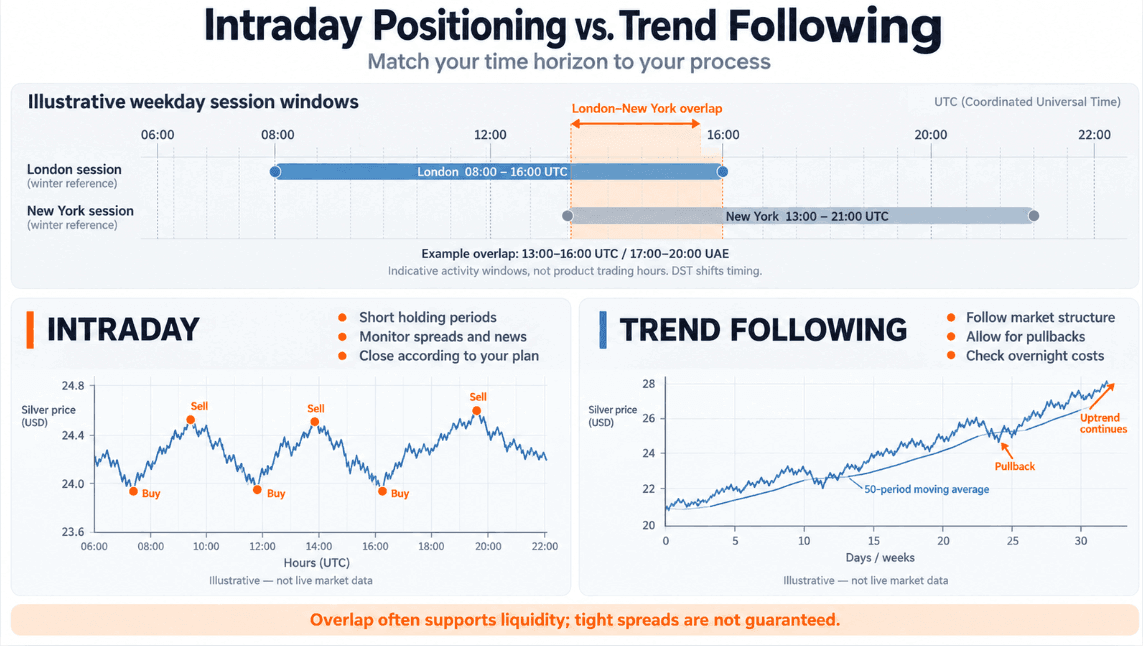
Focus active day trading during the London and New York session overlaps, where market liquidity peaks and bid-ask spreads narrow significantly.
Common Silver Trading Mistakes
Many avoidable losses begin with a mistaken assumption about price, costs or protection. Recognising these assumptions can improve the quality of your decisions.
❌“Silver is cheap, so it has less downside.” Unit price says little about valuation or potential percentage losses.
❌“A shortage guarantees higher prices.” Inventories, substitution, positioning and already-priced expectations can alter the outcome.
❌“Zero commission means free trading.” Spreads, financing, conversion and other charges can remain.
❌“A regulated provider guarantees my investment.” Authorization does not remove market risk or guarantee returns.
❌“Demo profits prove I am ready.” Live execution and emotional pressure can produce different results.
Other damaging habits include increasing size after losses, moving exits without a reason, and treating several correlated metals positions as diversification. Be particularly cautious of guaranteed-return promises and requests to send money to unrelated accounts.
Explore Silver Trading with Mitrade
Following silver prices and managing trades is easier when your tools are in one place. Mitrade combines commodity CFDs, charting and account management on a platform accessible through web and mobile, helping you fit market research and position monitoring into your daily routine. Explore Mitrade’s platform >>>
For beginners, a Mitrade demo account which is valued at $50,000 offers space to learn without putting real money and verification at risk. You can practise placing orders, sizing positions and planning exits with virtual funds, building familiarity before deciding whether to trade live. More experienced traders can use it to explore a different approach before committing capital. Try a Mitrade demo account >>>
What does XAGUSD actually mean?
XAG is the international currency symbol for one troy ounce of silver, paired against the US Dollar (USD).
What are the market opening hours for silver trading?
Spot silver markets operate nearly 24 hours a day, 5 days a week, opening Sunday evening and closing Friday evening (EST).
How are profits taxed for UAE-based residents trading international CFDs?
The UAE currently does not levy personal income tax on capital gains for individuals trading retail financial derivatives.
What is the difference between spot silver and futures contracts?
Spot silver reflects current market delivery prices with rolling daily financing, while futures contracts have standardized expiration dates and fixed settlement terms.
Can I trade silver using Islamic swap-free accounts in Dubai?
Yes, many regulated brokers operating in the UAE offer swap-free Islamic accounts tailored to prevent interest accumulation on overnight positions.
* The content presented above, whether from a third party or not, is considered as general advice only. This article should not be construed as containing investment advice, investment recommendations, an offer of or solicitation for any transactions in financial instruments.


