


Gold CFD Trading Guide: How it Works, Strategies, and Best Platform for Beginners

Gold has long been seen as a symbol of prosperity and an asset in times of need. Nowadays, trading gold does not simply involve purchasing bars or coins anymore. Gold Contract for Differences (CFD) is a very effective method of speculating changes in gold prices without owning any gold at all.
🎯This article gives a complete guide to trading gold CFDs, factors affecting gold prices, gold trading strategies for novices, and the selection of the best platform.
Gold CFD Trading – What is It?
Gold CFD, or Contract for Difference; trading is a form of financial derivative contract between a trader and a broker. In the case of trading gold CFDs, you do not buy or sell real gold bars. What you actually do is predict the spot gold price change (XAU/USD rate) from the moment of opening till the moment of closing of your trade.
If you believe the price will go up, you open a long (buy) position; if you think it will go down, you open a short (sell) position. The success of your trade will depend on your prediction.
How does it work?
The trading of gold contracts for difference (CFDs) is based on several market principles:
Leverage: The broker enables the trader to trade in amounts greater than the amount he deposits by offering him a margin. With 1:100 leverage, the trader would be able to trade with $10,000 worth of gold with a $100 deposit.
Two-way trading: Profit can be made regardless of whether the market goes up or down.
Margin Trading: It allows you to open a full market position by depositing only a fraction of the total trade value, known as the margin.
Gold CFD Examples
To better understand the mechanism of profit and losses with Mitrade, let us analyze two examples of trading 0.01 lot (1 ounce of gold) of XAU/USD currency pair with a leverage of 1:100.
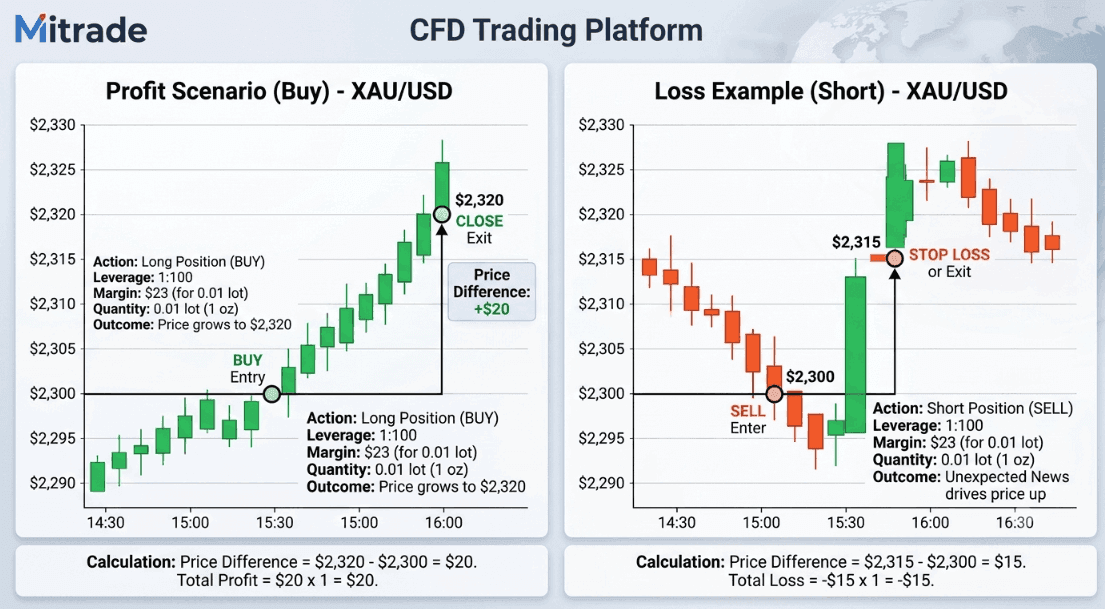
Profit Scenario (Buy) ▼
Market Environment: Spot Gold (XAU/USD) is priced at $2,300 per ounce. You assume that prices will go up. Action: You enter a long position on BUY by 0.01 lot (1 oz) using only $23 as margin. Price Change: Price grows by $20, reaching a level of $2,320 per ounce. End of the Trade: You close the trade at $2,320.
Calculation: Price Difference = $2,320 - $2,300 = $20 (You profit $20) |
Loss Example (Short) ▼
Situation in the Market: The price of gold is $2,300 per ounce. You feel that the price will go down. Action: You initiate a SELL order of 0.01 lot (1 ounce). Price Movement: Unexpected news drives the price up by $15 to $2,315 per ounce. Close trading: You close your trade at $2,315 to reduce losses incurred.
Calculation: Price Difference = $2,300 - $2,315 = - $15 (You loss $15) |
What Factors Affect the Value of Gold?
It is important to understand the factors affecting gold prices since they will determine how well you trade gold CFDs. Different from stocks and bonds, gold is not a source of dividends or interest payments. The value of the gold is influenced by macroeconomic trends, sentiments of investors, and monetary policies:
1. Supply and Demand: Gold prices are driven by the balance between global supply (mining production and recycling) and overall demand. Demand comes from jewelry, industrial applications, investment flows, and central bank purchases (such as the PBOC and Fed) aimed at reserve diversification. When demand outpaces limited market supply, gold prices naturally rise.
2. Strength of the US Dollar (USD Index): Gold is valued using US dollars. Traditionally, there exists an inverse correlation such that the stronger the dollar is, the more expensive gold is for foreign buyers; hence, its prices are depressed, while a weak dollar raises gold prices.
3. Central Bank Policies & Interest Rates: Gold has an opportunity cost since it does not give any interest. When the interest rate is increased, especially by the Central Bank of the US, gold becomes less attractive than Treasuries; hence, the prices are pushed down. When interest rates are low, gold prices rise.
4 Inflation and Purchasing Power: When inflation rises, fiat currency loses purchasing power, driving investors toward gold as a traditional hedge. As demand increases during inflationary periods, gold prices generally rise to preserve capital value.
5. Geopolitical Instability and Economic Crisis: In times of war, political uncertainty, and global economic crisis, gold tends to become a supreme "safe haven," leading to an increase in demand and prices.
Why do Traders Choose CFDs? What’s the Difference Between Gold CFDs, Physical Gold, and Gold ETF?
Active traders frequently turn to Gold CFDs for their unmatched flexibility and superior capital efficiency. Unlike traditional investments, CFDs allow you to trade both rising and falling markets with high leverage and minimal upfront capital.
However, the ideal approach depends on your unique financial goals. The comparison matrix below breaks down the key differences between Gold CFDs, Physical Gold, and Gold ETFs:
How to Match Your Investment Goal with the Right Gold Instrument?
Before choosing how to invest in gold, start with a critical question: What is your primary investment goal?
- For long-term wealth preservation, physical gold or Gold ETFs remain the gold standard, offering a reliable safe haven against inflation without the need for active monitoring.
- For maximum market flexibility, trading Gold CFDs provides a clear edge. CFDs allow you to profit from both rising and falling markets using leverage—making them ideal for active traders, provided you strictly apply risk management tools like stop-loss and take-profit orders.
- For cost minimization, CFDs and ETFs far outperform physical bullion by eliminating heavy storage, insurance, and dealer premiums. Specifically, Gold CFDs offer zero-commission trading and ultra-tight spreads, making them the most cost-effective choice for frequent, short-term positions.

Trade XAU/USD with Tight Spreads
Are You Suitable for Gold CFD Trading?
Gold CFD trading can provide good money-making possibilities, but it is definitely not meant for everyone.
Gold CFD Trading is for you if:
- You are a short-term trader or day-trader looking to earn on price movements over several hours or days.
- You want to enter the gold market with relatively small deposits thanks to the use of financial leverage.
- You want the flexibility to short the market when gold prices drop.
- You have structured risk management and know how to control your positions.
Gold CFD trading is not a passive investment—it is a high-leverage, short-term tactical tool. It works best for active traders who combine market agility with strict risk management.
Benefits and Risks of Gold CFD Trading
Gold CFD trading comes with dynamic market opportunities, but as with any other leveraged derivatives, it brings both benefits and certain financial risks.
Benefits of Gold CFD Trading
✅High Capital Efficiency with Leverage: Control larger market positions with a fraction of the upfront capital.
✅Two-Way Trading: Earn profits from an upward and downward trend by taking either Long (Buy) or Short (Sell) positions.
✅Free from Physical Storage & Handling Charges: Save yourself from the charges incurred when storing the physical gold.
✅High Liquidity & Fast Execution: Trade immediately in the online platform without any physical transactions.
Potential Risks of Gold CFD Trading
❌Amplified Losses from Leverage: In financial trading, leverage not only magnifies gains but also increases losses.
❌Overnight Holding Charges (Swap Rates): Overnight charges are incurred if an account is held open during the night period.
❌Market Volatility: Sudden changes in price levels of gold may result in either margin calls or liquidation of positions due to stop-loss orders.
What Are Gold CFD Trading Costs Included?
It is important to be aware of the trading costs that will be associated with gold CFD trading for you to optimize profits in the long run. Trading of CFDs in gold involves unique fees:
Spreads: Difference between the Buy and Sell prices. Spreads are the initial cost incurred in executing your trade. Some of the most reputable CFD brokers like Mitrade have very low spreads when it comes to XAU/USD (starting at 0.3 pips).
Overnight Fees (Swap): Daily interest fee incurred if you keep your leveraged trade open past the end of the day’s trading hours. If you conduct day trading, where you open and close your position on the same day, then no such costs will be incurred.
Commissions: CFD brokers might take commissions for each trade, but some platforms provide traders zero-commission trading and only charge traders via the spread, like Mitrade.
Best Strategies for Gold CFD Trading
There is no single strategy that would be suitable in all market situations. Skilled traders choose those that suit their trading goals and styles of analysis.
The following are 3 popular strategies for Gold CFDs trading including detailed steps to implement them:
1. Trend Following & Breakout Strategy
While gold does not always follow a smooth path, when it shows clear trends and breaks key price levels, there are many opportunities for trading. This method concentrates on capturing such trends rather than predicting the bottom or top of the market.
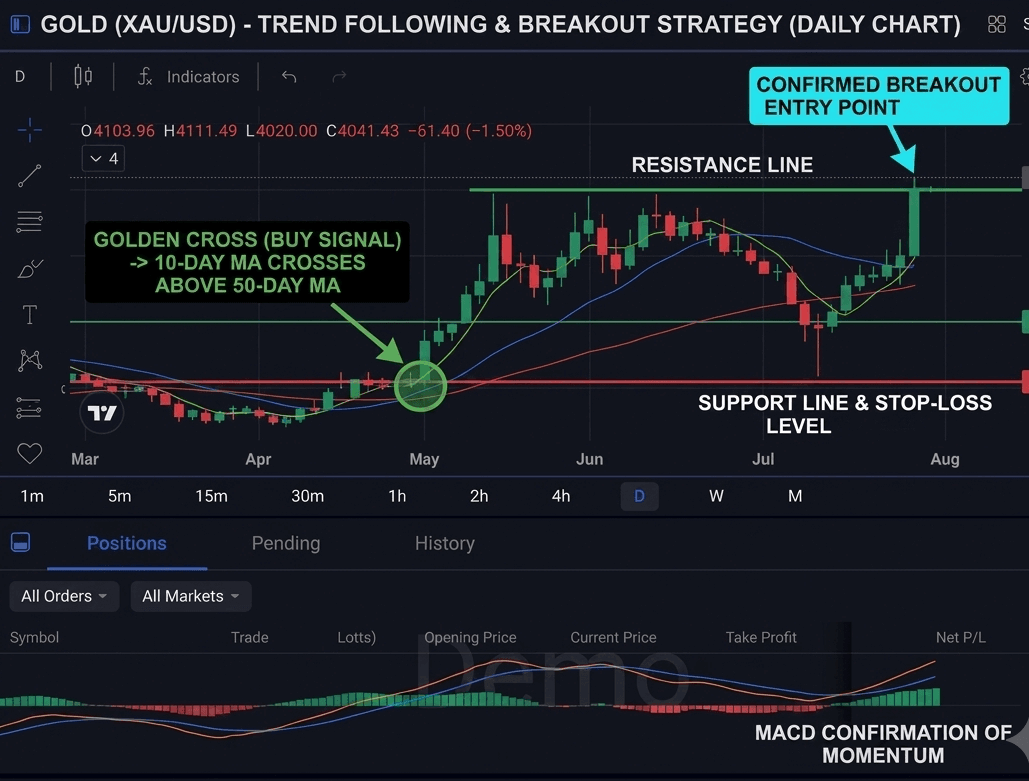
When is it suitable to use? Its usage is most ideal when there is increased volatility in the market, macroeconomic shifts such as interest rate shifts by the Federal Reserve, geopolitical tension, or immediately following the release of economic data, and gold price penetrates its long-term barriers.
Key Indicators: Moving Average indicators (10-day, 50-day MA, etc.), MACD, and Horizontal support/resistance levels.
Steps to Execute:
❶ Change of Momentum: Use the 10-period (fast) and 50-period (slow) Moving Average indicators on your gold chart. The appearance of a Golden Cross (a cross of the fast MA over the slow MA) means that there is a bullish change of momentum to enter a BUY trade, while the Death Cross suggests a bearish one.
❷ The Chart Formation of the Breakout: Look for the important resistance level that stops the price movement. The breakout happens when the green body of the candle closes above this resistance barrier.
❸ The Confirmation of the Trade Signal: Use the MACD indicator (expanding green histogram bars) to confirm the momentum. Enter the trade with the next candle and place your stop loss slightly under the key support level.
2. Range Trading and Support & Resistance Scalping Strategy
A strategy that seeks to take advantage of price changes of gold when the commodity is moving sideways within a certain range, having a definite support level at the bottom and resistance level at the top.
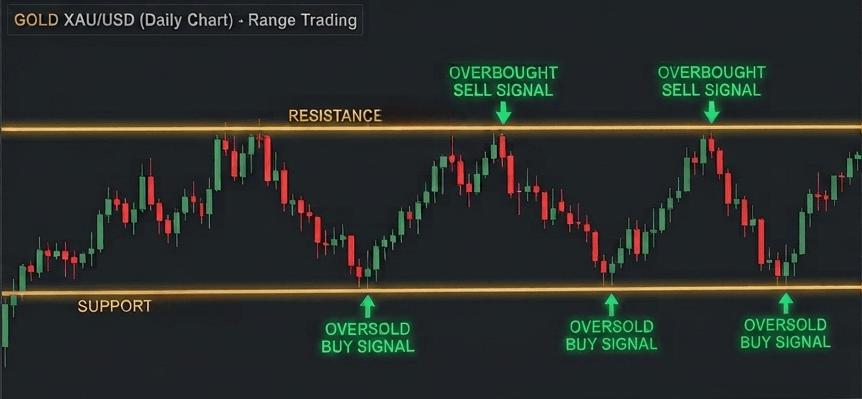
When is it suitable to use? Best applied when the markets are not in any trending phase but rather when there is consolidation in the market – this often happens before important economic news.
Key Indicators: Horizontal Support & Resistance Levels, RSI and Stochastic Oscillator.
Steps to Execute:
❶ Identify the Support and Resistance Level: This will be done by identifying a period of daily or hourly chart from where the gold has reversed itself twice after touching a higher level (Resistance Ceiling) and lower level (Support Floor).
❷ Look for Reversal Patterns: When the prices move closer to the Support floor, identify bullish candle patterns such as a Hammer or Pin Bar along with an oversold RSI indicator reading below 30.
❸ Place Trade & Manage Risk: Buy at the Support floor level with the stop-loss just below the support floor level and take-profit just below the resistance ceiling level. The opposite strategy can be followed for short trading at the resistance floor when the RSI is above 70.
3. News-Driven Fundamental Trading Strategy
An event-based trading strategy that uses important economic indicators, monetary policy changes, or global crises to trade in the sharp and immediate price volatility in the precious metal of gold.
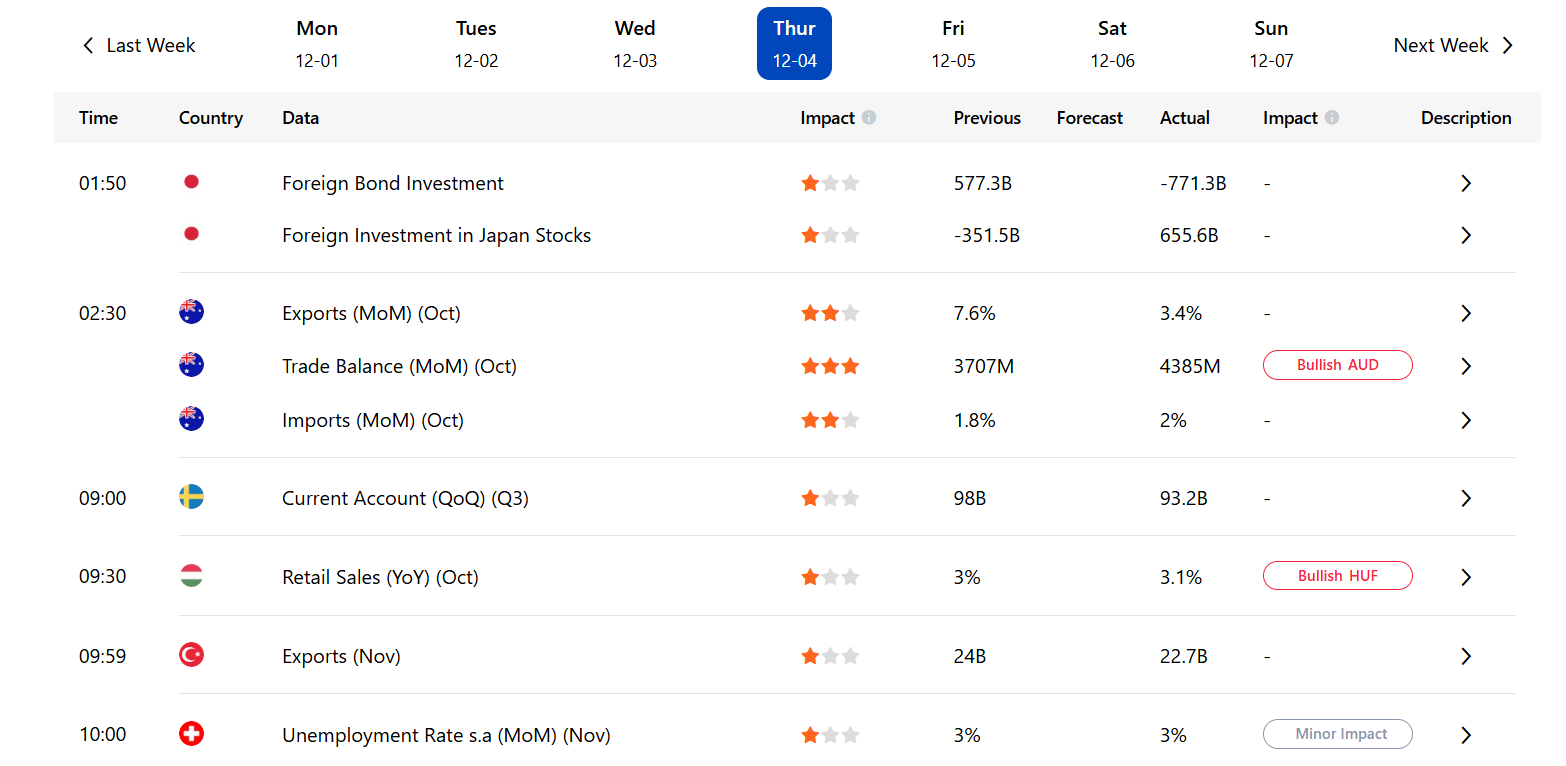
When is it suitable to use? It is best when implemented just prior to or after market-shaking events like Non-Farm Payroll NFP, Inflation CPI, interest rates, and any other crisis announcements around the world.
Key indicators: Include Economic Calendar (to know the exact time of the events), Average True Range (for volatility measurement), and 5m/15m timeframe charts.
Steps to Execute:
❶ Identify High-Impact Events: Scan through an economic calendar for any high-impact event regarding the USD and gold. Don't place a position for 15 to 30 minutes before the release because slippage cannot be predicted.
❷ Analyze Market Reaction vs. Consensus: Wait until the economic release is published officially. If the economic release is below expectations (for instance, deflationary reports, bad jobs data, etc.), then the price of gold will surge (buy signal). If the release is well above expectations, the gold price will fall (sell signal).
❸ Execute with Straddle or Retest Orders: After the initial knee-jerk reaction from the market dissipates, get into the market in the trend of the strong momentum or take the position at the retracement to the major 5-minute support and resistance level. Always place a stop-loss level.
10 Rules of Gold CFD Trading for Beginners
Adhering to these basic principles of trading can assist novice traders in managing risks effectively in dealing with the volatility of the gold CFD market:
1. Stop Loss All The Time: Never start a trade without a stop loss to guard yourself from the swift price changes in the gold.
2. Don't Over-Leverage: Employ conservative leverage in order not to have unexpected margin calls as a result of market retracements.
3. Do Not Exceed 1% Risk Per Trade: Maintain small positions by limiting your risk to 1% (max 2%) of your account per trade.
4. Avoid Trading Before NFP: Avoid trading during the fifteen to thirty minutes prior to the publication of high impact news, such as US Non Farm Payrolls.
5. Practice on a Demo Account First : Gain experience in making entries and exits in the market and follow your rules when using virtual money.
6. Trading With the Trend: Ensure that your trades are consistent with the general trend of the market, as opposed to timing any market tops or bottoms against the general trend.
7. Keep a Trading Journal: Write down everything in your journal, from entries and exits to strategies and emotions, so that you can recognize your weaknesses.
8. Read the Economic Calendar: Monitor important macroeconomic events, including interest rate decisions and CPIs, to prevent any market surprises.
9. Trade Liquid Sessions: Trade during liquid market sessions, including when London and New York are in session.
10. Don't Chase Candles (Avoid FOMO): Refrain from entering trades too late in price action.
Why Do Beginners Prefer Mitrade for Gold CFD Trading Platform?
The trading platform of Mitrade is an easy-to-use and feature-packed trading facility that can help beginners to trade gold CFDs effectively:
✅Competitive Trade Costs: Enjoy zero commission trades with tight spreads on the XAU/USD pair starting at 0.3 pips and no extra charges.
✅Spot Gold Pricing: Get instant price quotations from the global London spot gold market.
✅Generous Demo and Low Deposit: Get a $50,000 demo account and start live trading with a low deposit amount of $50.
✅Simple and Intuitive Platform: Use the convenient all-in-one trading platform offering all you need for trading: chart tools, market analysis, news feeds, execution options.
✅Regulated by Top Authorities: Get a safe trading experience according to the highest international standards due to regulations of ASIC, CIMA, and FSC.
✅Low-Threshold Trading Requirements: Get started trading with flexible requirements for the trade size – starting with 0.01 lots.
✅Multiple Fund Protections: Your money stays safe as the segregated client bank accounts and negative balance protection work automatically.


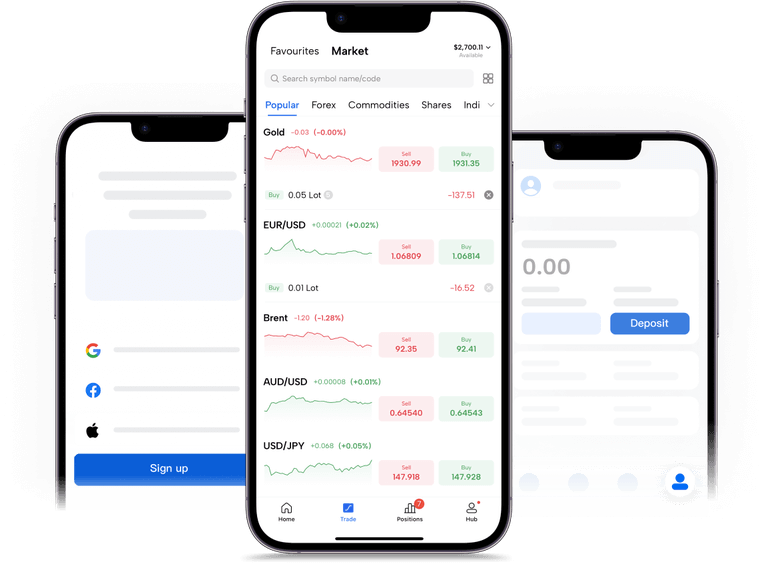
How to Make Your First Gold CFD Trade on Mitrade?
It is necessary to follow some steps for initiating a first gold trade with the help of CFD contracts on the Mitrade platform.
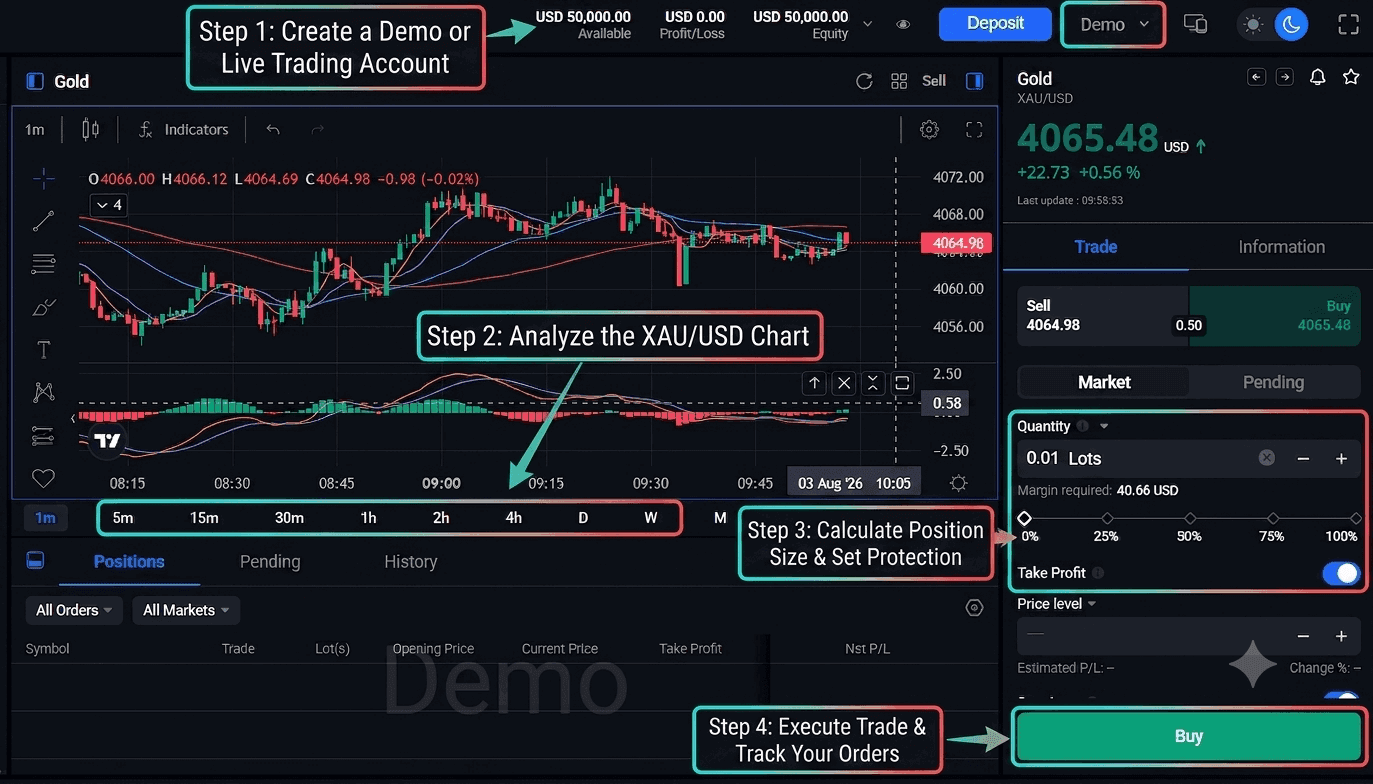
Step 1. Create a Demo or Live Trading Account: You can begin practicing by opening a demo account with $50.000 virtual funds and then proceed to open a real trading account.
Step 2. Analyze the XAU/USD Chart: Analyze the chart on the daily timeframe to understand the general direction and move to smaller time frames (1 hour or 15 minutes) for entry positions.
Step 3. Calculate Position Size & Protection: Calculate the position size as per your rules and make use of the pre-set Stop Loss and Take Profit.
Step 4. Trade & Track Your Orders: Open your order in the market or create a pending order and continue to track it.
Conclusion
Gold CFD trading offers exceptional capital efficiency and two-way flexibility, but long-term success demands market agility, strict risk control, and low-cost execution. Mitrade streamlines your trading with ultra-tight XAU/USD spreads from 0.3 pips, zero commissions, and flexible micro-lot orders. Test your strategies risk-free with a $50,000 demo account, or start live trading with just $50.
Risk-Free Demo Account
CMA-regulated | 24х5 | T+0 | low spreads. Enjoy limit and stop loss for every trade!
How much money do I need to trade gold CFDs?
You can start trading gold CFDs with as little as $50 on platforms like Mitrade, using flexible position sizes down to 0.01 lots.
What is the best time to trade gold?
The optimal time to trade gold is during the London and New York session overlap, when market liquidity and price volatility are at their highest.
How do I manage the risks of gold CFD trading?
You can effectively manage risk by using stop-loss orders on every trade, limiting risk to 1% of your account, and avoiding excessive leverage.
* The content presented above, whether from a third party or not, is considered as general advice only. This article should not be construed as containing investment advice, investment recommendations, an offer of or solicitation for any transactions in financial instruments.


