

Robinhood CEO Cashes Out Over $40 Million, Sparking Panic by Virtually Emptying Holdings: Has the Stock Peaked?

Source Tradingkey

TradingKey - Robinhood CEO dumps 370,000 shares, cashing in over $40 million and nearly wiping out his direct Class A holdings—does this signal the stock price has peaked?

On October 8, Eastern Time, Robinhood (HOOD) stock continued to weaken after opening, falling from near a high of $110 down to a low of $105, hitting a new low since mid-September. Subsequently, Robinhood's stock price rebounded and strengthened, narrowing its decline to 2.28% and closing at $107.01.

The direct cause of Robinhood's stock price decline was panic commentary in market communities alleging that the CEO was dumping all his holdings. According to disclosures published by the U.S. SEC yesterday, Robinhood CEO Vladimir Tenev sold over 370,000 shares of company stock at a high average price of $114 per share this Monday (October 5), securing $42 million in cash. Crucially, after this transaction was completed, his direct shareholding dropped to fewer than 7,000 shares.

However, looking at the equity structure and trading mechanisms in the SEC filings, this represents a market overinterpretation and an unjustified sell-off of the stock. Vladimir Tenev sold Class A shares, while his Class B super-voting power remains completely untouched. It is reported that Tenev and co-founder Baiju Bhatt still firmly control over 60% of the voting power and actual corporate control through Class B shares.

It should be emphasized that Vladimir Tenev's sale was an executive financial and tax planning transaction scheduled months in advance under Rule 10b5-1, rather than a sudden sell-off driven by a turn in the CEO's outlook on company fundamentals. In addition, Tenev still indirectly holds Class A shares through a family trust and holds a large volume of unvested equity awards and stock options.

Although executive cash-outs bring short-term psychological pressure, whether HOOD's stock price has peaked keyly depends on fundamental factors, including operational and financial performance, as well as cryptocurrency and 24/7 trading businesses, none of which have currently deteriorated. Benefiting from high BTC/ETH trading volumes, Solana ETF capital inflows, and the expansion of cross-chain/Layer-2 ecosystems, retail trading activity remains at historic highs. Furthermore, Robinhood's latest quarterly revenue topped $1.31 billion with an EPS of $0.62, both significantly beating Wall Street expectations.

From a technical analysis perspective, Robinhood failed twice in September to push above $130, and both pullbacks broke below the 0.236 Fibonacci support level. However, it did not break through the corresponding 0.382 key Fibonacci support level, which happens to be the psychological threshold of $100. Before the next earnings report is released (expected on October 27), Robinhood's stock price is more likely to fluctuate widely within the $100–$130 range.
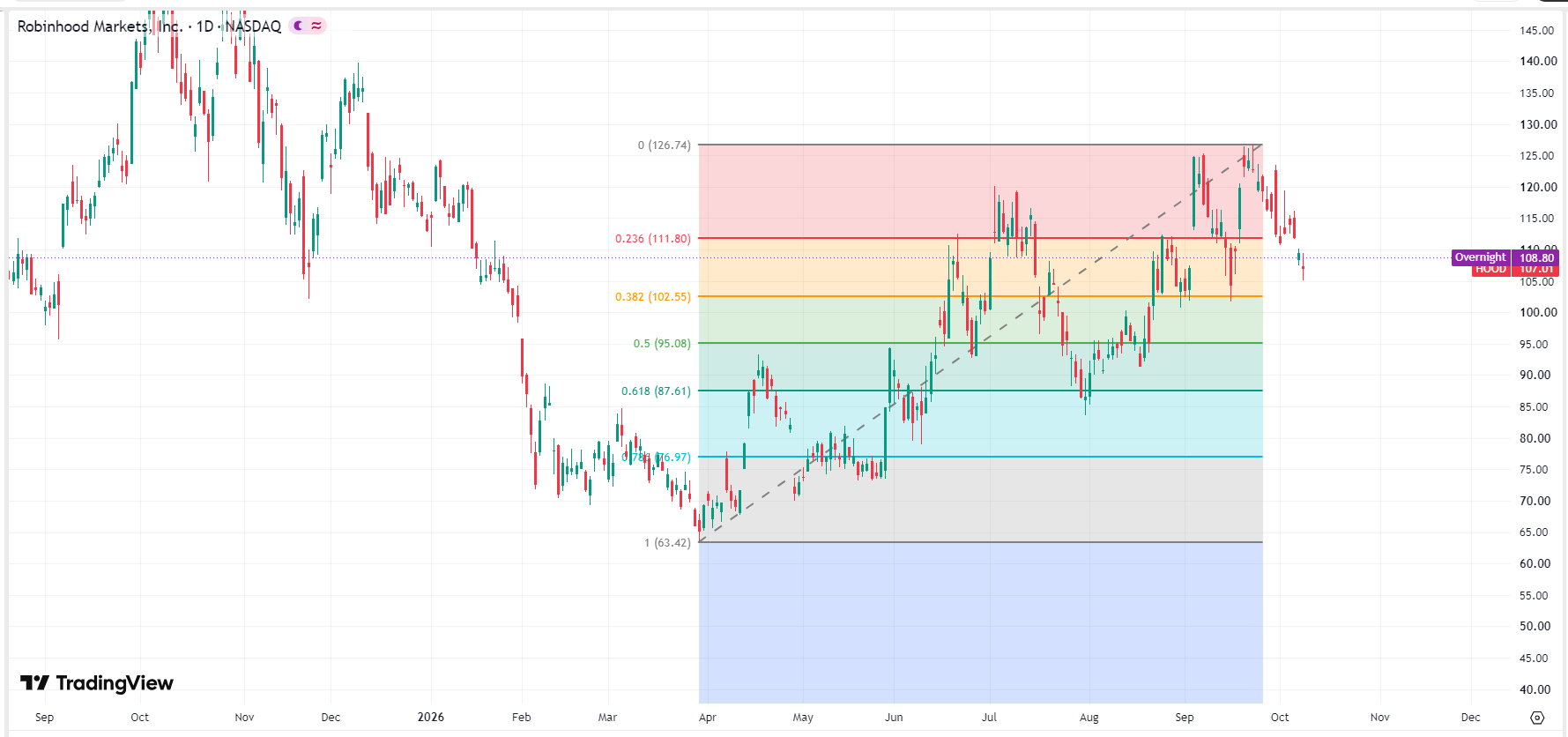
robinhood-hood-price-d2ad38bb484d4fdaa789e49ca7346b25Robinhood stock chart, source: TradingView

Disclaimer: For information purposes only. Past performance is not indicative of future results.
placeholder
October hike odds climb toward 60% as Goldman and BofA both flip — what Warsh's "dose of accommodation" really changedRate futures now price roughly 55% to 62% for a 25bp hike at the October 27-28 FOMC, up from about 30% before Chair Warsh's post-meeting framing that the Fed is merely "removing some accommodation." Goldman Sachs has added an October hike to its forecast and Bank of America now sees moves in both October and December. Here is the repricing, the language behind it, and the two data points that decide it.
Author  Irene Q.
Sep 23, Wed
Rate futures now price roughly 55% to 62% for a 25bp hike at the October 27-28 FOMC, up from about 30% before Chair Warsh's post-meeting framing that the Fed is merely "removing some accommodation." Goldman Sachs has added an October hike to its forecast and Bank of America now sees moves in both October and December. Here is the repricing, the language behind it, and the two data points that decide it.
placeholder
Hurricane Isaias has shut in a quarter of Gulf oil output — can WTI clear $92 before Thursday's EIA report?WTI trades at $90.80 after rebounding roughly 3% from Wednesday's $87.96 low as Hurricane Isaias — the Atlantic season's first — forces producers to shut in about 25% of US Gulf of Mexico output. Brent holds at $103.41. The first official read on the disruption arrives with the EIA weekly petroleum report on Thursday 15 October — here are the key levels and both scenarios.
Author  Irene Q.
Oct 09, Fri
WTI trades at $90.80 after rebounding roughly 3% from Wednesday's $87.96 low as Hurricane Isaias — the Atlantic season's first — forces producers to shut in about 25% of US Gulf of Mexico output. Brent holds at $103.41. The first official read on the disruption arrives with the EIA weekly petroleum report on Thursday 15 October — here are the key levels and both scenarios.
placeholder
US September CPI preview: inflation set to hit 3.7% — will the Fed hike in December?US September CPI lands Wednesday with headline inflation seen at 3.7% y/y and core at 0.2% m/m. December hike odds sit near 70% — here are the scenarios, the calendar and the key levels.
Author  Irene Q.
Oct 10, Sat
US September CPI lands Wednesday with headline inflation seen at 3.7% y/y and core at 0.2% m/m. December hike odds sit near 70% — here are the scenarios, the calendar and the key levels.
placeholder
Gold posts first weekly gain in three weeks — can $4,200 hold through CPI?Spot gold closed at $4,194.645, up 1.47% — its first weekly gain in three weeks — and COMEX futures settled back above $4,200 at $4,220.30. Here are the drivers, the levels and the scenarios into Wednesday's CPI.
Author  Irene Q.
Oct 10, Sat
Spot gold closed at $4,194.645, up 1.47% — its first weekly gain in three weeks — and COMEX futures settled back above $4,200 at $4,220.30. Here are the drivers, the levels and the scenarios into Wednesday's CPI.
placeholder
Brent swings $105.63 to $102.33 as Gulf risk meets an 'energy ceasefire' — can $100 hold into CPI?Brent spiked to $105.63 in Asian trade on fresh Middle East supply incidents, then reversed to $102.33 after the US announced a Russia-Ukraine 'energy ceasefire' and 300,000+ tonnes of Russian diesel headed to global markets; WTI fell through $90. Here are the drivers, the levels and the scenarios into Wednesday's US CPI.
Author  Irene Q.
Yesterday 05: 47
Brent spiked to $105.63 in Asian trade on fresh Middle East supply incidents, then reversed to $102.33 after the US announced a Russia-Ukraine 'energy ceasefire' and 300,000+ tonnes of Russian diesel headed to global markets; WTI fell through $90. Here are the drivers, the levels and the scenarios into Wednesday's US CPI.
goTop
quote