


Yen inches toward 159 as Tokyo reopens — where is the line in the sand before 160?

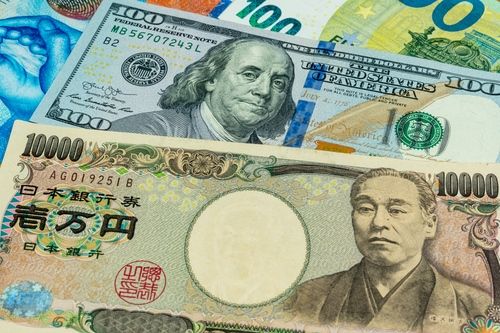
Mitrade Insights — The yen is grinding back toward the level that has defined its year: USD/JPY traded around 158.5 on Tuesday, after closing at 158.60 on Monday — the pair's highest close since September 24 — as Tokyo reopened from a holiday and the market re-focused on two dates that now dominate the yen calendar: the G20 finance ministers' meeting in Bangkok on October 15, and the Bank of Japan's October 30 decision. With the 160 line now less than 1% away, traders are asking one question: where does Japan actually defend?
The move: a slow grind, not a spike
Monday's close of 158.60 (+0.21%) carried USD/JPY to its strongest since September 24, with an intraday high of 158.75. Tuesday's Tokyo session brought little follow-through — the pair traded a narrow 158.40–158.65 range, last around 158.46 (−0.12%) — but the direction since late September is unmistakable: the pair has recovered roughly five yen from the late-September low near 153.5, a move built on a wide US–Japan rate gap rather than any single headline. The holiday-thinned Monday session (Tokyo closed for Sports Day, US bonds shut for Columbus Day) arguably overstated the liquidity behind the move; Tuesday's reopening is the first real test of whether the grind continues.
Why: three forces are leaning on the yen
The rate gap is still the whole story. The Fed has hiked to 3.75%–4.00% and markets price a December hike with near-88% odds; even after the BOJ raised its policy rate to 1.25% in September — a 31-year high — the carry trade math is unchanged, and two board members dissented on the September hike. One of them, board member Sato, has since backed gradual hikes citing oil-driven inflation risk, but the market's base case remains a hold on October 30, with December as the next live meeting.
The dollar bid is broad. The dollar index sits at 102.58, an 18-month high and a fifth straight weekly gain, with 10-year Treasury yields at 5.30% — the highest since 2002. Add Brent crude above $106 (a direct hit to Japan's import bill and a term-of-trade negative) and every macro input points the same way for now.
Fiscal policy is the wild card. Prime Minister Takaichi is pushing a plan to cut the consumption tax on food from 8% to 1% for two years from April 2027 — an estimated ¥10 trillion — without issuing bonds. Markets read it as mildly yen-negative (higher JGB supply at the margin), a notable shift for a premier who promised on October 1 to underpin the yen through competitiveness rather than intervention.
Flows and positioning: the intervention overhang
Japan's Ministry of Finance spent ¥15.4 trillion between July 30 and late August buying yen — the largest monthly intervention on record — after the pair traded near 164.00. The market has since re-tested the 160 area twice without triggering reported action, which itself is information: officials have drawn the line "around 160" rather than at a specific tick. Positioning cuts both ways — CFTC data as of October 6 showed speculators holding a net long of 62.3K yen futures contracts (about ¥779 billion), a crowded side of the boat that can amplify either a squeeze or a stampede.
On the sell-side (of the yen) view, Resona HD's Keiichi Iguchi sees room for the pair to stretch to 159.50 during the week, while flagging that market-sensitive warnings from the Takaichi government should cap the downside for the yen. On the other side, some participants still see a path back to 152–152.50 if the BOJ turns more hawkish at the October meeting.
Levels: the 160 defense and the 158 pivot
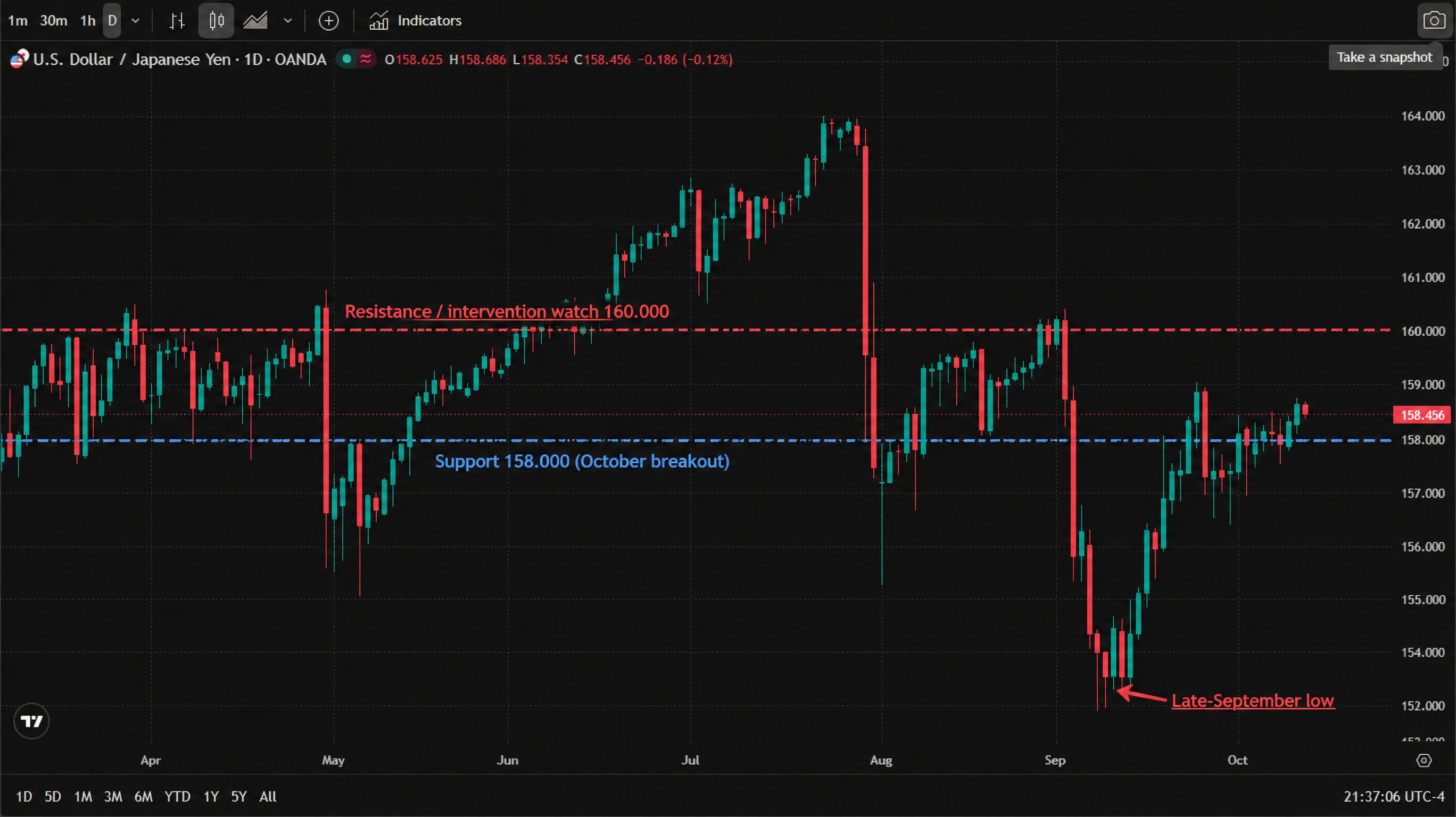
* Chart source: TradingView official chart screenshot, data source OANDA (USD/JPY).
Key levels. Resistance: 16* Chart source: TradingView official chart screenshot, data source OANDA (USD/JPY).0.000 (the intervention-watch line and the year's psychological ceiling) / 161.00 (September's swing high). Support: 158.000 (this month's breakout level — the line the pair has held since October 8) / 156.00 (mid-October shelf) / 153.50 (late-September low). The structure to respect: while 158 holds, the tape is free to probe 159.50; a clean break of 158 would signal the October recovery trade is unwinding.
What to watch: G20 in Bangkok, then CPI
The calendar delivers the catalysts in order. Wednesday's US September CPI (8:30 ET, consensus 3.6%–3.7%) sets the dollar's near-term direction — a hot print revives December Fed-hike pricing (already near 88%) and pushes the pair toward 159.50; a soft print is the yen's best near-term friend. Then on October 15, finance ministers and central bank governors gather in Bangkok for the G20, where Japan's Finance Minister Katayama and US Treasury Secretary Bessent will share a room — any bilateral read-out on currency policy is the most direct intervention signal the market can get. Finally, October 30: the BOJ decision, where a hold is expected but a hawkish dissenting tone would re-price December.
Scenario A — the rate gap keeps winning. A hot US CPI plus a BOJ on hold pushes USD/JPY through 159.50 toward the 160.000 defense line. That is the zone where intervention risk spikes: the MOF's ¥15.4 trillion track record says officials act when the move looks disorderly, and verbal warnings have already started to cluster.
Scenario B — the yen snatches a reprieve. A soft CPI print, a firm BOJ signal, or fresh G20 rhetoric unwinds the crowded short-yen trade: the pair slips back through 158 toward 156, and a deeper unwind — the path some desks still map to 152–152.50 — requires both the Fed to pause and Tokyo to get explicit. The asymmetry to keep in mind: one headline about intervention is worth more than a week of carry.
Read more
Before making any trading decisions, it is important to equip yourself with sufficient fundamental knowledge, have a comprehensive understanding of market trends, be aware of risks and hidden costs, carefully consider investment targets, level of experience, risk appetite, and seek professional advice if necessary.
Furthermore, the content of this article is solely the author's personal opinion and does not necessarily constitute investment advice. The content of this article is for reference purposes only, and readers should not use this article as a basis for any investment decisions.
Investors should not rely on this information as a substitute for independent judgment or make decisions solely based on this information. It does not constitute any trading activity and does not guarantee any profits in trading.
If you have any inquiries regarding the data, information, or content related to Mitrade in this article, please contact us via email: insights@mitrade.com. The Mitrade team will carefully review the content to continue improving the quality of the article.


