



Crypto markets move fast. Sometimes too fast.
A single news headline can push Bitcoin up 5% in hours, or erase the same amount just as quickly. For some traders, this volatility is a problem. For others, it’s an opportunity.
Leverage trading sits exactly in the middle of that tension. This guide is designed to provide a comprehensive walkthrough on how leverage and margin trading with crypto.
What is Leverage in Crypto Trading?
Leverage in crypto trading allows traders to open positions larger than their account balance by borrowing funds from the platform. In simple terms, it increases market exposure without increasing upfront capital.
For example, using 5x leverage with $1,000 means controlling a $5,000 position in Bitcoin.
Imagine a trader opens a long position on Bitcoin with 5x leverage using $1,000. If Bitcoin increases by 10%, the position gains 50% ($500) due to leverage. Conversely, if Bitcoin decreases by 10%, the trader loses $500, which is 50% of their initial capital. Liquidation occurs if losses approach the margin.
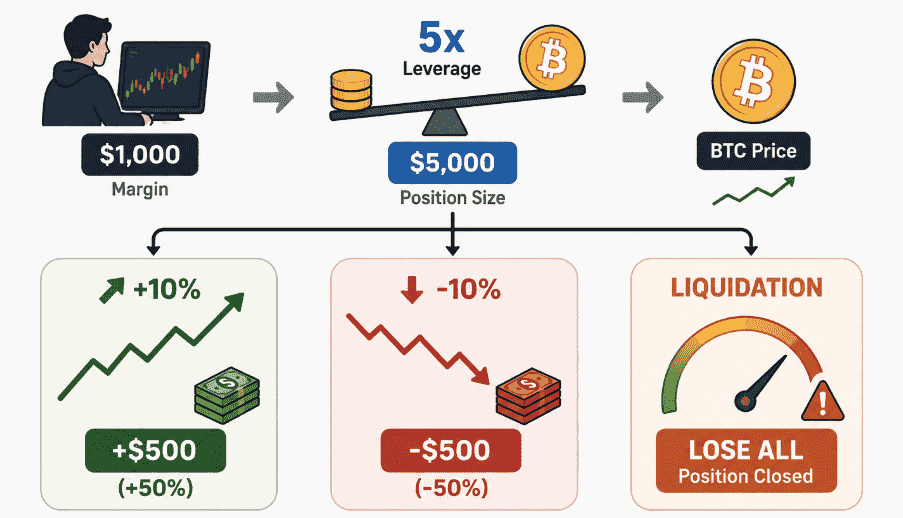
This is why leverage is often described as a double-edged tool. It does not change market direction. It only increases sensitivity to price movement.
The Basics: How Crypto Leverage Trading Works
Spot trading is straightforward. Buying Bitcoin means owning Bitcoin. It can be held, transferred, or stored long-term.You can move it to a cold wallet, hold it for ten years
Leverage trading works differently. It is not about ownership. It is about exposure through a margin-based contract tracks its price movement.
Here is how the basic mechanics work:
The Deposit: You deposit a certain amount of your own funds into your trading account.
The Multiplier: You choose a leverage multiplier (e.g., 2x, 5x, 10x, or even up to 100x on some platforms).
The Borrowing: The exchange provides the remaining capital required to open the position based on your multiplier.
The Trade: You open a position. If you think the price will go up, you "Go Long." If you think the price will go down, you "Go Short."
A simple comparison makes the difference clearer:
The key shift is this: leverage turns trading into a capital efficiency model, not an ownership model.
Margin, Leverage Ratio and Liquidation Explained
The crypto derivatives market is full of jargon, but once you break it down, it is surprisingly straightforward. Let's demystify the holy trinity of leverage trading: Margin, Collateral, and Liquidation.
Margin (Your Collateral)
Margin is the collateral deposited to open and maintain a leveraged position. It acts as a financial buffer between the trader and the borrowed capital provided by the exchange.
In practical terms, it is the “risk deposit” that supports the trade.
Depending on the platform, margin can be held in fiat currencies like USD, stablecoins such as USDT or USDC, or cryptocurrencies like BTC or ETH. Each option carries different exposure to volatility.
Initial Margin: This is the minimum amount of capital required to open a leveraged position. For example, if you want to open a $10,000 position with 10x leverage, your initial margin is $1,000.
Maintenance Margin: This is the minimum equity required to keep the position open as prices fluctuate in real time. When the market moves against the position, unrealized losses reduce account equity. If equity falls below the maintenance margin level, the position enters a critical zone where a margin call may occur or the system will automatically liquidate the trade.
Leverage Ratio
This determines how much your exposure is multiplied. Common levels in crypto trading:
2x – conservative
5x – moderate
10x–50x – high risk
100x+ – extremely aggressive (rarely sustainable)
Liquidation (The Ultimate Risk)
Liquidation is where things become serious.
It is the price level at which the exchange automatically closes your position because your margin can no longer support the loss.
You don’t choose when it happens, the system enforces it, and losses are realized instantly.
Higher leverage = closer liquidation price.
A 50x leveraged position can be liquidated by a 2%–3% move against you. In crypto, that kind of movement can happen in minutes.
Pro-tip: To avoid liquidation, you can either add more collateral to your account (increasing your margin and pushing the liquidation price further away) or set a Stop-Loss order well before the liquidation price is reached.
Choosing Your Platform for Leverage Trading
Finding the right exchange is crucial. You want a platform with deep liquidity (so you can enter and exit trades instantly without slippage), top-tier security, and an intuitive user interface. While the landscape constantly shifts due to regional regulations, Mitrade stands out as a regulated and reliable option for crypto traders.
Mitrade is a regulated broker licensed by ASIC, CIMA, and FSC, offering a safe environment for crypto CFD trading. The platform provides users with access to leveraged trading on multiple cryptocurrencies, including Bitcoin, Ethereum, and popular altcoins.
Leverage Trading Tools in Mitrade:
Stop Loss & Take Profit: Set predefined exit points to limit losses and lock in profits.
Price Charts & Analysis Tools: Advanced charts and indicators for informed decision-making.
Position Management Dashboard: Track margin usage, leverage ratio, and liquidation levels in real-time.
Automated Risk Alerts: Notifications to prevent excessive losses.
Start trading with Mitrade today and experience secure, regulated crypto leverage trading.
Practical Tips for Beginners
The gap between a successful leverage trader and a broke leverage trader is entirely defined by discipline and risk management. Here are golden rules to live by when you start to leverage trading crypto.
1. Use a Demo Account First (Paper Trading)
Almost all major exchanges offer a "Testnet" or "Mock Trading" environment. This gives you fake internet money to practice using the trading interface. Use this for at least a week to ensure you don't accidentally click "Short 100x" when you meant to "Long 2x."
2. The 1% Rule
Never risk more than 1% to 2% of your total trading capital on a single trade. If you have a $1,000 trading bankroll, your Stop-Loss should be set so that if the trade fails, you lose a maximum of $10 to $20. This allows you to lose 50 trades in a row before going broke, giving you plenty of time to learn and refine your edge.
3. Stick to High-Volume Assets
When starting, avoid low-market-cap "meme coins." These coins are easily manipulated by crypto whales and can experience 20% swings in a matter of seconds. Stick to highly liquid, large-cap assets like Bitcoin (BTC) and Ethereum (ETH). Their price movements are generally more predictable and respect technical analysis better.
4. Keep a Trading Journal
Every time you close a trade, log it in a spreadsheet. Write down the asset, the leverage used, why you entered the trade, why you exited, and the profit/loss. Reviewing this journal weekly will help you identify your emotional triggers and technical mistakes.
5. Don't Trade the News
When major economic news drops (like US CPI inflation data or Federal Reserve interest rate hikes), crypto prices go wild. Leverage traders routinely get "chopped up" during these events as prices spike up and down violently before choosing a direction. As a beginner, it is often best to sit on the sidelines during major news events.
Is Leverage Trading Crypto Right for Your Portfolio?
Leverage trading in crypto is often misunderstood as a way to increase returns. In reality, it simply compresses time and volatility into a smaller capital base.
If a trader lacks structure in spot trading, leverage does not fix that. It accelerates it.
The traders who remain consistent over time are not necessarily the ones using the highest leverage, but the ones who understand how quickly risk compounds when exposure increases.
At its core, leverage is not about maximizing profit. It is about managing how much uncertainty a position can survive before the system closes it for you.
Platforms like Mitrade help mitigate some of these risks. Features like automatic liquidation alerts, position size calculators, and integrated stop loss/take profit orders provide safeguards that make leverage trading more accessible to beginners.

 Licensed and Regulated Client Fund Insurance Negative Balance Protection Tight spreads & 0 commissions*

What are the main risks of leveraged crypto trading?
The most significant risk is the magnification of losses, which can rapidly deplete your margin and lead to forced account liquidations. Additionally, the 24/7 volatility of the crypto market can cause overnight price gaps, and funding rates can eat into long-term positions.
What is the best leverage for a beginner in crypto?
As a beginner, it is highly recommended to stick to 2x to 5x leverage. This provides a mild boost to your profits while keeping your liquidation price relatively far away from your entry point. This buffer gives your trades breathing room during normal market volatility and prevents you from losing your capital instantly to sudden market wicks.
Can I lose more than my initial investment in leverage trading crypto?
If you use Isolated Margin, the answer is no; you can only lose the specific collateral you committed to that individual trade. However, if you are using Cross Margin, a severely losing trade can drain your entire futures account balance to prevent liquidation. To be safe, beginners should always use Isolated Margin and set strict Stop-Loss orders.
* The content presented above, whether from a third party or not, is considered as general advice only. This article should not be construed as containing investment advice, investment recommendations, an offer of or solicitation for any transactions in financial instruments.


