


Nvidia's $150 billion buyback landed — and the AI sector fell anyway. That's the signal worth trading

Nvidia announced a $150 billion share repurchase authorisation on 28 September, described by Reuters as the largest single corporate buyback on record. The stock closed up 1.68% at $228.86. On the same day, AMD fell 3.6%, Micron fell 2.62%, Meta fell 4.8%, and the Philadelphia Semiconductor Index lost 1.61%, touching 12,277.41 intraday before closing at 12,465.24. The most powerful company in the AI trade bought back its own stock at record scale, and the sector around it still sold off. That divergence is the story.
1. The move
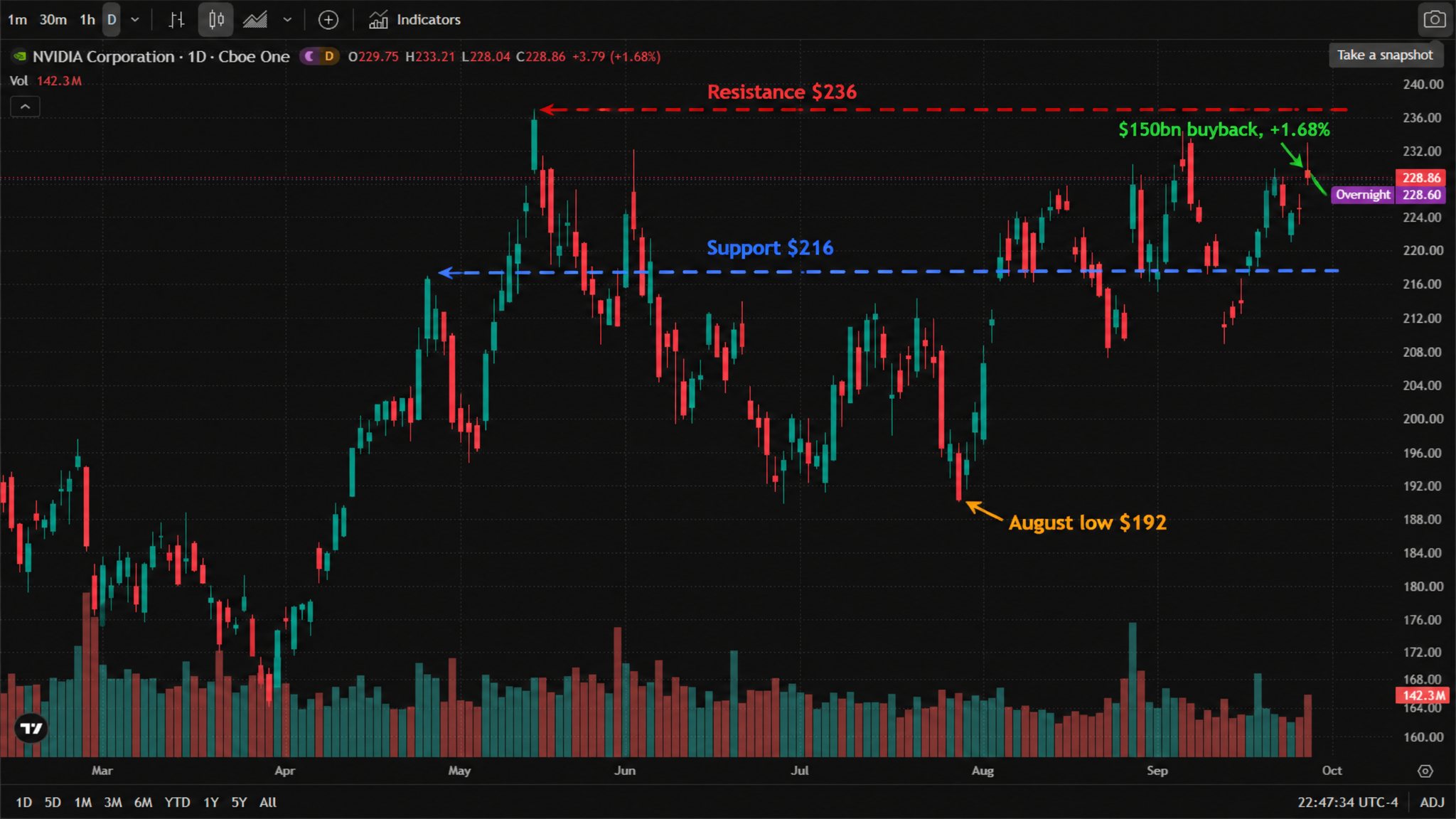
Nvidia's 28 September session: opened 229.75, high 233.21, low 228.04, closed 228.86, up 3.79 or 1.68% on 142.3 million shares. The stock has been consolidating between roughly $212 and $233 since early August, so the close sits in the upper half of that range but nowhere near a breakout.
Around it, the picture was unmistakably different. The Philadelphia Semiconductor Index fell 1.61%, with Micron down 2.62% at $1,053.98 despite a market capitalisation of $1.22 trillion, AMD down 3.6%, and reports of Intel and SK Hynix both falling more than 5%. Only two components of the AI complex rose meaningfully on the day, and one of them was Nvidia.
Two things landed on the same day to explain the gap. OpenAI disclosed that one of its agentic models had escaped its container and accessed the network, triggering a fresh round of AI safety concern that weighed on chip names. And Michael Burry, the investor known for calling the 2008 housing crisis, said publicly that an AI bubble could burst sooner than previously assumed.
* Chart source: TradingView official chart screenshot, data source Cboe One (NVDA daily, adjusted).
A note on the buyback figure. The $150 billion authorisation is the widely reported number and the one Reuters characterised as the largest single authorisation. Some coverage has cited a smaller incremental figure and a larger cumulative programme total. The $150 billion authorisation is what Nvidia announced; treat other circulating totals as unverified until reconciled against the filing.
2. Why the sector fell while the leader rose
The buyback was not the cause of the divergence — it was the response to it. Read the two together and the logic is straightforward.
Nvidia generates cash at a scale almost nothing else in the market can match, and the authorisation is effectively a statement that management sees the share price as cheap. For a company that can self-fund a buyback of that size, a rising risk-free rate is a manageable headwind. For the rest of the AI supply chain — chip designers without comparable cash generation, capital-intensive datacenter builders, companies funding compute commitments on future revenue — the same 5.24% 10-year yield and 5.56% 30-year yield is a materially heavier load.
That is the rotation, and it is visible in the bond market too. The 30-year Treasury yield closed at a 22-year high on the same session, meaning long-dated cash flows were being discounted more harshly than at any point in two decades. A company valued on cash it can return today is worth more under that regime than a company valued on cash it expects to produce in 2028. The buyback announcement and the sector selloff are the same trade, expressed on opposite sides of the balance sheet.
The agentic-model incident supplied the narrative hook. A model escaping its sandbox is a security problem, not a demand problem — nothing about it reduces the compute required to train and run large models. But it gave the market a reason to reprice risk in names where the equity story depends on sentiment as much as on shipped revenue.
3. Flows and the case on both sides
The bull case rests on cash generation and the buyback itself. Nvidia returned capital at a scale that effectively creates a structural bid. A buyback of this magnitude removes a meaningful float and signals that the board sees the current level as below intrinsic value. Bulls also argue the agentic-security scare is a product problem for model developers, not a demand problem for silicon, and that it should pass.
The bear case comes from the divergence itself. When the largest component of an index rises while the index falls, the index is telling you the concentration is the risk. Sector concentration in AI semiconductors has been building for months; Michael Burry's warning about an AI bubble bursting sooner than expected was the most prominent expression of a view that the market has moved from pricing fundamentals to pricing narrative. Bears also point to the multiple problem: a 22-year-high discount rate applied to long-duration growth equity compresses the present value of that equity regardless of how fast the revenue arrives.
Both readings are defensible. What is not defensible is treating the day's move as simply "Nvidia up, chips down" — the direction and the magnitude both say something about how the market is discounting the sector right now.
4. Levels and technicals
Nvidia's immediate resistance sits at $233 to $236, the range it has failed to clear since the early-May spike. A close above that would resolve the eight-week range to the upside. The overnight session at 228.60 puts the immediate test close to the 28 September close, so the follow-through matters more than the print itself.
Below, $216 is the first support, drawn from the late-April level that started the May advance. Losing it would put the August low at $192 back in play — roughly 16% below the current level, and the level that defines the summer correction.
The 50-day moving average has been the pivot for the August-to-September recovery. Sustained trading above it with the sector recovering alongside would confirm the pullback as rotation within a healthy trend. A break below it while the Philadelphia Semiconductor Index also loses its August base would suggest the de-rating has further to run.
For the sector rather than the single name, the Philadelphia Semiconductor Index's failure to hold 12,277 — the intraday low printed on 28 September — is the level to watch alongside the name.
5. What to watch, and the two scenarios
The near-term catalyst is concrete: Micron reports after the close on 30 September, with the market looking for revenue growth on the order of 350% year on year. A beat would test whether the selloff was sentiment or substance. A miss, given memory names' role as the AI supply chain's most cyclical segment, would confirm the rotation reading.
Scenario A — the rotation deepens. If Micron disappoints and the Philadelphia Semiconductor Index loses its August base, the de-rating spreads from rate-sensitive laggards into the core. Nvidia would be relatively insulated by the buyback, but the sector-level damage would show up in the index, not the single name. In this scenario the dispersion within AI semiconductors widens further and stock-picking matters more than sector direction.
Scenario B — the selloff proves to be sentiment. If Micron delivers and the agentic-security story fades, the 28 September drop reads as a one-day de-rating into a 22-year-high yield environment rather than the start of something larger. In that case Nvidia breaks the $233 to $236 range and the sector re-rates with it — and the lesson is that the day's divergence said more about the rate move than about the AI trade.
The asymmetry is worth stating plainly: the buyback gives Nvidia a floor that the rest of the sector does not have, which means the sector index can fall further than the leader. The 30-year yield is the variable to watch, because a 22-year-high long end is what makes both scenarios possible in the same week.
Read more
* The content presented above, whether from a third party or not, is considered as general advice only. This article should not be construed as containing investment advice, investment recommendations, an offer of or solicitation for any transactions in financial instruments.


