


How To Maximize Your Profits With A Trailing Stop Loss? A Practical Guide for Smarter Trade
In trading, one of the most difficult decisions that we face is when to cut our losses or take profits.
You might have a winning trade that has already accumulated some pips but then, you start worrying whether the market will reverse. On the other hand, you might be in a losing trade and you start wondering whether you should cut the trade or hold it, hoping it will recover and go your way.
Both of these scenarios have been known to hurt traders. Luckily for us, there are tools in Mitrade trading platform that can help minimize such emotional dilemmas. One is trailing stop loss order.
What is a Trailing Stop Loss?
Well, our keyword for today has two important parts to it: “Stop Loss”, and “Trailing.”
A stop loss, as we know it, is a market order that automatically cuts our losing trades when they reach a predetermined level. However, to“trail” means to follow something closely. Therefore, a trailing stop loss is a special type of stop loss in that it follows the price as it moves higher or lower.
In short, unlike the fix points stop loss that stop loss in the same place, a trailing stop loss order will move. The system will reset our stop loss with the latest price movements.
Why Many Traders Leave Money on the Table
One of the biggest misconceptions in trading is that profitability comes from predicting the market correctly. In reality, many traders predict direction reasonably well. The problem is they fail to monetize those correct predictions.
Consider these situations:
Scenario 1: The Frustrating Winner
A trader enters a long position on NAS100
The market rallies 150 pips.
At one point, the trade looks fantastic.
Then a small pullback begins.
Fear appears.
The trader closes the position manually.
Final result: +20 pips.
A few hours later, the market continues another 200 pips higher.
The analysis was correct.
The trade management wasn't.
Scenario 2: The Profit That Disappears
A stock trader buys shares after a breakout.
The position quickly gains 5%.
Everything looks good.
The trader decides to hold for more.
No exit plan exists.
A market correction begins.
The stock falls.
The profit disappears.
Eventually the trade closes at a loss.
Again, the problem wasn't market analysis. The problem was profit management.
Many traders focus heavily on limiting losses, which is important. Far fewer spend time developing a systematic method for protecting gains.
Ironically, that missing piece is often what separates breakeven traders from consistently profitable ones.
How A Trailing Stop Works?
►Examples1: Trailing stop 15%
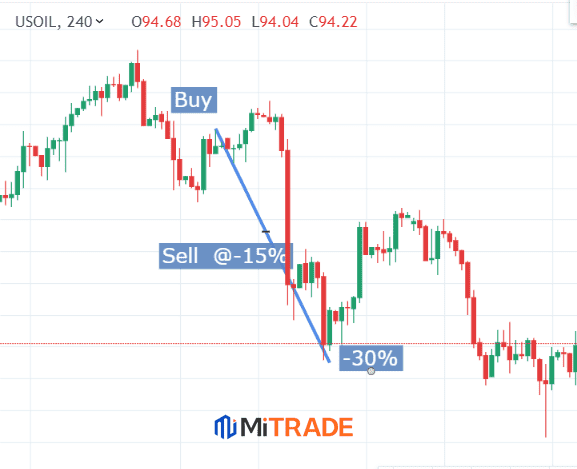
After entering the market, the stock price falls almost in a straight line
The share price fell to hit –15%.
At this point, whether you set a traditional stop loss or a trailing stop loss of 15%, both are stopped at 15%. So trailing stop is equal to a traditional stop loss.
►Examples2: Trailing stop 15%
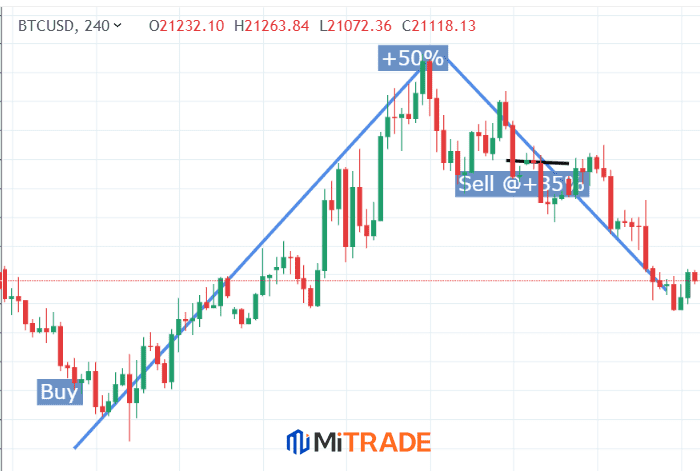
After entering the market, the stock price sprayed sharply. If the stock price rose sharply by 50%! However, after that, the momentum of the stock price began to weaken, and it fell back to the starting point...
At this point, if you set a traditional stop loss, you can only watch the $ float away again.
And if you set the trailing stop loss -15% strategy, it will be triggered when the price drops 15% from +50%. That is, we can make a profit at +35% in the uptrends!
You see a trailing stop order usually works to protect already-won profits from being absorbed back into the market.
In simple terms:
Trailing Stop (%) = Exit when price falls N% from the highest price reached after entry.
Well, you can check out Mitrade platform and see how simple it is to use the trailing stop in a trade.

 Licensed and Regulated Client Fund Insurance Negative Balance Protection Tight spreads & 0 commissions*

How a Trailing Stop Helps Maximize Profits?
It Lets Winners Run
One of the oldest principles in trading is: Cut losses short and let profits run.
Most traders understand this concept intellectually. Far fewer execute it successfully. The reason is psychological. When a trade becomes profitable, the temptation to lock in gains becomes overwhelming.
A trailing stop solves this problem by creating a rules-based framework. Instead of guessing when a trend has ended, the trader allows price action to make that decision. This often leads to much larger winners than would otherwise be captured manually.
It Removes Emotional Decisions
A trailing stop creates objective decision-making. Once the rules are defined, the market determines the outcome.This reduces emotional interference and creates more consistency over time.
Professional traders rarely depend on feelings. They depend on processes.
It Protects Existing Gains
Markets trend. But trends never move in straight lines. Even the strongest bull markets experience pullbacks.
A trailing stop helps preserve profits when those pullbacks eventually become full reversals. Rather than giving back an entire winning trade, the trader exits with a portion of the gains already secured.
Over dozens or hundreds of trades, this can have a significant impact on overall profitability.
How to Set a Trailing Stop Correctly?
A trailing stop is only as effective as the distance selected. Too tight and the market knocks you out prematurely. Too loose and profits evaporate before protection kicks in.
There are 3 popular approaches.
Method 1: Fixed Pip Distance
This is the simplest method. The trader sets a fixed number of pips as the trailing distance.
Example: On EUR/USD, a 20-pip trailing stop.
If the price moves up 20 pips, the stop moves to the entry price.
If the price moves up 50 pips, the stop moves to +30 pips.
The stop moves a fixed distance behind price. Fixed pip trailing stops work best in stable market environments where volatility remains relatively consistent.
Method 2: Percentage-Based Trailing Stops
This method is popular among stock and ETF traders.
Example: 5% trailing stop on a stock.
If the stock rises 5%, the stop moves to the entry price.
If the stock rises 20%, the stop moves to +15%.
The stop follows price by a specified percentage. By this way, you can adapts naturally to asset prices and easily to apply across different securities, but may still be too tight for highly volatile assets.
Method 3: ATR-Based Trailing Stops
This is where many professional traders start paying attention.
ATR stands for Average True Range, a volatility indicator that measures how much an asset typically moves during a given period. Instead of using arbitrary numbers, traders use market volatility itself to determine stop distance.
Example: 1.5 x ATR trailing stop.
If the daily ATR of gold is $20, the trailing distance is $30.
If volatility increases and ATR rises to $30, the trailing distance widens to $45.
For many experienced traders, ATR-based trailing stops provide the most balanced solution because the market itself determines the appropriate distance. By this way we can reduces unnecessary stop-outs, but it is slightly more complex.
How Traders Use Trailing Stops on Mitrade?
Many traders use trailing stop features available on platforms such as Mitrade to automate part of their trade management process.
Rather than monitoring charts constantly, traders can define risk parameters in advance and allow the platform to adjust stop levels automatically as the market moves.

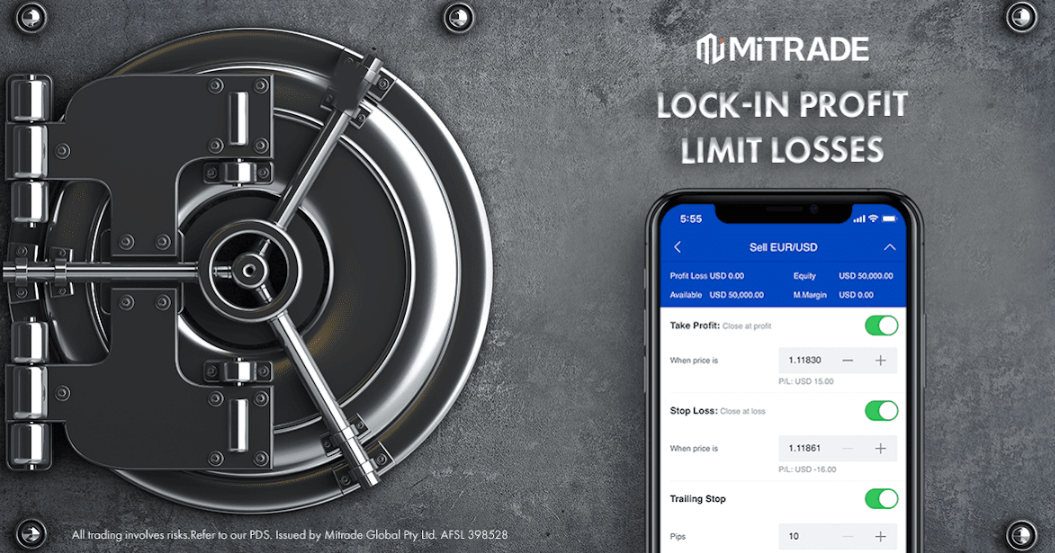
For example, you need to be booking 20 pips, input “20” in the box. Once your trade become profitable and moves to 20 pips, a trailing stop loss will be placed at the entry point of the trade.
Once it goes further and makes 40 pips, then the trailing stop loss will be moved to book 20 pips for you. As such, no matter what happens with this trade, you will always have your 20 pips profit.
It is that simple on the Mitrade platform!
 Risk-Free Demo Account Trade Stock CFDs at Mitrade. 0 commission, low spreads. Enjoy limit and stop loss for every trade!
Advantages of The Trailing Stop Loss Order
1. Unlimited Profits
If the trend had continued lower, the trader would be booking more and more pips. So, if the trend had continued for weeks or months as it does sometimes, the trader would have won thousands of pips for as long as the trend lasted.
2. It is Automatic
A trailing stop moves by itself. you do not need to monitor your charts all the time as it does all the work for you. In this way, fear and greed are eliminated from your trading.
3. It is Flexible
As we have seen, the trailing stop loss order can be customized as per the trader's needs. You can have a trailing stop starting from 1 pip to infinity. It is all up to you.
4. It Adheres to price action rules
The distance set by a trader for the stop distance allows natural price action to happen.
As we all know, the market moves up and down. Therefore, it gives the price time to correct and continue with the trend. In this way, a trader can comfortably ride a trend as far as it goes without premature exits.
Common Trailing Stop Mistakes
Mistake #1: Setting It Too Tight
This is the most common error. Many traders become obsessed with protecting every dollar of profit.As a result, they place stops so close to price that normal fluctuations trigger exits.
So, a trailing stop must allow room for the trend to breathe.
Mistake #2: Activating It Too Early
Some traders activate trailing stops immediately after entering a position. The trade moves slightly into profit. The stop begins chasing price. A minor pullback occurs. The trader gets stopped out.
The trend then resumes without them. A trailing stop works best after a trade has developed meaningful momentum.
Mistake #3: Ignoring Market Volatility
A 20-pip trailing stop may be appropriate for EUR/USD. It is completely inappropriate for Bitcoin. Every market has different volatility characteristics. Trailing stop settings should reflect that reality.
Mistake #4: Using It Without a Trading Plan
A trailing stop is not a strategy. It is a trade management tool. Without a sound entry process and risk management framework, even the best trailing stop cannot produce consistent results.
Trailing Stop vs Take Profit: Which Is Better?
This question appears frequently. The answer is simple. Neither is inherently better. They serve different purposes.
Take Profit
Sets a specific price level where the trade automatically closes.
Works well in range-bound markets or when a known resistance level exists.
Guarantees a certain profit if the price reaches that level.
Does not capture additional gains if the market moves beyond the target.
Trailing Stop
Does not set a fixed target. Instead, it follows the price.
Works well in trending markets where the top is unknown.
Captures large gains during strong trends.
Gives back some profit during pullbacks (by design)
For example:
Close half the position at a predefined take-profit level, and allow the remaining half to run using a trailing stop. This approach balances certainty with opportunity.
Conclusion
A trailing stop loss is a powerful yet highly underutilized risk management tool. If properly applied, it not only minimizes potential risks but also increases the possible profits by allowing the trader to milk as many pips from the market as possible.
From this post, you now have a clear understanding of how it trails the price. You also know that it is a customizable tool that can be tweaked to fit different types of charts or instruments.
Above all, as long as the trailing stop-loss order has been activated, you will always close the trade on the positive side.
Enjoy your new trading tool.
What is the best trailing stop loss percentage?
There is no universal percentage that works for every market. Many stock traders use ranges between 5% and 15%, while crypto traders often require wider settings due to higher volatility. The ideal setting depends on the asset's normal price fluctuations.
Is a trailing stop better than a regular stop loss?
They serve different purposes. A regular stop loss protects capital from excessive losses, while a trailing stop protects profits after a trade moves in the desired direction. Many traders use both during different stages of a trade.
What markets work best with trailing stops?
Trailing stops generally perform best in trending markets. Forex, indices, stocks, gold, and cryptocurrencies can all benefit when strong directional moves develop.
* The content presented above, whether from a third party or not, is considered as general advice only. This article should not be construed as containing investment advice, investment recommendations, an offer of or solicitation for any transactions in financial instruments.


