


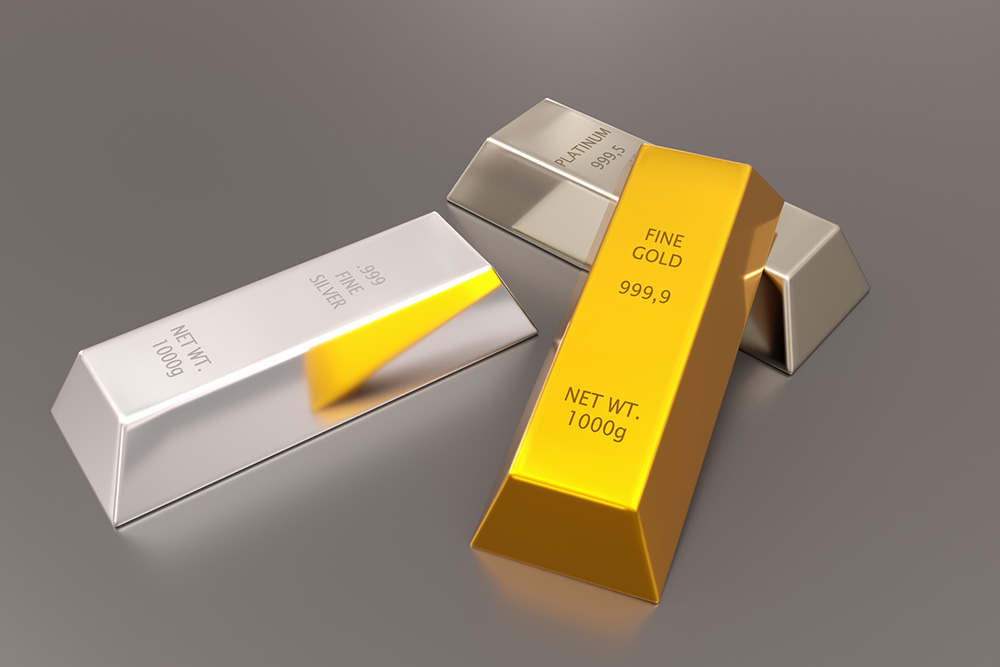
Gold may be the world’s best-known precious metal, but platinum is much rarer and plays a vital role in jewelry, automobiles, and green technology. So, what is platinum, and why is it so valuable? Is platinum more expensive than gold, and is platinum better than gold? The answer depends on factors such as rarity, price, uses, liquidity, and investment goals. This guide compares platinum vs. gold to help you decide which precious metal is the better choice in 2026.
What is Platinum?
Platinum is a dense, precious, silver-white metal represented by the chemical symbol "Pt" and atomic number 78. It is one of the members of the Platinum Group Metals (PGMs) which are the exclusive category of transition metals because of their remarkable chemical stability, extremely high melting point (1,768°C/3,214°F), and high oxidation resistance. In contrast to other metals that can deteriorate in contact with air, moisture, and high temperatures, platinum is almost absolutely inert chemically.
Physical Properties of Platinum
To understand platinum's unique value, consider these three core physical traits:
Extreme Rarity (~30x Rarer Than Gold): Primary global mining output is geographically concentrated, with annual production averaging just 180–200 metric tons—about 15 times less than gold.
High Density & Weight: With a specific gravity of 21.45 g/cm³ (compared to gold's 19.32 g/cm³), platinum is extremely dense. A platinum piece feels noticeably heavier and more substantial in hand than an identical gold piece.
Natural Silver-White Color: Platinum is naturally silver-white and will never change its color. It must be kept in mind that while white gold is yellow gold with a rhodium coating, this coating fades over time.
What is Platinum Used For?
While over 90% of gold goes into jewelry and financial reserves, platinum is a heavy-duty industrial metal. Its global demand is driven by three main sectors:
✅Automobile Industry and Catalysts: Makes up about 40% of global usage and is used as an important ingredient in catalytic converters to convert harmful exhaust gases into non-harmful gases.
✅Green Technology and Renewable Energy: Works as a major catalyst in PEM electrolyzers for creating green hydrogen as well as in zero-emission hydrogen FCEVs.
✅Precious Jewellery & Luxury Items: Sought after due to its high purity of about 95% and hypoallergenic properties, providing an excellent setting for precious stones in luxury jewellery.
✅Industrial Uses & Medical and Technical Applications: Important for high-temperature lab equipment, spark plugs, fiber optics, pacemakers, and lifesaving anticancer medicines.
What Are the Key Differences Among Gold and Platinum?
To choose between gold and platinum, it helps to compare their key features side by side:
Platinum Price vs. Gold Price: A 20-Year Historical Overview (2006–2026)
Platinum has been traditionally regarded as the most expensive metal with a price premium over gold for many decades. The last twenty years have witnessed a significant change in the platinum-gold price structure where the status is the historically high premium of gold price over platinum.
Why Was Platinum More Expensive Than Gold… and Why Did Its Price Decline Later?
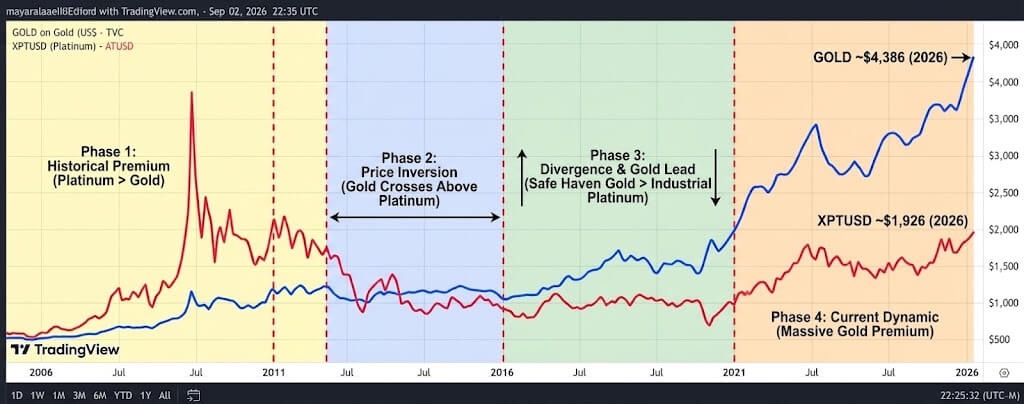
The Historical Premium Era (Pre-2011): In terms of historical background, platinum enjoyed a premium price in the market due to its rarity and rising industrial demand, especially in Europe's automotive industry. Before 2011, platinum used to outperform gold by rising to unprecedented levels of more than $2,200 per ounce, while gold was trading much cheaper.
The Diesel Shift & Industrial Decline (2012-2015): The dynamics of the market changed radically in the 2012-2015 period. Due to rising regulations on emissions and a decrease in diesel cars (as they require platinum in their catalytic converters), there was a decreased demand for platinum. The car manufacturers were also switching from platinum to palladium.
Gold’s Rise as a Safe Haven: Concurrently, global economic uncertainties and inflation drove record investment demand for gold. Central banks aggressively accumulated gold as a monetary reserve asset, pushing gold prices upward. By 2015, gold officially surpassed platinum in price, executing a historic market inversion.
The Market Dynamic in 2026: Today, gold continues to command a massive premium over platinum. Driven by record safe-haven demand, gold trades around $4,500 per ounce, while platinum hovers between $1,800 and $2,000 per ounce. The Gold/Platinum price ratio remains above 2.5, cementing gold's role as a monetary hedge and platinum's status as a value-driven industrial metal.
Is Platinum Better Than Gold? (Jewelry vs. Investment)
As far as which metal is superior, that really depends upon one’s objective because there are different objectives when it comes to deciding between platinum and gold.
◆ 4.1 For Jewelry & Daily Wear
When evaluating fine jewelry, platinum offers technical durability, while gold provides styling flexibility:
🔸Durability: Due to platinum’s high density, it does not lose material when scratched; the metal simply shifts, developing a characteristic soft patina over time. Gold is comparatively softer and gradually loses microscopic particles through daily wear and friction.
🔸Hypoallergenic Property: Platinum jewelry is crafted at high purity levels (typically 90%–95% pure; Pt900/Pt950), making it 100% hypoallergenic. Pure gold (24K) is also hypoallergenic, but gold jewelry is usually alloyed with other metals (like copper, silver, or zinc) for strength, which can occasionally trigger skin sensitivities in some wearers.
🔸Maintenance: Platinum naturally retains its silver-white color forever without needing protective chemical coatings. Gold jewelry, depending on its purity and alloy mix, requires periodic polishing or re-finishing over time to restore its original luster.
🔸Color Range and Price Flexibility: Gold offers significantly higher aesthetic flexibility through its various color alloys (yellow, rose, and white) at a lower overall metal weight and a wider range of price options compared to platinum, which naturally comes only in silver-white.
◆ 4.2 For Investment & Portfolio Diversification
From a financial market perspective, both metals play distinctly different strategic roles:
🔸Platinum as an Industrial and Green Energy Metal: The investment worth of platinum is mainly dependent on economic growth, car catalyst production and use in green technologies like PEM electrolyzers and FCEVs. Meanwhile, the investment worth of gold lies in the monetary security provided by the metal, being the reserve currency for the central banks of many countries and serving as a systemic risk hedge.
🔸Supply Risk: The platinum mining takes place mainly in limited geographic areas, making the metal susceptible to interruptions of the production and power grid issues in those regions. Meanwhile, the gold is mined throughout all continents, thus offering stability of the world supplies of the metal and reduced risks linked with the supplies.
🔸Gold as a Financial Hedge Asset: Gold is the perfect monetary haven and inflation hedge, with massive support from global monetary reserves held by central banks. Platinum is not a monetary asset held by central banks.
What Factors Influence the Price of Platinum?
The price of platinum is affected by an interesting mix of industrial demand-supply conditions and macroeconomic dynamics. Some of the determinants of platinum price are:
1. Automotive Demand: More than 40% of global platinum consumption is used in the automotive sector for catalytic converters. The transition to EVs and changes in automobile manufacturing affect market prices.
2. Mining Supply & South African Mining: About 70% of the world's mining of platinum takes place in South Africa. Strikes, lack of electricity supplies (issues with Eskom), and high mining costs often result in supply shortages and higher prices.
3. Green Hydrogen & Technological Trends: Growing investments in the world in PEM electrolyzers and fuel cell electric vehicles (FCEVs) act as a long-term catalyst for the demand side of platinum.
4. Macroeconomic Fundamentals & USD: As with most commodities, the platinum price is denominated in United States Dollars (USD). A strong USD will affect platinum prices negatively, while inflation and lower interest rates can favor investors.
5. Platinum-to-Palladium Substitution: Automakers tend to substitute platinum with palladium (or vice versa) depending on their cost advantages in the manufacture of catalytic converters.
Pros and Cons of Investing in Platinum
Before adding platinum to your investment portfolio, it is important to evaluate the specific growth potential and the inherent risk of the market:
Pros of Investing in Platinum
✅Extreme Rarity: Platinum is about 30 times rarer than gold in the Earth’s crust, making it a highly valuable scarce asset.
✅High Upside Potential from Hydrogen Transition: With the adoption of PEM electrolyzers and fuel cell electric vehicles (FCEVs), platinum stands to benefit greatly from the clean energy revolution.
✅Historical Valuation Discount: At a historically discounted price relative to gold, platinum is an extremely attractive investment.
Cons of Investing in Platinum
❌Higher Price Volatility: Since platinum prices are extremely sensitive to fluctuations in industrial economic cycles, they are more volatile than gold prices.
❌Lower Market Liquidity Than Gold: The size of the platinum market is substantially smaller than the gold market, resulting in an increased spread between ask and bid prices.
❌Industrial Demand Dependency: Around 65% of platinum demand comes from industries, which makes its price susceptible to global economic recession.
How to Invest in or Trade Platinum?
You can gain exposure to platinum through several methods, each with its own risk profile.
- Physical Platinum: In cases of purchasing physical platinum such as Pt9995 bars and coins (American Platinum Eagle) there is no need for counterparty risk, and the investor owns physical metal. But the need for proper security and storage is needed along with insurance of the metal.
- Platinum ETFs & Mutual Funds: Exchange-traded funds that are linked to the performance of the metal price are another option. They offer liquidity and don’t involve physical storage.
- Platinum Mining Stocks: Stock investment in companies that engage in mining the metal means having a higher level of leverage, but it implies greater risks due to the company’s performance.
- Platinum CFDs Trading: With CFDs, speculators can trade based on movements in platinum prices in both uptrends and downtrends without actually owning the asset. Trading platinum through platforms like Mitrade offers key benefits, including the ability to use leverage, trade in both directions (long or short), tight spreads, and fast order execution. However, using leverage involves high financial risks and requires disciplined risk management.

Conclusion
The choice between gold and platinum depends on your investment goals. Gold provides classic safe haven stability, whereas platinum promises growth fueled by industrial usage and green energy. While long-term investors often hold both metals to build a balanced portfolio, active traders can capture short-term price swings through Contracts for Difference (CFDs). Trading platforms like Mitrade make this accessible by offering 0% commission, tight spreads, and competitive leverage.

FAQs
Q1: Will platinum ever be worth more than gold again?
Possible long-term, but unlikely in the near term. Gold's status as a central bank reserve and safe-haven asset keeps its price high. Platinum would require a major surge in green hydrogen demand and severe South African mining deficits to flip gold again.
Q2: Does platinum scratch more easily than gold?
They scratch at similar rates, but platinum doesn't lose metal. Gold scratches shave off tiny particles over time. Platinum scratches simply displace the metal, forming a prized vintage finish called a patina.
Q3: Is white gold the same as platinum? No, they are completely different.
Platinum: A naturally white, highly dense, 95% pure noble metal that never yellows and is 100% hypoallergenic.
White Gold: Yellow gold alloyed with white metals and plated with rhodium, requiring re-plating every 1–3 years as it wears off.
* The content presented above, whether from a third party or not, is considered as general advice only. This article should not be construed as containing investment advice, investment recommendations, an offer of or solicitation for any transactions in financial instruments.


