


Virgin Galactic Stock Forecast: Why SPCE Crashed 32% After the SpaceX IPO
TradingKey - Virgin Galactic (NYSE: SPCE) jumped 21.7% to $5.73, a move retail investors drove as a substitute for SpaceX ahead of the rocket company's NASDAQ listing. However, on June 12, the stock finished at $3.91, falling 31.76% in a single session, the largest drop of all major space stocks on SpaceX IPO day. Rocket Lab slid 7.7%, Intuitive Machines dropped 15%, Redwire fell 14%, and Virgin Galactic shed 31.76%. The week encapsulated the trajectory of borrowed hype: those who paid $5.73 for shares at Thursday’s close were down 32% at Friday’s close.
The primary structural factor contributing to SPCE falling harder than its competitors in Q1 2026 was the company’s $227,000 in revenue, $65 million in net loss, and roughly $251 million in cash with a burn rate of roughly $90 million per quarter (roughly 2.5 quarters left on the runway). The whole focus now will be on the Delta-class programme executing Q3 glide tests and the first commercial spaceflight in Q4 2026 as planned.
SPCE Drops 32% While Rocket Lab Only Falls 7.7%: The Explanation for SpaceX's Proxy Trade in Full
The broad space sector rotation tied to SpaceX on June 12 was directly relative to the amount of hype-driven pricing in the price of any given space company. Rocket Lab brought in $344.1 million in Q1 2026 revenue, has a $2.2 billion backlog, and has locked government contracts with Anduril, Raytheon, and the SDA, a company that makes money and exists regardless of the broader sentiment surrounding SpaceX. When the SpaceX proxy trade unwound, RKLB lost out on the upside from sentiment in addition to the real business.
Virgin Galactic had Q1 2026 revenue of $227,000, basically $0 when rounded off against any other space company, and a net loss of $65 million. When the sentiment upside unwound there was basically nothing underneath. The complete price movement over the course of the week bears that out: SPCE rose 14% on June 5 after the SpaceX roadshow began (which is how the classic 'buy-the-rumour' cycle typically plays out), rose a further 21.7% on June 11 when the excitement around the SpaceX IPO reached its peak, and then fell 31.76% on June 12 when the more direct SpaceX alternative went public (anyone who tracked that entire cycle all the way back to the entry on June 5 was still down on the week).
This is a story not about SpaceX IPO-driven rotation negatively impacting the otherwise healthy business of any other space sector stock but rather about a stock with virtually no fundamental floor that was wholly priced to narrative proximity to a much bigger story. The takeaway for investors eyeing a position in Virgin Galactic at today's $3.91 is that the SpaceX-as-the-catalyst-for-the-price-of-Virgin-Galactic argument has run its course and the only remaining argument for the equity is the Delta-class programme.
The Actual Investment Case for SPCE: Delta-Class, 650 Astronauts, and a 2.5-Quarter Time Limit
Ignoring the noise surrounding the SpaceX IPO, the investment case for Virgin Galactic centers on one programme: Delta-class. The first Delta-class spaceship has already been rolled out of the Assembly Hangar and into the Test-and-Launch Hangar and VSS Unity is now engaged in glide-flight testing at Spaceport America. Michael Colglazier, Virgin Galactic's CEO, said on the May earnings call that Q3 2026 glide tests and a Q4 2026 first commercial spaceflight are on schedule.
At that point, the 650 founding astronauts that have booked seats at $750,000 apiece would represent about $487 million in contracted demand that doesn't need to be sold, just flown, according to the press release. If the Q3 and Q4 flight schedule comes in as planned, the company's projected cashflow in Q4 2027 is marginally positive. The only thing preventing this thesis is the cash clock. The firm has $251 million in cash on board, running through roughly $90 million quarterly, so we have 2.5 quarters of runway, right now.
Yesterday, they also raised $30.5 million by redeeming a portion of their 9.80% first lien notes in an exchange for common equity, pushing the remaining debt maturity out to March 2028, effectively eliminating the near-term risk of default and lowering future interest costs. The deal added to an already diluted share count, but with a $40.21 million mixed securities shelf registration in the books, management now holds the ability to print more shares if there's any notable rally. As the company burns its remaining cash without commercial flight revenue, the dilution risk becomes more pressing every quarter. Q3 2026 glide tests and Q4 2026 first commercial flight are milestones, but in some ways, they are more vital life signs than anything else.
SPCE Trading Setup — $3.56 Support, 2.5-Quarter Catalyst Window, Risk-Defined Entry
The intraday low from Friday, June 12, at $3.56 is the first support reference we have. There were two failed attempts during the session to get back to $4.00, followed by a steady high-volume push through the close at $3.91, this is distribution, not a dip. If you are an active trader, the source analysis recommends a risk-defined entry around or beneath the $3.56 Friday intraday low, with a stop underneath $3.35 and a target of $4.50 on volume stabilization and confirmed support. We need $3.56 to hold as a floor, and if that breaks to the downside we could see a retest at lower levels leading into the Q3 glide test catalyst.
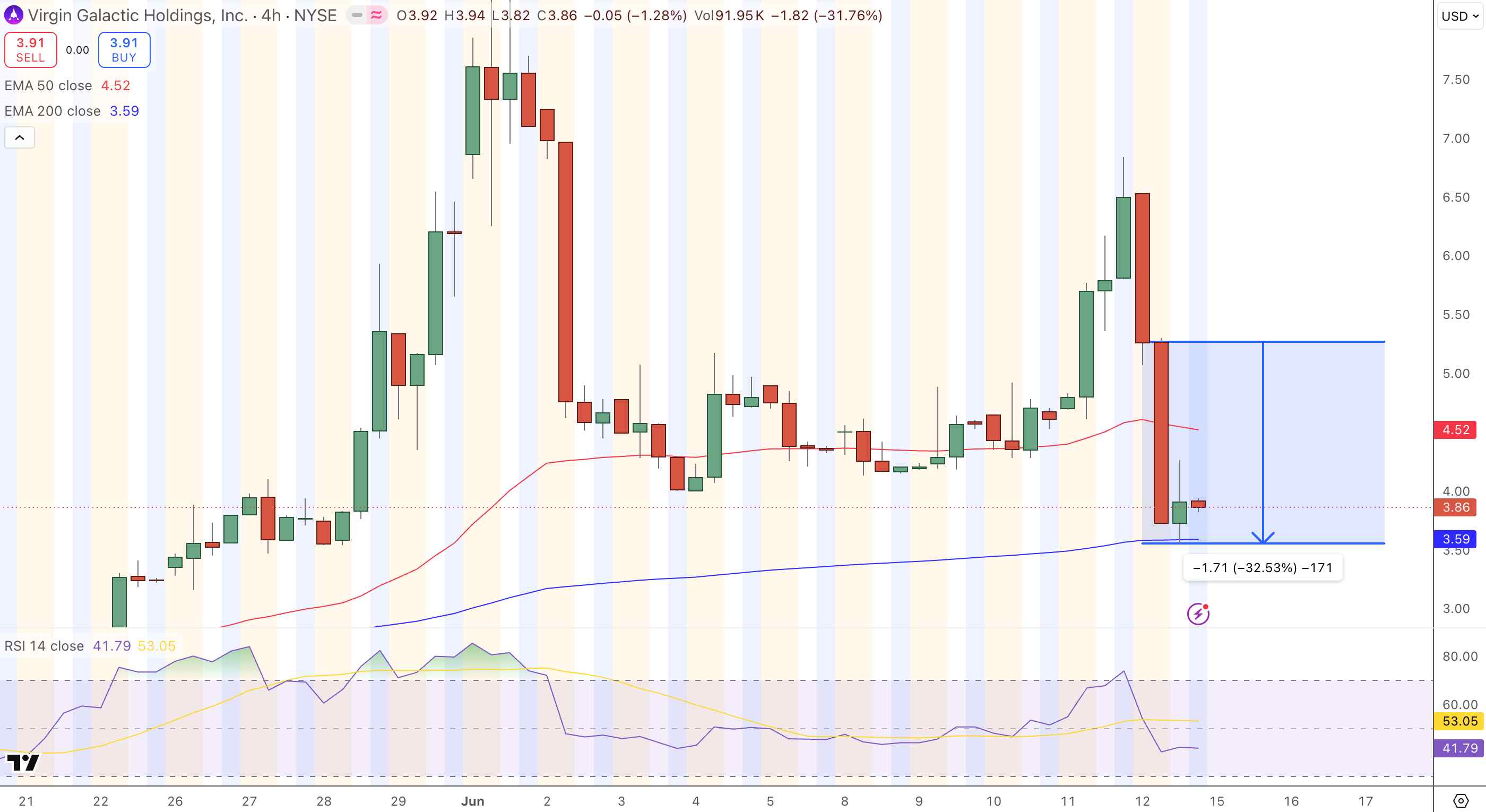
For any longer term holders, I don't know what your risk tolerance is here, but the position size should reflect the binary nature of the Q3 and Q4 milestones, and the 2.5 quarter runway. Q3 2026 glide tests and an on-schedule Q4 first commercial spaceflight will re-rate this stock considerably, as the 650 founding astronaut seats at $750,000 apiece will soon be cashed out. Should the Q3 glide tests or Q4 flights get delayed, the company may need to do another capital raise in dilutive fashion, putting the modestly positive cash flow projected at Q4 2027 further out of reach. This is a binary position, a high risk one, not a position you bet your life savings on.
Traders:
- Entry: Near or below $3.56, Friday intraday low
- Target: $4.50, on volume stabilization and confirmed support
- Stop Loss: Below $3.35, support structure removed
- Milestones: Q3 2026 Delta-class glide tests, Q4 2026 first commercial spaceflight
- Runway: $251 million, $90 million burn quarterly, ~2.5 quarters
Bottom Line
Virgin Galactic’s 32% drop on SpaceX IPO day was the endgame of a proxy position unrelated to SPCE fundamentals. At Q1 2026, Q1 2026 revenue of $227,000 versus net loss of $65 million was no defense against sentiment change. The Delta thesis has now shifted.
What matters is:
- Q3 2026 glide tests
- Q4 2026 first commercial spaceflight
- 650 founding astronauts at $750K each
- roughly 2.5 quarters of cash runway to complete these goals
We are now on the final stretch where the gap between story and real revenue is narrowing. Each milestone achieved, the cash clock stretches and less dilution risk looms over us. Each missed target or quarter wasted tightens the clock and dilutes investors more.
Trader entry point: $3.56, stop point: less than $3.35, target: $4.50. The Q3 and Q4 catalysts are where it counts.
Recommended Articles


