


Better Stock to Buy Now: Amazon vs. Microsoft
Key Points
Amazon is more leveraged to cloud computing than Microsoft is.
Both companies are growing and are valued similarly.
- 10 stocks we like better than Amazon ›
Two of the largest and most important companies in the world are Microsoft (NASDAQ: MSFT) and Amazon (NASDAQ: AMZN). Both companies rank among the top five largest companies in the world, coming in at fourth and fifth, respectively. However, investors may be torn between which is the better choice.
On the surface, they look like completely different businesses, but the more you dig, the more you'll find they have in common. But which is the better buy? Let's find out.
Will AI create the world's first trillionaire? Our team just released a report on the one little-known company, called an "Indispensable Monopoly" providing the critical technology Nvidia and Intel both need. Continue »

Image source: Getty Images.
Cloud computing is a major component for each
Ask your average person what each company does, and you'd likely get a response along the lines of: "Microsoft makes computer software, and Amazon sells goods and delivers them." While those two statements aren't wrong, they ignore the most important part of each business: cloud computing.
Both Microsoft and Amazon have major cloud computing divisions, with Microsoft Azure and Amazon Web Services (AWS) integral to their businesses. The effect cloud computing has on their businesses is impressive, especially with Amazon. AWS accounted for 59% of operating profits in Q1 despite generating only 21% of total revenue. Microsoft is less granular with its cloud reporting, and we only know that it grew 40% year over year -- Microsoft's fastest-growing individual unit.
These two are very similar businesses and are the primary reasons to invest in the stock, but you're not going to find much difference between the two, so let's look at their other business segments.
For Microsoft, a significant chunk of its sales comes from business productivity software, a high-margin business that's pretty safe during a downturn. Amazon's commerce business is also solid, but it operates on a low-margin model (sometimes at a loss) and can be impacted by consumer sentiment.
Microsoft has a stronger core business outside of cloud computing, so I'm giving it the win here.
Winner: Microsoft
Both companies are growing at a similar rate
During their most recent quarters, each business grew at around the same pace. Microsoft's revenue rose 18% year over year, and its cash from operations rose 26%. Cash from operations is a better metric for these two companies than earnings because each is spending heavily on data centers and also has various one-time effects coming from significant investments in generative artificial intelligence firms like Anthropic and OpenAI.
Amazon's revenue grew 17% year over year, but its cash from operations rose 53% thanks to AWS' strength.
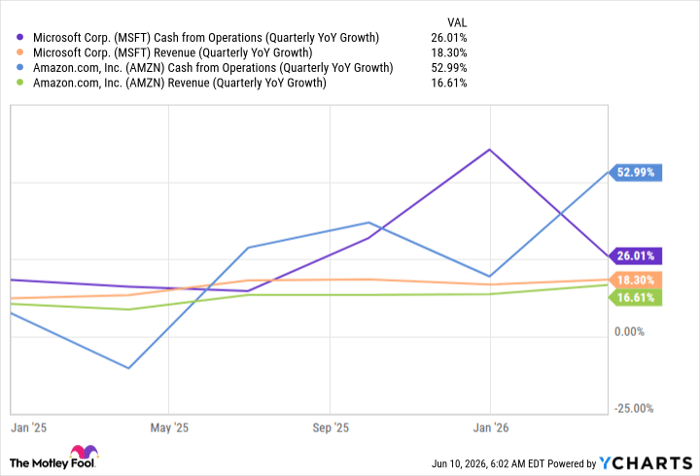
Data by YCharts.
Because there is such a difference in profit margins between Amazon's commerce and cloud business, it will likely continue to grow cash from operations at an outsize pace for some time, as its high-margin business is growing far faster than its low-margin businesses. Microsoft is more balanced and won't show as rapid a cash flow growth as Amazon will in the future.
Winner: Amazon
Both stocks are priced cheaply from a historical standpoint
Sticking with the trend of using cash from operations, both stocks are valued at a pretty cheap level, at least compared to the last five years.
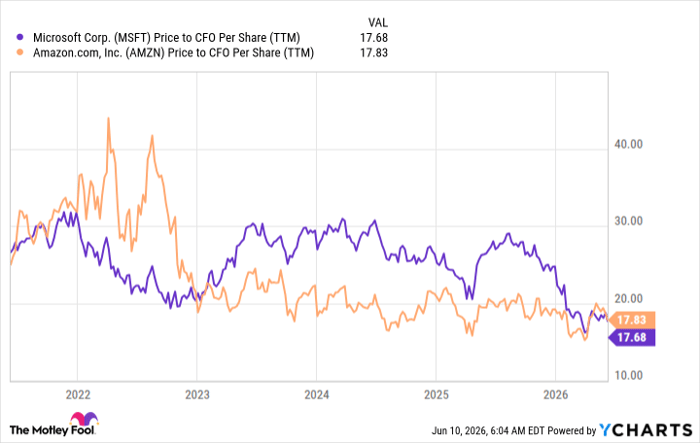
Data by YCharts.
This price tag, especially for Microsoft, is far off from its normal levels. Even Amazon is valued decidedly lower than it was over the previous few years, but it's not down as much. With both companies trading at nearly identical prices, I don't know if I can call one a winner here. They are both excellent stocks to buy and have the same price tag. As a result, I'm going to call this one a tie.
Winner: Tie
A tie?!
The reality is that both Amazon and Microsoft are excellent investments. I don't think investors can go wrong with either, and with their attractive prices, now is a perfect time to buy. However, this analysis cannot just end in a tie. If I'm looking for a differentiating factor, I think Amazon has it.
Amazon's custom AI chip business is exploding, growing at a triple-digit year-over-year pace. Additionally, it has deep partnerships with Anthropic. While Microsoft has its own custom AI chip and has a partnership with OpenAI, Amazon's custom chip business is doing better, and by all accounts, Anthropic's models are outperforming OpenAI's. As a result, I'll give the edge to Amazon at the moment.
Should you buy stock in Amazon right now?
Before you buy stock in Amazon, consider this:
The Motley Fool Stock Advisor analyst team just identified what they believe are the 10 best stocks for investors to buy now… and Amazon wasn’t one of them. The 10 stocks that made the cut could produce monster returns in the coming years.
Consider when Netflix made this list on December 17, 2004... if you invested $1,000 at the time of our recommendation, you’d have $433,268!* Or when Nvidia made this list on April 15, 2005... if you invested $1,000 at the time of our recommendation, you’d have $1,259,391!*
Now, it’s worth noting Stock Advisor’s total average return is 935% — a market-crushing outperformance compared to 206% for the S&P 500. Don't miss the latest top 10 list, available with Stock Advisor, and join an investing community built by individual investors for individual investors.
See the 10 stocks »
*Stock Advisor returns as of June 14, 2026.
Keithen Drury has positions in Amazon and Microsoft. The Motley Fool has positions in and recommends Amazon and Microsoft. The Motley Fool has a disclosure policy.
Recommended Articles


