


Better AI Growth Buy Right Now: Nvidia vs Micron
Key Points
Nvidia and Micron both serve AI customers with products crucial for their success.
These stocks have each soared more than 1,000% over the past five years.
- 10 stocks we like better than Nvidia ›
Nvidia (NASDAQ: NVDA) and Micron Technology (NASDAQ: MU) each have seen revenue soar amid this artificial intelligence (AI) boom. This is because these companies offer something that is crucial for the development and performance of this hot technology: compute power, and memory and storage.
Nvidia is the compute expert, designing the fastest graphics processing units (GPUs) around, while Micron offers the memory and storage necessary for AI tasks. Investors have recognized these companies' strengths and have rushed to get in on the stocks. As a result, Nvidia and Micron each have climbed more than 1,000% over the past five years.
Will AI create the world's first trillionaire? Our team just released a report on the one little-known company, called an "Indispensable Monopoly" providing the critical technology Nvidia and Intel both need. Continue »
Both of these companies are likely to win as this AI story continues to unfold. But if you could only invest in one today, which is the better AI growth buy? Let's find out.

Image source: Getty Images.
The case for Nvidia
Nvidia is the leading designer of GPUs, the chips powering key AI tasks like the training and inference of AI models. Though rivals also offer compute, and in many cases are delivering revenue growth too, Nvidia remains a big step ahead. Companies may invest in a broad range of compute, but those who aim to win in AI generally rely at least partially on Nvidia's GPUs -- their high speed helps customers reach the finish line faster and may result in a lower total cost of ownership over time.
But Nvidia doesn't rely on GPUs alone. The company offers a full portfolio of related products and services, and today it's in the process of entering another enormous market: the central processing unit (CPU) market. These are the chips that generally power all computers, and they are a key tool to fuel AI agents, the next area of AI growth. Nvidia is launching its first-ever stand-alone CPU this fall and is conquering the CPU for PC market with a new superchip. This may set it on track for leadership in this $200 billion market.
Nvidia also has designed products and services specifically for certain markets, from telecom to healthcare and robotics, which offers it a pretty significant revenue growth opportunity moving forward.
The case for Micron
Micron, as mentioned, is an expert in memory and storage -- two critical elements for AI customers, particularly as the era of AI agents unfolds. AI agents go through a thought process and carry out steps, in many cases multiple steps, to solve a particular problem. For this, they clearly need compute power but also memory and storage.
Demand for these products has been so high that Micron recently reported records in revenue, gross margin, earnings per share, and free cash flow, and revenue from DRAM and NAND, two types of memory, increased in the triple digits.
"In the AI era, memory has become a strategic asset for our customers," the company said in the latest earnings update.
Micron has noted increased adoption of AI agents in PCs and smartphones, a point that supports ongoing demand for the company's products.
The tech giant expects earnings records in the current quarter, the third fiscal quarter. Micron predicts free cash flow will "roughly double sequentially" in the period. And it forecasts third-quarter revenue of $33.5 billion, a record high for any quarter or year so far.
The biggest headwind for Micron at this point is supply -- due to supply constraints, it's unable to serve 100% of its customers' needs.
Which stock is the better buy?
Though Nvidia and Micron both have climbed this year, Micron's advance is much steeper than that of Nvidia. It's soared more than 240%, while Nvidia has added 9% as of the June 11 market close.
Micron actually is cheaper than Nvidia: It trades for 16x forward earnings estimates, while Nvidia trades for 22x. But while Nvidia's valuation has fallen this year, Micron's has increased.
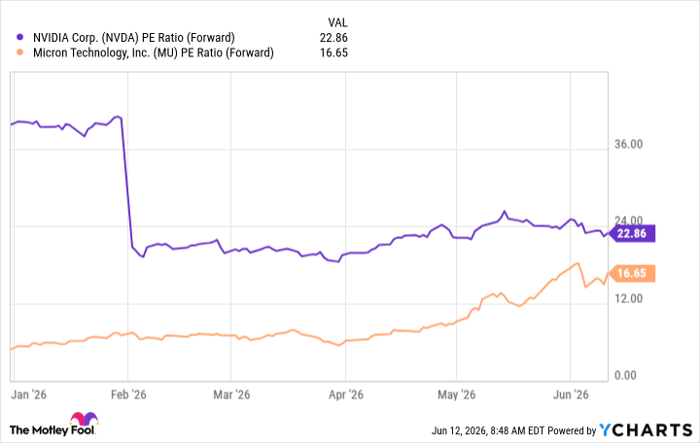
NVDA PE Ratio (Forward) data by YCharts
I think Micron is a great stock to own, but the run-up in its price and rising valuation suggest this player could be heading for a pullback at a certain point. Meanwhile, Nvidia, at today's valuation, offers investors a fantastic buying opportunity. And that's why, today, I think Nvidia is the better AI growth buy to add to a tech portfolio.
Should you buy stock in Nvidia right now?
Before you buy stock in Nvidia, consider this:
The Motley Fool Stock Advisor analyst team just identified what they believe are the 10 best stocks for investors to buy now… and Nvidia wasn’t one of them. The 10 stocks that made the cut could produce monster returns in the coming years.
Consider when Netflix made this list on December 17, 2004... if you invested $1,000 at the time of our recommendation, you’d have $433,268!* Or when Nvidia made this list on April 15, 2005... if you invested $1,000 at the time of our recommendation, you’d have $1,259,391!*
Now, it’s worth noting Stock Advisor’s total average return is 935% — a market-crushing outperformance compared to 206% for the S&P 500. Don't miss the latest top 10 list, available with Stock Advisor, and join an investing community built by individual investors for individual investors.
See the 10 stocks »
*Stock Advisor returns as of June 14, 2026.
Adria Cimino has no position in any of the stocks mentioned. The Motley Fool has positions in and recommends Micron Technology and Nvidia. The Motley Fool has a disclosure policy.
Recommended Articles


