


Japanese Yen depreciates due to softer CPI, stronger US Dollar
- The Japanese Yen lost ground as Japanese CPI fell to 2.5% YoY in April from 2.7% prior.
- The Japanese inflation remains above the 2% target, keeping the BoJ under pressure to tighten policy further.
- The US Dollar gained ground as stronger US PMI data reinforced that the Fed may maintain higher rates for longer.
The Japanese Yen (JPY) continued its decline on Friday after the release of softer National Consumer Price Index (CPI) data by the Statistics Bureau of Japan. The annual inflation rate dropped to 2.5% in April from 2.7% in the previous month, marking the second consecutive month of moderation but still staying above the Bank of Japan’s (BoJ) 2% target. This sustained inflation keeps pressure on the central bank to consider further policy tightening.
The Bank of Japan has emphasized that a virtuous cycle of sustained, stable achievement of its 2% price target along with strong wage growth is essential for normalizing policy. Meanwhile, investors expect that the persistent weakness of the JPY might compel the BOJ to advance its next interest rate hike to mitigate the impact on the cost of living, according to Reuters.
US Dollar (USD) advances on hawkish sentiment surrounding the Federal Reserve (Fed) of maintaining higher policy rates for an extended period. This sentiment is reinforced by the higher-than-expected Purchasing Managers Index (PMI) data from the United States (US) that was released on Thursday.
According to the CME FedWatch Tool, the probability of the Federal Reserve implementing a 25 basis-point rate cut in September has decreased to 46.6% from 49.4% a day earlier.
Daily Digest Market Movers: Japanese Yen extends losses after softer CPI
- Japan’s Core CPI (YoY), which excludes fresh food but includes fuel costs, rose 2.2% in April as expected, slowing for the second straight month, as compared to March’s reading of 2.6%.
- The S&P Global US Composite PMI jumped to 54.4 in May, from 51.3 in April, reaching its highest point since April 2022 and surpassing market expectations of 51.1. The Service PMI climbed to 54.8, reflecting the largest output growth in a year, while the Manufacturing PMI edged up to 50.9.
- The Bank of Japan announced on Thursday that it left the Japanese government bonds (JGB) amounts unchanged compared to the previous operation. Over a month ago, the BoJ trimmed the amount of 5-10 years it bought in a scheduled operation.
- Tensions are escalating following Lai Ching-te's assumption of office as Taiwan's new president. Chinese state media reports indicate that China has deployed numerous fighter jets and conducted simulated strikes in the Taiwan Strait and around groups of Taiwan-controlled islands, per Reuters.
- Japan’s Manufacturing Purchasing Managers Index (PMI), released on Thursday by Jibun Bank and S&P Global, rose to 50.5 in May from April’s 49.6, surpassing market expectations of 49.7. This marks the first growth since May 2023. Meanwhile, the Services PMI fell to 53.6 from the previous 54.3, still indicating the fastest expansion in eight months.
- Japan’s 10-year government bond yield surpassed 1% this week for the first time since May 2013, fueled by traders' increasing bets that the Bank of Japan would tighten policy further in 2024.
Technical Analysis: USD/JPY moves above the psychological level of 157.00
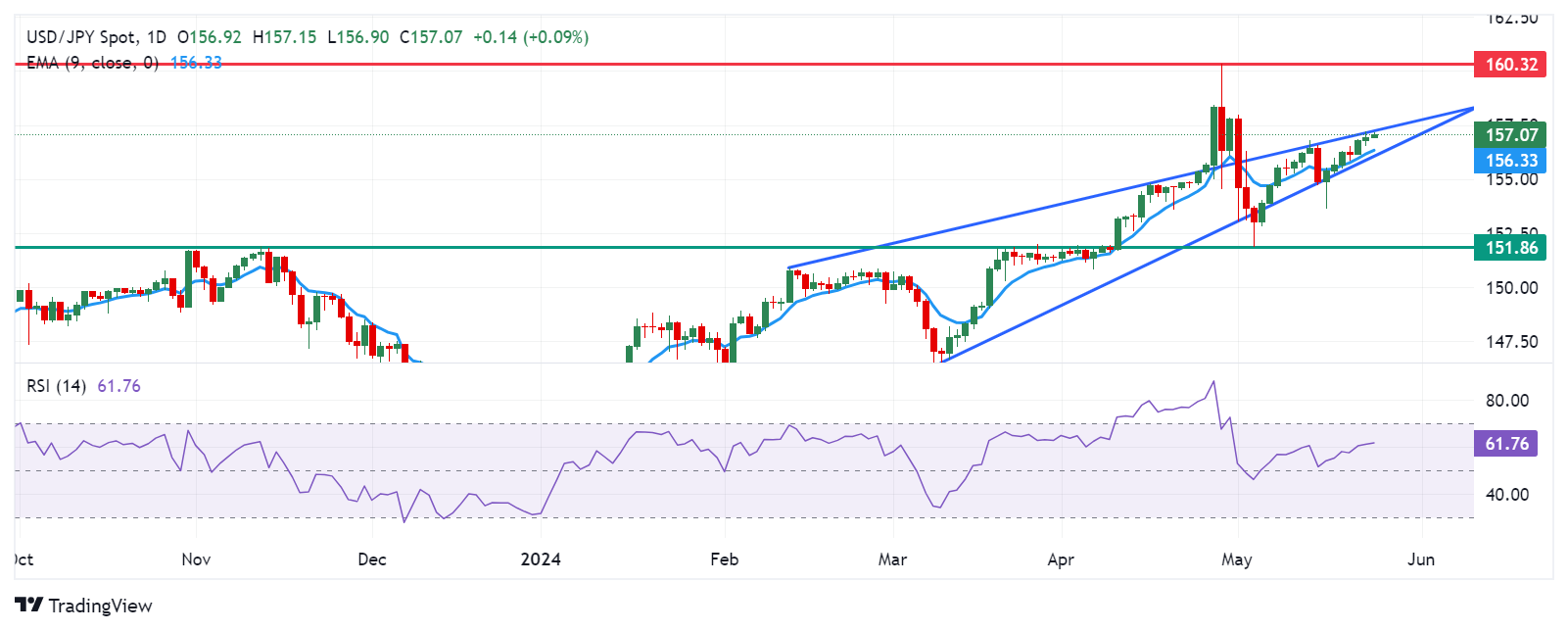
The USD/JPY pair trades around 157.10 on Friday. A rising wedge pattern on the daily chart suggests a potential bearish reversal as the pair approaches the wedge’s tip. Despite this, the 14-day Relative Strength Index (RSI) remains above 50, indicating continued bullish momentum. A decline below this level would signify a shift in momentum.
The USD/JPY pair might retest the upper boundary of the rising wedge at approximately 157.20. If it breaks above this level, the pair could advance toward the recent high of 160.32.
On the downside, the nine-day Exponential Moving Average (EMA) at 156.33 seems to appear as immediate support, followed by the lower threshold of the rising wedge and a psychological level of 156.00. A break below this level could exert downward pressure on the USD/JPY pair, potentially moving it toward the throwback support at 151.86.
USD/JPY: Daily Chart
Japanese Yen price today
The table below shows the percentage change of the Japanese Yen (JPY) against listed major currencies today. Japanese Yen was the weakest against the US Dollar.
| USD | EUR | GBP | CAD | AUD | JPY | NZD | CHF | |
| USD | 0.03% | 0.02% | 0.02% | 0.09% | 0.06% | 0.07% | 0.07% | |
| EUR | -0.03% | 0.00% | -0.01% | 0.08% | 0.03% | 0.07% | 0.04% | |
| GBP | -0.02% | 0.00% | -0.01% | 0.08% | 0.04% | 0.06% | 0.04% | |
| CAD | -0.03% | 0.04% | 0.00% | 0.08% | 0.04% | 0.07% | 0.05% | |
| AUD | -0.10% | -0.08% | -0.09% | -0.09% | -0.05% | -0.02% | -0.03% | |
| JPY | -0.07% | -0.04% | -0.04% | -0.05% | 0.01% | 0.06% | 0.01% | |
| NZD | -0.06% | -0.07% | -0.07% | -0.08% | 0.02% | -0.03% | -0.03% | |
| CHF | -0.07% | -0.03% | -0.05% | -0.06% | 0.02% | -0.02% | 0.00% |
The heat map shows percentage changes of major currencies against each other. The base currency is picked from the left column, while the quote currency is picked from the top row. For example, if you pick the Euro from the left column and move along the horizontal line to the Japanese Yen, the percentage change displayed in the box will represent EUR (base)/JPY (quote).
Japanese Yen FAQs
The Japanese Yen (JPY) is one of the world’s most traded currencies. Its value is broadly determined by the performance of the Japanese economy, but more specifically by the Bank of Japan’s policy, the differential between Japanese and US bond yields, or risk sentiment among traders, among other factors.
One of the Bank of Japan’s mandates is currency control, so its moves are key for the Yen. The BoJ has directly intervened in currency markets sometimes, generally to lower the value of the Yen, although it refrains from doing it often due to political concerns of its main trading partners. The current BoJ ultra-loose monetary policy, based on massive stimulus to the economy, has caused the Yen to depreciate against its main currency peers. This process has been exacerbated more recently due to an increasing policy divergence between the Bank of Japan and other main central banks, which have opted to increase interest rates sharply to fight decades-high levels of inflation.
The BoJ’s stance of sticking to ultra-loose monetary policy has led to a widening policy divergence with other central banks, particularly with the US Federal Reserve. This supports a widening of the differential between the 10-year US and Japanese bonds, which favors the US Dollar against the Japanese Yen.
The Japanese Yen is often seen as a safe-haven investment. This means that in times of market stress, investors are more likely to put their money in the Japanese currency due to its supposed reliability and stability. Turbulent times are likely to strengthen the Yen’s value against other currencies seen as more risky to invest in.
Empfohlene Artikel


