


No policymaker has more global influence over monetary policy than the FOMC. Interest rate decisions from the Federal Reserve affect the prices we pay and can cause stocks and crypto to instantly change in price. Because the Fed's decisions can sway prices so easily, just about everyone pays attention to what the Federal Reserve will do next.
In 2026, this attention is skyrocketing. Inflation and the Fed’s perception of an uncertain global economy have a significant influence over their monetary policy decisions. Knowing the FOMC meeting plans and how to read their documents is important.
Next FOMC Meeting & Current Federal Funds Rate
The next FOMC meeting will happen on October 27 and 28, 2026. This meeting is very important since the Summary of Economic Projections (SEP) or the Fed’s Dot Plot will also be released. We will talk about what this report shows further in the article.
Meanwhile, the current Federal Funds rate sits at 3.62% as per the Federal Reserve Bank of New York. This current figure aligns with the Federal Reserve's established target range of 3.50% to 3.75%.
Changes in this rate impact almost every corner of the economy and can be seen in home mortgage rates as well as credit card interest rates. Overall, the economy’s liquidity as well as its level of risk will be impacted.
Typically, the markets will start pricing expectations weeks before the date of the FOMC meeting. Having an understanding of the economic metrics, such as inflation or unemployment, could give you the power to predict the rate changes. This could help you determine whether the Fed takes a dovish or hawkish stance.
A single sentence of the Fed statement or a single comment at the press conference could trigger a skyrocket in the market or make it crash in just minutes.
Because this intense market volatility can trigger within seconds of an FOMC announcement, professional traders rely on real-time tracking tools. You can monitor the countdown to the next Fed rate decision and set instant alerts via the Mitrade Economic Calendar to manage your risk and exposure effectively before the next policy statement drops.
 What does Mitrade offer? Free Economic Calendar and Real-time Market News Push.
FOMC Meeting Schedule 2026
Now, we will talk about the entire FOMC meeting schedule for 2026. This will include meetings that have already passed and scheduled meetings in the future.
The main reason these SEP meetings are seen as the most important on the market is investors get their best estimates on how Fed officials look at the pace of economic growth. Will unemployment rise or will it dip? That sort of thing.
What's the FOMC Meeting?
The Federal Open Market Committee (FOMC) is the part of the Federal Reserve System that makes the monetary policies. Its job is to control the money supply and interest rates in the system. It oversees the development of the economy by holding scheduled meetings about 8 times a year. In these meetings, the FOMC reviews and talks about the state's economic and financial conditions.
At its core, the meetings talk about three basic things: changing the Federal Funds Rate (FFR) or starting Quantitative Easing (QE) and Quantitative Tightening (QT) to control liquidity in the market. It is a good thing to remember that these decisions do not only impact the US economy, they impact the entire world.
Let’s go over these three things in more detail.
1. Federal Funds Rate (FFR): The Foundation of Borrowing Costs
The FFR is the foundational interest rate that banks set to lend each other money. You can think of it as the cost of money. If the Fed lowers it, money becomes “cheap” which leads to more spending and really boosts the economy. If the Fed increases it, money becomes “expensive” and leads to less spending. This slows the economy down.
2. Quantitative Easing (QE): Injecting Liquidity
If lowering the FFR does not boost the economy, the Fed will try QE. This is just the Fed buying long-term securities and bonds from commercial banks. The main goal of this method is to directly lower long-term interest rates which may trigger a growth in the economy.
3. Quantitative Tightening (QT): Reducing Liquidity
Finally, QT is like QE but the opposite. The Fed basically starts to shrink its balance sheet by selling or letting government bonds mature. This takes liquidity out of the market which may slow down inflation in the long run.
Current Committee Members
When it comes to the FOMC itself, it consists of 12 members. These include 7 Board of Governors members, the president of the Federal Reserve Bank of New York and 4 of the 11 Reserve Bank presidents. The 4 Reserve Bank presidents serve one-year terms that rotate.
The current committee members are:
Kevin Warsh, Board of Governors, Chairman
John C. Williams, New York, Vice Chair
Michael S. Barr, Board of Governors
Michelle W. Bowman, Board of Governors
Lisa D. Cook, Board of Governors
Beth M. Hammack, Cleveland
Philip N. Jefferson, Board of Governors
Neel Kashkari, Minneapolis
Lorie K. Logan, Dallas
Anna Paulson, Philadelphia
Jerome H. Powell, Board of Governors
Christopher J. Waller, Board of Governors
What Happens During an FOMC Meeting?
Most people think the FOMC meetings happen in front of the cameras on Day 2. However, these meetings are made of a lot of discussions about the economy and precise data presentations for 2 days straight.
Day 1: Economic Review
The Fed staff brings detailed reports on things like employment data, inflation, consumer spending and more. Then FOMC members compare economic conditions in their Fed areas and share regional insights that may be missing in the national data. Then they talk about whether the current policy is being too tight or too loose.
Everything said during Day 1 will impact the decision the FOMC makes on Day 2. Remember that no votes are cast and no interest rate announcements are done on this day.
Day 2: The Vote
The second day brings the FOMC to finalize their policy stance and make a vote. Committee members look at all the policy options they could take. Then they show their preference for a policy path and justify their support for a rate hike, cut or a pause. Afterward, the Chairman asks them to make a definitive vote.
The FOMC Interest Rate Decision and Policy Statement
Finally, at 2:00 PM EST, we get the Federal Reserve's official decision regarding interest rates plus the Fed's reasoning behind their decision with the release of their policy statement. A press conference is then done exactly 30 minutes later (2:30 PM EST) which informs the public about the decisions that the FOMC made.
The SEP and Dot Plot: Forecast Roadmap Revealed
It is also worth mentioning that the Fed releases the quarterly SEP and the “Dot Plot” at the same 2:00 PM EST mark during specific meetings (March, June, September and December). This is a sort of visual map with a "dot" for each committee member showing their predictions for interest rates and unemployment.
FOMC Meeting Minutes: Understanding their Internal Debates
Exactly three weeks later, the FOMC puts out detailed meeting minutes at 2:00 PM EDT which give market participants a closer look into the internal debates of the policymakers.
How Does the FOMC Affect the Federal Funds Rate?
The FOMC doesn't set your local bank's interest rates. However, it does control the target range of the federal funds rate. Usually, a change in the federal funds rate triggers change in other interest rates. If the Fed changes this rate, then banks feel the pressure to change their Prime Rate. As the Prime Rate shifts, every other rate for a loan adjusts along with it. This affects everything from credit cards to auto loans.
The Federal Reserve works with banking liquidity and market pressure using 3 traditional mechanisms. Let’s go over them one by one.
1. Open Market Operations
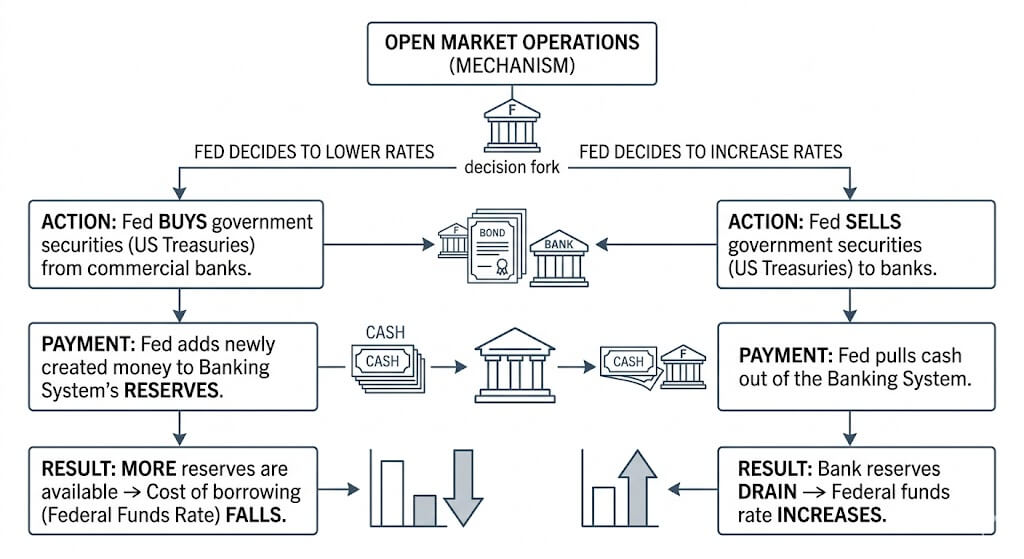
Open market operations let the Fed modify the federal funds rate as needed. This is just buying and selling government securities like US treasury bonds on the open market. The Fed buys government bonds from commercial banks at lower rates. To pay for these bonds, The Fed adds newly created money into the banking system's reserves. Now with more reserves available, the cost of borrowing those reserves (the federal funds rate) falls.
When they want to increase rates the Fed sells securities to banks, pulling cash out of the banking system to pay for them. As bank reserves drain the federal funds rate increases.
2. The Discount Rate
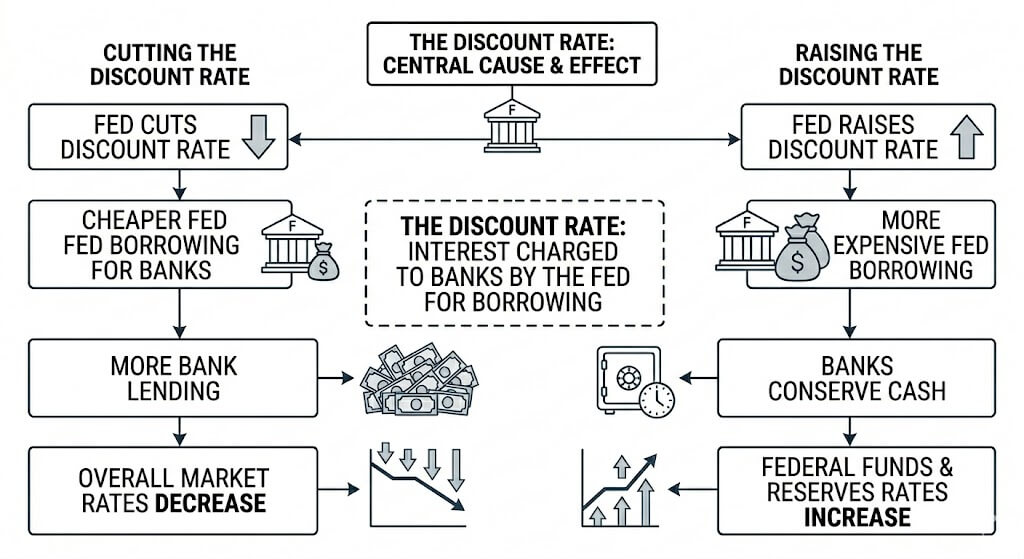
Another key factor to mention is the discount rate. This is the interest the Fed charges banks to borrow money from the Fed’s own Discount Window lending facility. If the Fed cuts the discount rate, then commercial banks can borrow funds from the Fed for cheaper. Banks are more likely to lend to consumers and then the pressure on the overall market rates decreases.
If the Fed raises the discount rate, then the funds from the Fed are more expensive, so commercial banks have to conserve their cash which increases the market-wide federal funds rate and the reserves rate.
3. Reserve Requirements
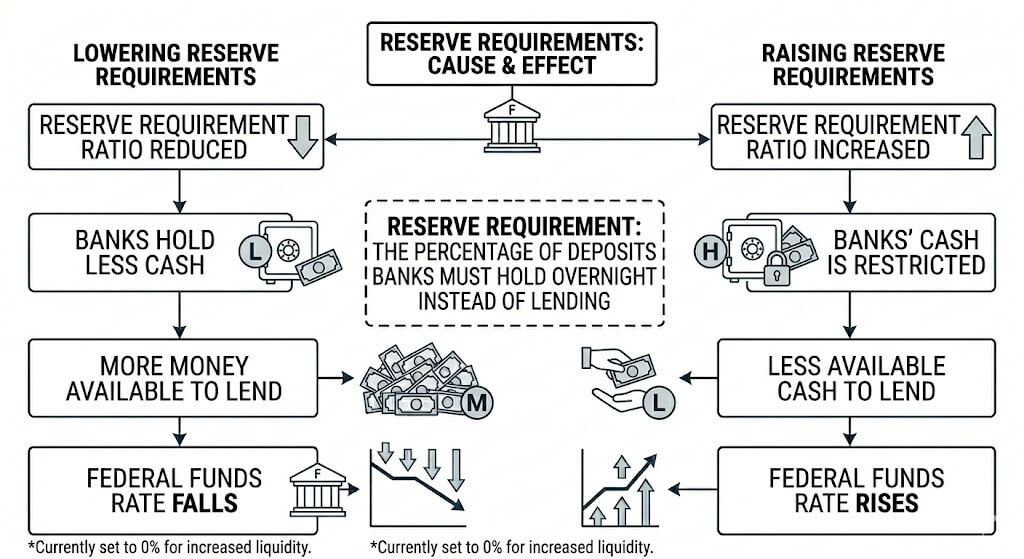
The reserve requirements are also a tool that the FOMC uses to affect the rates. The reserve requirement is the percentage of deposits that a commercial bank must hold in their bank or at the Federal Reserve overnight instead of lending. Remember that the Federal Reserve set reserve requirement ratios to 0% so banks would have more liquidity. However, it is still a basic structure tool.
When reserve requirements are lowered, banks can use more of their money to make loans and have less cash just sitting around. Forcing banks to hold less cash means there is more available to lend. With more money available, banks can lend more and liquidity increases. This also puts downward pressure on the federal funds rate.
With higher reserve requirements, banks' cash is even more restricted and there is less money available to lend. Less available cash means there is much more competition among banks to lend and liquidity decreases significantly. This has the effect of increasing the federal funds rate.
Key Documents Investors Look For
Understanding what the Fed says can seem confusing. That’s because the FOMC have their own codes for things. It’s like their own language. It is known as Fedspeak. This is done to not alert the markets and make them panic. Investors analyze key documents on Fed day.
1 The FOMC Policy Statement
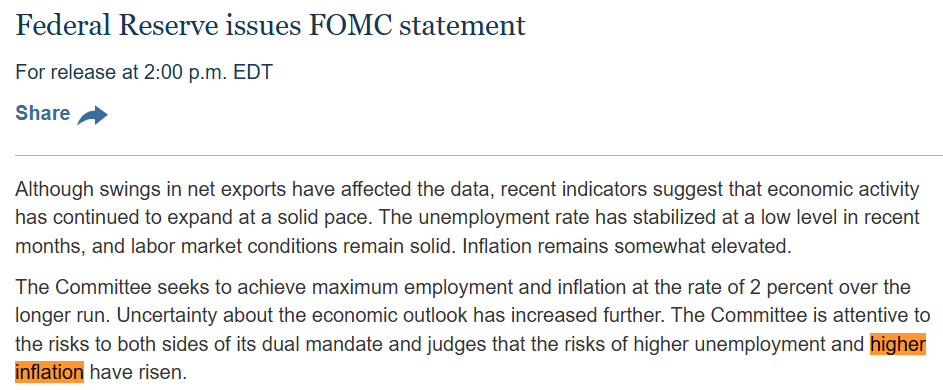
Release Frequency: 8 times a year (Every meeting on Day 2 at 2:00 PM EST).
Key Highlights: This is a 1-2 page document. It is a report done by the committee that includes information on the economy that they analyzed. Plus, they point to reasons for the changes to the interest rate and possible future changes to their policies.
How To Interpret: Notice words that have been changed from the past meeting. If inflation was called “somewhat elevated” and now it’s “higher inflation”, expect the Fed to set a “tightening” policy shift. Meanwhile, “strong” means job growth is healthy.
2 The Summary of Economic Projections (SEP)
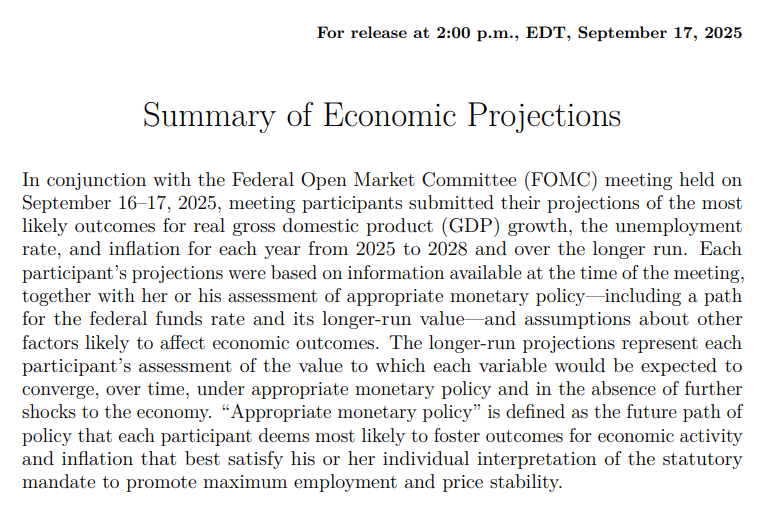


Release Frequency: 4 times a year (Quarterly in March, June, September and December, alongside the Policy Statement)
Key Highlights: This document shows the official predictions of the FOMC for real GDP growth, unemployment rate and more.
How To Interpret: If the SEP shows members decreasing their GDP forecasts, it means the Fed expects economic growth to slow. Or if they project that the unemployment rate will drop, they foresee economic growth as more jobs get created.
3 The Dot Plot
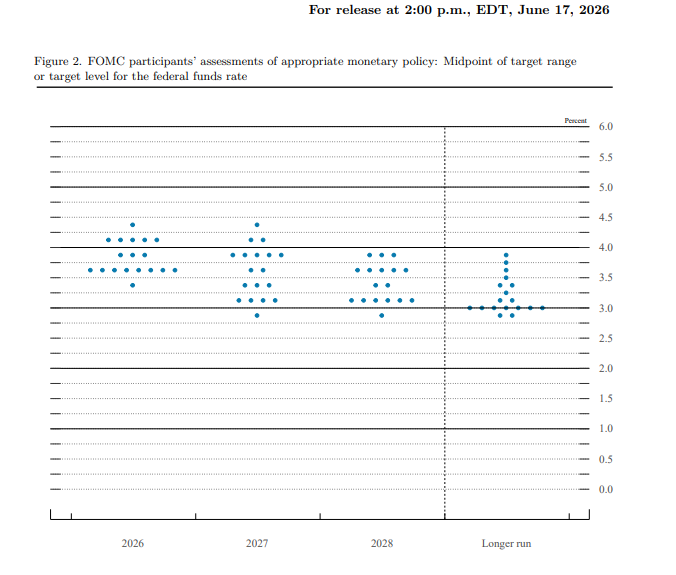
Release Frequency: 4 times a year (In the quarterly SEP report)
Key Highlights: The Dot Plot shows a visual presentation of the viewpoints of the individual FOMC members. These show the predictions of the FOMC on where they think the federal funds rate could go in the near future.
How To Interpret: Dots going high is considered a hawkish stance by the markets. Treasury yields are expected to increase, probably resulting in lower prices. Meanwhile, dots going lower is considered a dovish stance. This suggests higher risk assets could appreciate in value.
4 The Chair's Press Conference Opening Statement
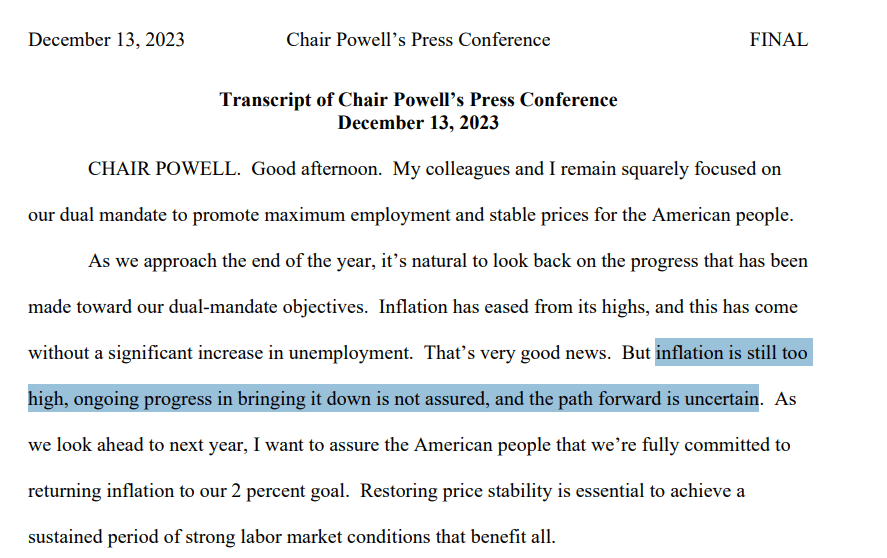
Release Frequency: 8 times a year (Day 2 at 2:30 PM EST, precisely 30 minutes after the statement release)
Key Highlights: The Federal Reserve Chairman delivers a live and formal speech. This bridges the tricky technical wording of the Policy Statement with the media.
How To Interpret: The data shows that the language in the opening statement is intentionally simplified in comparison to the more complex language seen in the official Policy Statement. If the opening statement has sentences like “inflation is too high”, “the path forward is uncertain,” the Chair is creating a public justification for maintaining higher interest rates for longer.
5 Minutes of the FOMC
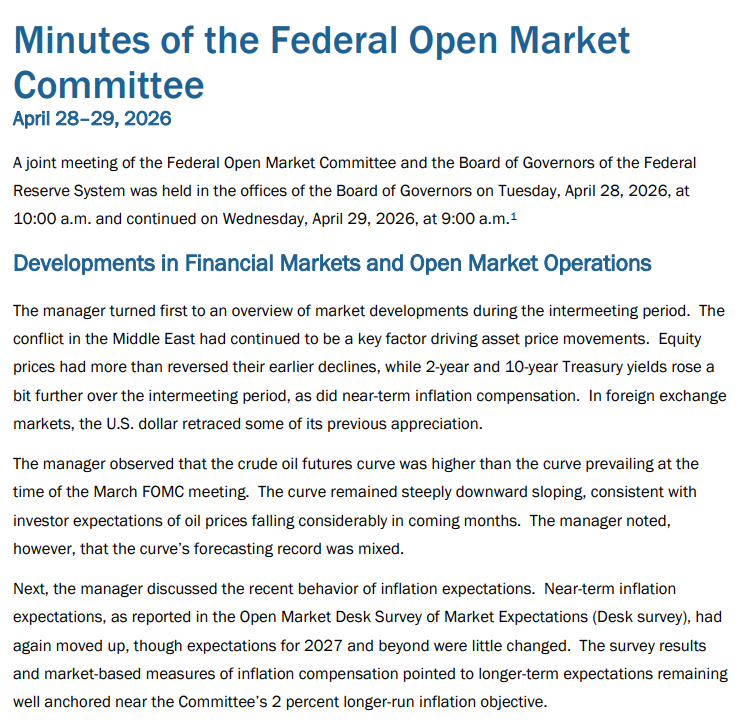
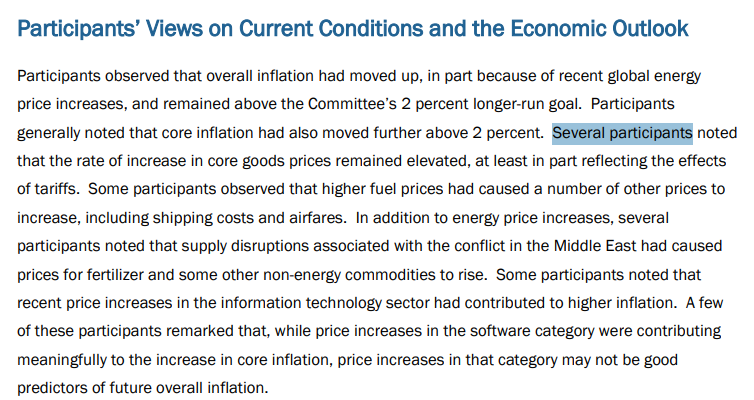
Release Frequency: 8 times a year (Released exactly three weeks after the policy decision day)
Key Highlights: This document is an overview of what happened behind the scenes during the members' private two-day meetings. These include debates and economic theories.
How To Interpret: Look for words like "many participants" or "a significant majority". They show that there is a consensus and the policy discussed has a strong backing behind it. On the other hand, "a few participants" or "several members" means there is internal conflict and an uncertain policy path.
The 3 Core Economic Indicators Directing FOMC Decisions
The Federal Reserve says that they rely on data to make decisions. To figure out the FOMC’s next move, you have to watch three big economic indicators that they look at.
1. Inflation
The FOMC usually watches inflation using CPI, Core CPI, PCE, and PPI. If inflation is above the desired 2% target, the FOMC has cause to keep interest rates high.
2. Unemployment Rate
For the Fed to maintain high interest rates and avoid a recession, there needs to be a consistently strong labor market consisting of plenty of job openings and little unemployment. But if unemployment goes up a lot, the FOMC will lower interest rates so that businesses can continue operations and keep workers employed.
3. Gross Domestic Product (GDP) Growth
GDP is an indicator of how much and how strong the economy is growing. Above-trend GDP growth means strong positive growth. If the economy is doing well then the Fed can concentrate on inflation. Because GDP can also go stagnant or go negative, then the economy will most likely retract. In that case, expectations for rate cuts grow.
How the FOMC Meeting Impacts Your Money
The value of nearly all your financial categories are affected if an FOMC meeting brings interest rate changes. This all depends on whether the Fed is taking a Hawkish stance or a Dovish stance.
If you want to learn more, an award-winning, ASIC-regulated platform like Mitrade gives you instant, zero-commission access to Forex, Gold, Stock CFDs, and Crypto under a single interface. Since CFDs allow for both long and short positions, you can trade the market's direction whether the Fed triggers a massive rally or a sudden correction - all backed by negative balance protection to limit your downside risk.
You might be interested in the following article >>> What Is Mitrade? Is It a Legal Trading Platform?


Conclusion
The FOMC is the steering force of the global financial system. Their meetings decide how much people and corporations will be paying to borrow money and ultimately how the economy will act and behave.
The meeting in June 2026 will be really important as the second SEP report will also be published. Keep an eye on the inflation and labor report data as well as the Dot Plot. Make sure you have hedges in place to protect your portfolio from both hawkish and dovish stances.
How many times does the FOMC meet a year?
Normally, there are eight planned FOMC meetings every year. Remember that meetings can be called if there is an economic emergency or crisis.
What is an emergency FOMC meeting?
An emergency FOMC meeting is when the FOMC has to meet to address issues in the economy that are too important to wait for the next scheduled meeting. Notably, the last emergency FOMC meeting was in March 2020 when the economy was dropping due to the coronavirus pandemic. In that meeting, a rate cut was announced.
What is the difference between "Hawkish" and "Dovish" FOMC stances?
A hawkish stance tightens monetary policy and increases rates to control inflation. On the other hand, a dovish stance prioritizes growth and higher employment while reducing interest rates.
What is the Fed's "Dot Plot" and why is it important?
The Dot Plot appears four times a year in the SEP report. It is a visual chart, with each dot showing a different FOMC member's estimate of what the target interest rate will be at the end of a certain period. It is important because it could help you guess potential future rate hikes or cuts. This impacts stocks, crypto and forex in the long run.
* The content presented above, whether from a third party or not, is considered as general advice only. This article should not be construed as containing investment advice, investment recommendations, an offer of or solicitation for any transactions in financial instruments.


