


Today’s Market Recap: Oil Breaks $100, Fueling Inflation Fears, as AI Capex Faces Scrutiny and Tesla’s 14% Plunge Drags Down Tech Sector

Tracking the Market Trend
TradingKey - The market was hit by a double whammy of soaring oil prices and doubts about the return on AI investments sparked by increased capital expenditures at Google(GOOGL) and Tesla(TSLA). The three major U.S. stock indices plummeted. At the close, the Dow Jones Industrial Average fell 0.97% to 51,711.65; the Nasdaq Composite Index dropped 2.15% to 25,137.69; the S&P 500 fell 1.21% to 7,408.12.
Google fell more than 7%, and Amazon (AMZN) dropped over 4%, both leading the Dow lower; Tesla plummeted by as much as 14%. The combined market capitalization of the “Big Seven” tech companies evaporated by approximately $800 billion, marking the worst single-day performance since April of last year, while Oracle (ORCL) also broke through its 52-week low.
The chip sector saw mixed performance: the Philadelphia Semiconductor Index (SOX) edged down 0.54%, but Micron Technology(MU)rose more than 3% and Applied Materials (AMAT) gained over 1%, while Texas Instruments (TXN) fell more than 3% and Qualcomm (QCOM) dropped over 2%. In after-hours trading, Intel (INTC) briefly rose more than 10% on the back of positive earnings reports, providing a localized boost to the sector.
A sharp rise in oil prices reignited inflation concerns, dragging global bond yields higher across the board. The yield on the 2-year U.S. Treasury note climbed 4.5 basis points to a 17-month high, while the 10-year yield rose 4 basis points to 4.70%, and the real yield on the 30-year U.S. Treasury note approached 3%.
Commodity markets experienced sharp volatility, with spot gold(XAUUSD) plunging 2% and silver(XAGUSD) tumbling 3.3%; WTI crude oil futures surged more than 6%, while Brent crude oil futures soared over 7%, breaking through the $100 mark.
Market Headline
The U.S. House of Representatives passed a resolution explicitly calling for restrictions on Trump’s military actions against Iran, sending a political signal urging him to “hit the brakes.” The resolution passed by a narrow margin of just six votes in the Republican-controlled House, with four Republican lawmakers defecting to support the Democrats—a sign that concerns over the president’s military authority are growing even within the party.
Geopolitical tensions have entered a dangerous new phase, with Brent crude oil prices already hitting the $100 mark. RBC has warned that oil prices could break through the all-time high of $146 set in 2008. The Houthi rebels’ entry into the conflict has put simultaneous pressure on the Strait of Hormuz and the Strait of Mandeb—two major energy transport corridors—causing the risk of supply disruptions to rise sharply. RBC assesses that if the conflict escalates fully, oil prices are likely to surpass the December 2022 high of $128 and, in an extreme scenario, could even challenge the all-time record of $146; Goldman Sachs also forecasts that if shipping disruptions persist, oil prices could rise above $120 in the fourth quarter.
AMD is rolling out a flurry of new products, betting heavily on the AI computing market—projected to reach $2 trillion by 2030—and striving to consolidate its competitive edge through performance advantages. Its Helios platform is scheduled for delivery by the end of Q3 and has secured a commitment from OpenAI for “large-scale” deployment; CEO Lisa Su revealed that customer demand is “extremely strong”; The new-generation EPYC Venice CPUs deliver performance up to 3.4 times that of Intel’s Xeon products and are approximately 20% faster than NVIDIA’s Vera CPUs. AMD forecasts that by 2030, the AI accelerator market will reach $1.4 trillion, while the data center CPU market will reach $220 billion.
Oracle’s stock price fell below its 52-week low as the market lost confidence in the growth narrative of its cloud infrastructure (OCI), and concerns over the return on AI capital expenditures continued to weigh on the stock. On July 23, Oracle closed down more than 4% at $120, marking a year-to-date decline of over 37% and hitting a new low; all investors who bought the stock within the past year are now facing paper losses. Investors’ growing concerns about the AI investment-to-return cycle, coupled with a broader weakness in the tech sector, have subjected Oracle’s valuation to even stricter scrutiny.
AI demand is driving Intel to post its strongest growth in 15 years. Q2 revenue surged 25% year-over-year, far exceeding expectations, and the company maintained its guidance for high growth; its stock price rose more than 10% at one point in after-hours trading. Q2 revenue exceeded market expectations by nearly 12%; revenue from the data center and AI business surged 59% year-over-year—a growth rate nearly four times that of Q1—while the foundry business grew 31%, nearly doubling its growth rate. Q3 revenue guidance projects a year-over-year increase of 15% to 23%, exceeding the lower end of market expectations by nearly 5% and the upper end by more than 10%. The CEO stated that AI is driving “unprecedented” demand for computing power. Meanwhile, the company expects supply shortages to persist, and next year’s capital expenditures will be significantly higher than this year’s.
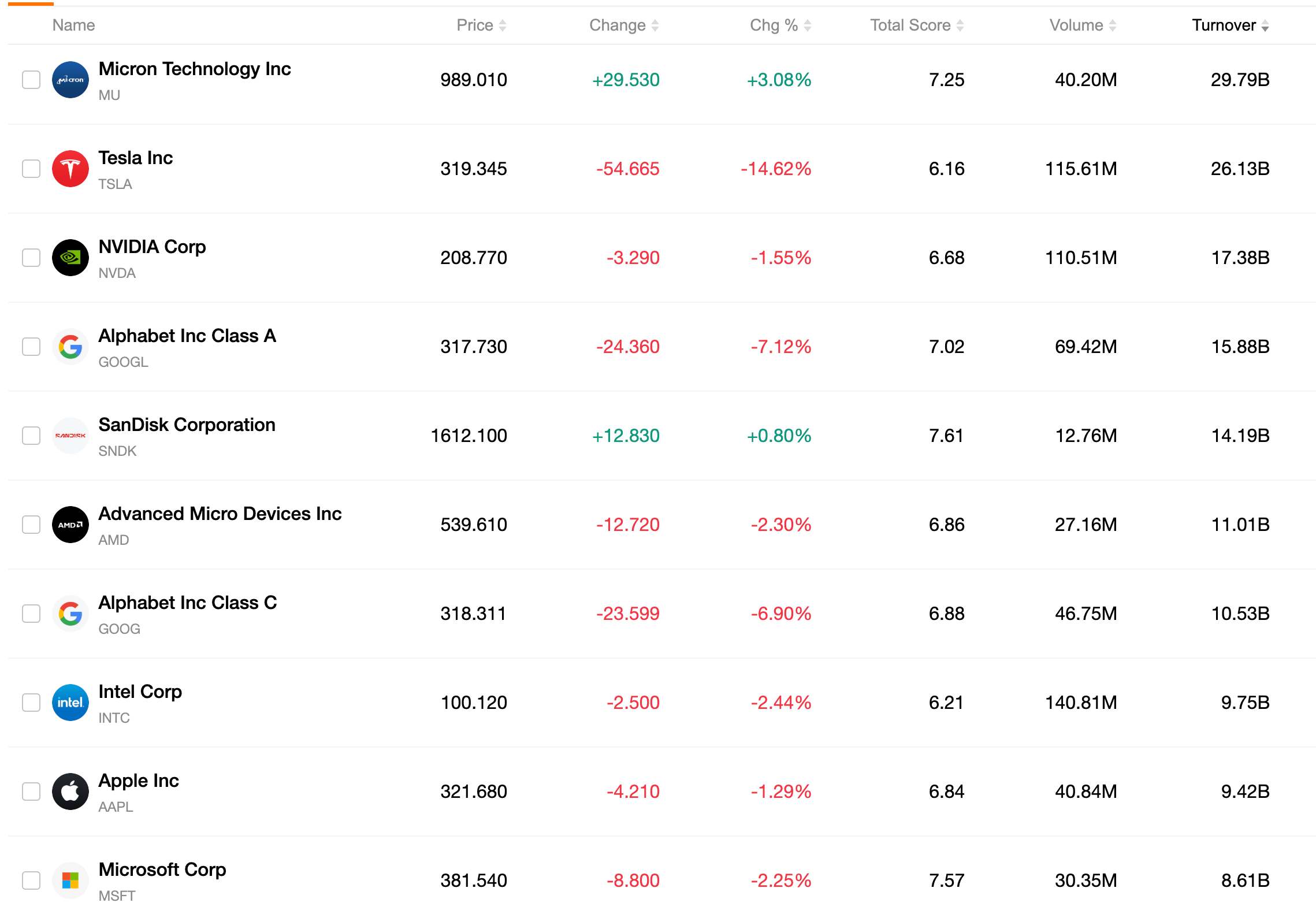
Top 10 Most Traded Stocks
The table below lists the ten most actively traded stocks in the market recently. Backed by massive trading volumes and excellent liquidity, these assets have become key benchmarks for tracking global market dynamics.
Read more
* The content presented above, whether from a third party or not, is considered as general advice only. This article should not be construed as containing investment advice, investment recommendations, an offer of or solicitation for any transactions in financial instruments.


