


Australian and New Zealand Dollars dig in ahead of a Japanese rate hike
- AUD/JPY rises a fourth session to 111.00 while NZD/JPY holds its weakest since February.
- Speculators flipped from a 92.2K Yen short to a net long in a single week.
- Japan's rate reaches 1.25% on Friday, its highest since 1993.
The Australian Dollar trades near 111.00 against the Yen and the New Zealand Dollar near 89.50, both a little higher and both a long way below where they were in August. The Bank of Japan (BoJ) is expected to raise its rate to 1.25% on Friday, and that decision is supposed to be the thing that breaks the trade that borrows Yen cheaply to buy currencies paying more. The funds that publish their positions were out of it more than a week ago.
What the trade pays after Friday
The mechanics are plain. Borrow Yen at 1%, buy Australian Dollars earning 4.35% or New Zealand Dollars earning 2.75%, and keep the difference for as long as the exchange rate does not move against you. After Friday, Australian Dollars earn 3.10% more than the Yen costs to borrow and New Zealand Dollars earn 1.50% more, before anyone counts hedging or the spread.
At 89.42, that 1.50% comes to about one and a third Yen a year. NZD/JPY has fallen more than six Yen since its August high near 95.00, which is more than four years of the rate difference gone inside a month. AUD/JPY earns about three and a half Yen a year and has lost five since its own August high near 115.00. Nobody rebuilds a position that size for interest it can lose in a fortnight.
The unwind was published on September 12
Large speculators in the Commodity Futures Trading Commission (CFTC) data went into September net short 92.2K Yen contracts, near the biggest bet against the currency since 2007. In the week to September 8 that position improved by about 103K contracts and turned into a net long of 10.8K, the largest weekly swing since early August. The traders who are supposed to be caught by Friday spent the preceding week getting out of the way.
That is one slice of the book and not all of it. Banks and the leveraged money that borrows Yen directly file no weekly report, and the two pairs say the selling has not entirely stopped. What the futures data does say is that the crowd is now long the Yen, which is the side that loses if BoJ Governor Ueda sounds more careful than money markets expect.
Japanese institutions file no weekly report either. Japan's 10-year government bond yield is at a three-decade high, and every step up in it gives Japanese life insurers and pension funds a reason to bring savings home from Sydney and Auckland rather than send more out. Those transfers do not show up in a weekly number and they do not reverse on a press conference. They are why 3.10% a year does not go far against a move of two Yen.
New Zealand beat its forecast and made a new low anyway
New Zealand's economy grew 0.2% in the second quarter against a 0.1% forecast, which cleared the bar and still came to a fifth of the 0.9% managed the quarter before. The Reserve Bank of New Zealand (RBNZ) raised its rate to 2.75% on September 2 and its own forecasts leave room for one more increase this year. Headline inflation there is 4.1% and 2.9% once vehicle fuel comes out, so the bank is raising rates into an oil price rather than a spending boom.
Australia is the stronger of the two. The Reserve Bank of Australia (RBA) held its cash rate at 4.35% in August and meets again on September 29, underlying inflation is 3.6%, and the four largest Australian banks now all forecast an increase before the end of the year. That gap is why AUD/JPY is still above its 200-day average near 110.00 while NZD/JPY trades more than two Yen below its own, at the weakest level since February.
What lands before the decision
RBA Governor Bullock speaks at 23:30 GMT, and the 4.35% cash rate is the number she can change on September 29. Japan's national Consumer Price Index (CPI) for August arrives at the same time, with the measure that strips out fresh food forecast at 1.8% and unchanged. New Zealand's trade figures come at 22:45 GMT, and the country imports its fuel, so a barrel near $97.50 widens that deficit.
The decision itself lands on Friday, with the statement at 03:00 GMT and the press conference at 06:30 GMT. A quarter-point to 1.25% is priced at about 97%, which makes it the least informative part of Friday. Money markets price roughly nine-tenths of a point of further increases over the following twelve months, and that is the number Governor Ueda either confirms or does not. A rate at 1.25% would be the highest in Japan since 1993, and it still leaves the Yen the cheapest funding currency in the developed world.
The guidance has a political constraint on it. Prime Minister Sanae Takaichi has been arguing for easier money to support growth, and her spending plans are part of why long Japanese yields are where they are. Governor Ueda has to signal more increases without picking a fight with the government that appoints his board, which is the sort of drafting problem that produces a cautious sentence and a two-Yen move in the crosses.
Levels and bias
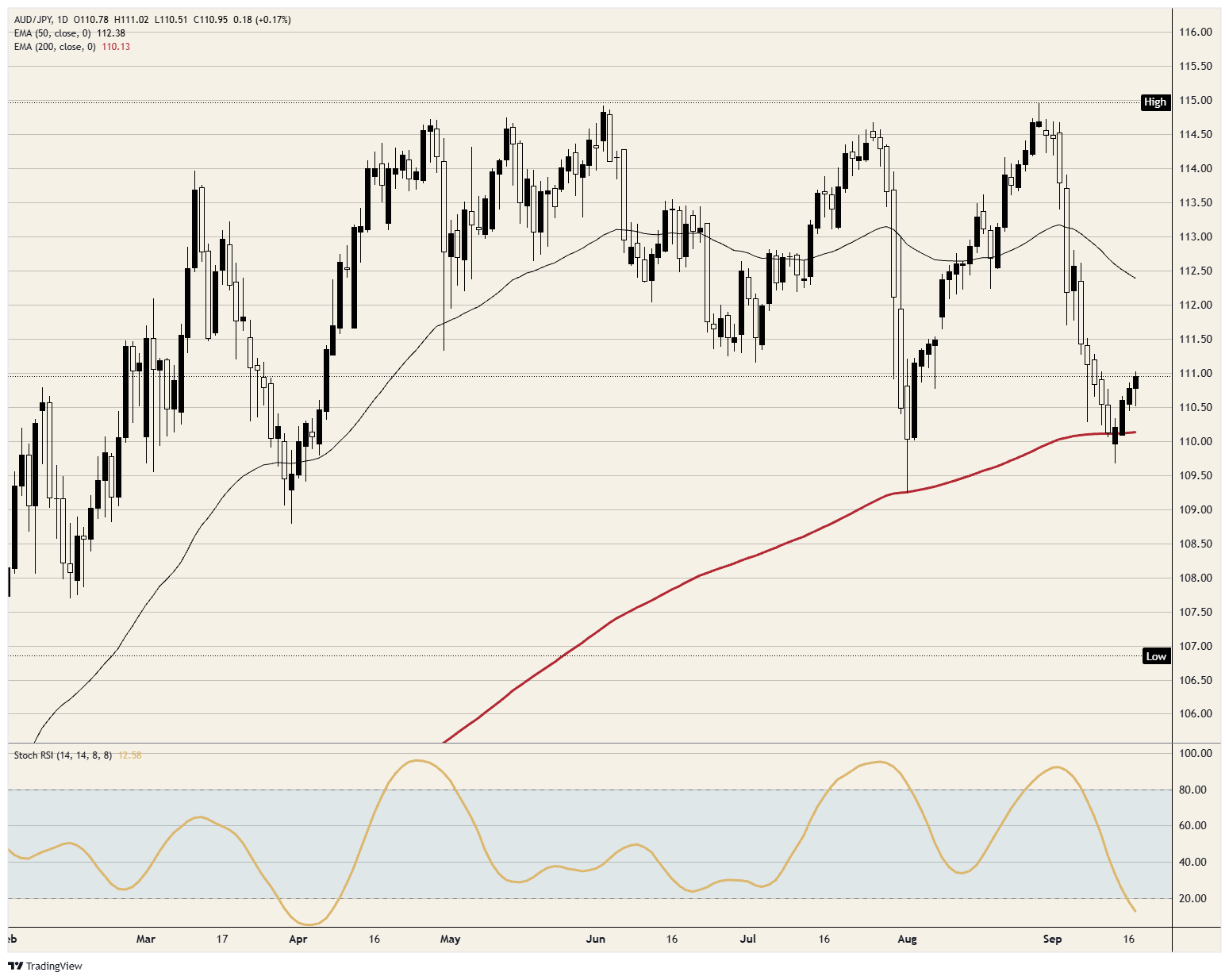
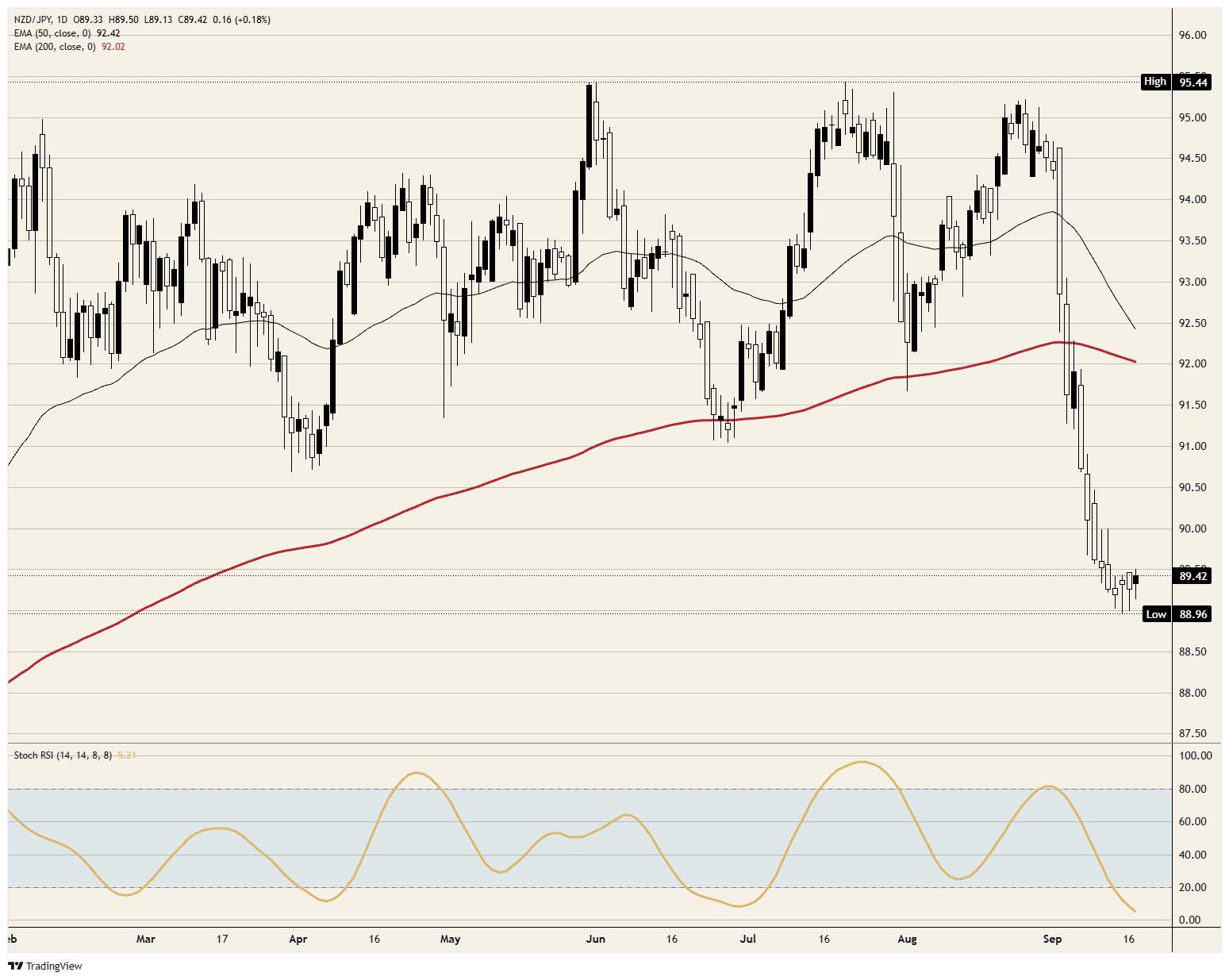
Resistance: 111.00 is the level AUD/JPY has just reached for the first time in a week, and 111.50 is where the August slide paused. NZD/JPY has been capped at 89.50 for four sessions, with 90.00 the level it lost on September 11.
Support: AUD/JPY traded under its 200-day average near 110.00 on September 14 and has held above it since, which leaves that day's low just above 109.50 as the next floor. NZD/JPY has 89.00 beneath it and then the September 15 low at 88.96.
Bias: Higher on AUD/JPY while 110.00 holds. The objectives are 111.50 and then 112.50, and the case is wrong on a daily close below 109.50. NZD/JPY stays the weaker leg while 90.00 caps it, aiming at 89.00 and then 88.50, and a daily close above 90.00 ends that one. The daily Stochastic Relative Strength Index (Stoch RSI), a momentum gauge, reads near 13 on the Australian cross and near 5 on the New Zealand one, both at the bottom of their ranges.
AUD/JPY Daily chart
NZD/JPY Daily chart
Bank of Japan FAQs
The Bank of Japan (BoJ) is the Japanese central bank, which sets monetary policy in the country. Its mandate is to issue banknotes and carry out currency and monetary control to ensure price stability, which means an inflation target of around 2%.
The Bank of Japan embarked in an ultra-loose monetary policy in 2013 in order to stimulate the economy and fuel inflation amid a low-inflationary environment. The bank’s policy is based on Quantitative and Qualitative Easing (QQE), or printing notes to buy assets such as government or corporate bonds to provide liquidity. In 2016, the bank doubled down on its strategy and further loosened policy by first introducing negative interest rates and then directly controlling the yield of its 10-year government bonds. In March 2024, the BoJ lifted interest rates, effectively retreating from the ultra-loose monetary policy stance.
The Bank’s massive stimulus caused the Yen to depreciate against its main currency peers. This process exacerbated in 2022 and 2023 due to an increasing policy divergence between the Bank of Japan and other main central banks, which opted to increase interest rates sharply to fight decades-high levels of inflation. The BoJ’s policy led to a widening differential with other currencies, dragging down the value of the Yen. This trend partly reversed in 2024, when the BoJ decided to abandon its ultra-loose policy stance.
A weaker Yen and the spike in global energy prices led to an increase in Japanese inflation, which exceeded the BoJ’s 2% target. The prospect of rising salaries in the country – a key element fuelling inflation – also contributed to the move.
Recommended Articles


