


This AI Stock Is Trading Near Record Highs. Is It Too Late to Buy?
Key Points
Amphenol's stock is about 3% below its all-time high after gaining 311.6% in the last three years.
The company's connectors and cables link AI processors, and its IT datacom business is roughly four times its size from two years ago.
Orders of $10.7 billion topped sales of $8.8 billion, resulting in a healthy book-to-bill ratio of 1.23.
- 10 stocks we like better than Amphenol ›
Amphenol (NYSE: APH) makes connectors, cables, and sensors. Nobody has ever put a cable assembly on a magazine cover. I mean, aside from very niche industry mags. Yet, on Oct. 1, the stock sits 3.2% below a recent all-time high, and the AI boom is a big reason.
A run like that raises the obvious question about whether the easy money is gone. The business results suggest it isn't, at least not yet.
Missed AI’s "Act 1"? Act 2 Could Be 15x Bigger. Most investors think they missed the AI boat because they didn't buy Nvidia in 2005. But according to our analysts, we’re only at the end of "Act 1"—the R&D phase. "Act 2" is the global rollout. Continue »
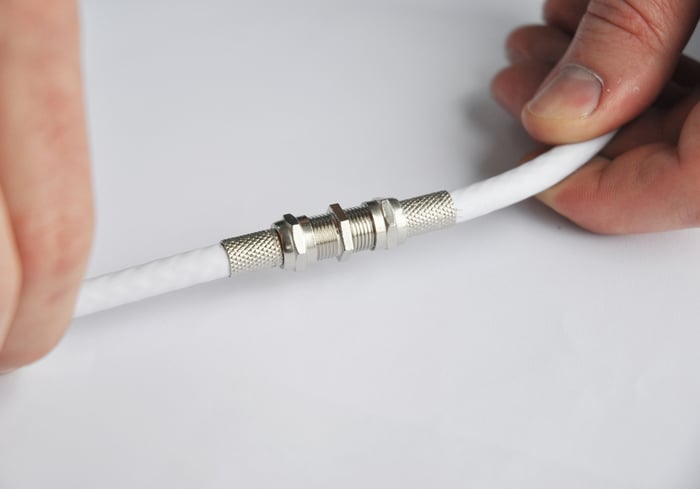
Image source: Getty Images.
Plumbing for the AI boom
The company holds the least glamorous seat at the AI party: the one that connects the processors. CEO Adam Norwitt calls interconnect the central nervous system of AI, and the logic is hard to dispute. A server rack that sells for $3 million is worth very little if the connectors never arrive. Amphenol's IT datacom business is roughly four times its size two years ago.
Start with the second quarter. Sales of $8.8 billion rose 55% year over year. Organic growth was 30%. Adjusted earnings per share of $1.35 jumped 67%. Orders reached $10.7 billion, a book-to-bill ratio of 1.23, meaning customers ordered 23% more than Amphenol shipped. That gap is the closest thing to a forward indicator in the report, and it points up.
Loud numbers, quiet CEO
Norwitt avoids the spotlight. At a recent Citi conference, he told the crowd that he doesn't do interviews and that the company announces none of its customer commitments, including long-term non-cancelable orders.
But he doesn't have to say much.
Quarterly orders of $10.7 billion against sales of $8.8 billion say plenty without an adrenaline-packed press release. That makes a nice change in an AI sector that often seems to run on video clips, social media posts, and headlines.
Slow and steady beats the hotshots
Here's the part that should interest anyone worried about being late. Amphenol is up 27.9% this year. Respectable, but well behind the company's closest rivals. Corning (NYSE: GLW) gained 81.1%, Flex (NASDAQ: FLEX) stock rose 85.9%, and Littelfuse (NASDAQ: LFUS) posted a 71.7% year-to-date run.
And the recent trends have been in Amphenol's favor. Over the past quarter, Amphenol gained 4.9% while Flex fell 18% and Corning dropped 19.4%. Tech giants are still planning and building massive AI data centers, but there's public pushback ahead of the midterm elections. The AI-adjacent crowd has been running harder and wobbling more, while Amphenol is holding steady.
Cheaper than the neighbors
The profits aren't thin, either. Operating margin is 28.1%, the highest in the peer group. The CommScope purchase, at $10.5 billion, is now expected to deliver $4.6 billion in sales this year, up from an earlier forecast of $4.1 billion.
At 26.4 times forward earnings, the stock trades at a lower multiple than Corning (36.6) and Cognex (30.6). The PEG ratio of 0.9 suggests the market isn't fully valuing growth. The dividend yield of 0.6% is a rounding error, and short interest is only 1.3% of the float. Few investors are betting against Amphenol's rising stock.
So, is it too late?
None of this makes Amphenol's stock a bargain, and 311.6% over three years has a way of making a new buyer feel tardy. Moreover, investors are currently paying an AI multiple for a mostly old-school product catalog. Still, the third-quarter guide calls for sales growth of 50% to 52%.
Is it too late? For the first quadrupling in three years, sure. The next leg is a separate question, and the bulging order book is making a decent bull case.
Should you buy stock in Amphenol right now?
Before you buy stock in Amphenol, consider this:
The Motley Fool Stock Advisor analyst team just identified what they believe are the 10 best stocks for investors to buy now… and Amphenol wasn’t one of them. The 10 stocks that made the cut could produce monster returns in the coming years.
Consider when Netflix made this list on December 17, 2004... if you invested $1,000 at the time of our recommendation, you’d have $375,240!* Or when Nvidia made this list on April 15, 2005... if you invested $1,000 at the time of our recommendation, you’d have $1,403,292!*
Now, it’s worth noting Stock Advisor’s total average return is 932% — a market-crushing outperformance compared to 211% for the S&P 500. Don't miss the latest top 10 list, available with Stock Advisor, and join an investing community built by individual investors for individual investors.
See the 10 stocks »
*Stock Advisor returns as of October 1, 2026.
Anders Bylund has no position in any of the stocks mentioned. The Motley Fool has positions in and recommends Amphenol, Cognex, and Corning. The Motley Fool recommends Flex. The Motley Fool has a disclosure policy.
Recommended Articles


