

US September Nonfarm Payrolls Preview: Job Growth May Cool, How Will US Stocks, Dollar and Gold React?


Mitrade
coverImg
Source: DepositPhotos

TradingKey - On Friday, October 2 (EDT), the U.S. will release its September nonfarm payrolls report, with markets focusing on whether job growth can sustain August's rebound and whether the data will alter expectations for subsequent Federal Reserve rate hikes.

Markets generally expect U.S. job growth to slow noticeably from August. According to a Reuters survey, nonfarm payrolls are projected to add about 100,000 jobs in September, with the unemployment rate potentially rising from 4.1% in August to 4.2%; forecasts from some institutions are clustered near 90,000. By comparison, U.S. nonfarm payrolls increased by 162,000 in August, marking the largest gain in five months.

Jobs May Cool Modestly, Fed Policy Expectations Face Repricing

Looking at recent labor market indicators, August JOLTS job openings fell by 256,000 to 7.079 million, reflecting a cooling in corporate labor demand, though layoffs remained low at 1.641 million. Meanwhile, US initial jobless claims fell to 197,000 in the week ended September 19, near multi-decade lows, indicating that companies have not yet engaged in significant large-scale layoffs.

Therefore, the key to this non-farm payrolls report is not whether job gains slow from August's 162,000, but whether the magnitude of the decline exceeds market expectations. If September job additions can still stay around 90,000 to 100,000 while the unemployment rate remains at 4.1% to 4.2%, the market is more likely to view it as a normal cooling of the labor market rather than a clear deterioration of the US economy.

Institutional forecasts also diverge significantly. Bank of America estimates that September job gains may be only around 60,000, while most market forecasts remain close to 100,000. This means that if actual job growth reaches above 150,000 again, it will be significantly stronger than current expectations; conversely, if job growth drops below 50,000 while the unemployment rate rises further, it could reinforce market concerns over a slowdown in economic growth.

Employment data is also a crucial factor determining the Fed's next policy move. Inflation currently remains well above the long-term target of 2%; if employment continues to show resilience, the Fed will have greater policy space when controlling inflation. If September non-farm payroll gains are significantly higher than 100,000, the unemployment rate stays low, and wage growth remains solid, the market may further raise expectations for subsequent Fed rate hikes.

Conversely, if job growth falls significantly below expectations alongside an unemployment rate rising to 4.2% or even higher, the need for the Fed to continue raising rates may decline. New York Fed President Williams also recently stated that following previous policy tightening, there is no need for the Fed to rush into taking further action and it can wait for more economic data.

How September Non-Farm Payrolls Will Impact Short-Term Movements of US Stocks, Dollar, and Gold

As for US equities, a 'moderate cooling' in employment may be a relatively favorable outcome for the current market. If job growth hovers around 80,000 to 100,000, it would neither signal a significant economic deterioration nor necessitate further Fed rate hikes. Consequently, US Treasury yields could pull back, offering support to high-valuation sectors such as the Nasdaq, AI, and semiconductors. If nonfarm payroll additions rebound to over 150,000, the market may raise rate-hike expectations, driving US Treasury yields further up and placing valuation pressure on high-valuation tech stocks. However, if employment falls significantly below expectations, while the market might initially trade on falling interest rates, it will subsequently need to reassess corporate earnings and consumer growth prospects.

Regarding the US dollar, if September nonfarm payrolls come in significantly stronger than expected, the dollar may continue to find support. Robust employment figures would indicate that the US economy remains resilient, while bolstering market expectations that the Fed will maintain high interest rates or even hike further. Additionally, the interest rate differential between the US and other major economies could continue to support the dollar. If job additions drop to around 50,000 or even lower, accompanied by a rise in the unemployment rate, US Treasury yields and rate-hike expectations could fall in tandem, leaving room for a tactical correction in the US dollar.
gold-838643b8c8394783a484351581f98499

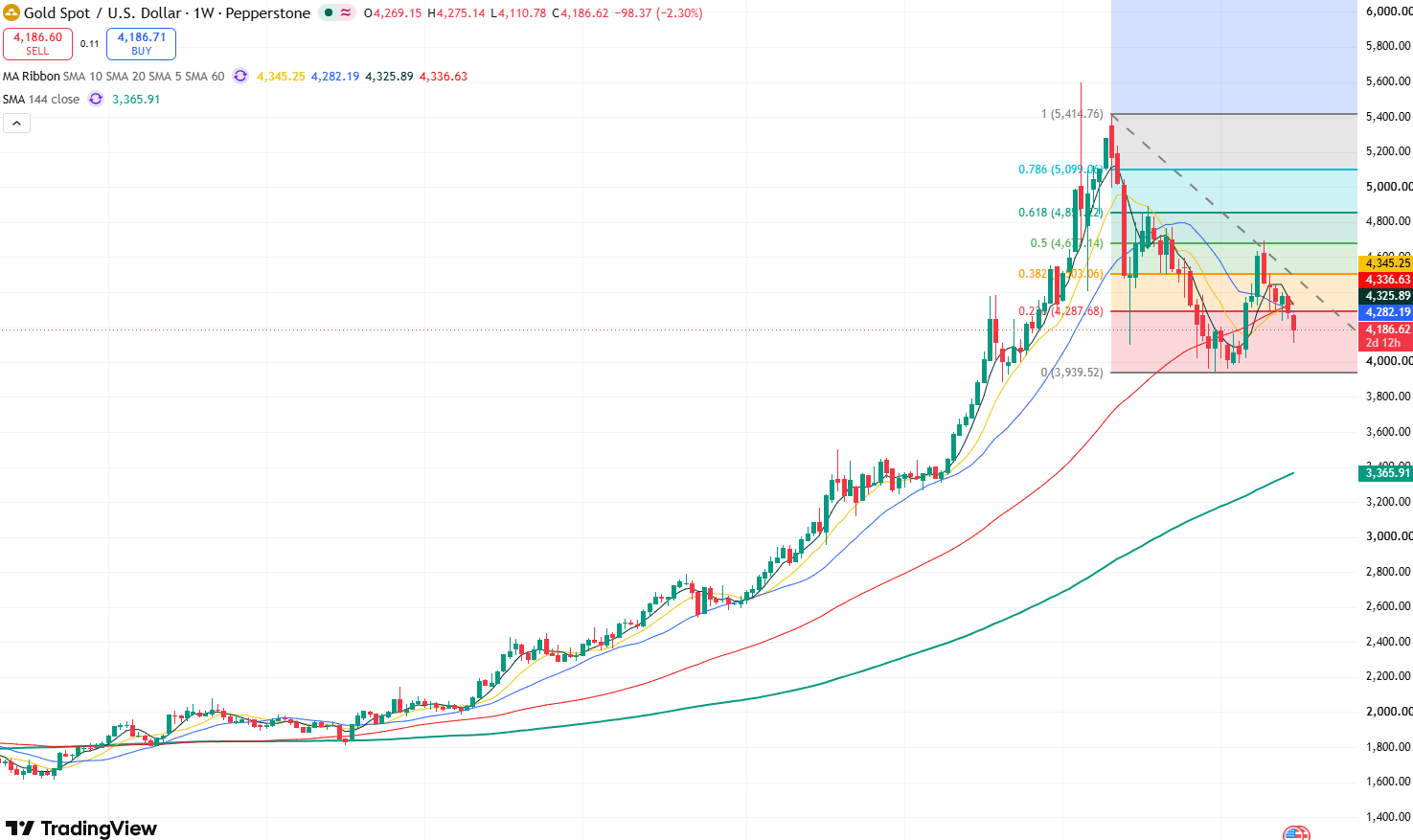
Gold price weekly chart, Source: TradingView

As for gold (XAUUSD), if employment is significantly stronger than expected, rising Fed rate-hike expectations could push the US dollar and Treasury yields higher, continuing to suppress gold's performance. Gold prices could test downward toward $4,100 or even further toward the $4,000 mark. If job growth slows significantly and the market dials back rate-hike expectations, causing Treasury yields and the US dollar to pull back in tandem, it would favor a recovery in gold prices, potentially opening up upside room toward $4,400. If the data falls roughly within the expected range of 90,000 to 100,000, gold's further trajectory will need to be judged in combination with wage growth, the unemployment rate, and the market's repricing of the Fed's next meeting.

Read more

  • Gold Faces Pressure Ahead of Fed Decision as Prices Extend Drop Below $4,000
  • Gold falls to two‑month low below $4,050 as oil spikes
  • * The content presented above, whether from a third party or not, is considered as general advice only.  This article should not be construed as containing investment advice, investment recommendations, an offer of or solicitation for any transactions in financial instruments.

    goTop
    quote
    Related Articles
    placeholder
    Nasdaq closes at 26,008.86 — 8.9 points above 26,000, and the credit market never blinkedThe Nasdaq Composite fell 2.60% to 26,008.86 on October 22, its worst session since June, as Meta sank 6.98% on 2026 capex guidance of $135–145 billion. But the equal-weight S&P 500 rose 0.73%, high-yield credit was flat and 10-year yields fell 20 basis points. This was an AI de-rating, not a risk-off event — here is the transmission chain, the 29,000 / 28,200 levels and what would prove it wrong.
    Author  Irene Q.
    Yesterday 06: 39
    The Nasdaq Composite fell 2.60% to 26,008.86 on October 22, its worst session since June, as Meta sank 6.98% on 2026 capex guidance of $135–145 billion. But the equal-weight S&P 500 rose 0.73%, high-yield credit was flat and 10-year yields fell 20 basis points. This was an AI de-rating, not a risk-off event — here is the transmission chain, the 29,000 / 28,200 levels and what would prove it wrong.
    placeholder
    Brent tops $113 on Saudi supply risk — but the diesel line in the EIA report is the tellBrent's December contract settled at $113.17 on October 22, up 4.00% and the highest close since May 4, after Saudi Arabia restricted refined-product shipments. The same session's EIA report showed crude stocks down 3.06 million barrels and gasoline down 2.95 million — but distillates built 1.68 million. That single line decides whether $113 holds: here are the data, the 108.8 / 114.0 / 119.3 levels and the two scenarios.
    Author  Irene Q.
    Yesterday 05: 51
    Brent's December contract settled at $113.17 on October 22, up 4.00% and the highest close since May 4, after Saudi Arabia restricted refined-product shipments. The same session's EIA report showed crude stocks down 3.06 million barrels and gasoline down 2.95 million — but distillates built 1.68 million. That single line decides whether $113 holds: here are the data, the 108.8 / 114.0 / 119.3 levels and the two scenarios.
    placeholder
    The Fed will sit still on October 28 — but 100 of 100 economists now expect a December hikeA Reuters poll run October 16-20 found 94 of 100 economists expecting the Fed to hold at 3.75-4.00% on October 28 — and all 100 expecting a hike in December, against less than half a month earlier. The market is close to the same price, with CME FedWatch at roughly 17% for October and 82.8% for December. With the Fed in blackout since October 17, here are the five dates that decide the rest of the year, what each one is priced for, and the two directions each can take.
    Author  Irene Q.
    Oct 22, Thu
    A Reuters poll run October 16-20 found 94 of 100 economists expecting the Fed to hold at 3.75-4.00% on October 28 — and all 100 expecting a hike in December, against less than half a month earlier. The market is close to the same price, with CME FedWatch at roughly 17% for October and 82.8% for December. With the Fed in blackout since October 17, here are the five dates that decide the rest of the year, what each one is priced for, and the two directions each can take.
    placeholder
    Housing starts fell to the second-lowest since the pandemic shutdown — with the 10-year at 5.12%, who is left to buy?US housing starts dropped 5.2% to 1.221 million in September, the second-lowest pace since the 2020 pandemic shutdown, and building permits hit a three-and-a-half-year low of 1.400 million. Both figures are worse than they look because July and August were revised up. With the 10-year Treasury at 5.117% — only 19bp below its October 5 peak of 5.311% — and the NAHB builder confidence index at 2012 levels, here are the three numbers, the transmission chain from rates to permits, and the two scenarios into the October 28 FOMC.
    Author  Irene Q.
    Oct 21, Wed
    US housing starts dropped 5.2% to 1.221 million in September, the second-lowest pace since the 2020 pandemic shutdown, and building permits hit a three-and-a-half-year low of 1.400 million. Both figures are worse than they look because July and August were revised up. With the 10-year Treasury at 5.117% — only 19bp below its October 5 peak of 5.311% — and the NAHB builder confidence index at 2012 levels, here are the three numbers, the transmission chain from rates to permits, and the two scenarios into the October 28 FOMC.
    placeholder
    Dollar presses 102 as the 10-year yield sits at 5.14% — and October hike odds are only 17%The dollar index closed at 101.99 (+0.20%) on Monday after briefly topping 102.07, while the 10-year Treasury yield rose to 5.14% and the 2-year hit 4.774% — yet futures price only about a 17% chance of a hike at the October 27-28 FOMC, versus roughly 90% for December. The driver is a global bond selloff, not a Fed repricing: France's 10-year OAT jumped to 4.84% ~ 4.94% and the OAT-Bund spread widened to 140 ~ 146bp. Here are the levels, the cross-asset read-through and what to watch.
    Author  Irene Q.
    Oct 20, Tue
    The dollar index closed at 101.99 (+0.20%) on Monday after briefly topping 102.07, while the 10-year Treasury yield rose to 5.14% and the 2-year hit 4.774% — yet futures price only about a 17% chance of a hike at the October 27-28 FOMC, versus roughly 90% for December. The driver is a global bond selloff, not a Fed repricing: France's 10-year OAT jumped to 4.84% ~ 4.94% and the OAT-Bund spread widened to 140 ~ 146bp. Here are the levels, the cross-asset read-through and what to watch.
    Live Quotes
    Name / SymbolChart% Change / Price
    XAUUSD
    XAUUSD
    0.00%0.00
    USDOLLAR-F
    USDOLLAR-F
    0.00%0.00
    NAS100
    NAS100
    0.00%0.00

    Macroeconomic Related Articles

    • How Trumponomics Influenced Oil Price Volatility in the Iran War
    • Decoding Trumponomics: Trading Volatility in 2026 Ebook

    Click to view more