


As the Stock Market Flashes a Warning Seen Only 2 Times in 155 Years, Warren Buffett has a Big Warning for Investors
Key Points
Warren Buffett is one of the most successful investors in history. And it pays to listen to what he has to say.
This market has some striking parallels to the dot-com bubble.
- 10 stocks we like better than S&P 500 Index ›
Over the last three years, the S&P 500 has gone into overdrive -- gaining roughly 26%, 25%, and 18% consecutively over the last three years. These numbers are well above the index's 100-year average return of just 10%, and the outperformance can be credited to a new technology called generative artificial intelligence, which promises to transform the global economy.
That said, history tells us that periods of exceptional stock market growth are often followed by a mean reversion or underperformance as the market corrects its irrational exuberance. Investing legend Warren Buffett knows this well, and navigating these periods has been one of the keys to his exceptional long-term track record. Let's dig into his strategy to see what lessons investors can apply to their own portfolios.
Missed Nvidia in 2009? This Rare Signal Is Flashing Again. In 2009, a "Double Down" signal flashed for a little-known chipmaker called Nvidia. For the first time in years, that same "Total Conviction" signal is flashing for a company 1/100th the size of Nvidia. Continue »
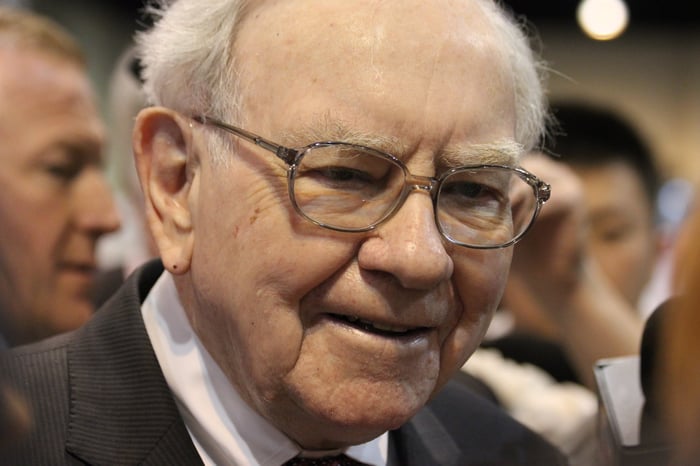
Warren Buffett. Image source: The Motley Fool.
Why is the market soaring?
It's hard to overstate the impact generative AI has already had on the world. According to Pew Research, around a quarter of Americans use AI chatbots daily, and that number will likely grow as the models become more mainstream and sophisticated. The business side of the equation is even more explosive, with an estimated 78% of companies globally already adopting the technology for at least one function.
Silicon Valley has responded to the megatrend by pouring unprecedented sums into acquiring and deploying the infrastructure needed to run and train the consumer-facing large language models (LLMs) that make AI possible. Capital spending is expected to exceed $1 trillion this year, and it is partly responsible for the market's elevated returns by contributing to the growth of computer hardware giants like Nvidia and Micron.
In fact, analysts at Goldman Sachs believe AI is behind a whopping half of the S&P 500's recent total earnings growth, highlighting how dependent the market has become on this one burgeoning industry.
The market is repeating a very alarming pattern
It's generally not a good sign for the market to become overly dependent on one industry -- especially considering the fact that much of the profits remain concentrated on the picks-and-shovels side of the opportunity. Meanwhile, consumer-facing companies like OpenAI continue to burn through cash, with the ChatGPT maker losing $3.7 billion in the first quarter of 2026, more than half its revenue of $5.7 billion.
While most experts believe AI will ultimately be a transformational technology for the economy, there is no guarantee that the early movers will stay ahead or that contemporary business models will remain viable.
The situation has a strong similarity to the dot-com bubble of the late 1990s, when many early mover internet stocks failed despite the long-term impact of the technology they sought to pioneer.
There are also similarities in stock market valuations between the two periods according to the cyclically adjusted price-to-earnings (CAPE) ratio. This metric measures stock prices relative to average inflation-adjusted earnings over the previous 10 years, helping to smooth out short-term fluctuations. And it currently stands at 41, repeating a pattern seen only twice in the past 155 years -- before the dot-com bubble in 1999 and the Great Depression in 1929.
What can we learn from Warren Buffett?
In a recent interview with CNBC, Warren Buffett harshly criticized the current market environment, stating, "It is tough to find values when everybody is preferring gambling." And these remarks fit well with his long-running strategy of trying to bet on affordable businesses with strong fundamentals instead of chasing the latest market trends.
In the short term, a value-oriented approach can cause investors to miss out on explosive short-term returns. But speculative stocks tend to bust just as quickly as they boomed. And Buffett's strategy has been proven to work better over the long term. Right now, investors should pay close attention to valuation and business sustainability when picking stocks to avoid being left holding the bag when the music stops.
Should you buy stock in S&P 500 Index right now?
Before you buy stock in S&P 500 Index, consider this:
The Motley Fool Stock Advisor analyst team just identified what they believe are the 10 best stocks for investors to buy now… and S&P 500 Index wasn’t one of them. The 10 stocks that made the cut could produce monster returns in the coming years.
Consider when Netflix made this list on December 17, 2004... if you invested $1,000 at the time of our recommendation, you’d have $412,074!* Or when Nvidia made this list on April 15, 2005... if you invested $1,000 at the time of our recommendation, you’d have $1,314,319!*
Now, it’s worth noting Stock Advisor’s total average return is 932% — a market-crushing outperformance compared to 209% for the S&P 500. Don't miss the latest top 10 list, available with Stock Advisor, and join an investing community built by individual investors for individual investors.
See the 10 stocks »
*Stock Advisor returns as of September 17, 2026.
Will Ebiefung has no position in any of the stocks mentioned. The Motley Fool has positions in and recommends Goldman Sachs Group, Micron Technology, and Nvidia. The Motley Fool has a disclosure policy.
Recommended Articles


