


Indian Rupee gains further as oil prices extend losses
- The Indian Rupee adds more gains due to further weakness in oil prices.
- US President Trump confirms that strikes on Iran have halted to open the door to diplomacy.
- India’s GDP growth will likely slow down to 6.6% YoY this year.
The Indian Rupee (INR) extends its winning streak against the US Dollar (USD) for the third trading day on Tuesday. The USD/INR pair falls to near 95.65 as a further decline in oil prices has strengthened the Indian currency.
In the opening trade, the MCX Crude Oil contract expiring on August 19 trades 1.4% down at around Rs. 7,848, the lowest level seen in a week.
Given that India meets 85% of its energy demand through imports, a steep decline in oil prices reduces foreign outflows from India and hence improves the appeal of the Indian Rupee.
Trump confirms Iran negotiating with US
On Monday, United States (US) President Donald Trump said that Iran is talking to Washington about a deal and said “reaching one is possible”. Trump added that there’s plenty of time to reach a deal with Iran and that “we'll see what happens”, Axios reported. Trump added that he halted strikes on Iran to open the door to diplomacy, while maintaining the stance of expanding military aggression if talks failed.
The pause in the exchange of attacks between the US and Iran has resulted in a sharp decline in oil prices. However, it doesn’t mean that the energy supply is returning to normal, with the Strait of Hormuz remaining closed.
Countdown to Fed’s policy starts
This week, the major trigger for financial markets will be the Federal Reserve’s (Fed) monetary policy announcement on Wednesday.
According to the CME FedWatch tool, traders see a 62% chance that the Fed will leave interest rates unchanged in the range of 3.50%-3.75%. The tool shows a strong possibility of an interest rate hike in the September policy meeting.
However, US President Trump urged Fed Chairman Kevin Warsh to lower interest rates, adding that there was a good inflation report recently, costs were falling rapidly, and that prices should drop significantly once the Gulf War ends.
Experts warn of slower India’s GDP growth
According to the latest Reuters poll, India’s Gross Domestic Product (GDP) is forecast to grow 6.6% Year-on-Year (YoY) in the fiscal year ending March 2027, down from 7.7% in FY2025-26. Growth is then expected to edge up to 6.8% in FY2027-28. The report showing poll results also revealed that weak private investment and higher oil prices will weigh on India’s economic growth.
Going forward, the major trigger for the Indian currency will be the Reserve Bank of India’s (RBI) monetary policy announcement next week.
Technical Analysis: USD/INR falls below 20-day EMA
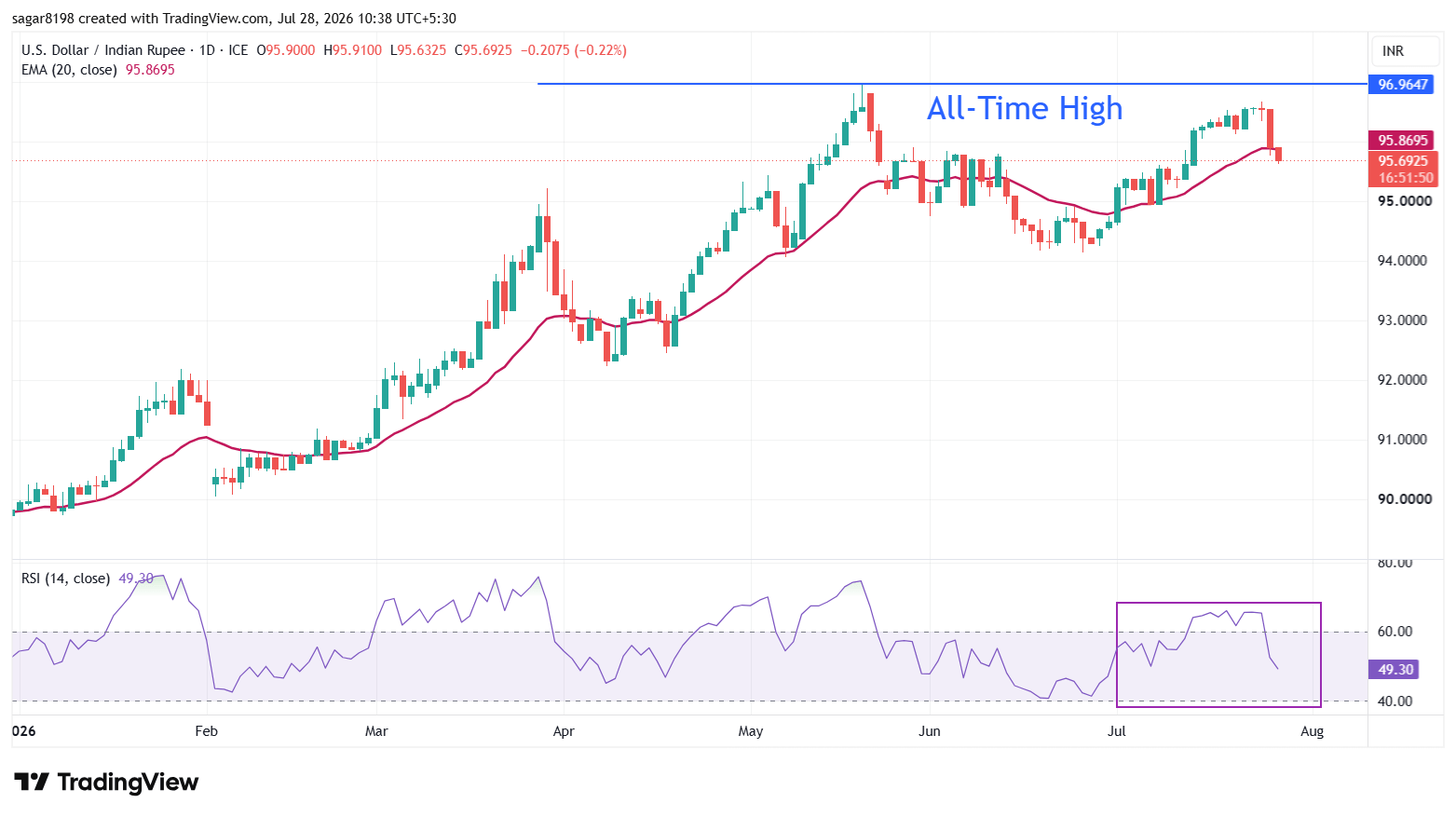
USD/INR trades lower at around 95.65, holding in a corrective phase after recent gains as it slips just under the 20-day exponential moving average (EMA), which is at 95.93. The loss of this short-term average as immediate resistance hints that upside momentum is fading, while the Relative Strength Index (RSI) at 50.6 sits near neutral territory, suggesting a consolidative rather than impulsive tone for now.
On the topside, the 20-day EMA at 95.9278 is the first barrier that bulls would need to reclaim to revive a more constructive bias and open the way for a retest of all-time highs around 97.10. Looking down, the 95.00 level will be the key support area.
(The technical analysis of this story was written with the help of an AI tool. Know more.)
Indian Rupee FAQs
The Indian Rupee (INR) is one of the most sensitive currencies to external factors. The price of Crude Oil (the country is highly dependent on imported Oil), the value of the US Dollar – most trade is conducted in USD – and the level of foreign investment, are all influential. Direct intervention by the Reserve Bank of India (RBI) in FX markets to keep the exchange rate stable, as well as the level of interest rates set by the RBI, are further major influencing factors on the Rupee.
The Reserve Bank of India (RBI) actively intervenes in forex markets to maintain a stable exchange rate, to help facilitate trade. In addition, the RBI tries to maintain the inflation rate at its 4% target by adjusting interest rates. Higher interest rates usually strengthen the Rupee. This is due to the role of the ‘carry trade’ in which investors borrow in countries with lower interest rates so as to place their money in countries’ offering relatively higher interest rates and profit from the difference.
Macroeconomic factors that influence the value of the Rupee include inflation, interest rates, the economic growth rate (GDP), the balance of trade, and inflows from foreign investment. A higher growth rate can lead to more overseas investment, pushing up demand for the Rupee. A less negative balance of trade will eventually lead to a stronger Rupee. Higher interest rates, especially real rates (interest rates less inflation) are also positive for the Rupee. A risk-on environment can lead to greater inflows of Foreign Direct and Indirect Investment (FDI and FII), which also benefit the Rupee.
Higher inflation, particularly, if it is comparatively higher than India’s peers, is generally negative for the currency as it reflects devaluation through oversupply. Inflation also increases the cost of exports, leading to more Rupees being sold to purchase foreign imports, which is Rupee-negative. At the same time, higher inflation usually leads to the Reserve Bank of India (RBI) raising interest rates and this can be positive for the Rupee, due to increased demand from international investors. The opposite effect is true of lower inflation.
Recommended Articles


