


USD/MXN (USDMXN) Is down 0.60% on Sep 29: What Is Behind the Currency Move?
USD/MXN (USDMXN) is down 0.60% at Sep 29 08:05(ET), now at $17.87452, with a 7-day up of 3.40%.
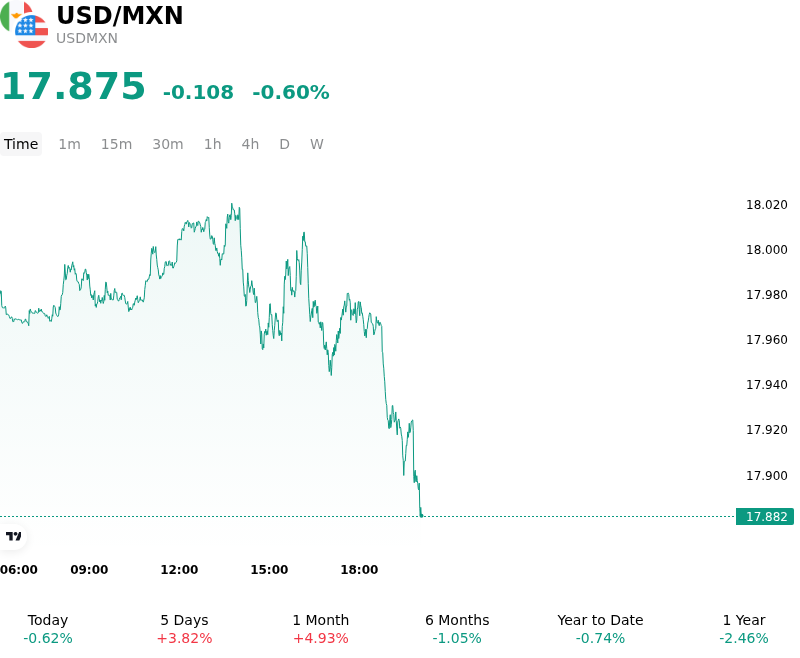
What is driving USD/MXN (USDMXN)’s stock price down today?
The retreat in USDMXN reflects a combination of technical profit-taking and a pause in the U.S. dollar's recent upward trajectory, which had previously pushed the exchange rate into overbought technical territory. Following a multi-session rally that lifted the pair toward multi-month highs, institutional market participants took advantage of stretched positioning to trim long U.S. dollar exposures. A stabilization in U.S. Treasury yields further sapped momentum from the greenback, allowing the Mexican peso to stage a corrective rebound.
Fundamental support for the Mexican peso remains anchored by the Bank of Mexico's monetary policy framework. Banxico's commitment to holding its benchmark interest rate at 6.50 percent while signaling a prolonged policy pause reinforces expectations that Mexican rates will remain elevated to ensure disinflation toward target. Although the U.S. Federal Reserve maintains a cautious stance, the substantial nominal yield advantage offered by Mexican sovereign debt continues to underpin carry-trade dynamics. With the Banxico-Fed rate spread remaining sufficiently wide, institutional capital flows resumed toward high-yielding Latin American paper once the dollar's immediate rally lost momentum.
Broader market sentiment also played a role as stabilizing risk appetite across emerging markets reduced safe-haven demand for the dollar. While investors continue to monitor upcoming U.S. macroeconomic releases and global geopolitical developments, the peso benefits from robust relative yields and solid domestic policy fundamentals. In the short term, USDMXN movements will remain sensitive to incoming inflation data, shifts in U.S. rate expectations, and the durability of carry-trade interest.
Technical Analysis of USD/MXN (USDMXN)
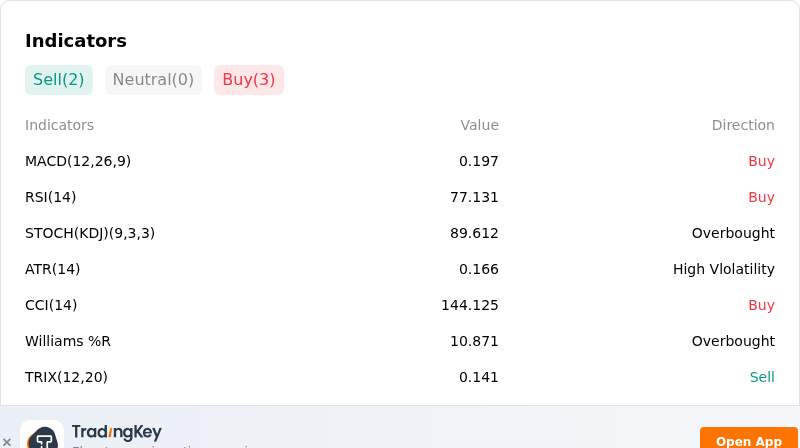
Technically, USD/MXN (USDMXN) shows a MACD (12,26,9) value of 0.197, indicating a buy signal. The RSI at 77.131 suggests buy condition and the Williams %R at 10.871 suggests overbought condition. Please monitor closely.
More details about USD/MXN (USDMXN)
Recent Events and Risks:
- Banxico Policy Decoupling and Narrowing Rate Spread: Banco de México Governor Victoria Rodríguez reaffirmed that Banxico will not mechanically follow Federal Reserve rate hikes, maintaining its policy rate at 6.50%. This deliberate pause has compressed the U.S.-Mexico benchmark interest rate differential to 250 basis points—its narrowest margin since 2015—substantially eroding the Mexican peso's yield cushion against hawkish Fed monetary repricing.
- Unwinding of Heavy Long-MXN Carry Positioning: Market positioning reveals stretched net-long Mexican peso holdings, creating significant market structure vulnerability. Rising U.S. Treasury yields, with the 10-year yield holding above 5.00%, threaten to trigger stop-loss liquidations and an accelerated unwind of long-MXN carry trades.
- Geopolitical Risk Aversion and Safe-Haven USD Bids: Stalled Middle East diplomatic negotiations and souring global risk sentiment have bolstered safe-haven demand for the U.S. dollar, driving the U.S. Dollar Index above 101.00. This risk-off capital reallocation from high-beta emerging market currencies has pushed USD/MXN toward key resistance near 18.00.
- Domestic Growth Slack and Softening Economic Data: Weaker Mexican economic activity indicators and softer retail sales data reflect underlying slack in the domestic economy. This constrains Banxico's ability to enact defensive rate hikes to support the currency, leaving the peso exposed to further downside volatility.
Recommended Articles


