


Yen hits one-month high on BOJ September-hike bets; AUD/JPY cracks support as carry unwinds


The yen has staged its sharpest two-day advance in months, driving USD/JPY from the 160 area down to a one-month high near 155.2 as markets ramp up bets that the Bank of Japan will hike on September 18. With Tokyo core CPI running above expectations and Prime Minister Takaichi now backing an early move, traders increasingly see the BOJ acting — and the data show this leg of the rally came without fresh official intervention. The move is rippling through the yen crosses: AUD/JPY has broken below its August support at 112.7, an early sign that carry-trade unwinding is under way.
Price action: the 160 battle flipped into a 155 retest in two days
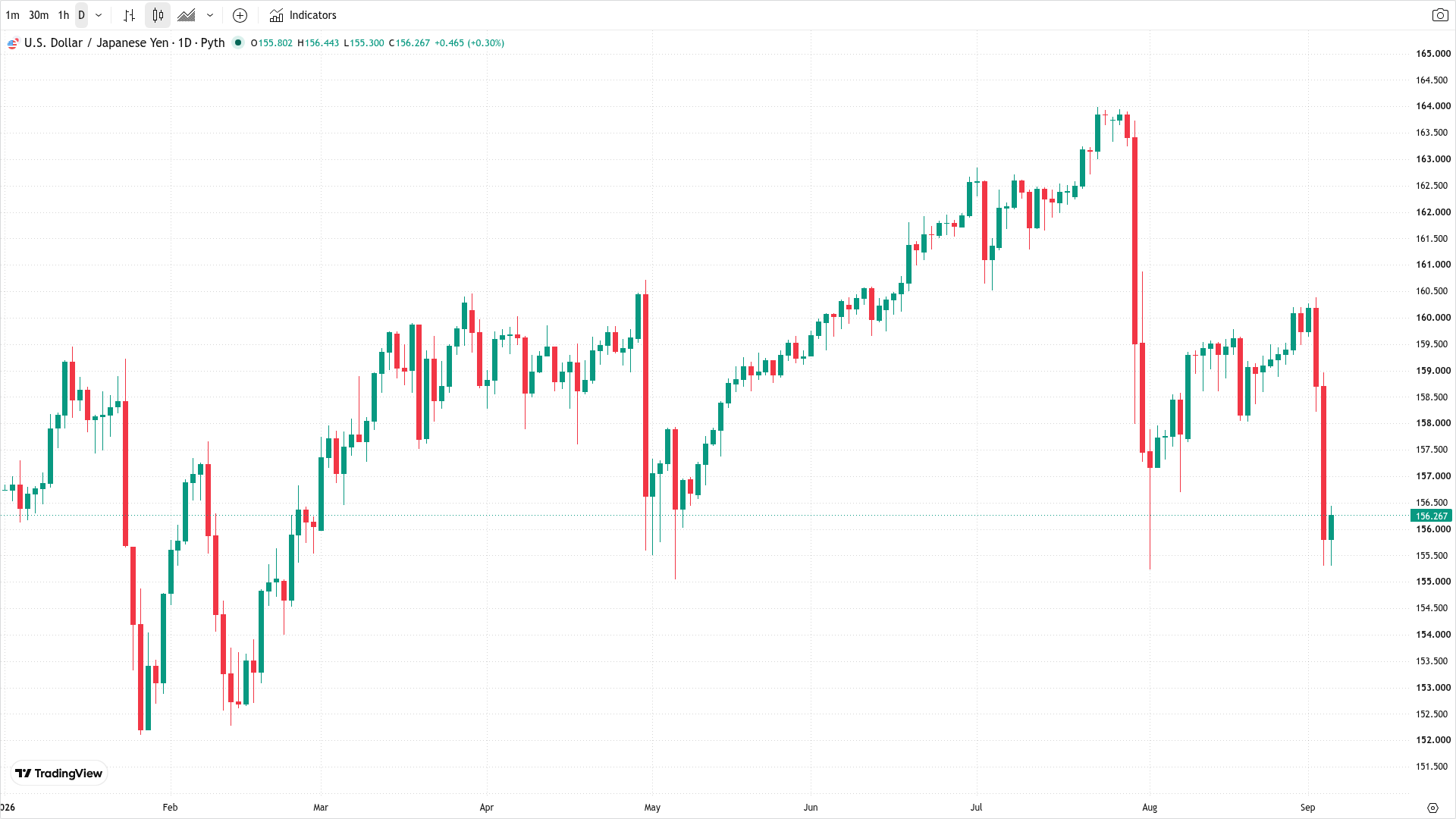
Until Tuesday, USD/JPY had spent late August knocking repeatedly against 160 — testing 160.05 on August 27, 160.20 on August 31 and 160.39 as recently as September 1 — only to be sold each time at what the market treated as an intervention line. The reversal came swiftly. USD/JPY fell roughly 1% on Tuesday, and on Wednesday the yen jumped more than 2% in a single session, touching 155.28 per dollar at the strongest point — its best level since August 3, shortly after the record US-Japan intervention on July 31. Early Thursday Asia time the pair was trading near 156.3, consolidating just above that spike low.
The broader arc is a round trip. USD/JPY hit 163.98 on July 22, Japan and the US then spent a record ¥15.4 trillion on yen-buying intervention between July 30 and August 26, the dollar fell to about 155.21 in the aftermath, and the rebound back above 160 in late August now looks like a bear-market rally that has failed at resistance. Yen strength has extended against the euro and sterling as well.
Why the yen turned: BOJ bets, a Bessent nod — and no intervention on this leg
Rising BOJ hike odds. Markets had already priced close to an 80% chance of a 25-basis-point hike to 1.25% at the September 17-18 meeting, and those bets have intensified since. Tokyo's August core CPI printed at 1.8% year on year on August 27, above the 1.7% consensus, with food prices up 3.5% — fresh ammunition for the "weak-yen import inflation" case. A Reuters poll on August 25 found a majority of economists expecting a September hike, faster tightening after that and a higher terminal rate.
Political headwinds gone. Prime Minister Takaichi, long a skeptic of tightening, has now publicly backed an early BOJ move (September or October), worried that a weak yen is feeding import prices — removing what the market viewed as the biggest obstacle.
US blessing. Treasury Secretary Scott Bessent told CNBC on Monday that he expects the Japanese government and central bank to act to strengthen the yen; reports that his talking points at a meeting included "Buy Japanese Yen (JPY)" added to the speculative heat. Crucially, BOJ data show no official intervention behind Wednesday's surge, according to Reuters — meaning this rally is being driven by rate expectations and a softer dollar rather than by stealth buying, which makes the move harder to fade.
Institutions: an expectations-driven rally needs BOJ follow-through
Nomura Research Institute economist Takahide Kiuchi said in mid-August that "with political pressure weakening, the Bank of Japan could accelerate the pace of its rate hikes" — a view the recent price action has validated.
Japan Macro Advisors chief economist Takuji Okubo told CNBC it is "possible" Thursday's sharp move represented further intervention, underscoring how much uncertainty surrounds the size of Japan's war chest and its trigger levels.
Fitch Ratings argued in an early-August report that further yen appreciation "is likely to require BOJ rate hikes" — i.e., if the bank stands pat on September 18, the currency could give back this entire rally and retest 160.
The year-start house-view divergence is now resolving in the yen's favour: J.P. Morgan looked for 164 at end-2026, ING for 153 and Scotiabank for 150. With intervention exhausted and the BOJ expected to accelerate, the market is trading toward the bullish-yen end of that range.
Technical analysis: 155.21 is the line that separates a pause from a trend
On the daily chart, USD/JPY has broken decisively below both the 50-day moving average (near 157.6) and the 100-day MA (near 158.4) — the same 157.5 zone that acted as the multi-month pivot in mid-August now caps rallies from underneath. Momentum has turned firmly yen-positive, and the only meaningful structure left above the post-intervention low is the round 155 handle itself.
If the BOJ delivers on September 18, a break of 155.21 (the high set right after the July intervention) would open a clear path toward 155 and then the 153 area that ING and others target for year-end — the level that would confirm a genuine uptrend in the yen rather than a spike. If the BOJ disappoints or guidance turns dovish, expect a swift mean-reversion: 157.5 becomes the first overhead hurdle, then the 158.9 breakdown point, with 160.2 (September 1 high) the level that would put the intervention battle fully back on the table.
| Support | Resistance |
|---|---|
| 155.28 (September 3 one-month high / spike low) | 157.5 (former pivot & 50-day MA zone) |
| 155.21 (post-July-intervention high) | 158.9 (September 2 breakdown point) |
| 153.00 (ING year-end target) | 160.2 (September 1 high) |
The Australian angle: AUD/JPY cracks 112.7 as carry unwinds
For AUD readers, the clearest expression of this trade is AUD/JPY. The Australian cash rate sits at 4.35% (the RBA has hiked three times this year and held in August) against Japan's 1.0% — even after a September hike to 1.25% the spread would remain a hefty 3.1 percentage points, so the pair's appeal as a carry vehicle is intact in theory. In practice, however, AUD/JPY is the cross where carry unwinding tends to surface first: it fell from its August 27 high near 114.96 to around 112.66 in early Asia Thursday, breaking below the 112.73 low of August 19 in the process — the exact "if that gives way, losses accelerate" scenario flagged before the break. Below 112.7 there is little chart support until the psychological 110 handle. For anyone carrying AUD/JPY exposure or hedging yen conversion needs, the BOJ meeting on September 18 is now the pivotal risk event.
What to watch
The August US nonfarm payrolls report lands on Friday US time — a strong print would support the dollar and could stall the yen's run at 155.21, while a soft one would compound the move. The main event remains the BOJ decision on September 18 (meeting September 17-18): whether the bank hikes to 1.25%, and — more importantly — whether guidance signals a faster pace thereafter. The RBA meets on September 29 and will set the medium-term tone for AUD/JPY.
Related reads: for the dollar side of this trade, see our US Dollar Index forecast as Fed bets and Iran risks collide; for how a struggling greenback is lifting the Aussie against the majors, see Australian Dollar gains as US Dollar struggles amid fading Fed rate hike bets.
Read more
* The content presented above, whether from a third party or not, is considered as general advice only. This article should not be construed as containing investment advice, investment recommendations, an offer of or solicitation for any transactions in financial instruments.


