


Gold struggles as rising yields and hawkish Fed signals weigh
- Gold’s recovery fades as a stronger US Dollar and elevated yields keep bulls on the sidelines.
- Higher Oil prices and hawkish Fed signals reinforce expectations of an additional rate hike later this year.
- XAU/USD retains a bearish bias, with the RSI near 37 and MACD in negative territory.
Gold (XAU/USD) reverses its modest recovery on Thursday as a stronger US Dollar (USD) and rising US Treasury yields cap upside attempts, leaving the metal in a bearish consolidation phase near two-month lows. At the time of writing, XAU/USD trades around $4,119, easing from an intraday high of $4,143.
US Treasury yields remain elevated near multi-year highs, largely driven by higher Oil prices fuelling inflation concerns. Rising government debt, fiscal concerns and resilient US economic growth add further upward pressure on yields.
Oil prices rebound on Thursday, with West Texas Intermediate (WTI) gaining around 3% after reports that the Pentagon has ordered preparations for possible renewed strikes on Iran. Axios reports that military action could take place before November’s US midterm elections.
Strategists at Brown Brothers Harriman highlight that the “renewed increase in crude oil prices is weighing on stocks and bonds, while underpinning a firmer USD.” They add that “persistently high energy prices keep risks to inflation, policy rates, and benchmark bond yields skewed to the upside, while favoring energy exporters’ currencies and USD over energy importers’ currencies.” In their view, “US growth outperformance and strong foreign appetite for US securities give USD an added boost.”
The US Dollar Index (DXY), which tracks the Greenback’s value against a basket of six major currencies, trades around 102.40, close to the 18-month high of 102.53 reached earlier this week. A hawkish Fed outlook lends additional support to the Greenback.
Fed Governor Christopher Waller said on Thursday, “More hikes needed but flexible about the pace.” Waller added, “Inflation too high, with AI buildout, ongoing energy shock among a range of persistent inflationary forces.”
The Fed’s September meeting minutes, released Wednesday, show unanimous support for a 25-basis-point (bps) hike to 3.75%-4.00%. Most participants considered another rate increase likely appropriate by year-end amid persistent inflation risks. The minutes offered no commitment to a hike at the October 27-28 meeting, where traders broadly expect rates to remain unchanged.
A firm US Dollar, elevated yields and the prospect of further Fed tightening keep Gold bulls on the sidelines. However, longer-term support remains intact, backed by robust ETF demand and continued central bank purchases.
TD Securities argues that “a continued bid from discretionary traders, ETFs, and central banks all combine to provide a strong floor for gold,” reinforcing their view that the current weakness is being met by robust underlying demand. In their assessment, “we continue to see the stage being set for gold to disconnect from real rates further and begin a new bull run into 2027.”
Technical analysis: XAU/USD risks further losses below $4,100
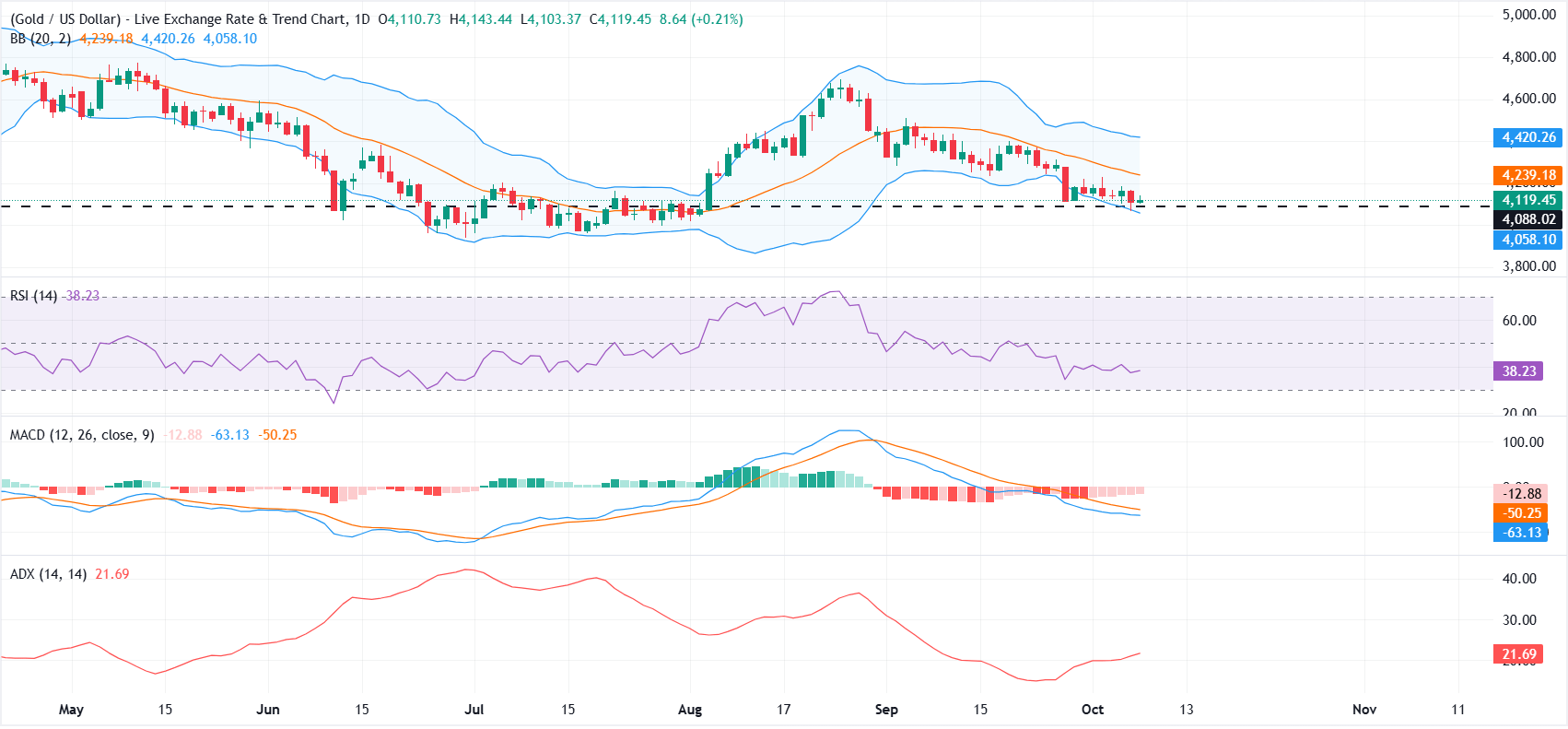
On the daily chart, XAU/USD keeps a bearish near-term bias as price sits below the 20-period Bollinger Simple Moving Average (SMA) at $4,239 while holding just above the lower Bollinger band at $4,057 and the horizontal level at $4,100, while the Relative Strength Index (RSI) at 37 drifts in the lower half of its range and the Moving Average Convergence Divergence (MACD) remains negative, together suggesting downside pressure persists but without extreme oversold conditions.
On the topside, initial resistance appears at the Bollinger middle SMA near $4,239, ahead of the upper band at $4,420, and only a sustained move over these caps would ease the current bearish tone. On the downside, the immediate focus is on the horizontal support at $4,100, followed by the lower Bollinger band at $4,057.47, where failure to hold could open the way for a deeper slide.
(The technical analysis of this story was written with the help of an AI tool. Know more.)
Gold FAQs
Gold has played a key role in human’s history as it has been widely used as a store of value and medium of exchange. Currently, apart from its shine and usage for jewelry, the precious metal is widely seen as a safe-haven asset, meaning that it is considered a good investment during turbulent times. Gold is also widely seen as a hedge against inflation and against depreciating currencies as it doesn’t rely on any specific issuer or government.
Central banks are the biggest Gold holders. In their aim to support their currencies in turbulent times, central banks tend to diversify their reserves and buy Gold to improve the perceived strength of the economy and the currency. High Gold reserves can be a source of trust for a country’s solvency. Central banks added 1,136 tonnes of Gold worth around $70 billion to their reserves in 2022, according to data from the World Gold Council. This is the highest yearly purchase since records began. Central banks from emerging economies such as China, India and Turkey are quickly increasing their Gold reserves.
Gold has an inverse correlation with the US Dollar and US Treasuries, which are both major reserve and safe-haven assets. When the Dollar depreciates, Gold tends to rise, enabling investors and central banks to diversify their assets in turbulent times. Gold is also inversely correlated with risk assets. A rally in the stock market tends to weaken Gold price, while sell-offs in riskier markets tend to favor the precious metal.
The price can move due to a wide range of factors. Geopolitical instability or fears of a deep recession can quickly make Gold price escalate due to its safe-haven status. As a yield-less asset, Gold tends to rise with lower interest rates, while higher cost of money usually weighs down on the yellow metal. Still, most moves depend on how the US Dollar (USD) behaves as the asset is priced in dollars (XAU/USD). A strong Dollar tends to keep the price of Gold controlled, whereas a weaker Dollar is likely to push Gold prices up.
Recommended Articles


