




CFD Trading Australia 2026: Complete Beginner’s Guide
If you’re looking to invest in the global financial market out of Australia, you’ve likely heard savvy investors talk about CFD trading. This trading and investing model, which uses Contracts for Difference (CFDs), is popular among Aussie traders today because of its simplicity in accessing forex, stocks, commodities and cryptocurrencies in one place.
Additionally, CFD trading removes the typical investment risk by allowing traders to speculate on asset price movements without directly owning or holding the underlying assets. Plus, you can profit from both rising and falling markets, making volatility a potential advantage.
However, many beginners misunderstand CFD trading, especially when leverage is involved. This guide explains everything you need to know about CFD trading in Australia in 2026 so that you can start your journey without stress.
What Is CFD Trading?
CFD trading involves a contract or financial agreement between a trader and a broker based on the price movement of an asset. Instead of purchasing the asset directly, the trader speculates on whether the price will rise or fall over a certain period.
That means as a trader, if the market moves in your favour, you profit from the difference between the opening and closing prices. If the market moves against you, that’s a loss.
One of the biggest differences between CFD trading and traditional investing is ownership. When trading CFDs, you do not own physical assets. For instance, trading gold CFDs doesn’t require purchasing actual gold. The same applies to company stocks, which you can trade via CFDs without buying actual shares.
And if you’re interested in cryptocurrencies, you don’t have to buy Bitcoin or Ethereum or hold them in your wallet because crypto CFDs allow you to trade their price movements.
This flexible structure is why CFDs are sought after among investors and traders, especially those seeking global market exposure. You can access multiple financial markets from a single platform without worrying about the complexities and risks of ownership.
In Australia, CFDs are commonly used to trade:
Forex
Stocks
Indices
Commodities
Cryptocurrencies
Exchange-traded funds (ETFs)
The accessibility of this range of investment options and their availability on mobile trading platforms make them very popular among modern traders and investors.
“Trade CFDs with an ASIC-regulated broker. Fast AUD funding via PayID. ”
How Does CFD Trading Work?
CFD trading basically allows traders to speculate on market price movements without directly purchasing the underlying asset.
When placing a CFD trade, you have two options:
Buy (go long) if you expect an asset’s price to rise
Sell (go short) if predicting that an asset’s price will fall
The difference between the opening and closing prices determines your profits or losses. For example, if you believe that the S&P/ASX 200 index will experience a price increase and open a buy trade at 8,000 points.
In this case, if the index later rises to 8,100 points and you close the position, you profit from the 100-point increase. However, if the market falls instead, you record a loss.
The option of being able to trade both rising and falling markets is one of the main reasons people trade CFDs in Australia and beyond. Unlike traditional investing, where profits generally depend on assets increasing in value, CFD traders can potentially benefit from bearish markets as well.
Understanding Leverage in CFD Trading
Another core feature of CFD trading is leverage. With this, you can open larger positions with a small chunk of your capital. For example, with 5:1 leverage, you can enter a $5,000 position using only $1,000 of your own funds as margin.
Total trade size = $5,000
Margin requirement = 20%
Capital required = $1,000
This means you can boost your potential profits. However, despite the higher exposure, better profit opportunity, and flexibility, CFD trading with leverage is high-risk.
If the market moves against the trade, losses are calculated on the full position size, and not just the initial deposit. This means even small price movements can significantly impact your balance.
As such, beginners should avoid common mistakes like overusing leverage before fully understanding the risks involved. Every trader, regardless of experience, must have solid risk management strategies in place to be successful.
Understanding Spreads and Fees
Most CFD trading platforms charge spreads and other fees, as these are their primary sources of revenue. As a beginner, you need to understand these details and how they can affect your balances.
A spread is the difference between the buy and sell prices of an asset. For example, if you buy an asset at 1.2502 and sell at 1.2500, the difference between the two prices is the spread, which is part of the total trading cost.
However, you may find other fees, depending on the CFD broker you choose. Some brokers may charge overnight holding fees, withdrawal fees, or currency conversion costs (especially if you're trading with AUD).
These costs can accumulate over time, especially for active traders. This is why choosing a platform with transparent pricing is crucial to success.
Why CFDs Appeal to Australian Traders
CFD trading is a common trading method among Aussies for many reasons besides its flexibility. Through CFDs, Australian traders can:
Access global markets from one account. With a single brokerage account from Mitrade or other leading platforms, you can access assets from global exchanges, such as the New York Stock Exchange (NYSE) and NASDAQ.
Trade a range of financial instruments, including forex, stocks, commodities, and crypto, from one app.
Speculate on both rising and falling prices of assets and not only profit from increases.
Use leverage for greater market exposure and better potential profits.
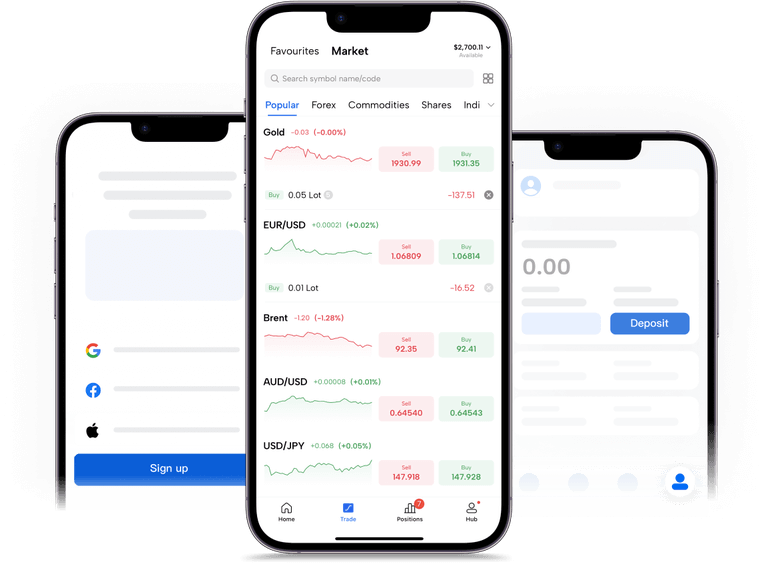
Monitor the markets, analyse positions, and execute trades directly from your mobile device.
Considering that the average Australian is interested in global US stocks and indices, CFDs offer a high level of accessibility to these assets and inform their investment strategies.
“Trade CFDs with an ASIC-regulated broker. Fast AUD funding via PayID. ”
Example of a CFD Trade
To simplify what trading CFDs looks like, let's use the example below.
Imagine you're into crypto CFD trading and your favourite digital asset is Bitcoin, which costs $98,000 per unit. You can open a CFD buy position at $100,000 using leverage if you believe that the Bitcoin price will increase.
If Bitcoin rises to $105,000, you profit from the difference. However, if Bitcoin falls to $95,000, you record a loss.
Since leverage is involved, these gains and losses are amplified in tune with your initial deposit. This is why successful CFD trading depends heavily on discipline, risk management, and emotional control over moving in a predicted market direction.
Best Markets for Beginner CFD Traders
Here are the markets to trade CFDs in Australia:
1. Forex
Forex is one of the most popular CFD markets globally because of its liquidity and accessibility. For context, trillions of dollars are traded in the forex market daily.
The market involves trading popular and exotic currency pairs such as:
A major reason for the high interest in the forex market is that it operates 24/7. There are no breaks during the weekends or holidays, making it possible to enter and exit the market at any time, regardless of your time zone.
Beginners also often start with forex because major currency pairs usually have tight spreads and smooth execution. However, forex markets typically react to macroeconomic conditions like changes in interest rates, inflation data, employment reports, and central bank policies.
Successful forex traders are those who stay informed enough to predict how these factors can sway the markets.
2. Indices
Indices CFDs allow traders to speculate on broader market performance instead of relying on individual shares from companies. This easy and automatic diversification is why many beginners prefer trading index CFDs.
Popular index CFDs include:
With these assets, you get a combination of an industry’s assets in one fund, so you can minimise risks associated with one company’s stock performance.
3. Commodities
Commodity CFDs include markets with assets such as:
Gold is particularly popular among beginners because it is often viewed as a safe-haven asset during periods of economic uncertainty.
Because commodities react differently to economic conditions compared to stocks or forex, they can help diversify trading exposure. However, they can also experience sharp volatility during major geopolitical unrest.
4. Stock CFDs
Stock CFDs allow traders to speculate on company share prices without owning the shares themselves. As an Australian trader, this gives you access to both local and international companies such as:
However, individual stocks can be more volatile than indices because they are affected by company-specific events, such as earnings reports, financial health, and internal policies.
5. Cryptocurrency CFDs
Crypto CFDs allow traders to speculate on digital asset prices without directly purchasing or holding cryptocurrencies in their wallets.
Popular crypto CFDs include:
Ethereum (ETH)
Bitcoin Cash (BCH)
Solana (SOL)
Ripple (XRP)
One reason many traders prefer crypto CFDs is convenience. Instead of handling blockchain transactions or private keys, traders can focus purely on price movements through a standard trading platform. They can also profit from both uptrends and downtrends, depending on their strategies.
However, cryptocurrencies are highly volatile. So, solid risk management is crucial.
“Trade CFDs with an ASIC-regulated broker. Fast AUD funding via PayID. ”
CFD Trading Strategies for Beginners
If you’re just getting started with CFD trading in Australia, here are the common strategies you can explore:
Trend Trading
As the name implies, trend trading involves identifying the overall market direction (or trend) and trading in line with it.
If the market is rising, trend traders look for buying opportunities. If the market is falling, they often find short-selling opportunities.
Breakout Trading
Breakout traders, who are often forex and indices traders, look for market movements beyond key support or resistance levels. The idea is that strong momentum often follows once prices break through major zones.
Range Trading
Range trading involves identifying markets moving sideways between support and resistance levels. This movement gives a price range that the traders can key into. They usually buy near support and sell near resistance, aiming to profit from repeated price movements within the range.
News Trading
Economic news, company announcements, earnings reports, and geopolitical events often impact the market positively or otherwise.
News traders, especially forex and stock CFD traders, leverage the volatility during such periods for potential returns. However, this strategy can be risky because markets often move rapidly during such moments.
Risk Management Strategy
As a beginner, having a trading strategy is good, but risk management is arguably more important. Popular risk management strategies include:
Using stop-loss orders
Limiting leverage
Avoiding oversized positions
Managing emotional decision-making
Advantages and Risks of CFD Trading
Like every form of trading, CFDs come with risk and reward.
Advantages of CFD Trading
CFDs allow traders to diversify across forex, stocks, commodities, indices, and crypto on one platform.
Traders can potentially profit whether markets move up or down.
Leverage increases market exposure with smaller capital requirements.
No direct ownership is required.
Risks of CFD Trading
Leverage can amplify losses.
CFD markets can be volatile.
Fear and greed can lead to poor decisions without discipline
How to Start CFD Trading in Australia
1. Choose a CFD Trading Platform
Select a platform with a user-friendly interface, low fees, a wide asset coverage, and fast execution. Mitrade is a popular option among beginner CFD traders for these reasons.
2. Create and Verify Your Account
Sign up on Mitrade and complete identity verification.
3. Deposit Funds
Fund your account using supported AUD payment methods, including Visa, Mastercard, PayID, and bank transfers.
4. Create a Strategy
Analyse the markets and explore the platform’s features to develop a solid trading strategy. A good idea is to start with a free demo account.
5. Start Trading
Start small and choose small leverage if necessary.


1. Is CFD trading legal in Australia?
Yes. CFD trading is legal and regulated in Australia.
2. Can beginners trade CFDs?
Yes, you can trade CFDs as a beginner. However, pay attention to leverage and risk management before starting.
3. What is the best CFD market for beginners?
Many beginners start with forex or indices because of liquidity and broader market exposure.
4. Can you lose money trading CFDs?
Yes. CFD trading involves risk, especially when leverage is used.
Disclaimer: The content presented above, whether from a third party or not, is considered as general advice only. CFD trading involves significant risk of loss. Past performance does not guarantee future results. This article serves informational purposes only and does not constitute financial advice. Consider your risk tolerance before trading.


