




Top 8 Commodities Trading Platforms in 2026 – Compare Fees & Features
 Best Overall
 Best for Copy Trading
 Best for Experienced
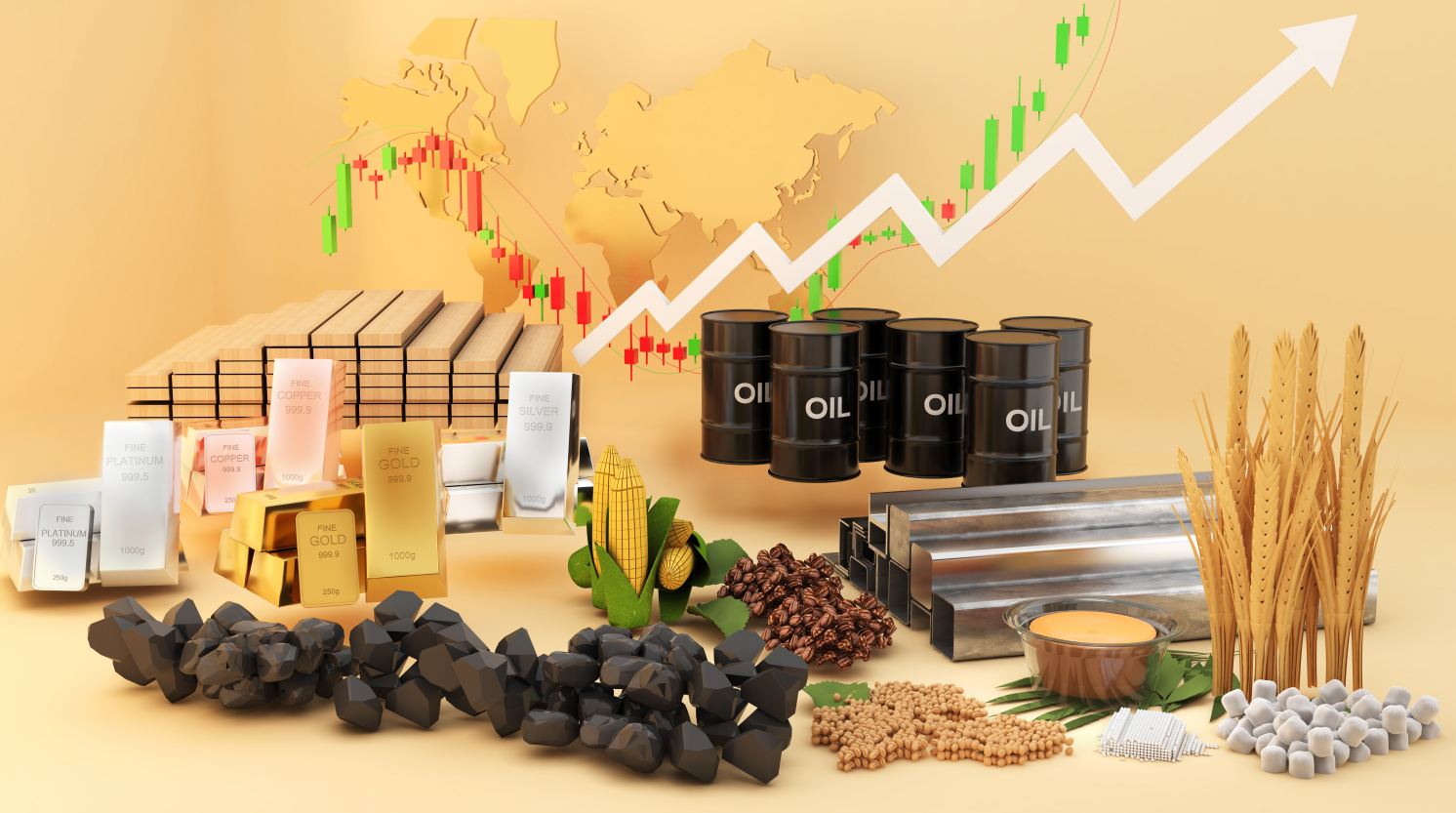
Commodities trading is one of the most popular ways to buy and sell assets in the financial markets for profit. This trading activity involves buying and selling physical items such as oil, gold, energy and other assets on brokerages due to their high demand and supply globally.
However, while interest in commodities is growing, many beginner investors still ask: What is the best commodities trading platform to trade with? If you ask the same question of experienced traders, you will realise that different people have their preferences. Similarly, different platforms offer different features and perks. After hours of extensive research, we’ve curated the best platforms for trading commodities in Australia and beyond. We have also compared their fees, features, and overall performance to help you make informed decisions.
What Commodities Can You Trade Online?
There are tons of commodities that can be traded across online brokerages. Similarly, you’ll find many brokers offering commodities to traders. Before choosing a platform for trading commodities, here are the most popular commodities you’ll find for trading online:
1. Energy Assets
Energy and oil are among the most traded commodities by investors. This is because countries worldwide need them throughout the year, and their prices can increase due to external factors like increased demand, geopolitical tensions, and decisions from the Organisation of Petroleum Exporting Countries (OPEC).
As such, energy commodities like crude oil (WTI and Brent), natural gas, and heating oil are actively traded in this commodity class. However, as a commodity trader, you must factor in the possibility of massive price swings when trading energy assets.
2. Precious Metals
While traders with a strong appetite fancy energy commodities, other investors consider precious metals as safe-haven assets that can serve as stores of value over time. Usually, these metals experience an increase in demand during unfriendly economic situations. For example, if Australia is experiencing inflation and the AUD is losing value, many people opt for precious metals such as gold, silver, platinum, and palladium to protect their money.
However, some people also trade the metals for money. For instance, some people invested in gold and silver and locked in good gains when the assets reached all-time high prices of $5,500 and $120 per ounce in 2026.
3. Industrial Metals
Industrial metals are another asset class used in commodities trading. Think of metals like copper, aluminium, and nickel, which are in demand globally for infrastructure purposes. As countries and cities invest in construction, transportation, and manufacturing, their demand increases. As such, commodity traders find these metals attractive due to their movement with economic growth.
4. Agricultural Commodities
Another commodity asset class that is mostly overlooked is agriculture. While these are not metals, their demand is also massive since everyone across the world eats or produces food. For instance, commodities like wheat, corn, soybeans, coffee, sugar, livestock, and dairy products are crucial to food, biofuel, and industrial manufacturing supply. However, factors like weather, global policies, and consumption levels influence these markets and their traders.
“Trade Commodities with an ASIC-regulated broker. Fast AUD funding via PayID. ”
Top 8 Commodities Trading Platforms in 2026
The best commodities trading platforms in 2026 offer their users access to the different asset classes highlighted above. This means as a trader, you can diversify your exposure to high-risk and low-risk commodities in one place. Let’s take a look at the commodities trading platforms that made our list:
1. Mitrade
Established in 2011, Mitrade is top of mind for commodities traders and investors. The Australian-based broker has a user-friendly platform suitable for traders across all experience levels.
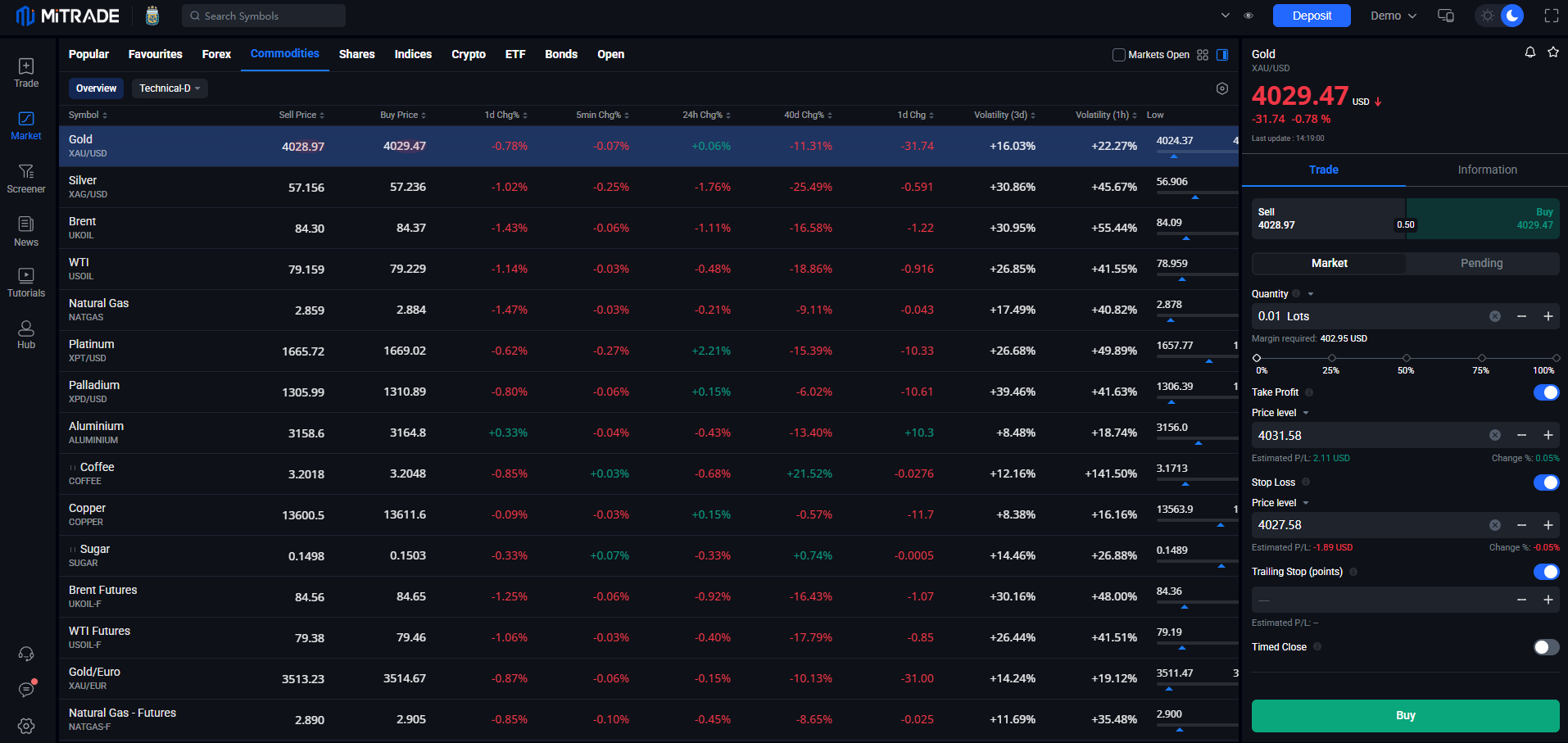
Despite having its headquarters in Australia, Mitrade has a solid presence across Europe, Asia, and some parts of Africa. Another reason traders fancy the platform is its Contract for Difference (CFD) model, which allows the trading of commodities, including oil, gold, and natural gas, without owning the underlying assets.
This is the Mitrade advantage in volatile financial markets because it allows you to go long and short, depending on your trading strategy. In other words, you can potentially profit whether prices rise or fall.
Also, Mitrade thrives with its ease of use. The platform also accommodates beginners and experienced traders and offers fast transaction speed. Experienced traders will fancy Mitrade’s real-time charts, technical indicators, and built-in risk management tools, which make market analysis and trade execution easy.
In terms of fees, Mitrade has a transparent spread-based model instead of commissions. You can also enjoy up to 1:400 leverage for some precious metals. If you’re a beginner, you’ll find the Mitrade demo account handy. It lets you test the platform before spending your capital on trades. Based on these features and perks, Mitrade is a top commodities trading platform to consider in 2026.

Trade XAU/USD with Tight Spreads
2. eToro
eToro is another global broker for commodity trading. The platform shines with its unique social trading feature, which allows users to copy each other’s trades under certain systems and conditions. That means as a beginner, you can opt for copying the market movements of verified traders instead of figuring out commodities trading from scratch.
Like Mitrade, eToro allows users to trade commodities through CFDs. The platform also has commodity exchange-traded funds (ETFs) combining assets like gold, oil, and agricultural products.
In terms of fees, eToro operates on a spread-based model, but spreads can be relatively higher compared to specialised trading platforms like Mitrade. It also charges withdrawal and inactivity fees.
3. Plus500
Plus500 is a CFD-focused trading platform that offers access to a wide range of commodities, including oil, gold, and natural gas. It is known for its simplicity and strong regulatory framework.
One of its main advantages is its pricing structure. Plus500 does not charge commissions on trades, relying instead on spreads. This makes it relatively cost-effective, especially for traders who prefer a straightforward fee model.
The platform also includes useful risk management tools such as stop-loss orders and guaranteed stops. With these features, you can secure your trades from price swings. However, Plus500 has limited research and educational resources compared to some competitors. Traders who rely heavily on fundamental or technical analysis may find this limiting.
4. IG Group
IG Group is one of the most established trading platforms globally and offers a comprehensive range of commodities through CFDs and futures. One of the platform’s strong selling points is its provision of market research tools, analytics, and educational content.
For experienced traders, IG Group provides advanced charting tools and a highly customisable trading environment. It also offers access to a wide range of global markets, making it a versatile platform for multi-asset trading.
In terms of fees, IG Group charges spreads from 0.1 to 2.0 points, depending on the asset and market conditions. While not the cheapest or most beginner-friendly brokerage, IG has a good range of commodities and tools for advanced traders.
5. CMC Markets
CMC Markets is known for its advanced trading platform and strong analytical tools. It offers a wide range of commodities with competitive spreads from 0.2 to 0.3 points. The platform’s sleek interface is easy to customise, making it possible for traders to tweak their trading environment to their preferences. It also includes detailed charting tools, technical indicators, and market insights. CMC Markets also provides educational content and research reports. However, the platform isn’t the best for beginners due to its complexity.
6. Saxo Bank
Saxo Bank is another notable name when thinking of the best commodities trading platforms. However, unlike many competitors, the platform supports both CFD and futures trading, making it suitable for advanced traders.
The platform provides advanced trading and research tools. It also has a sophisticated trading interface. That means advanced traders will find it the most appealing. Additionally, Saxo Bank has a relatively higher fee structure for commodities CFD and futures trading. This makes it less suitable for beginners or traders with limited budgets.
7. Interactive Brokers
Interactive Brokers (IBKR) is a powerful platform designed for professional and institutional traders. It offers direct access to global commodity markets through futures and options.
One of its biggest advantages is its low-cost structure, especially for high-volume traders. It also provides access to a wide range of markets and advanced trading tools.
However, the platform can be difficult to navigate for beginners. So, if you’re just starting out and not yet comfortable using complex trading features, consider reliable Interactive Brokers alternatives like Mitrade.
8. AvaTrade
AvaTrade is a beginner-friendly platform that offers access to commodities through CFDs. It provides a range of educational resources and supports multiple trading platforms, including MetaTrader.
The platform offers competitive spreads and a simple interface, making it accessible to new traders. However, it may not offer the same level of advanced tools as more sophisticated platforms.
Best 8 Commodities Trading Apps Comparison Table
Now, let’s place our top recommended commodities trading platforms side-by-side to see how they compare.
| Platform | Fees | Supported Commodities | Beginner Friendly | Key Feature |
|---|---|---|---|---|
| Mitrade | 0% commission (Spreads only) | 20+ | Yes | Long and short trades with up to 1:200 margin |
| eToro | Variable spreads | 30+ | Yes | Copy Trading |
| Plus500 | Spreads from 0.02% to 0.40% | 25+ | Yes | Simple Interface |
| IG Group | Spreads from 0.1 to 2.0 points | 35 | No | Deep Research Tools |
| CMC Markets | Spreads from 0.2 to 0.3 points | 100+ | No | Advanced Charts |
| Saxo Bank | Commodities commission starts from $0.85/lot. Futures from $1/contract | 20+ | No | Premium Trading Tools |
| Interactive Brokers | Spot: 1.5 to 3.0 bps ($0 to $250k) Futures: $0.25 to $0.85/contract | 15+ | No | Deep Market Access |
| AvaTrade | Variable spreads | 35+ | Yes | Educational Support |
How We Rated the Best Commodities Trading Platforms in Australia
Before choosing the commodities trading platforms in this guide, here are the factors we considered:
Fees: We looked out for platforms with transparent pricing, whether through spreads or commissions. Zero hidden fees that can impact your profits.
Leverage and Flexibility: We stuck to platforms that allow both long and short positions to give you more opportunities to trade under different market conditions.
Asset Range: We prioritised platforms that allow easy diversification with users’ access to multiple commodities.
Execution Speed: Commodities experience constant price swings, so we spotlighted brokerages without delays that can lead to missed trading opportunities or losses.
Security and Regulation: We confirmed that each recommended platform is properly regulated with verifiable licenses.
How to Trade Commodities in Australia
Here are the ways to trade commodities as an Aussie investor:
1. Spot Trading
This involves trading the actual commodity (or a fund that tracks it) at current market prices. In Australia, this typically involves buying and selling through ETFs or commodity-backed assets instead of physical ownership.
2. Derivatives Trading
This involves trading commodity CFDs instead of holding the underlying asset. It’s the easiest way to buy and sell commodities because you can go short, long, or use leverage. Here’s how it works:
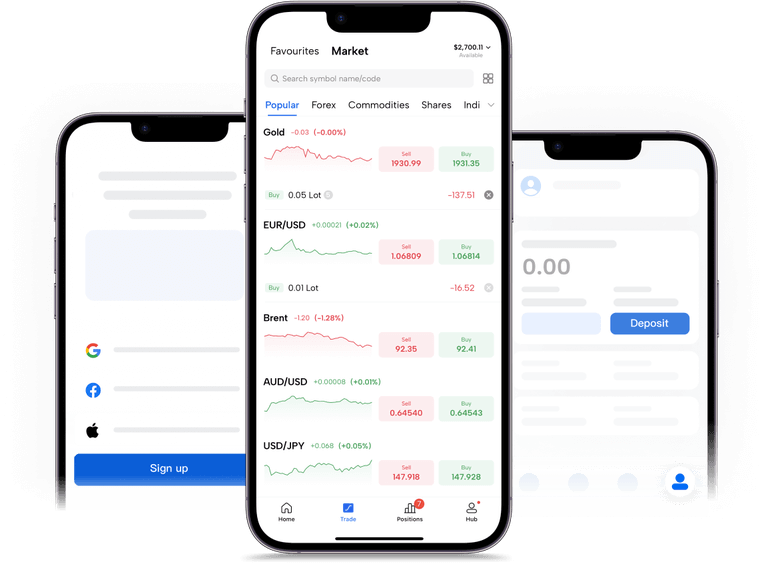
Visit the Mitrade website or get the mobile app to create an account
Add funds to your wallet and choose a commodity
Analyse built-in price charts to understand market trends
Set your trade size and risk management tools
Choose long (buy) or short (sell) and execute the trade
Having reviewed the best platforms for trading commodities, you have some reputable brokerages to choose from. While Mitrade ranks as the overall best due to its low fees, beginner-friendly interface and diverse asset options, the choice boils down to your preference, skill level, and trading goals.


You might be interested in…
1. What is the best commodities trading platform in 2026?
Mitrade ranks as the best option for Australians due to its low fees, flexible asset choices, CFD trading model, and ASIC license.
2. Can beginners trade commodities?
Yes, many platforms are beginner-friendly and offer tools such as demo trading accounts and educational resources to help beginners get started.
3. What is the safest way to trade commodities?
To be safe, use only regulated platforms like Mitrade. Don’t forget to also apply risk management strategies and avoid excessive leverage.
Disclaimer: The content presented above, whether from a third party or not, is considered as general advice only. CFD trading involves significant risk of loss. Past performance does not guarantee future results. This article serves informational purposes only and does not constitute financial advice. Consider your risk tolerance before trading.


