




AI Memory Stocks Rally After Nvidia Earnings: SanDisk, Micron and SK Hynix Rise — Which Stock Is Best to Buy?
Today's AI Memory Stocks Performance
Source: U.S. market close on August 31, 2026. SanDisk gained 5.50%, Micron rose 2.77%, SK Hynix increased 2.20%, Seagate slipped 0.17% and Western Digital fell 1.94%. The latest moves come as investors reassess AI infrastructure spending following Nvidia's strong earnings outlook and as the memory sector continues to benefit from tight supply and robust AI demand.
SanDisk Leads as AI Memory Stocks Diverge
SanDisk was the strongest performer among the major storage names on August 31, gaining 5.50%. The move highlights continued investor interest in NAND flash and AI-related storage demand. SanDisk has become an increasingly direct way to gain exposure to the flash-storage side of the AI infrastructure buildout.
The broader NAND market is also attracting significant investment. Kioxia and SanDisk recently announced plans to invest more than US$31 billion in Japan by 2032 to expand flash-memory production, citing growing demand for high-capacity and energy-efficient storage driven by AI applications.
Micron and SK Hynix Extend Their Gains
Micron rose 2.77%, while SK Hynix gained 2.20%, keeping the HBM-focused memory trade firmly in focus.
The fundamental backdrop remains supportive. AI data centres require increasing quantities of HBM and high-performance DRAM, while major memory manufacturers are allocating more production capacity toward AI-related products. Recent industry commentary has also pointed to persistent memory shortages as AI infrastructure expands.
Nvidia's latest results have provided another important catalyst. The chipmaker's bullish long-term outlook and forecast for approximately 70% revenue growth in its next fiscal year reinforced expectations that AI infrastructure spending can remain strong, helping lift Micron and SK Hynix alongside the broader semiconductor sector.
Seagate and Western Digital Lag Behind
Not every storage stock participated in the latest rally.
Seagate slipped 0.17%, while Western Digital fell 1.94% on August 31. Western Digital's decline marked its third consecutive losing session, showing that investors are becoming more selective within the AI storage trade.
This divergence is important for investors. The AI memory theme is no longer a simple “buy the entire sector” trade. HBM leaders such as SK Hynix and Micron, NAND-focused SanDisk, and HDD-focused companies such as Seagate and Western Digital have different earnings drivers and different levels of exposure to the AI spending cycle.
What Does the Latest Move Mean for Australian CFD Traders?
The August 31 session suggests that AI memory stocks remain a major market theme, but momentum is becoming increasingly selective.
For Australian CFD traders, the key names to watch are:
SanDisk: Higher-beta exposure to NAND and AI storage
Micron: Diversified exposure to HBM, DRAM and NAND
SK Hynix: Direct exposure to the HBM-driven AI memory cycle
Seagate: Exposure to high-capacity HDD and AI data-centre storage
Western Digital: Data-storage exposure with greater recent price volatility
The recent divergence also creates potential trading opportunities around earnings, AI-capex announcements, memory pricing and semiconductor-sector momentum. However, CFDs are leveraged products, so sharp moves in either direction can magnify both potential gains and losses.
“Trade AI Chip Stock with an ASIC-regulated broker. Fast AUD funding via PayID. ”
Which AI Memory Stock Looks Most Attractive?
The AI memory trade has become more diversified in the second half of 2026. While HBM remains the strongest structural growth driver, investors can now choose between HBM/DRAM exposure through Micron and SK Hynix, NAND and enterprise SSD exposure through SanDisk, or AI data-storage exposure through Western Digital and Seagate.
The latest earnings and technology developments also suggest that the biggest opportunity may not necessarily be the stock that rises the most in a single session. Investors should consider AI exposure, memory pricing, product mix, earnings momentum and valuation when comparing these companies.
| Company | AI Exposure | Key Strength | Outlook |
|---|---|---|---|
| Micron (MU) | HBM4 + DRAM + NAND with strong AI data-centre exposure | Best All-Round AI Memory Play | |
| SK Hynix | Leading HBM position and strong HBM4 roadmap | Best HBM Growth Play | |
| SanDisk (SNDK) | NAND, enterprise SSDs and AI storage | Higher-Beta NAND Play | |
| Western Digital (WDC) | High-capacity HDD and data-centre storage | AI Storage Play | |
| Seagate (STX) | Nearline HDD and mass-capacity data storage | AI Data-Storage Play |
1. Micron (MU): Best All-Round AI Memory Stock
The company's latest results provide strong evidence that AI demand is translating into financial performance. Micron reported US$41.46 billion in fiscal Q3 2026 revenue, while its fiscal Q4 guidance called for approximately US$50 billion in revenue and around 86% gross margin.
2. SK Hynix: Best HBM Growth Play
The company reported record second-quarter 2026 results, with revenue reaching KRW79.32 trillion and operating profit reaching KRW60.54 trillion. The company has attributed the strength of its business to the structural shift toward AI memory and continues to position HBM as a central growth engine.
3. SanDisk: Higher-Beta NAND and AI Storage Play
SanDisk is investing in next-generation flash technology to address these workloads. In July, the company announced sampling of its BiCS10 1Tb TLC 3D NAND, featuring 332 layers, up to 4.8Gb/s NAND interface speed and a 59% improvement in bit density compared with BiCS8.
4. Western Digital and Seagate: Beneficiaries of AI Storage Growth
While HBM attracts most of the attention, AI data centres also require enormous amounts of storage. Western Digital and Seagate are benefiting from rising demand for enterprise SSDs and high-capacity nearline hard drives, making them attractive secondary plays on AI infrastructure expansion.
Investment Takeaway:If AI cloud spending remains robust, Micron appears to offer the most balanced investment opportunity thanks to its leadership across HBM, DRAM and NAND. SK Hynix remains the preferred choice for investors seeking direct exposure to the fast-growing HBM market, while SanDisk offers the greatest upside potential if the NAND recovery strengthens further. For investors looking beyond memory, AI infrastructure leaders such as AMD and TSMC also remain well positioned to benefit from the next phase of the AI investment cycle.
“Trade AI Memory Stocks with an ASIC-regulated broker. Fast AUD funding via PayID. ”
Memory Stocks vs AI Chip Stocks: What's Driving the Rally?
The latest AI semiconductor rally is becoming broader — but memory stocks and AI chip stocks are not benefiting from exactly the same drivers.
AI chipmakers such as Nvidia, AMD and Broadcom are primarily benefiting from continued growth in AI accelerator demand, hyperscaler capital expenditure and the expansion of data-centre computing capacity. Memory companies such as Micron and SK Hynix, meanwhile, are benefiting from a second layer of the AI infrastructure boom: the rapidly increasing amount of HBM and DRAM required by next-generation AI accelerators.
The distinction has become more important following Nvidia's latest earnings. Nvidia delivered another record quarter and projected roughly 70% revenue growth for its next fiscal year, helping reassure investors that the AI infrastructure spending cycle remains intact. The results triggered a broad rally across AI-related stocks, including Micron and SK Hynix.
At the same time, Nvidia disclosed that its memory purchase commitments had increased from US$119 billion to US$279 billion, highlighting how critical memory supply has become to the next generation of AI systems.
| Memory Stocks | AI Chip Stocks |
|---|---|
Products & FocusProduce HBM, DRAM, NAND flash and enterprise SSDs | Products & FocusDesign or manufacture AI GPUs, CPUs and advanced semiconductors |
Main DriversHBM shortages, improving DRAM pricing, stronger enterprise storage demand | Main DriversAI cloud investment, hyperscaler capex, GPU demand and advanced chip production |
Market DynamicsMore cyclical as memory prices fluctuate with supply and demand | Market DynamicsMore directly tied to long-term AI infrastructure investment |
Sensitivity & RisksHigher sensitivity to memory pricing and inventory cycles | Sensitivity & RisksHigher sensitivity to AI spending and earnings from major cloud providers |
HBM, DRAM & NAND Outlook (H2 2026)
The memory market is entering the second half of 2026 with an unusually tight supply-demand balance, driven by the rapid expansion of AI data centres.
High Bandwidth Memory (HBM): The Core AI Memory Growth Engine ⭐⭐⭐⭐⭐
HBM remains the biggest beneficiary of the AI infrastructure boom. NVIDIA, AMD and custom AI chip providers continue to increase HBM content per accelerator, while hyperscalers are locking in long-term supply agreements. Industry analysts expect HBM demand to remain supply-constrained through at least 2027, with HBM accounting for a growing share of total DRAM wafer capacity.
H2 2026 Outlook
Strongest pricing power among all memory products
Supply expected to remain tight
AI server deployments continue to drive demand
Positive for SK Hynix and Micron
DRAM: AI Demand Is Tightening the Broader Memory Market ⭐⭐⭐⭐⭐
Traditional DRAM is also benefiting from AI spending. As manufacturers dedicate more wafer capacity to HBM production, supply growth for DDR5 and server DRAM remains limited, helping support contract prices. Analysts expect DRAM pricing to strengthen further during the second half of 2026, with demand continuing to outpace supply.
H2 2026 Outlook
Server DRAM demand remains robust
DDR5 adoption continues to expand
Prices likely to trend higher through year-end
Positive for Micron, SK Hynix, and Samsung Electronics
NAND Flash: AI Storage Turns the Market More Bullish ⭐⭐⭐⭐☆
After several challenging years, the NAND market is finally showing signs of a healthier recovery. Enterprise SSD demand is improving as AI data centers require more high-capacity storage, while disciplined production cuts have reduced oversupply. Analysts expect NAND pricing and profitability to improve throughout H2 2026, although the recovery is likely to be more gradual than in HBM.
H2 2026 Outlook
Enterprise SSD demand continues improving
AI storage spending supports higher NAND consumption
Consumer demand remains mixed
Positive for SanDisk and Micron, with broader benefits for the enterprise-storage ecosystem
How Australian Investors Can Trade Semiconductor CFDs
Australian investors don't necessarily need to purchase U.S. or Korean-listed shares directly to gain exposure to AI memory stocks. Another option is trading semiconductor CFDs, allowing traders to speculate on both rising and falling prices without owning the underlying shares.
Step 1: Open a Free Mitrade Account: Create a live or demo account in just a few minutes. Mitrade is ASIC-regulated and offers access to a wide range of global financial markets from a single platform.
Step 2: Complete Account Verification: Verify your identity by uploading the required documents. Once approved, you'll be able to fund your account and start trading.
Step 3: Deposit Funds: Choose your preferred payment method and make your initial deposit. New traders can also practise risk-free using Mitrade's demo account before trading with real money.
Step 4: Search for AI memory stocks: Use the platform's search function to locate the SanDisk CFD instrument and review the latest market price, chart and trading conditions.
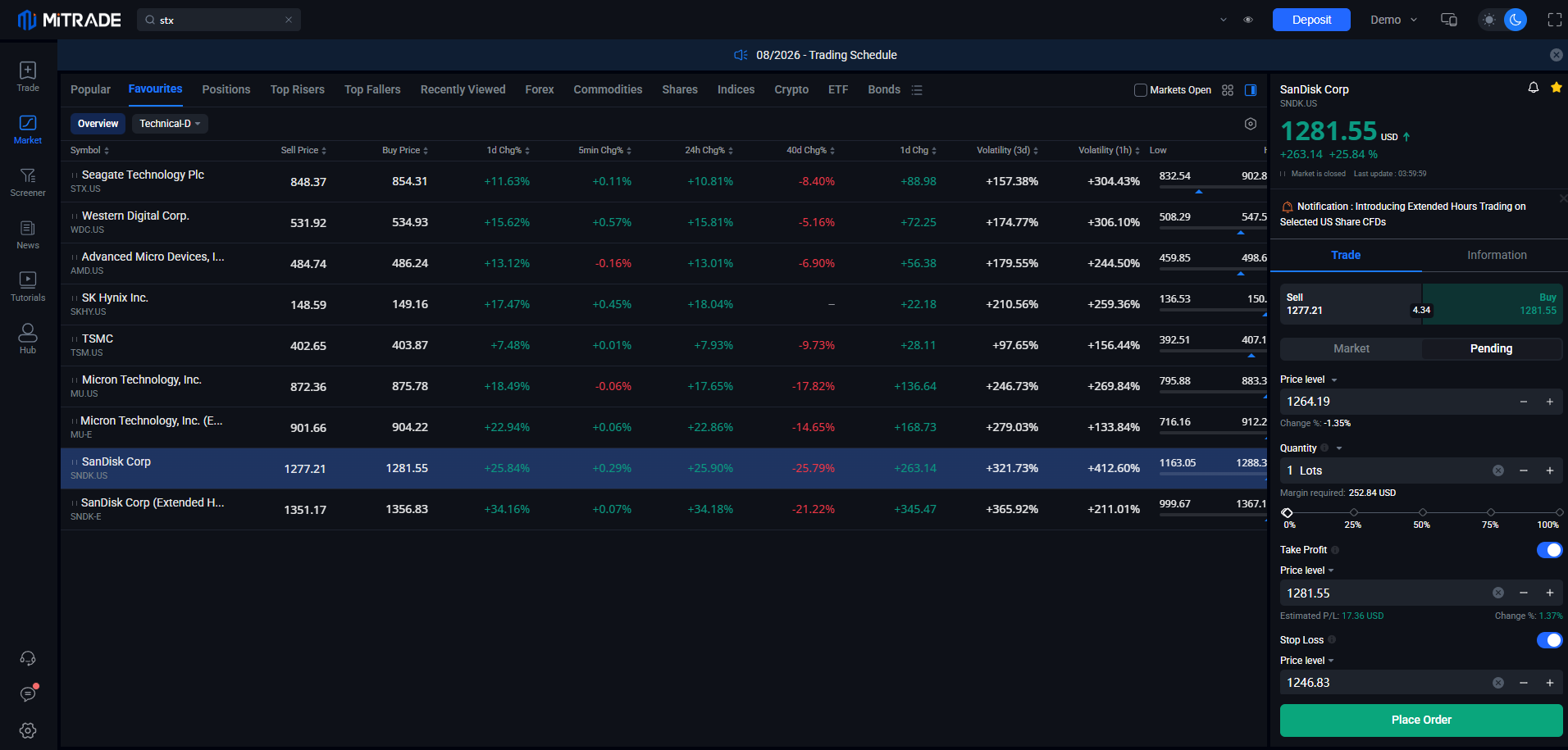
Step 5: Choose Buy or Sell: If you believe SanDisk will continue benefiting from AI demand, you can open a Buy (Long) position.
If you expect the share price to decline after earnings or profit-taking, you can instead open a Sell (Short) position.
Step 6: Manage Your Risk: Before placing your trade, set a stop-loss and take-profit level to help manage risk. Monitoring position size and using disciplined risk management are essential, particularly when trading leveraged products.
👉 Ready to trade the AI semiconductor boom?
With Mitrade, investors can trade leading semiconductor companies through Contracts for Difference (CFDs), providing access to global markets from a single trading platform.


1. Why did SK Hynix stock surge?
SK Hynix rallied after strong investor demand for its Nasdaq-listed shares, supported by its leadership in High Bandwidth Memory (HBM), continued AI infrastructure spending, and expectations of tight memory supply through 2027.
2. Is Micron a good AI stock?
Micron is considered one of the leading AI memory companies thanks to its expanding HBM business, improving DRAM market conditions, and growing exposure to AI data centers. Many analysts remain optimistic about its long-term earnings growth.
3. Is SanDisk benefiting from the AI boom?
Yes. While SanDisk focuses primarily on NAND flash and enterprise SSDs rather than HBM, growing AI workloads require significantly more storage capacity, which could support long-term demand for its products.
4. What is HBM memory?
HBM (High Bandwidth Memory) is an advanced type of memory designed for AI accelerators and high-performance computing. Compared with traditional DRAM, HBM delivers much higher bandwidth while consuming less power, making it essential for modern AI GPUs.
5. Can Australians trade SK Hynix, Micron and other semiconductor stocks?
Yes. Australian investors can access semiconductor companies either by purchasing shares through an international broker or by trading CFDs, which allow speculation on both rising and falling prices without owning the underlying stock.
Disclaimer: The content presented above, whether from a third party or not, is considered as general advice only. CFD trading involves significant risk of loss. Past performance does not guarantee future results. This article serves informational purposes only and does not constitute financial advice. Consider your risk tolerance before trading.


