




What Is a Stop Loss and Why Traders Who Skip It Almost Always Regret It

Every trader has a story about the trade that got away from them. Not the one that missed a target. The one that kept going against them while they stared at the screen, convinced it would turn around, until it took out a week of gains in a single session.
Research shows 88% of day traders use stop-loss orders as part of their risk management approach. The other 12% are learning the hard way. A stop loss is not a complicated concept and it is not reserved for professionals. It is the single most important tool between you and a blown account, and this guide explains exactly how it works, which type to use, and how to place one before your next trade.
This guide covers what a stop loss is, the four main types available to Australian CFD traders, the most common mistakes traders make when placing them, and how to set one correctly on the Mitrade platform.
What Is a Stop Loss?
A stop loss is an instruction you give your trading platform to automatically close your position if the price moves a set amount against you. It exits the trade for you so you do not have to.
For example, a trader who buys gold at $3,300 per ounce and sets a stop loss at $3,280 would have the position automatically closed if the price falls to $3,280, capping the loss at $20 per ounce.
That is the entire concept. You decide before the trade opens exactly how much you are willing to lose. The platform handles the rest, even if you are asleep, away from your screen, or caught in a fast-moving news event.
Without a stop loss, your only exit is a manual one. And manual exits under pressure almost always happen too late, too emotionally, or not at all.
The Four Types of Stop Loss
Not all stop losses work the same way. Choosing the right type for the right situation separates traders who manage risk well from those who get stopped out unnecessarily.
Fixed Stop Loss
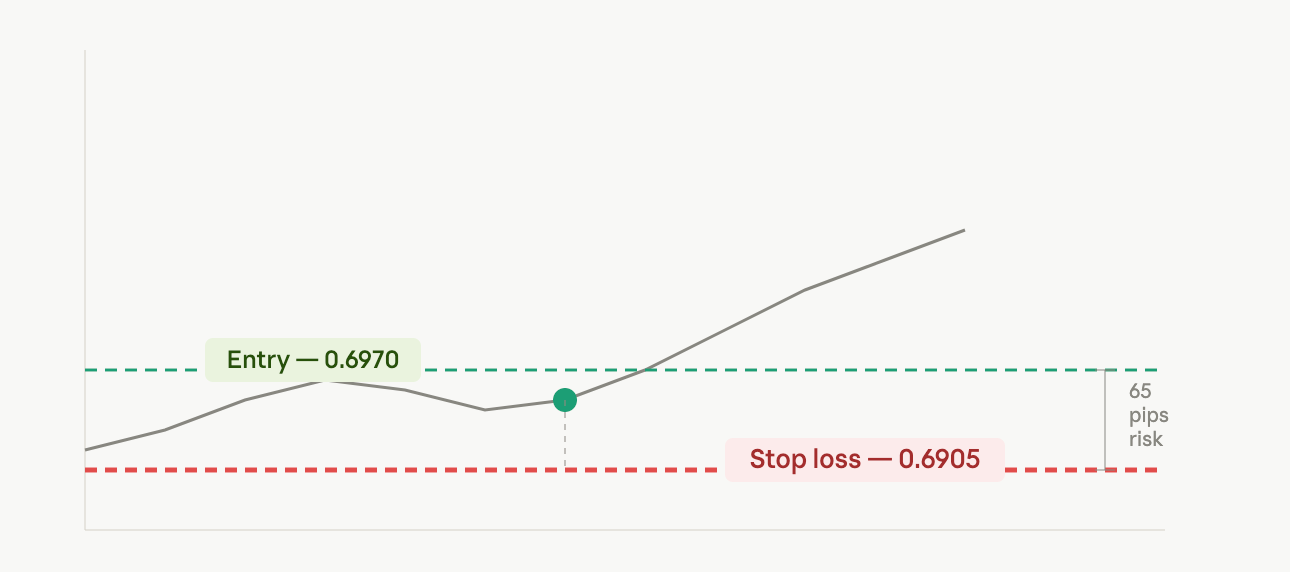
This is the most straightforward type. You set a specific price level and the trade closes the moment the market hits it. It does not move, it does not adjust, and it does not require any further action from you. A fixed stop loss is a specific number of pips set when entering the trade and stays at that level no matter how the market moves. This is the right choice when you have a clear invalidation level in mind, for example a key support or resistance zone where your trade idea is proven wrong.
Trailing Stop Loss
A trailing stop loss is a type of stop order that automatically adjusts with the market price to protect profits while limiting losses. As the asset price moves in your favour, the stop level trails the price by a fixed distance. When the price reverses by that distance, the order triggers and closes the position immediately.
This is the tool long-term traders use to let winners run without giving back everything they made. If you buy AUD/USD at 0.6900 and set a 50-pip trailing stop, the stop moves up every time the price moves up, but never moves down. It locks in profit automatically as the trade runs in your favour.
ATR-Based Stop Loss
The Average True Range (ATR) measures how much an instrument moves on average over a given period. Setting stop losses at 1.5 times the ATR gives trades enough room to breathe while still protecting capital, and determines position size by dividing your dollar risk by the ATR multiplied by the chosen multiplier, ensuring consistent risk across different markets and timeframes.
This is how experienced traders approach stop placement. Rather than guessing a pip number or using a round percentage, they let the instrument's own volatility tell them where the stop belongs. A stop too tight for the instrument's normal range gets hit by noise before the trade has a chance to work.
Guaranteed Stop Loss
A standard stop loss executes at or near your chosen level, but in fast markets, slippage can mean it fills slightly worse than expected. A guaranteed stop loss fills at exactly the level you set, regardless of how fast or far the market moves. Some platforms charge a small premium for this protection. It is worth considering on instruments that regularly gap on news events, like oil or indices during major data releases.
“Trade CFDs with an ASIC-regulated broker. Fast AUD funding via PayID. ”
The Mistakes That Get Traders Into Trouble
Understanding what a stop loss is matters less than understanding where traders go wrong with them. Here are the four most common errors.
Placing it too tight
One classic stop order mistake is placing the stop too tight against the Average True Range. If the ATR of EUR/USD is 40 pips and you set a 10-pip stop, normal intraday noise will hit your stop before the trade has any room to develop. Every instrument has a normal range of movement that has nothing to do with your trade idea. Your stop needs to sit outside that range or it will be triggered by the market breathing, not by your trade being wrong.
Moving it further away mid-trade
This is the most destructive habit in retail trading and almost every trader does it at least once. The price approaches your stop, you convince yourself it will reverse, and you move the stop lower to give it more room. You have just removed the only protection you had. Research across 78,000 retail accounts reveals that overconfident traders systematically avoid stop-loss mechanisms, and that only 23% of losing positions are closed via stop-loss orders compared to 67% of winning positions closed via profit-taking. Letting losses run and cutting winners short is the defining pattern of unprofitable retail traders.
Placing it at a round number
Research documents that 68% of stop-loss orders are placed at round numbers like 5%, 10%, 15%, and 20%. This anchoring leads to suboptimal threshold selection in 71% of cases. Round numbers attract clusters of stops from thousands of traders simultaneously. Market makers and institutional players know this. Price frequently runs to round numbers, triggers all those stops, and then reverses exactly from that level. Place your stop just beyond a structural level, not at the round number itself.
Skipping it entirely on short trades
A lot of beginners skip the stop loss on trades they plan to watch closely, telling themselves they will exit manually if things go wrong. Then the NFP drops, the market gaps 80 pips in two seconds, and there is no time to react. A stop loss is most important precisely in the situations where you feel least likely to need it.
“Trade CFDs with an ASIC-regulated broker. Fast AUD funding via PayID. ”
How Much Should You Risk Per Trade?
The stop loss tells you where you exit. Position sizing tells you how much that exit costs if it triggers. The two work together.
Most experienced traders risk between 1% and 2% of their account on any single trade. On a $5,000 account, that is $50 to $100 per trade. If your stop loss on AUD/USD is 40 pips away and you risk $100, that tells you exactly what lot size to use. You never need to guess, and no single losing trade can do serious damage to your account.
The traders who blow accounts do not lose on one catastrophically bad trade most of the time. They risk 10% or 20% per trade, get four or five losers in a row, and there is nothing left to recover with. 40% of day traders quit within the first month. Only 13% remain active after three years. The majority of those who quit early do so because of position sizing and stop loss decisions, not because their market read was wrong.
Pros and Cons of Using a Stop Loss
How to Set a Stop Loss on Mitrade
Mitrade builds the stop loss directly into the order screen. You do not need to navigate a separate menu or place a secondary order after opening your position.
When you tap any instrument and open the order panel, the stop loss field appears alongside your entry price and take profit before you confirm the trade. You enter your chosen price level, the platform calculates the dollar value of the potential loss based on your position size, and you place the trade with the stop already attached.
For AUD/USD, gold, oil, and every other instrument on the platform, the process is identical. Mitrade also supports trailing stops, which you activate from the same order panel by toggling the trailing stop option and entering the distance in points.
Both standard and trailing stop orders are available as professional-grade risk management tools on the Mitrade platform for CFD traders.
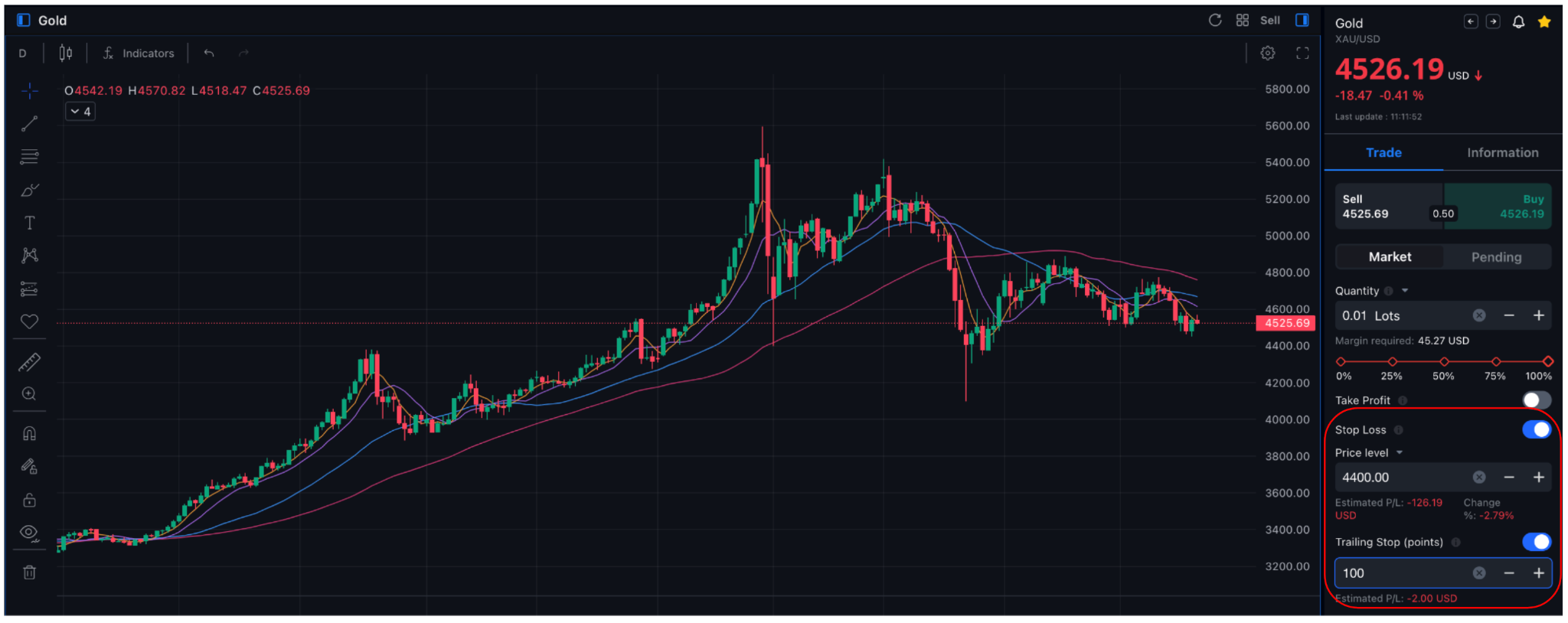
Source - Mitrade Demo Account


1. What is a stop loss in trading?
A stop loss is an instruction attached to your trade that automatically closes your position if the price reaches a level you have set in advance. It limits how much you can lose on any single trade without requiring you to monitor the market in real time or make a manual exit decision under pressure.
2. Where should I place my stop loss?
Place your stop loss beyond the level where your trade idea is proven wrong, not at a random percentage or round number. For technical traders, this usually means just below a support level on a long trade or just above a resistance level on a short. Using the ATR indicator to measure normal volatility for that instrument helps you set a stop that gives the trade room to breathe without taking excessive risk.
3. What is the difference between a fixed stop loss and a trailing stop loss?
A fixed stop loss stays at the level you set when you opened the trade. A trailing stop loss moves in your favour as the trade runs profitably, locking in gains automatically, but never moves against you. Use a fixed stop when you have a specific invalidation level in mind. Use a trailing stop when you want to let a winning trade run as far as possible while protecting what you have already made.
4. What happens if the market gaps past my stop loss?
In fast-moving markets, particularly around major news events or over weekends, the market can open or move to a price that skips past your stop loss level entirely. In that case your stop fills at the next available price, which may be worse than your chosen level. A guaranteed stop loss, available on some platforms for a small premium, eliminates this risk by guaranteeing execution at exactly your set level.
5. How much should I risk per trade?
Most experienced traders risk between 1% and 2% of their account on any single trade. On a $5,000 account that is $50 to $100 per trade. Your position size should be calculated based on the distance to your stop loss so that if the stop triggers, the loss stays within that 1% to 2% range regardless of how many pips away the stop sits.
6. Does Mitrade support stop loss orders?
Yes. Mitrade supports both standard stop loss orders and trailing stop loss orders on all instruments including forex, indices, commodities, shares, and crypto CFDs. The stop loss field appears directly on the order screen before you confirm any trade, so there is no separate step required to attach one to your position.
Disclaimer: The content presented above, whether from a third party or not, is considered as general advice only. CFD trading involves significant risk of loss. Past performance does not guarantee future results. This article serves informational purposes only and does not constitute financial advice. Consider your risk tolerance before trading.


