




Best Platform for CFD Trading in Australia (2026): Compare Features, Fees & Markets

Trading CFDs (Contracts for Difference) is one of the most common ways Australians invest in the financial markets. This is because many traders are looking for flexible options to invest in with lower risk.
With CFDs, you can speculate on price movements across a wide range of markets, including stocks, forex, indices, commodities, and cryptocurrencies. Instead of purchasing the asset itself, you only need to enter a contract based on your prediction of whether an asset’s price will rise or fall.
However, choosing the right platform is a crucial step because it determines your potential fees, available markets, and risk management tools. This guide reviews the best platform for CFD trading in Australia in 2026. Check out the leading providers and understand what to look out for when choosing.
What Is a CFD Trading Platform?
A CFD trading platform is an online trading app that allows you to buy and sell Contracts for Difference across financial markets. These platforms stand out because they let you speculate on price movements of selected assets, so you don’t have to buy or hold the underlying asset directly.
If the market moves in your favour, you’ll profit from the difference between the opening and closing price. However, if your prediction goes wrong, you’ll make a loss. Interestingly, there is a range of assets you can find on CFD platforms, making it easy to diversify your portfolio from a single account. The common instruments include:
Another top feature of CFD trading is leverage. This allows you to access larger positions with a smaller initial capital. Some brokerages allow up to 1:200 on some assets, allowing you to increase your potential profits. However, this can also increase risk because losses follow the same leverage structure.
Modern CFD platforms also come with charting tools, technical indicators, mobile trading apps, and market analysis features.
“Trade CFDs with an ASIC-regulated broker. Fast AUD funding via PayID. ”
Things to Consider When Choosing a CFD Trading Platform
There’s no hard and fast way to choose the best platform for CFD trading in Australia. However, these are the major factors to look out for to have the best trading experience.
1. Ease of Use
As a beginner, your primary focus should be simplicity. Prioritise a trading platform that makes it easy to search for assets, execute trades quickly, monitor positions, and manage risk.
2. Available Markets
Different platforms offer different asset selections. However, you should choose the one with enough assets to allow you to diversify in one place. Some focus mainly on forex, while others provide access to equities, indices, commodities, and crypto CFDs
3. Fees and Spreads
When trading CFDs in Australia, the costs you’ll typically cover include spreads, overnight financing fees, withdrawal charges, and currency conversion costs. Opt for platforms with tighter spreads to avoid high trading costs that can add up over time.
4. Execution Speed
Fast execution is critical in CFD trading because the markets are volatile. To avoid delays between placing and executing trades, which can affect profitability, choose platforms with top execution speed.
5. Risk Management Tools
Good CFD platforms allow you to manage risks with tools like stop-loss, take-profit, and negative balance protection. Also, if you’re a beginner, prioritise trading platforms with educational resources and demo trading to help you build confidence before committing your capital to real trading.
Best CFD Trading Platform in Australia: Quick Comparison Table
7 Best Platforms for CFD Trading in Australia (2026)
1. Mitrade
Mitrade is a leading name among the best trading platforms for Australians. It is a beginner-friendly CFD trading platform that balances simplicity, functionality, and market access.
One of its biggest strengths is flexibility. The platform is designed with a clean interface that removes much of the complexity commonly associated with CFD trading. This makes it easier for you to navigate markets, place trades, and monitor positions without feeling overwhelmed — whether you are a beginner or not.
Mitrade also supports over 200 assets, including forex, stocks, indices, commodities, and cryptocurrencies. The platform also uses a spread-based pricing model with zero commission fees, making trading costs easier to understand and cover.
The platform’s infrastructure also supports fast order execution and offers built-in risk management tools such as stop-loss and take-profit.
Australians also appreciate Mitrade because it supports local-friendly payment methods, such as Visa, Mastercard, PayID, with a minimum deposit of $100. These make it easier to get started compared to some international alternatives.

 Enjoy simple and fast trading Flexible leverage options available Follow real-time trading strategies Demo account with $50,000 virtual funds

2. eToro
eToro is another CFD trading platform that is well recognised in Australia and beyond. The brokerage is popular because of its CopyTrader social trading features, which allow beginner users to mirror experienced traders’ market moves.
eToro also offers diverse assets, including stocks, forex, cryptocurrencies and indices. However, eToro fees can be slightly higher than those of some competitors, because the platform charges due to spreads and other fees, such as withdrawal and weekend trading fees. Advanced trading features are also more limited compared to competitors designed for technical analysis.
3. Plus500
Plus500 is another Australia-friendly platform that is big on simplicity and accessibility. This makes it appealing to beginners who want exposure to markets without advanced systems or complicated interfaces.
The platform also supports a broad range of CFDs, including forex, indices, commodities, stocks and crypto CFDs. One of its key strengths is its commission-free structure. Instead of charging traditional commissions, Plus500 users primarily pay spreads.
However, the platform is specifically made for beginners, making it limited for advanced traders.
4. IG Group
IG Markets is one of the oldest CFD trading companies servicing Aussies. It is highly popular among experienced traders because of its depth of tools and market access. The platform provides access to thousands of tradable instruments across global markets alongside advanced charting tools for detailed market analysis.
This means that as a beginner, the platform can be complex and overwhelming, and you’ll need some time to get familiar with it. IG’s pricing structure can also be complex because fees vary across asset classes, and it also combines spreads and commissions.
5. CMC Markets
CMC Markets is widely known for its competitive pricing and advanced charting features. The platform also offers tight spreads across many CFD markets. However, due to its sophisticated charting tools and technical indicators, CMC is more attractive to highly technical traders.
6. Pepperstone
Pepperstone is known for its smooth execution and fast speed. The platform also has a professional trading infrastructure that makes it easy for experienced traders to access the markets.
It supports advanced platforms such as MetaTrader and cTrader, making it popular among traders who use technical strategies or automated systems. The platform offers competitive spreads, especially on its proprietary Razor accounts, making it one of the strongest CFD brokers in Australia.
7. AvaTrade
AvaTrade offers a balanced CFD trading experience that combines accessibility and a diverse asset range. Besides being able to trade hundreds of assets across forex, company shares, commodities, indices, and cryptocurrencies.
The platform also supports multiple interfaces, including MetaTrader, giving traders flexibility depending on their experience level.
Educational resources are another strength. AvaTrade provides tutorials, webinars, and beginner-focused content designed to help you understand markets and trading strategies as a beginner. However, it doesn’t have the tightest spread in the market.
What Assets Can You Trade with CFDs in Australia?
Here are the popular assets you can trade via CFDs as an Aussie investor:
1. Forex
Forex CFDs allow you to speculate on the movement of currency pairs such as AUD/USD, EUR/USD, GBP/USD, and USD/JPY without directly exchanging physical currencies.
The market is the largest and most liquid globally, with a 24/5 operating system and weekends off. This high liquidity means trades are generally executed quickly, even during volatile market conditions.
For Forex CFD traders, the appeal of the asset class is due to the fact that currency prices are influenced by global economic events, such as interest rates, inflation data, and central bank decisions. This creates constant trading opportunities as policies shift from one country to another.
The best part is that Australian forex CFDs provide exposure to both domestic and international economic trends that you can capitalise on. However, because forex markets are very volatile, price movements can result in both gains and losses.
2. Stocks
Stock CFDs allow you to speculate on the price movements of individual company shares without directly owning them. This means as a stock CFD trader, you can gain exposure to major companies like Apple Inc, Tesla, Commonwealth Bank of Australia, NVIDIA, and Microsoft.
The major advantage is that you can trade both ways by trading shares through CFDs instead of purchasing units of their stocks from the market. That means you can profit from both rising and falling share prices instead of only when prices rise.
Stock CFDs also allow you to access international markets more easily from a single place. For example, you can invest in global markets like NASDAQ and the NYSE (New York Stock Exchange) instead of only the Australian Securities Exchange (ASX).
However, individual stocks can experience sharp price swings due to company-specific news, earnings reports, or broader market sentiment, so you should factor in risks.
3. Index CFDs
Index CFDs allow you to speculate on the overall performance of a stock market or sector rather than focusing on individual companies. Popular indices available through CFDs include:
Trading indices through CFDs is popular because it provides built-in diversification. Instead of relying on the performance of a single company, you can diversify your investment across the broader market.
4. Commodities
Commodity CFDs expose you to physical assets like gold, silver, oil and natural gas without needing to own or store them. That means you don’t need a barrel of oil or an ounce of gold stored in your home since you’re speculating on their prices.
The CFD class is popular because it allows for diversification beyond traditional stock markets. Gold and silver, in particular, are used as a store of value to hedge against inflation or market instability.
However, commodity prices can be highly volatile, especially during periods of economic uncertainty or geopolitical tensions, making risk management crucial.
5. Cryptocurrencies
Crypto CFDs allow traders to speculate on digital asset prices without owning or holding cryptocurrencies or managing crypto wallets and private keys. Through CFDs, you can buy and sell popular cryptocurrencies like Bitcoin, Ethereum, and Solana with little capital.
However, cryptocurrencies are among the most volatile CFD markets. Prices can rise and fall easily, which creates both opportunity and risk.
6. ETFs
ETF CFDs are exchange-traded funds that provide exposure to a basket of assets instead of investing in an individual stock. Typically, they track stock indices, commodities, and investment schemes.
For instance, ETFs like the Vanguard Australian Shares Index ETF (ASX: VAS), Betashares Australia 200 ETF (ASX: A200) make it easy to diversify across companies and sectors to balance risk and reward.
How to Start CFD Trading on Mitrade
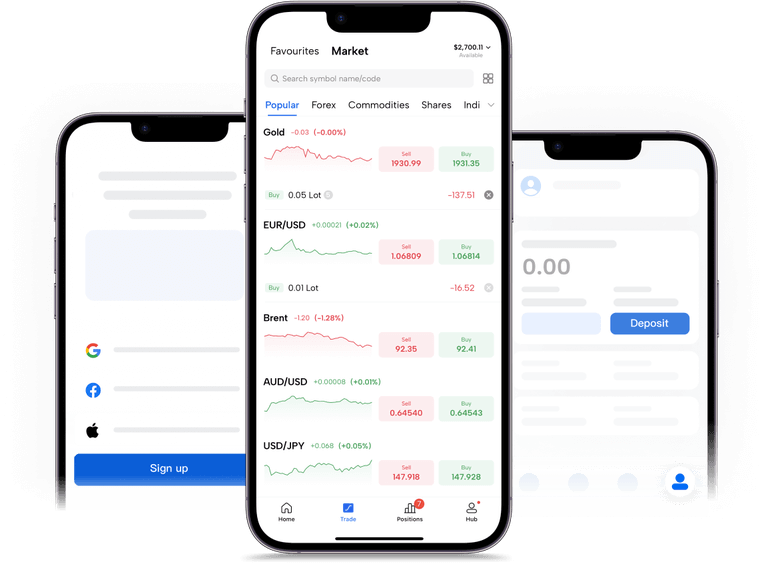
Whether you’re a beginner or an experienced trader looking to trade CFDs in Australia, Mitrade is the best platform to consider. Here’s how to get started:
Create a Mitrade account and complete identity verification
Deposit funds using any of the supported payment options
Explore 100+ supported digital assets (including forex, indices, commodities, and cryptocurrencies) and choose your preferred option
Analyse the market and decide what position to take
Open a position (go long or short) based on your projection
1. What is CFD trading?
CFD trading involves speculating on the price movements of financial instruments without owning the underlying asset.
2. What is the best platform for CFD trading in Australia?
Many traders choose Mitrade as the best CFD trading platform for Aussies due to its simplified trading, broad market access, and low fees.
3. What assets can be traded with CFDs?
Forex, stocks, indices, commodities, cryptocurrencies, and ETFs are commonly available.
Disclaimer: The content presented above, whether from a third party or not, is considered as general advice only. CFD trading involves significant risk of loss. Past performance does not guarantee future results. This article serves informational purposes only and does not constitute financial advice. Consider your risk tolerance before trading.


