




How to Invest in the S&P 500 in Australia (2026 Guide)

The majority of financial market investors, especially those who invest in stocks, hold the S&P 500. That’s because they want access to the global market, which is the United States economy. Besides having the largest economy worldwide, many of the biggest companies in the health, technology, and retail industries operate in the US. That is why when these businesses thrive or struggle, their stock performances sway the broader markets.
However, instead of investing in individual stocks, many people invest in the S&P 500, a stock market index that provides exposure to the shares of the world’s leading 500 companies (the Fortune 500). If you’ve been researching how to invest in S&P 500 in Australia, this guide will help you do exactly that.
What Is the S&P 500?
The S&P 500 is a stock market index that tracks the performance of 500 of the largest companies in the United States. So, when people around you ask: What is the S&P 500? It’s simply an index that offers access to the US economy through the country’s top 500 companies.
The index offers a way to gain exposure to these US companies in a single move, without needing to analyse each one individually or take on the risk of holding them one at a time.
However, it’s important to note that while 500 companies make the S&P 500, the entities are not random. They must meet specific criteria, including market capitalisation, liquidity, and sector representation. This ensures that the index remains stable and relevant regardless of the market conditions.
Another thing to note is that the S&P 500 is market-cap weighted. This means that companies with larger market values have a greater influence on the index’s movement. For example, when major corporations like Apple Inc. or Microsoft experience significant price changes, they can move the entire index.
As an investor, this is important because it lets you know that investing in the S&P 500 is not about betting on a single company. It is about gaining exposure to a diversified group of businesses. Their overall market performance drives your potential returns.
Another important aspect is how the index evolves. The companies that make up the S&P 500 are not fixed. They can be added or removed at any time based on performance and if they meet the eligibility requirements. This means the index continuously adapts to real-time economic conditions. If you’re a long-term investor, this structure keeps your portfolio relevant since you don’t need to readjust it upon every market change.
“Trade S&P 500 with an ASIC-regulated broker. Fast AUD funding via PayID. ”
Why Invest in the S&P 500?
People fancy the S&P 500 for several reasons, which is why the index has become a top choice for modern investing. Here are some of the reasons, especially for Australian inventors:
1. Easy Portfolio Diversification
When you invest in the index, you are automatically spreading your capital across hundreds of companies. One advantage of this is that you won’t carry the risk associated with relying on the performance of any single company. When one asset is down in price, other assets with upward momentum can balance your portfolio.
As an Australian investor, this diversification also extends beyond the local markets, considering that the Australian Securities Exchange (ASX) and the country’s economy are heavily concentrated in sectors like mining and financial services.
The S&P 500, on the other hand, provides exposure to a broader range of industries, including technology, healthcare, and consumer goods. This creates a more balanced investment profile.
2. Access to Global Stocks
Beyond the easy access to stocks across other industries, investing in the S&P 500 exposes you to the global economy. Instead of limiting yourself to buying shares of only Australian or European companies, you can expose your investment to bigger entities in the US with potentially higher dividends.
3. Consistent Long-Term Performance
Historically, the S&P 500 has delivered stronger returns over extended periods than numerous individual stocks. This is driven by economic growth and corporate expansion in the US, which makes businesses experience significant growth. For context, as of the time of writing, the S&P 500 has a year-to-date (YTD) growth of over 30% compared to April 2025.
The growth doesn’t eliminate short-term volatility, but the upward trend shows how strong the asset’s performance is. So, if you are exploring how to invest in S&P 500, this is another consideration.
4. Simplified Investing
When investing in the S&P 500, you don’t have to research various stocks and their performances because the index covers them all at once. This reduces the need for constant monitoring and realignment of your portfolio, making it appealing for passive investors who prefer to hold assets for their long-term potential.
5. High Flexibility
The S&P 500 is designed for all types of investors. Whether you are a newbie investing with small capital and limited experience or someone with better experience and a deeper wallet, the index can accommodate different strategies.
“Trade S&P 500 with an ASIC-regulated broker. Fast AUD funding via PayID. ”
Which Companies Make Up the S&P 500?
The S&P 500 includes the 500 best-performing companies worldwide. These companies also cut across different sectors and industries. Some of the most prominent entities are:
Apple Inc: The brand behind iPhones, the iOS operating system, and Apple TV.
Microsoft: The software company behind the Windows operating system, Microsoft Azure, and Bing.
Amazon: The e-commerce brand that owns Amazon Web Services (AWS), Amazon Marketplace, and Prime Video.
NVIDIA: The popular maker of computing chips, graphics processing units (GPUs), and other hardware.
Coca-Cola: The non-alcoholic beverage company behind products like Coca-Cola, Sprite, Fanta, and Dasani.
These firms are often at the forefront of innovation, which is one of the reasons they carry significant weight in the index. However, while there’s a strong tech presence, the S&P 500 is not solely dominated by such companies. It includes businesses from sectors such as healthcare, financial services, industrials, and energy. This diversity is what allows the index to serve as a reliable representation of the broader economy.
Best Ways to Invest in the S&P 500 in Australia
On paper, the concept of investing in the S&P 500 is simple, but getting into the market isn’t as straightforward. That’s because you can’t buy the S&P 500 directly like stocks. Instead, you access it through different instruments, each with its own structure, costs, and level of flexibility. Here are the options to choose from when thinking of how to buy S&P 500 in Australia:
Buy the S&P 500 Via ETFs
The most common way to invest in the S&P 500 is through exchange-traded funds (ETFs). These track the performance of the index and can be traded like regular shares. This makes them a convenient option for short-term traders and long-term investors who want direct exposure to the index.
Invest Through Brokerages
Another method of investing in the S&P 500 is through online brokerage accounts with international assets. With such a broker, Aussies can access US-listed ETFs directly. However, this method involves buying the underlying asset, which may involve additional considerations such as currency conversion and international transaction costs.
That’s where trading platforms like Mitrade stand out. Instead of owning the underlying asset, you can trade the S&P 500 through contracts for difference (CFDs). This means you are taking a position on the index’s price movement instead of holding it directly.
With this method, you can enjoy better flexibility, as you are not limited to long-term growth potential alone. You can also trade the index in line with the short-term market movements.

 Enjoy simple and fast trading Flexible leverage options available Follow real-time trading strategies Demo account with $50,000 virtual funds

S&P 500 vs Dow Jones
When comparing US stock market indices, the S&P 500 is often discussed alongside the Dow Jones Industrial Average (DJIA). Both are followed and traded by Aussies, but they aren’t the same. The S&P 500 tracks the top 500 companies in the US, while the Dow Jones includes just 30. This makes the S&P 500 a broader reflection of the US market.
Another key difference is their calculation. The S&P 500 is market-cap weighted, meaning larger companies have more influence. The Dow Jones, on the other hand, is price-weighted, which gives more weight to companies with higher share prices, regardless of their market size.
The S&P 500 is generally considered a more accurate reflection of the overall market, while the Dow Jones provides a narrower view focused on a smaller group of established companies. As a result, many investors prefer investing in the S&P 500 and use it as a litmus test for long-term stock performance.
S&P 500 Returns and Outlook for 2026
The historical performance of the S&P 500 is one of its strongest selling points. Over the years, the index has shown strong average annual returns of around 8–10%. This is why many investors have it in their portfolios.
Looking ahead to 2026, the S&P 500 is poised for continuous growth. However, several factors are likely to influence the market. These include:
Interest rates are a key driver. Changes in the US monetary policy by the Federal Reserve can affect borrowing costs, corporate profitability, and investor sentiment.
Corporate earnings are also critical. Strong earnings growth supports higher valuations, while weaker performance can lead to market corrections.
Broader economic conditions also matter, as global trends, technological advancement, and geopolitical developments all play a role in shaping market trends. In other words, while short-term movements are difficult to predict, the long-term outlook for the S&P 500 is positive among experts. Still, the index’s growth is tied to the US economy.
How to Invest in the S&P 500 on Mitrade
If you want a simple way to access the S&P 500 in Australia, Mitrade provides a user-friendly trading platform to access the S&P 500 without stress. With this option, you also don’t have to hold the asset or worry about converting AUD to USD for your trades. Follow the steps below to start trading the S&P 500 CFD on Mitrade:
Create a Mitrade account and complete identity verification
Deposit funds using any of the supported payment options
Search for the S&P 500 index or “US500.”
analyse the market and decide what position to take
Open a position (go long or short) based on your projection
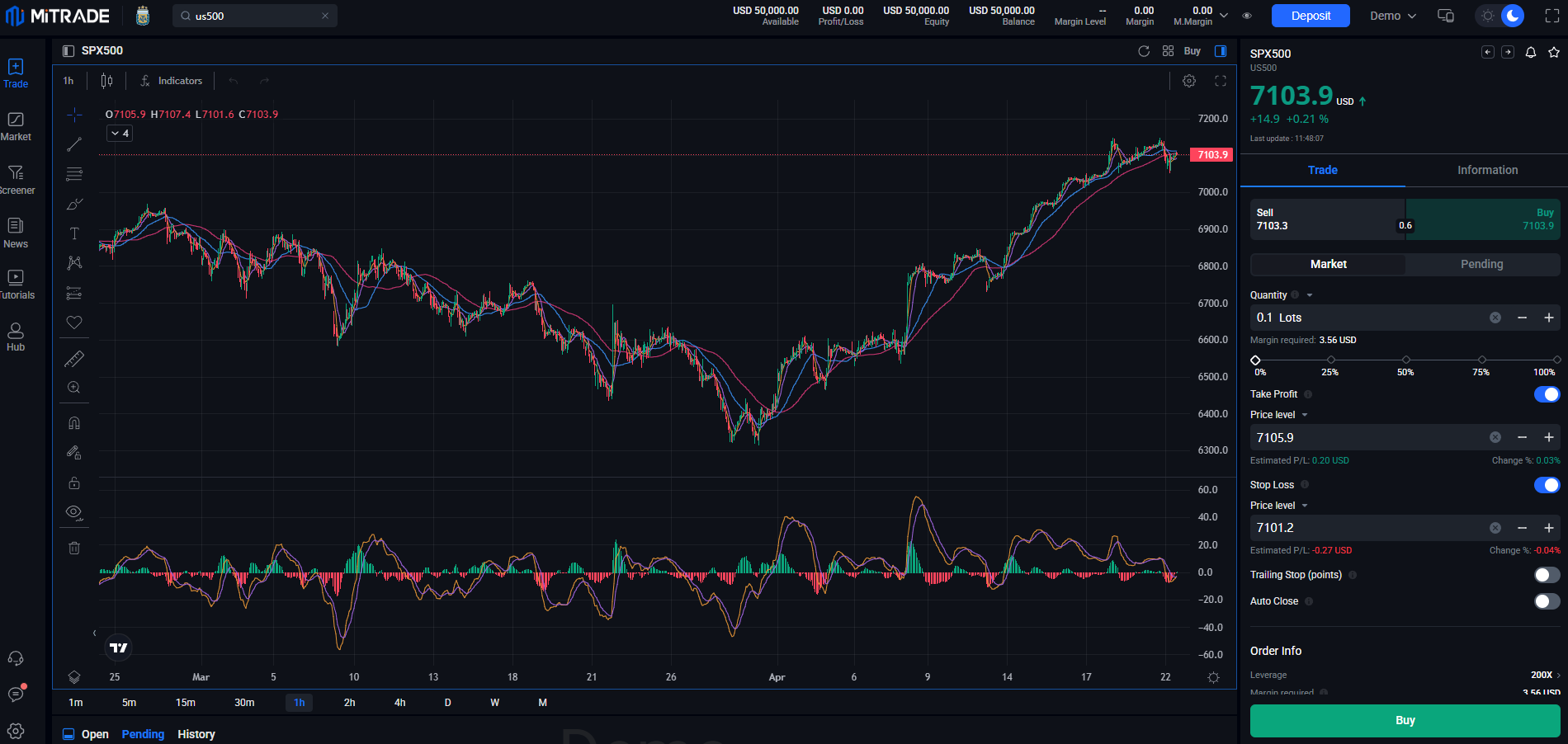
Additionally, Mitrade offers up to 1:200 leverage to S&P500 CFD traders. This flexibility allows you to engage with the market under different conditions, so you’re not limited to your capital.
For many investors learning how to invest in S&P 500, this Mitrade approach simplifies access and offers better opportunities besides holding the index for long-term potential.
Common Mistakes to Avoid When Investing in the S&P 500
While the S&P 500 is often seen as a straightforward investment, there are still common mistakes to pay attention to. These include:
Trying to time the market. Attempting to buy at the lowest point and sell at the highest rarely works consistently. A more effective approach is to do this with strong market analyses or leverage long-term trends instead of short-term movements.
Another mistake is overtrading. Constantly entering and exiting positions can increase costs and reduce overall returns.
Being inconsistent. Some investors fail to be consistent. Meanwhile, investing irregularly or reacting emotionally to market movements can hurt your portfolio.
Final Thoughts
Learning how to invest in S&P 500 in Australia is a combination of knowing how the index works and the best investing model based on your strategy. For Australian investors, it provides a channel to explore the global stock markets, with access to some of the world’s largest companies.
So, if your goal is to invest in the US economy or expand your portfolio straight out of Australia, you now have all the information you need.
1. Can Australians invest in the S&P 500?
Yes, Aussies can invest in the index through ETFs, international brokers, or trading platforms like Mitrade with S&P 500 index CFD.
2. What is the easiest way to invest in the S&P 500?
ETFs and simplified trading via CFD platforms are the most straightforward options.
3. Is the S&P 500 a good long-term investment?
Yes, the index is considered one of the best-performing long-term investments of all time. However, it carries risks like other forms of investment.
Disclaimer: The content presented above, whether from a third party or not, is considered as general advice only. CFD trading involves significant risk of loss. Past performance does not guarantee future results. This article serves informational purposes only and does not constitute financial advice. Consider your risk tolerance before trading.


