




Bitcoin hovers around $63,000 as Iran tensions rise — what’s next?

Bitcoin continues to hold around US$63,000, showing notable resilience as tensions between the United States and Iran escalate once again.
The world’s largest cryptocurrency was trading near US$62,893, down just 1.32%, after another round of US strikes on Iranian military targets and Tehran’s renewed declaration that the Strait of Hormuz was closed. Despite the threat to global energy supplies, Bitcoin avoided the kind of panic selling often seen during major geopolitical shocks and remained roughly 6% above last month’s low.
That resilience stood out because Bitcoin was one of the few major liquid assets trading through the weekend. With oil, equity, and bond markets closed, crypto became an early gauge of how investors were pricing the latest escalation.
Rather than collapsing under the weight of the news, Bitcoin held relatively steady, suggesting traders were not yet treating the conflict as a reason to abandon risk assets.
For Australian traders, that matters. Bitcoin trades around the clock, reacting to geopolitical developments, US policy, and market-moving news without waiting for Wall Street or the ASX to open.
Attention is now shifting to Washington, where the CLARITY Act could reshape US crypto regulation, while an internal dispute over Bitcoin’s blockchain rules is building ahead of an early-August deadline.
What’s keeping Bitcoin at current levels?
Bitcoin Price Today
Escalating conflict in the Middle East would ordinarily weigh on risk assets as investors move towards cash, the US dollar, or traditional safe havens. This time, however, Bitcoin remained relatively stable even as the US launched fresh strikes and Iran renewed its claim that the Strait of Hormuz had been closed.
At the same time, investors are following major developments in Washington and within Bitcoin’s own developer community.
The most striking development was not a dramatic rally, but the absence of a major sell-off.
Bitcoin’s ability to remain stable while geopolitical risk intensified suggests traders are not yet treating the latest escalation as a reason to abandon digital assets. Even after oil prices jumped and global equities weakened on concerns over energy supplies and inflation, the latest escalation had still not triggered a widespread crypto sell-off.
For Australian traders, Bitcoin CFDs provide a way to respond to these movements without purchasing cryptocurrency directly or managing a digital wallet. Moreover, traders can take either long or short positions as market conditions change.
“Trade Bitcoin with an ASIC-regulated broker. Fast AUD funding via PayID. ”
Why Bitcoin’s latest developments matter
Bitcoin trades continuously, making it one of the few major assets able to respond immediately when news breaks over a weekend.
During the latest escalation, it offered an early read on risk sentiment before oil, bond, and equity markets reopened.
That does not make Bitcoin a traditional safe haven. It can still fall sharply when investors reduce risk or when higher oil prices revive inflation and interest-rate concerns.
But its 24-hour market gives traders a live view of sentiment while events are still unfolding.
Why regulation is back in focus
Geopolitics is not the only story shaping Bitcoin. US Senator Cynthia Lummis has renewed efforts to advance comprehensive digital-asset market legislation through the CLARITY Act. The proposed framework aims to define responsibilities between US regulators and establish clearer rules for digital assets, exchanges, and market participants.
The legislation has already progressed through the House and received committee support in the Senate, although further approval is still required before it can become law. Supporters argue that clearer regulation could encourage institutional adoption while providing stronger protections for consumers and investors.
Recent events in Singapore have also highlighted how cooperation between regulators and cryptocurrency companies is evolving. Police worked with seven exchanges during a six-week operation that identified more than 145 potential scam victims and prevented over S$4.2 million in potential losses.
Together, these developments suggest the next phase of cryptocurrency adoption may depend as much on regulation, enforcement, and market infrastructure as price speculation alone.
The challenge of trading Bitcoin
Bitcoin’s ability to trade through weekends creates opportunities, but it also makes the market unusually demanding. Several practical challenges stand out:
The market never closes. Bitcoin can move sharply overnight, during weekends or while Australian traders are away from their screens. There is no scheduled market close to pause trading when geopolitical news breaks.
Multiple catalysts can collide. Bitcoin can react simultaneously to interest-rate expectations, regulatory developments, geopolitical events, technology-sector sentiment, and changes within its own network.
Direct ownership requires custody. Purchasing Bitcoin means deciding whether to leave it with an exchange or transfer it to a private wallet. Both approaches require traders to manage security, passwords, and access to their assets.
Technical debates can affect sentiment. The current BIP-110 dispute shows that changes to Bitcoin’s blockchain rules can become market events, even when the proposals themselves are difficult for non-technical traders to evaluate.
For traders trying to respond as conditions change, Bitcoin’s uninterrupted market and unusually broad range of catalysts can make timing and risk management more difficult.
How Mitrade helps traders respond
Mitrade uses CFDs to provide exposure to Bitcoin price movements without requiring traders to purchase cryptocurrency or manage blockchain-based assets directly.
Respond in either direction. Bitcoin does not need to keep rising to create trading opportunities. CFDs allow traders to take long or short positions as geopolitical risk, regulation or broader market sentiment strengthens or weakens.
Trade without managing a wallet. Rather than purchasing Bitcoin and securing private keys, CFDs provide exposure to price movements without ownership of the underlying cryptocurrency.
Prepare for around-the-clock volatility. Entry orders, stop-losses, and take-profit levels can be set in advance, allowing positions to open or close automatically if Bitcoin reaches a predetermined level.
Define risk before entering. Mitrade displays required margin and potential profit or loss before a trade is placed, helping traders understand their exposure before committing capital.
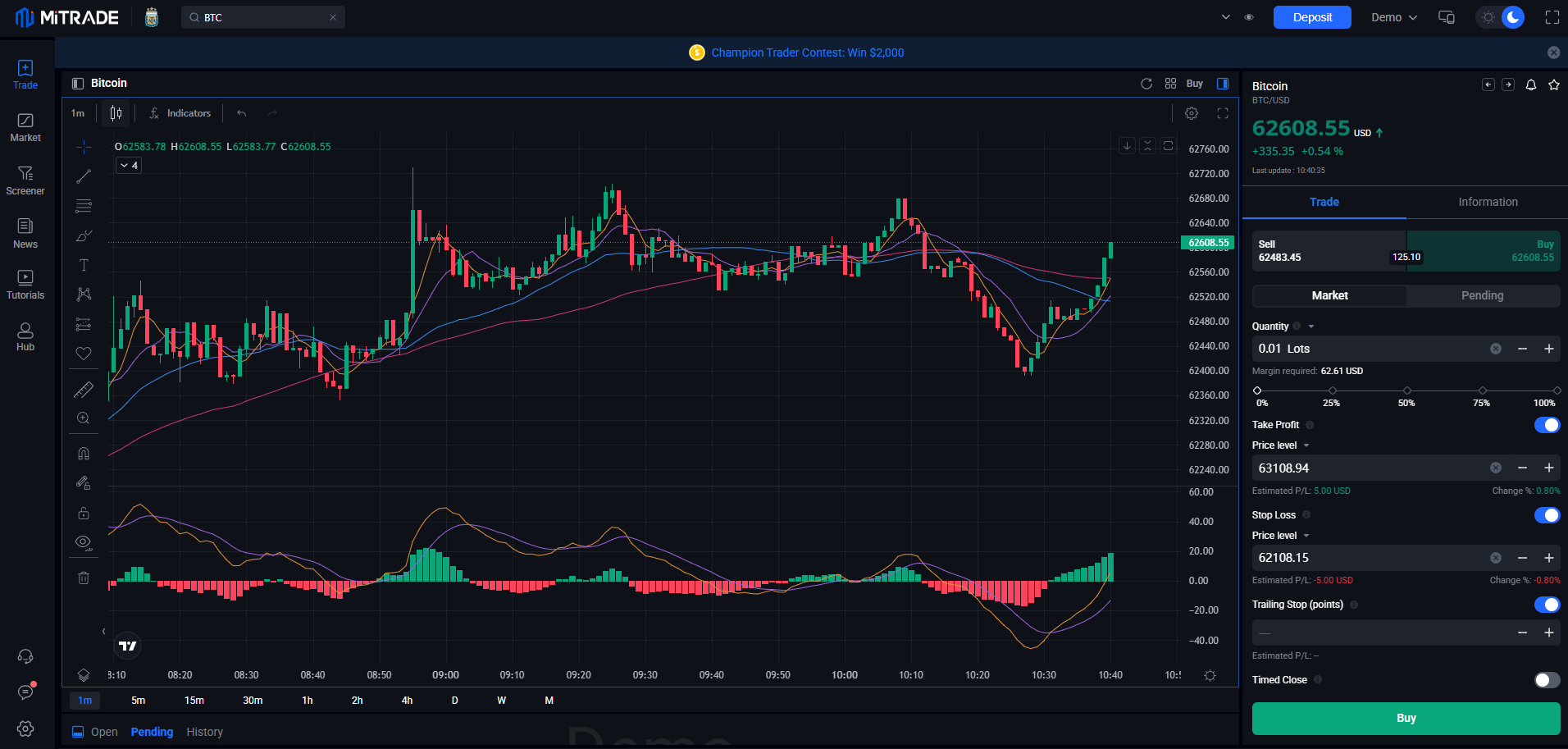
CFDs also involve leverage, which can magnify both gains and losses. Traders should therefore define their position size and exit levels before entering a volatile market such as Bitcoin.
“Trade Bitcoin with an ASIC-regulated broker. Fast AUD funding via PayID. ”
What could drive Bitcoin next?
Bitcoin’s resilience has moved the conversation beyond the initial geopolitical shock. The reopening of markets brought a sharp rise in oil prices and renewed pressure on global equities, but Bitcoin remained relatively steady. Attention is now shifting towards whether that resilience can continue if higher energy costs begin influencing inflation expectations, interest rates, and broader risk appetite. Several developments are likely to determine whether Bitcoin can continue holding above current levels:
Oil prices and the Strait of Hormuz: If renewed tensions cause crude prices to surge, markets could begin pricing in higher inflation and tighter monetary policy, potentially weighing on Bitcoin and other risk assets.
Further US-Iran escalation: Additional attacks, shipping disruptions, or signs of diplomatic progress could rapidly alter global risk appetite.
The CLARITY Act: Progress towards a comprehensive US regulatory framework could support institutional confidence, while further delays may reduce near-term optimism.
The BIP-110 deadline: The proposal would temporarily restrict some non-financial data stored on Bitcoin’s blockchain. Current miner signalling remains extremely low, making activation unlikely under present conditions, but the August timetable will keep the debate in focus.
Broader market sentiment: Oil prices have already risen sharply, and global equities have come under pressure following the latest escalation. Bitcoin’s response to any further deterioration will help show whether its weekend resilience reflects genuine strength or simply a delayed reaction to wider market stress.
For active traders, the key question is no longer simply whether Bitcoin survived the weekend. It is whether that resilience can continue as higher oil prices, geopolitical escalation, and renewed inflation concerns spread across global markets.
Be ready when crypto markets move
Bitcoin’s uninterrupted trading schedule means the next major move does not need to wait for a stock exchange to open.
Mitrade helps Australian traders stay prepared with:
AUD-based accounts.
Bitcoin and other cryptocurrency CFDs.
0% commission trading, with costs incorporated into spreads.
Advanced charting and integrated risk-management tools.
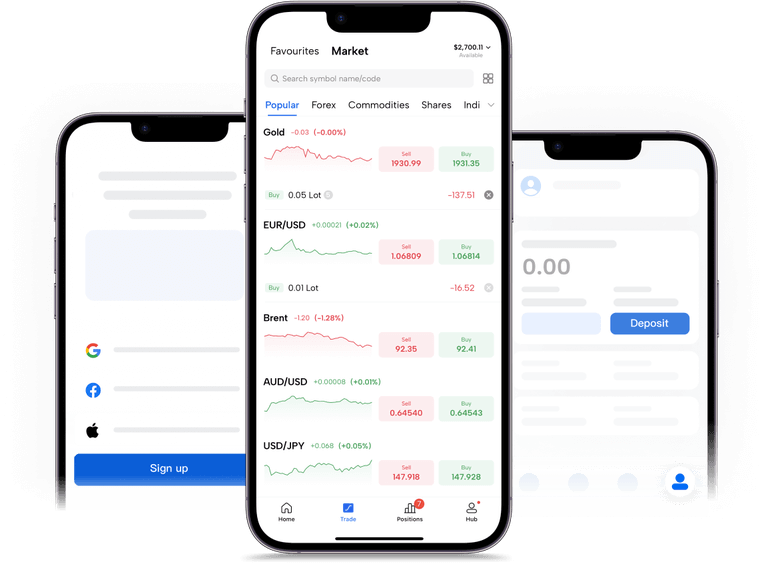
A mobile app designed for monitoring global markets.
ASIC regulation under AFSL 398528.
A free demo account with up to A$50,000 in virtual funds.
Start Trading Bitcoin CFDs in Three Simple Steps
Open an Account: Register manually via the Mitrade homepage, or use the fast sign-up process by linking your existing Google or Facebook credentials.
Fund Your Account: Deposit your initial margin using secure Australian payment methods, including POLi or Visa/Mastercard.
Trade Bitcoin CFDs: Access the platform, analyze your preferred crypto, define your risk parameters, and execute your long or short position.
Bitcoin has remained unexpectedly steady through the latest geopolitical escalation, but oil markets, US regulation, and an approaching blockchain debate could all reshape the outlook. Open your Mitrade account today and be ready as the next chapter unfolds.


1. Why does Bitcoin trade during the weekend?
Bitcoin operates through a decentralised global network rather than a traditional exchange. It therefore trades 24 hours a day, seven days a week, including weekends and public holidays.
2. Is Bitcoin a safe haven during geopolitical conflict?
Bitcoin has sometimes remained resilient or risen during periods of uncertainty, but it is not consistently treated like gold or government bonds. It can also fall sharply when investors reduce exposure to risk, so its safe-haven status remains debated.
3. What is BIP-110?
BIP-110 is a proposed change to Bitcoin’s consensus rules that would temporarily restrict certain types of non-financial data stored on the blockchain. The proposal has generated debate over network congestion, censorship resistance, and the risks of changing Bitcoin’s core rules.
4. Can Bitcoin be traded without owning cryptocurrency?
Yes. Bitcoin CFDs allow traders to speculate on price movements without buying Bitcoin or storing it in a digital wallet. CFDs can be traded in either direction, although leverage can amplify losses as well as gains.
Disclaimer: The content presented above, whether from a third party or not, is considered as general advice only. CFD trading involves significant risk of loss. Past performance does not guarantee future results. This article serves informational purposes only and does not constitute financial advice. Consider your risk tolerance before trading.


