




Gold Price Rebounds Toward US$4,140: Can XAU/USD Recover in Australia? (October 2026 Outlook)

Today's Gold & Silver Performance (8 October)
Gold & Silver Market Dashboard
Gold Price Today
Gold (XAU/USD) is extending its rebound from a two-month low, rising toward the US$4,130–4,135 area in Asian trading on Thursday. Spot gold was recently reported around US$4,141 per ounce, up about 0.7% after falling to its lowest level since early August on Wednesday.
The immediate support for gold is coming from a pause in the US dollar's rally. The dollar had climbed to its strongest level in around 18 months before pulling back slightly, making dollar-denominated gold more affordable for international buyers.
However, the recovery remains fragile. US Treasury yields are still elevated, with the 10-year yield around 5.30%, while the latest Federal Reserve meeting minutes reinforced concerns about inflation and the possibility of further rate increases later this year. Higher yields increase the opportunity cost of holding a non-yielding asset such as gold.
This leaves gold caught between two opposing forces: a softer dollar is helping the rebound, but higher yields, persistent inflation risks and expectations for another Fed hike are limiting the upside.
Oil Prices Add Another Layer of Uncertainty
Oil prices have also returned above the US$100 per barrel level. Brent crude recently rose to around US$102.28, while WTI was around US$89.94, as continued Middle East supply concerns and attacks on oil tankers increased fears of further disruption.
Higher oil prices are a double-edged factor for gold.
On one hand, geopolitical uncertainty and concerns over energy supply can increase demand for traditional safe-haven assets. On the other hand, persistently higher oil prices can push inflation expectations higher, potentially keeping interest rates elevated for longer.
That second effect is particularly important for gold right now. If higher energy prices reinforce expectations of further Fed tightening, the resulting rise in yields and the dollar could outweigh safe-haven demand.
What Traders Are Watching
The Federal Reserve's policy outlook remains the dominant catalyst for gold.
The latest Fed minutes showed that policymakers remain concerned about inflation, while markets are currently pricing in a relatively low probability of another rate hike at the October meeting. At the same time, the probability of a December hike remains substantially higher. Reuters reported that markets were pricing only around an 18% chance of an October hike, compared with roughly 80% for December.
This creates a difficult environment for gold. A pause in October could give precious metals some breathing room, but expectations of another hike later in the year could continue to keep yields elevated.
For Australian traders, the immediate question is whether US$4,100–4,130 can develop into a durable support area. A sustained recovery above US$4,200 would improve the short-term technical picture, while a break back below the recent lows could reopen the path toward the US$4,000 psychological level.
The more important upside reference is around US$4,275. A decisive move above this area would provide stronger evidence that the recent correction is losing momentum. Until then, the gold market remains vulnerable to renewed strength in the US dollar and Treasury yields.
For Australian investors considering Gold CFDs or Silver CFDs, the current environment favours careful risk management rather than assuming that the latest rebound marks the start of a new sustained uptrend. CFDs allow traders to speculate on both rising and falling prices, but leverage can magnify both potential gains and losses.
Where to Buy Gold in Australia
If you're wondering where to buy gold in Australia after the recent price pullback, the answer depends on your investment objectives. Some investors prefer owning physical bullion as a long-term store of value, while others choose ETFs, gold mining shares, or Gold CFDs for greater flexibility and lower capital requirements. Australia offers all four options, making it one of the world's most accessible markets for gold investing.
Here's a comparison of the most popular ways Australians invest in gold:
1. Buy Physical Gold
Buying physical gold remains the traditional choice for investors seeking a hedge against inflation or financial uncertainty. Australian investors can purchase gold bullion bars, investment-grade coins and minted collectibles from reputable dealers. While physical ownership provides tangible security, investors should also consider storage, insurance and dealer premiums before making a purchase.
Where to Buy Physical Gold
2. Invest in Gold ETFs
Gold ETFs offer one of the simplest ways to gain exposure to gold prices without holding physical bullion. They trade on the ASX like ordinary shares and typically have lower transaction costs than buying and storing gold.
Popular Gold ETFs
BetaShares Gold Bullion ETF (QAU)
Global X Physical Gold (GOLD)
Perth Mint Gold (PMGOLD)
Where to Buy Gold ETFs
3. Buy Gold Mining Stocks
Instead of investing directly in bullion, investors can purchase shares of gold mining companies. Mining stocks may outperform the gold price during strong bull markets but also carry company-specific operational risks.
Popular examples include:
Northern Star Resources (ASX: NST)
Evolution Mining (ASX: EVN)
Newmont (NYSE: NEM)
Where to Buy Gold Stocks
4. Trade Gold CFDs
For investors looking to profit from short-term gold price movements, Gold CFDs provide significantly more flexibility than physical ownership. CFDs allow traders to speculate on both rising and falling gold prices without worrying about storage or delivery, making them popular among active traders.
Where to Trade Gold CFDs
📌 Editor's Pick: Mitrade gives Australian traders a flexible way to trade Gold CFDs, with the ability to take long or short positions on gold price movements without owning or storing physical bullion. Whether you're looking to trade a potential breakout or manage short-term pullbacks, Mitrade provides access to gold markets as price volatility remains elevated.
“Trade gold CFDs with an ASIC-regulated broker. Fast AUD funding via PayID. ”
How to Trade Gold CFDs with Mitrade
If you don't want to buy and store physical gold, Gold CFDs offer a flexible way to speculate on gold price movements.
With Mitrade, Australian investors can trade XAU/USD CFDs in just a few steps:
Step 1. Open a Free Mitrade Account: Register online and complete the account verification process.
Step 2. Fund Your Account: Deposit funds using your preferred payment method. You can also start with a free demo account before risking real capital.
Step 3. Search for XAU/USD: Locate Gold (XAU/USD) on the trading platform and review the latest market charts and technical indicators.
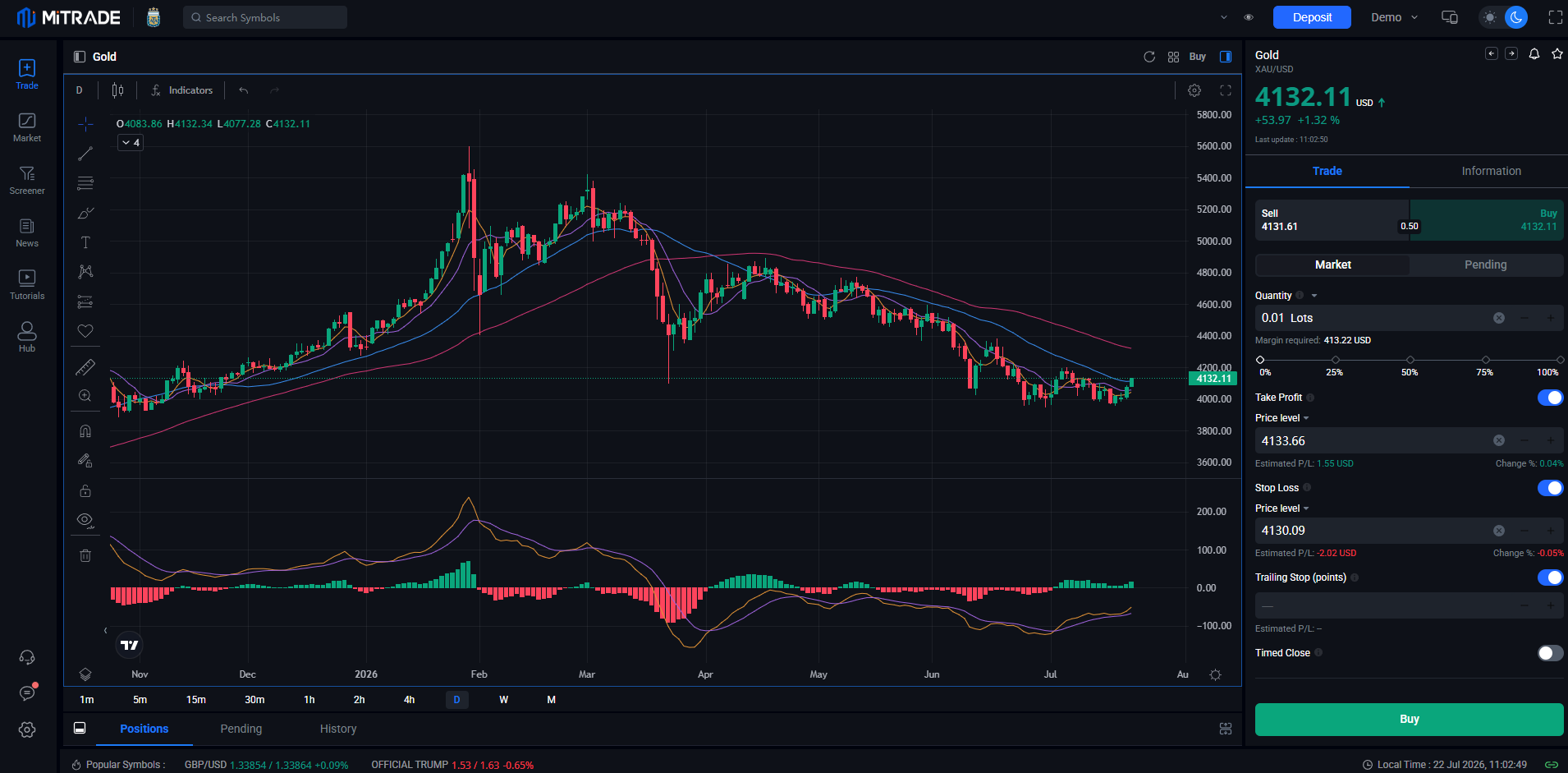
Step 4. Choose Your Position
Buy (Long): If you expect gold prices to rebound.
Sell (Short): If you believe the recent downtrend will continue.
Step 5. Manage Your Risk: Set stop-loss and take-profit orders before opening your trade. Position sizing and disciplined risk management are particularly important during periods of heightened volatility.
Why Trade Gold CFDs with Mitrade?
✔ Trade rising and falling gold markets
✔ Competitive spreads with no physical storage costs
✔ Mobile and desktop trading platforms
✔ Real-time charts and technical analysis tools
✔ Free demo account for beginners
✔ Access to multiple global markets from one account
Gold CFDs allow traders to respond quickly to changing price action without the need to purchase, transport, or store physical bullion. Whether you're looking to trade a potential rebound from key support levels or position for further downside, Gold CFDs offer a flexible way to trade both rising and falling markets.


You might be interested in…
1. Is now a good time to buy gold?
That depends on your investment objective. Long-term investors may view the recent decline below US$4,000 as a buying opportunity, while short-term traders should be prepared for continued volatility driven by Federal Reserve policy, inflation data and geopolitical developments.
2. What is the best way to buy gold in Australia?
It depends on your goals:
Physical Gold – Best for long-term wealth preservation.
Gold ETFs – Suitable for passive investors.
Gold Mining Stocks – Offer higher growth potential but with additional company-specific risk.
Gold CFDs – Ideal for active traders who want to profit from both rising and falling markets.
3. Can I buy gold with a small amount of money?
Yes. Gold ETFs and Gold CFDs allow investors to gain exposure with much less capital than purchasing a full gold bar or bullion coin. Many CFD brokers also offer fractional position sizes.
4. Can I trade gold 24 hours a day?
Gold CFDs are available for trading nearly 24 hours a day during the trading week, allowing investors to respond quickly to global market events, economic releases and geopolitical news.
Disclaimer: The content presented above, whether from a third party or not, is considered as general advice only. CFD trading involves significant risk of loss. Past performance does not guarantee future results. This article serves informational purposes only and does not constitute financial advice. Consider your risk tolerance before trading.


