




AUD/USD Forecast 2026: The Australian Dollar Is Fighting Two Wars at Once
The Australian Dollar climbed from 0.6415 in Nov 2025 to above 0.7200 in Feb 2026, its strongest level in three years, then reversed hard below 0.70 as Middle East conflict sent traders rushing into the US Dollar.
The Reserve Bank of Australia raised its cash rate twice in a row in February and March 2026, bringing it to 4.10%, the highest level since 2012, as inflation refuses to fall back within the 2% to 3% target band.
Markets now fully price in a third consecutive hike in May 2026, which would push the RBA to 4.35% and give Australia the highest central bank rate in the entire G10.
That rate advantage supports the Aussie structurally, but Middle East oil shocks, US Dollar safe haven demand, and China's economic health are pulling in the opposite direction right now.
Where AUD/USD Stands Right Now
The Aussie Dollar sits at a crossroads as of March 24, 2026.
It rallied from 0.6415 in November 2025 to above 0.7200 in February 2026. That is a move of over 1,200 pips. China was buying, the RBA was turning hawkish, and the US Dollar was losing ground across the board.
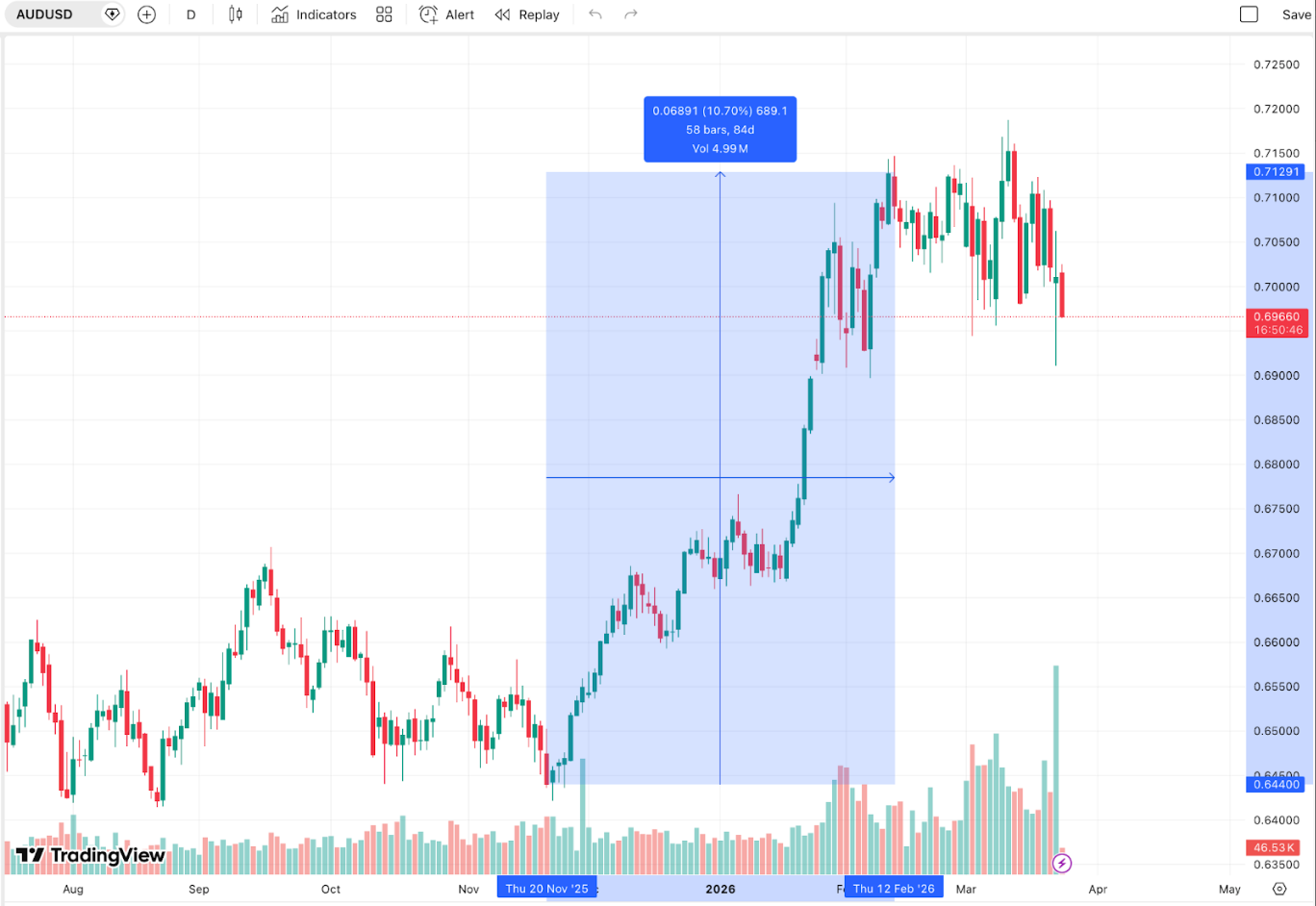
Source - TradingView AUD/USD Daily Chart
Then it reversed.
The Australian Dollar depreciated past $0.69 early this week, hitting its lowest level in eight weeks. A stronger US Dollar and declining Asian stocks weighed on AUD, which traders treat as a risk sensitive currency and sell first when global confidence drops.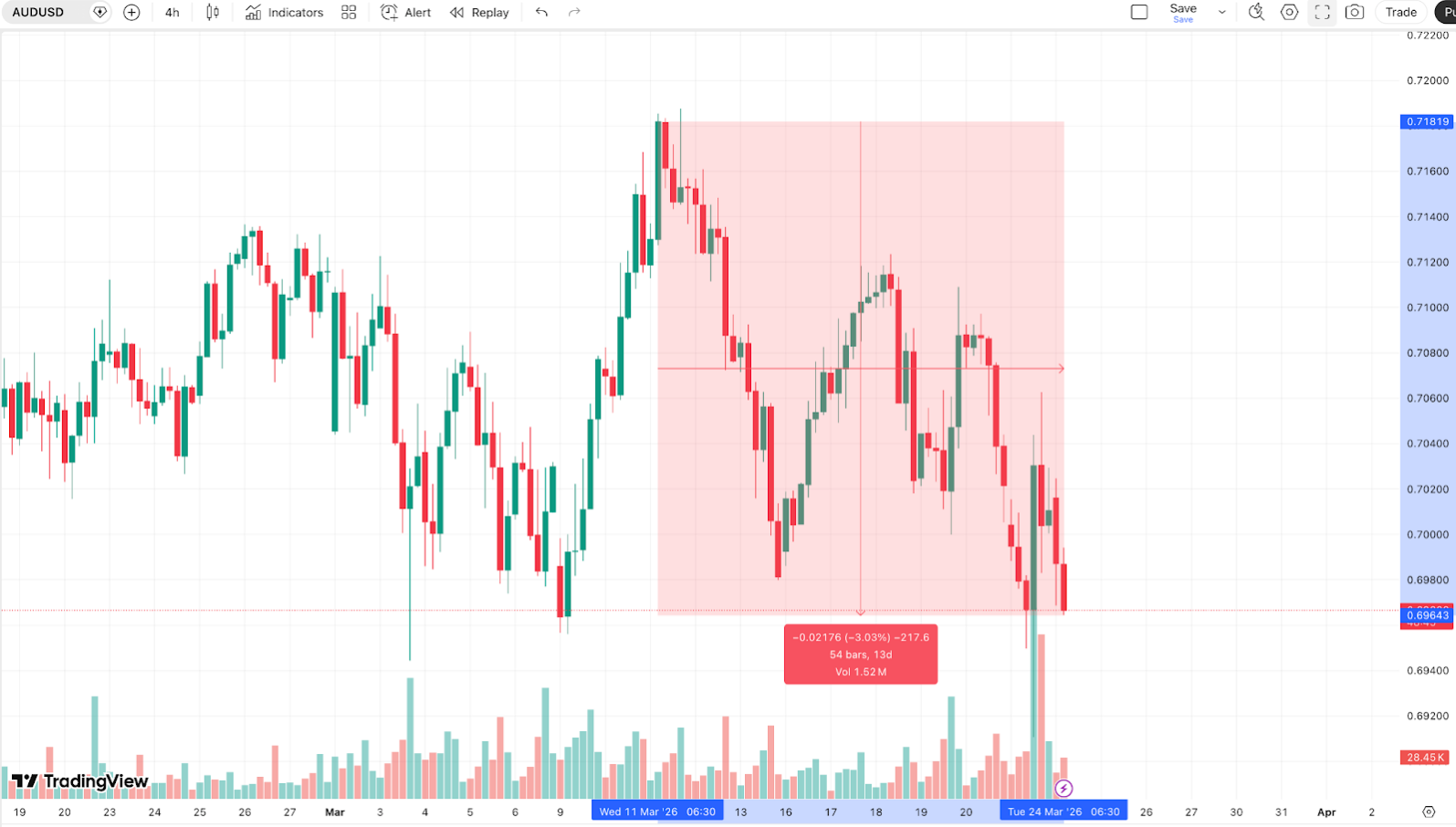
Source - TradingView AUD/USD 4H Chart
AUD/USD now trades in the 0.6970 to 0.7040 zone. The pair fights strong technical resistance below 0.7120. The weekly structure shows recovery, but the trend remains unclear.
“Trade AUDUSD with an ASIC-regulated broker. Fast AUD funding via PayID. ”
The RBA Just Did Something It Has Not Done Since Mid-2023
The Reserve Bank of Australia raised its Official Cash Rate by 25 basis points to 4.10% at its March meeting, marking the second consecutive hike of the year after an identical move in February.
Governor Michele Bullock has made the RBA's position clear: inflation is still too high, the labor market is still too strong, and rising energy costs from the Middle East conflict risk triggering a second wave of price pressures that the RBA is not willing to tolerate.
Major Australian banks including CBA, ANZ, NAB, and Westpac now expect the cash rate to reach 4.35% as early as May, depending on how inflation data evolves over the next two months.
That rate gap matters directly for AUD/USD because when Australian interest rates run above US rates, global investors shift capital into Australian assets to earn a higher return, and that demand pushes the Aussie higher.
The Fed held its rate at 3.75% to 4.00% in March and signaled no cuts before 2027, which means the gap between Australian and US rates is widening, not closing. Global investment bank ING now estimates Australia will hold the highest central bank rate in the entire G10 by mid-2026.
That is the structural bull case for AUD in 2026.
The Middle East Problem Cuts Both Ways
Iran blocked the Strait of Hormuz and oil prices hit $100 to $103 per barrel. Markets started pricing in stagflation risk where inflation rises while global growth slows simultaneously.
Trump threatened strikes on Iranian power plants and Tehran threatened US and Israeli assets in return. That exchange collapsed global risk appetite and traders moved their money straight into the US Dollar.
AUD sold off hard because markets treat it as a risk currency and sell it first. But Australia is a net energy exporter and that single fact changes the whole picture.
The same oil spike hurting Japan and the eurozone is actually adding to Australian export revenues. Governor Bullock warned that energy driven inflation from this conflict could force the RBA to keep hiking.
Strong jobs data confirmed the Australian economy is resilient enough to absorb further rate increases. So the Middle East conflict hurts AUD short term but builds a medium term case for further strength.
“Trade AUDUSD with an ASIC-regulated broker. Fast AUD funding via PayID. ”
The Three Things That Actually Drive the Australian Dollar
Forget the noise. Consider these three dials that move the Aussie.
The RBA vs Fed Rate Gap
When Australian rates run higher than US rates, AUD strengthens. Australia sits at 4.10%. The US sits at 3.75% to 4.00%. The widening gap encourages global capital to move toward Australian assets and drives AUD demand. This dial currently points up.
China Demand and Iron Ore Prices
When iron ore prices rise, export income increases, national income improves, and the Australian Dollar tends to strengthen. Australia earns over $100 billion per year from iron ore alone and China buys most of it.
Goldman Sachs revised upward its forecast for China's 2026 GDP growth and made larger increases to predictions for 2026 and 2027. A US-China tariff agreement that reduced the potential 100% rate on Chinese goods supported this revision.
China data stays critical. Any deterioration in Chinese PMI adds significant bearish pressure to AUD regardless of what the RBA does.
Global Risk Appetite
Traders treat AUD as a risk on currency. Confidence in global growth drives money into the Aussie. Fear drives money into the US Dollar and away from AUD. The Middle East conflict keeps risk sentiment fragile. That is the main headwind keeping AUD below 0.71 despite strong domestic fundamentals.
What the Big Banks Forecast for AUD in 2026
In early January, Westpac, NAB, and CBA projected that the AUD would trade in the 0.69 to 0.72 range in 2026, with CBA allowing for upside to 0.73. By 26 February, the Aussie had already climbed to 0.71 US cents, its highest value since February 2023, surpassing many of these early predictions.
The RBA's February Statement on Monetary Policy acknowledged that AUD strength is being driven by higher domestic rate expectations and built a 5% appreciation into its own forecasts.
For AUD/USD to hold in a 0.70 to 0.75 range, the market generally needs the Fed to delay cuts, commodity demand to stay stable, and risk sentiment to stay constructive.
Traders Union's statistical model projects AUD/USD averaging near 0.71 by year end with a high scenario approaching 0.79. A resolution to geopolitical tensions, a stable Chinese economy, and continued RBA tightening would realign the Aussie with the bullish consensus.
“Trade AUDUSD with an ASIC-regulated broker. Fast AUD funding via PayID. ”
How to Trade AUD/USD in 2026 on Mitrade
Three scenarios traders watch right now:
Scenario 1 (Bull): Middle East tensions ease. Oil prices pull back. Risk appetite returns. The RBA hikes again in May. AUD targets the 0.7120 resistance zone and aims for 0.73 by Q3.
Scenario 2 (Bear): Middle East escalates further. Oil stays above $100. Safe haven USD demand dominates. AUD tests 0.6850 and possibly revisits 0.67.
Scenario 3 (Range): The geopolitical situation stays uncertain but contained. The RBA holds at 4.10% through mid year. AUD oscillates between 0.69 and 0.71. Range traders capture the move via CFDs on each swing.
All three scenarios are tradeable from one Mitrade account with no software download. You can trade AUD/USD as a CFD with competitive spreads and zero commission on the standard account.
Our platform operates under ASIC regulation (AFSL 398528), CIMA, and the Mauritius FSC. Every account type gets the same treatment. No tiered access. No hidden spreads based on account size.
Open a free 90-day demo account to practice before going live. The demo converts to permanent status once you open a live account.


1. Will the Australian Dollar rise in 2026?
The structural case stays bullish. The RBA cash rate at 4.10% ranks among the highest in the G10. Iron ore and energy exports support national income. Major banks forecast AUD/USD in the 0.69 to 0.73 range. The main downside risk is a geopolitical shock that drives safe haven demand into the US Dollar and suppresses AUD below fair value.
2. What is the AUD/USD forecast for mid-2026?
Most analysts target 0.70 to 0.73 for mid-2026. EBC Financial Group sees 0.70 to 0.75 as achievable if rate differentials, China demand, and risk sentiment all align. The RBA embeds a 5% appreciation from late 2025 levels in its own projections.
3. Does an RBA rate hike strengthen the Australian Dollar?
Yes. A rate hike increases the yield on Australian assets. Global investors move capital into those assets to earn higher returns. That buying pressure lifts AUD against currencies from countries with lower rates, including the US Dollar.
4. How does oil affect the Aussie Dollar?
Oil creates a dual effect on AUD. Rising prices generate global risk off sentiment which weakens AUD in the short term. But Australia exports energy, so high oil prices also increase national income and provide a structural buffer. This makes AUD more resilient during oil shocks than currencies of oil importing nations like Japan or the eurozone
5. How does the Middle East conflict affect AUD/USD?
In the short term it is bearish. Risk off sentiment drives traders into the US Dollar. AUD sells off. Over the medium term, if oil stays elevated, Australian export revenues rise, the RBA faces more inflation pressure, hikes further, and the rate differential widens in AUD's favor.
6. Can I trade the Australian Dollar as a CFD?
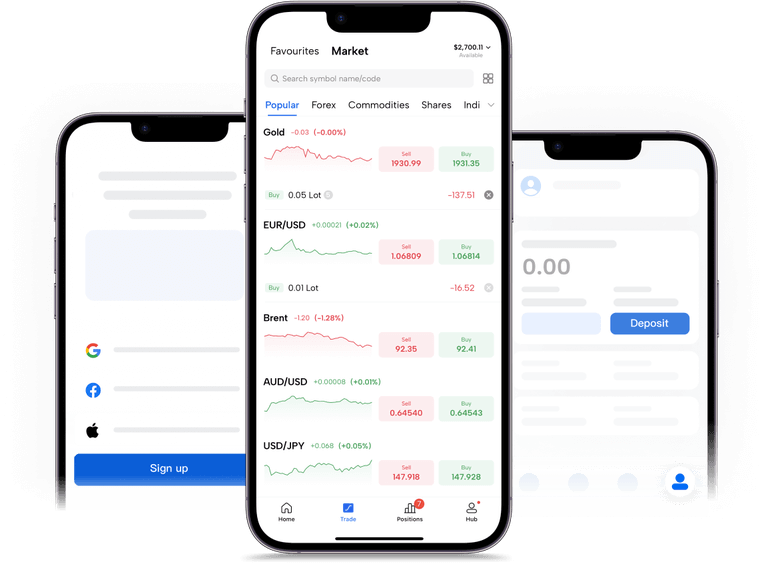
Yes. Mitrade offers AUD/USD as a CFD instrument. You go long if you expect the Aussie to rise. You go short if you expect it to fall. Mitrade charges zero commission on its standard account. The platform operates under ASIC regulation and runs on web, iOS, and Android.
Disclaimer: The content presented above, whether from a third party or not, is considered as general advice only. CFD trading involves significant risk of loss. Past performance does not guarantee future results. This article serves informational purposes only and does not constitute financial advice. Consider your risk tolerance before trading.


