




Gold Price Forecast: What You Can Expect in 2026
The gold price forecast for 2026 is one of the most debated topics on Wall Street right now, and for good reason.
Gold hit an all-time high of $5,602/oz in January 2026, capping a year where prices rose around 65%.
But by April, it had pulled back to around $4,700/oz, a 16% drop from the peak in under three months.
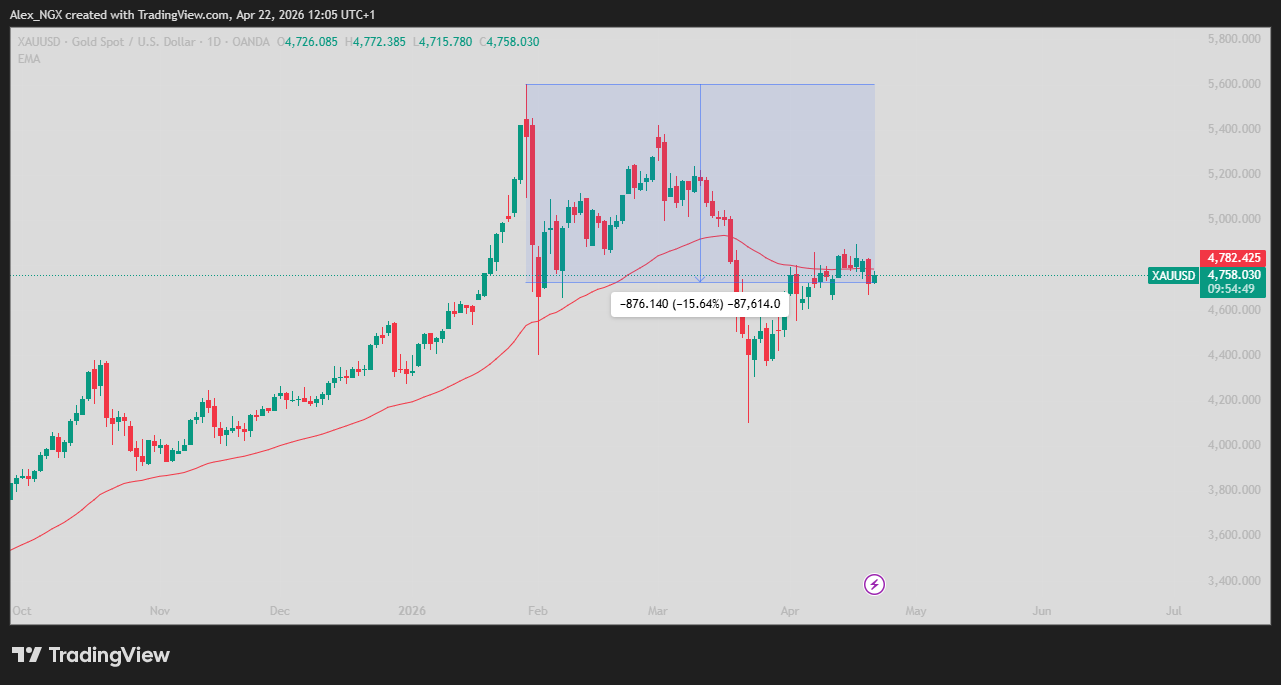
Image via TradingView: XAU/USD Daily Chart
Some analysts see this as a buying opportunity within a larger bull market. But others think the rally is losing momentum. The gap between the most bullish and most bearish gold price forecast figures is over $2,000/oz.
So what's actually going on?
This post breaks down what the major banks are saying, what's driving prices, and what it all means for your trading decisions.
Why the Gold Price Forecast for 2026 Is Unusually Hard to Call
Gold had a remarkable 2025. Prices rose around 65% across the year, setting 53 all-time highs along the way before reaching $5,602/oz in January 2026. This was the strongest annual performance since 1979.
Since then, prices have cooled to around $4,700/oz as of April 2026, sitting roughly 15.6% below that peak.
What makes the current gold price forecast so tricky is the sheer range of where analysts think prices go from here.
Macquarie puts its estimates at around $4,323/oz. J.P. Morgan sits at the other end, targeting $5,055/oz by Q4 2026, with Wells Fargo going further at $6,300/oz by year-end.
That's a spread of about $2,000 between the bears and the bulls. This tells you something important: that even the most informed voices in the room are working with a lot of uncertainty.
That uncertainty isn't a sign that analysts don't know what they're doing. It reflects how many moving parts are in play right now.
Inflation, interest rates, geopolitical tensions, central bank behavior, and the strength of the US dollar are all pulling in different directions.
So before looking at where gold might go, it helps to understand what's actually driving it.
“Trade gold CFDs with an ASIC-regulated broker. Fast AUD funding via PayID. ”
What's Actually Driving the Gold Price Right Now
To make sense of where gold is headed, you need to understand what's moving it. Four forces are doing most of the heavy lifting right now.
Interest Rates and Real Yields
Gold doesn't pay interest or dividends. So when bond returns are high, gold becomes less attractive.
The key number to watch is the real yield, which is the nominal interest rate minus inflation. When that figure turns negative, gold tends to benefit.
The Fed is expected to cut rates two to three times in 2026, which would push real yields lower and make gold more appealing by comparison.
Inflation
Core inflation in the US is still running above the Fed's 2% target. Gold has long been seen as a store of value when the purchasing power of money is under pressure.
When your cash buys less over time, assets like gold tend to hold their ground. This is one of the most consistent threads running through any bullish gold price forecast right now.
Central Bank Buying
Central banks bought over 1,100 tonnes of gold in 2025, the third straight year above 1,000 tonnes according to J.P. Morgan.
The biggest buyers include China's People's Bank, the Reserve Bank of India, the National Bank of Poland, and Turkey.
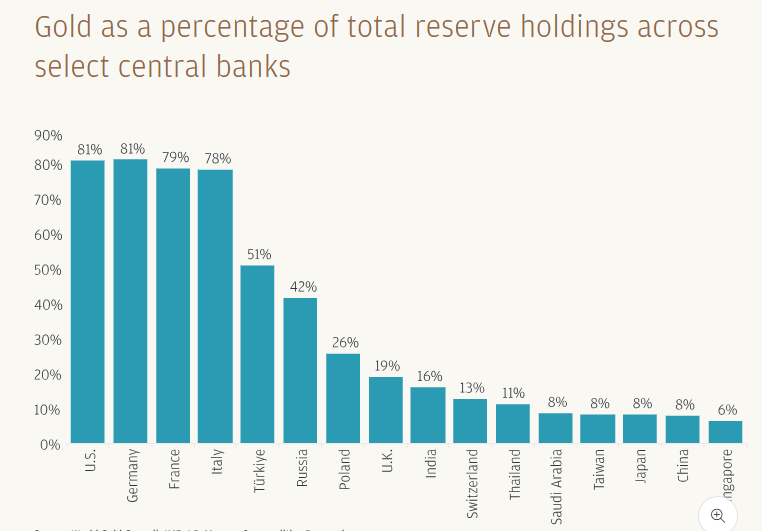
Image via J.P. Morgan
It should be mentioned that this demand is price-insensitive. These institutions are building strategic reserves, not chasing short-term profits, which creates a solid demand floor under prices.
The US Dollar
Gold is priced in US dollars, so the two tend to move in opposite directions. When the dollar weakens, gold becomes cheaper for international buyers, which pushes demand and prices up.
Traders watch the DXY, the US Dollar Index, as one of the most reliable short-term guides to gold's direction.
What Major Banks Are Forecasting for Gold in 2026
Here's where the major banks currently stand on their gold price forecast for the rest of 2026:
The spread here is worth paying attention to. Macquarie sits at the most conservative end at around $4,323/oz, while Wells Fargo targets $6,300/oz by year-end.
That's a gap of nearly $2,000 between the most bearish and most bullish calls on this list, and both are coming from serious, well-resourced institutions.
Their forecasts are based on different assumptions about inflation, Fed policy, and how long geopolitical tensions stay elevated.
The World Gold Council takes a different approach altogether, working with probability scenarios rather than a single price target.
In a mild economic cooling scenario with falling interest rates, it sees gold gaining 5–15%. In a global recession or major geopolitical shock scenario, the upside stretches to 15–30%.
Ultimately, the honest read is that the range of outcomes is genuinely wide, and anyone claiming certainty on either side deserves some skepticism.
“Trade gold CFDs with an ASIC-regulated broker. Fast AUD funding via PayID. ”
What Could Push the Gold Price Higher or Lower
No gold price forecast comes with a guarantee, and the direction gold takes from here depends on how a few key factors play out. Here's what analysts are watching on both sides.
Factors That Could Drive Gold Higher
The Fed cuts rates more aggressively than markets currently expect, pushing real yields further into negative territory
Geopolitical tensions escalate, whether in the Middle East, Ukraine, or around US-China trade relations, driving more investors toward safe-haven assets
De-dollarization accelerates as more countries reduce their US dollar reserves and shift toward gold
The US dollar weakens sharply, making gold cheaper for international buyers and lifting demand
ETF inflows pick up pace, with J.P. Morgan projecting around 250 tonnes of ETF inflows into gold in 2026
A stagflation scenario takes hold, combining slow economic growth with persistent inflation, which has historically been one of the most bullish environments for gold
Factors That Could Push Gold Lower
The US dollar strengthens more than expected, making gold more expensive for international buyers
The Fed holds rates higher for longer, keeping real yields elevated and reducing gold's appeal
Central banks slow or reverse their gold purchases, removing a key structural demand floor
Major geopolitical conflicts find resolution, reducing the safe-haven premium built into current prices
Gold looks technically overbought and triggers a wave of profit-taking, as happened in January 2026 when prices fell around 10% in a single day
Both scenarios are live possibilities right now. The same forces driving the bullish case, namely inflation, geopolitics, and central bank behavior, are the ones that could reverse quickly if conditions change.
That's worth keeping in mind as you assess where gold fits in your trading approach, which is exactly what the next section covers.
How to Trade Gold on Mitrade
Gold can be traded in several ways. The most common options include:
Spot gold (XAU/USD)
Exchange-traded funds (ETFs)
Futures contracts
Contracts for difference (CFDs)
A CFD is an agreement between a trader and a broker to exchange the difference in an asset's price between when a trade opens and when it closes. You never own the underlying asset, but you can still benefit from price moves in either direction.
On Mitrade, you can go long or short on gold. Going long means you're betting on prices rising. Going short means you're positioned to benefit if prices fall.
That flexibility matters in a market as volatile as gold, where the gap between the most bullish and most bearish gold price forecast figures currently spans thousands of dollars.
CFD trading on gold involves leverage, which means you can control a larger position with a smaller upfront deposit. If you put down $500, you might control a position worth several times that amount.
That can work in your favor when the market moves your way, but it also magnifies losses when it doesn't.
A clear risk management plan, including setting stop-loss levels and knowing how much you're willing to lose on any single trade, matters just as much as having a view on where gold is headed.

Trade XAU/USD with Tight Spreads
Conclusion
The gold price forecast for 2026 covers a wide range for a reason. Inflation, interest rates, central bank behavior, and geopolitical tensions are all moving at the same time, and no single analyst has a clean read on how they'll interact.
What you can do is stay close to the drivers. Watch real yields, track the DXY, and pay attention to what central banks are doing.
The number matters less than the conditions behind it. If those conditions stay intact, the structural case for gold stays intact too. Sign up with Mitrade today to trade your ideas.
1. What Is the Gold Price Forecast for the End of 2026?
Analyst targets currently range from around $4,323/oz at the conservative end to $6,300/oz at the most bullish. The consensus midpoint sits roughly between $5,300 and $5,500/oz. These are informed estimates based on current conditions, not guarantees, and several banks have already revised their targets multiple times this year.
2. Why Did Gold Drop After Hitting Its All-Time High in January 2026?
Gold fell around 10% in a single day after President Trump nominated Kevin Warsh as the new Federal Reserve chair. Markets took that as a signal of restored confidence in the Fed's independence, which strengthened the dollar and pushed gold lower. Profit-taking after a historic run also played a role.
3. Is Gold Still a Good Investment in 2026?
That depends on your risk profile and investment horizon. The case for gold includes persistent inflation, strong central bank buying, and ongoing geopolitical uncertainty. The risks include high entry prices, significant volatility, and the fact that gold pays no interest or dividends. It's worth weighing both sides carefully before making any decision.
4. What Is the Biggest Risk to the Gold Price Forecast Right Now?
Most analysts point to two main downside risks: a stronger-than-expected US dollar and the Fed keeping interest rates higher for longer. Either scenario would push real yields up and reduce gold's appeal relative to interest-bearing assets.
5. How Do Central Banks Affect the Gold Price?
Central banks buy gold as a strategic reserve asset, and they've been doing so at scale. Purchases exceeded 1,000 tonnes annually for three straight years leading into 2026, according to the World Gold Council. That level of sustained, price-insensitive demand creates a structural floor under prices, meaning even during pullbacks, there's a consistent source of buying support in the market.
6. Can I Trade Gold on Mitrade?
Yes. Mitrade allows you to trade gold as a CFD, which means you can take a position on the gold price without owning the physical metal. You can go long if you think prices will rise or go short if you expect a pullback. CFD trading involves leverage, so your risk exposure can exceed your initial deposit. It's worth setting clear stop-loss levels and sizing your positions carefully before you enter any trade.
Disclaimer: The content presented above, whether from a third party or not, is considered as general advice only. CFD trading involves significant risk of loss. Past performance does not guarantee future results. This article serves informational purposes only and does not constitute financial advice. Consider your risk tolerance before trading.


