




Silver Price Prediction 2026: Why It’s Harder to Call Than Gold
Any serious silver price prediction for 2026 has to start with the honest admission that silver is not an easy metal to read.
For years, markets treated it as little more than a budget alternative to gold. That changed in 2025, when silver surged 147%, hit an all-time high of $121.67/oz in January 2026, and forced even the most skeptical analysts to pay attention.
But since then, it has pulled back to around $77–$80/oz, leaving traders wondering what comes next.
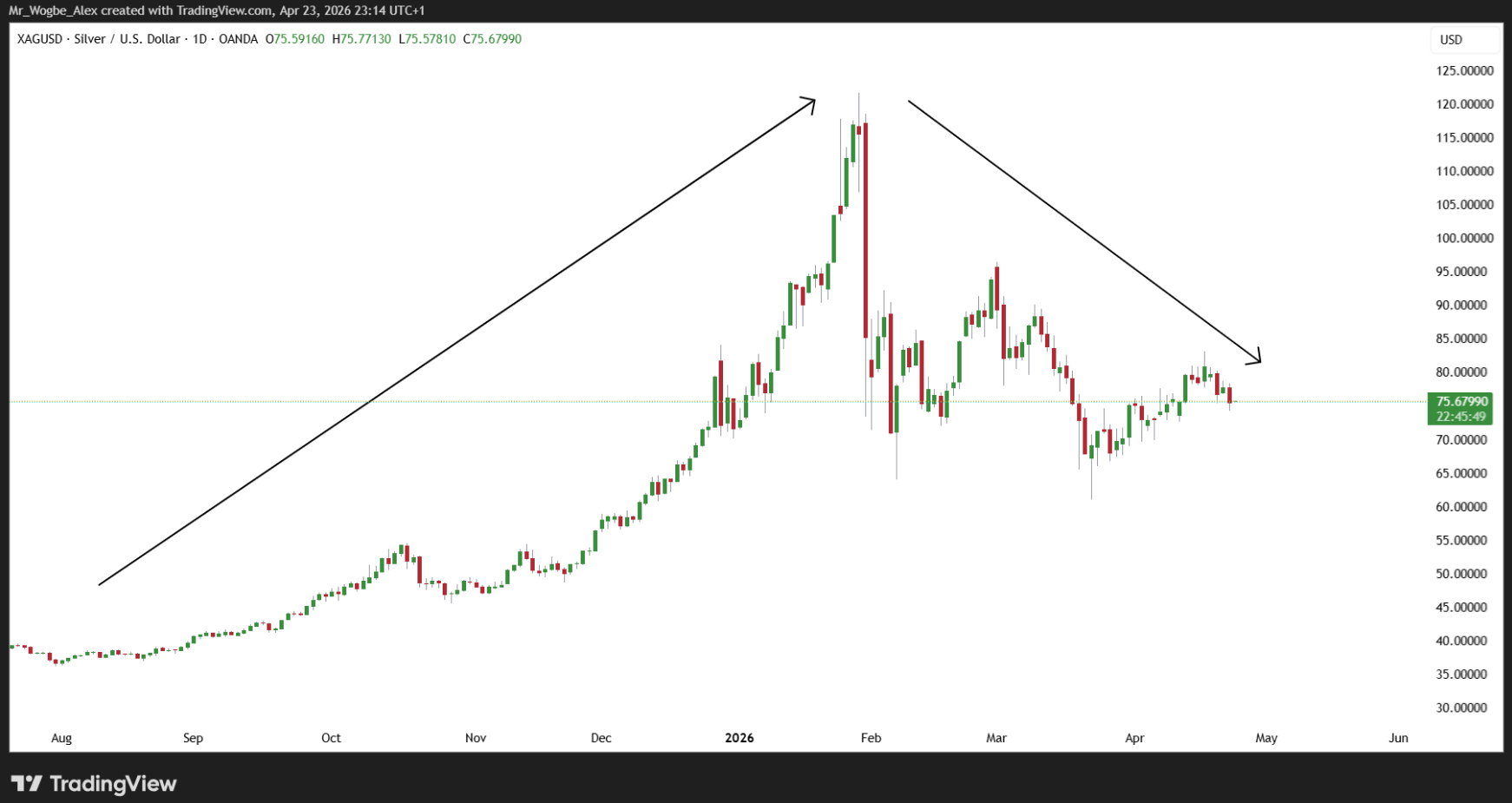
Image via TradingView: XAG/USD Daily Chart
The answer isn't straightforward, and that's because silver lives in two worlds at once.
It's a precious metal that responds to fear and monetary policy and an industrial commodity the global energy transition genuinely cannot function without.
That tension is at the heart of every silver price prediction you'll read this year.
This post unpacks both sides.
Silver's Split Personality and Why It Makes Forecasting a Nightmare
Silver occupies a strange position in financial markets.
On one side, it's a monetary metal. It’s a store of value that tends to rise when inflation picks up, the dollar weakens, or geopolitical tension sends investors toward safer assets.
On the other side, it's an industrial commodity. It’s the most electrically conductive element on earth and a material that solar panels, electric vehicles, AI data centers, and 5G infrastructure all depend on.
According to the Silver Institute, industrial applications now account for over half of all global silver demand. That's a fundamental shift from how this metal was traditionally understood.
What makes this split identity so significant for any silver price prediction is that these two sides don't always move in the same direction.
In 2025, they did. Monetary fear was high, the dollar was weakening, and at the same time, industrial demand was accelerating. Both forces pushed silver up together, and the result was a 147% surge.
But early 2026 told a different story. When the Iran war began in late February, it raised oil prices sharply, strengthened the dollar, and hurt industrial metal sentiment broadly.
Silver fell in that environment despite the geopolitical fear because its industrial identity made it vulnerable in a way gold was not.
That's the forecasting challenge in a nutshell. Silver responds to variables that can and do contradict each other, sometimes within the same news cycle.
The Supply Problem Nobody Is Talking About Enough
While most headlines focus on price levels and analyst targets, the more important story is happening beneath the surface. Silver has been in a structural supply deficit for five consecutive years.
The Silver Institute forecasts that the structural market deficit could widen to 46.3 million ounces (Moz) in 2026. This would put further pressure on already stretched above-ground stocks.
The reason supply can't simply catch up comes down to how silver is produced. Around 70–72% of silver comes out of the ground as a byproduct of mining other primary metals, copper, lead, and zinc. That makes supply inelastic, meaning it can't respond quickly to higher prices.
Miners aren't making production decisions based on what silver is doing. They're mining for the primary metal, and silver just comes along with it.
Global mine production rose 3% to 846.6 Moz in 2025, and recycling climbed 2% to 197.6 Moz, a 12-year high. But even those gains weren't enough to close the gap.
The physical tightness showed up clearly in late 2025. A rush of metal into CME vaults, rising demand for silver-backed exchange-traded products (ETPs), and a sudden surge in coin and bar buying all hit at the same time.
That combination created a severe liquidity squeeze in October 2025. This pushed lease rates sharply higher and helped drive silver to its all-time high in January 2026.
Additionally, China's decision to tighten silver export controls from January 2026 added more pressure on global physical supply.
When a market is persistently undersupplied and the supply side can't respond quickly, prices tend to find support even during sharp pullbacks.
“Trade Silver with an ASIC-regulated broker. Fast AUD funding via PayID. ”
Why the World Needs More Silver Than It Can Mine
The supply deficit in silver doesn't exist in a vacuum. It's being driven by demand that keeps growing across three sectors, none of which are showing signs of slowing down. Let’s look at these sectors and the role they play.
Solar Energy
Solar photovoltaic technology is the single largest and fastest-growing source of industrial silver demand.
Silver's conductivity is what allows PV cells to convert sunlight into electricity. Also, the scale of global solar expansion means this sector alone puts enormous pressure on supply.
The Silver Institute reports that solar's share of industrial silver demand grew from 11% in 2014 to 29% in 2024. This means it grew nearly threefold in a decade.
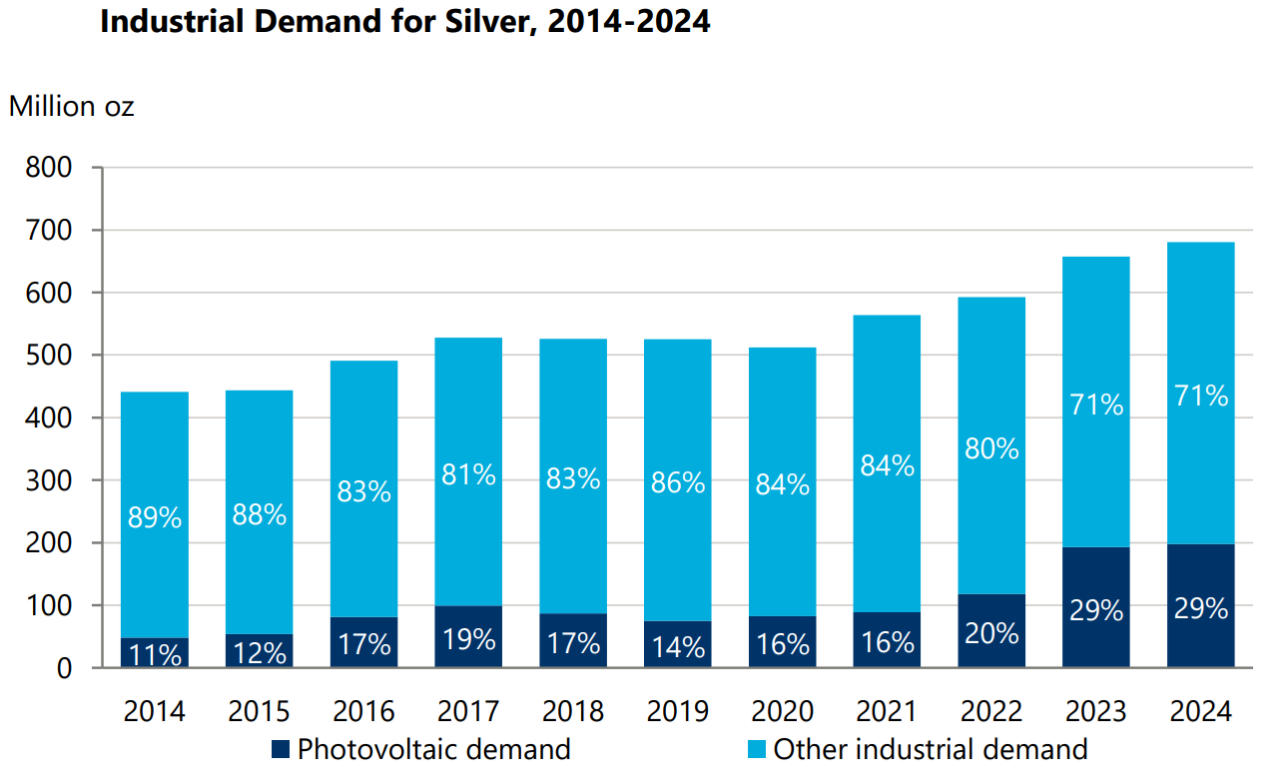
Image via The Silver Institute
That said, there's an important nuance here. Manufacturers including Longi and Jinko Solar are working to reduce silver content per panel as prices rise. But substitution remains technically difficult for high-efficiency designs.
With global solar capacity still expanding, total demand from this sector stays significant even as silver intensity per panel declines in some product lines.
Electric Vehicles and the Energy Transition
EVs use roughly 25–50 grams of silver per vehicle, considerably more than traditional combustion-engine cars.
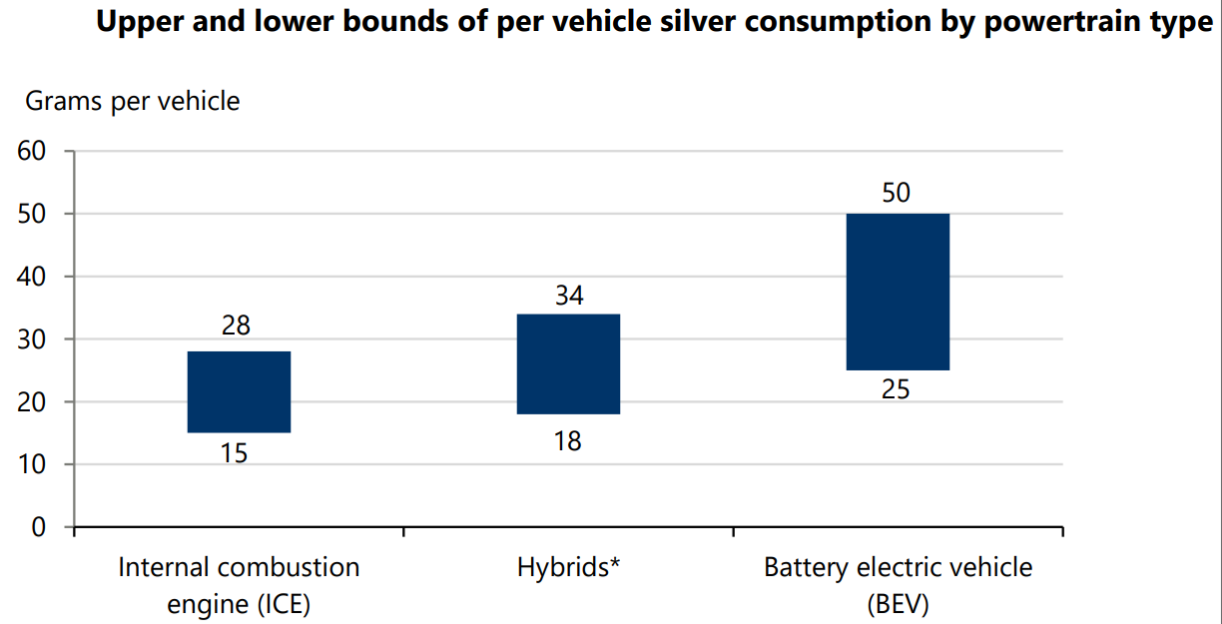
Image via The Silver Institute
The same Silver Institute report forecasts global automotive silver demand to grow at a compound annual growth rate (CAGR) of 3.4% between 2025 and 2031.
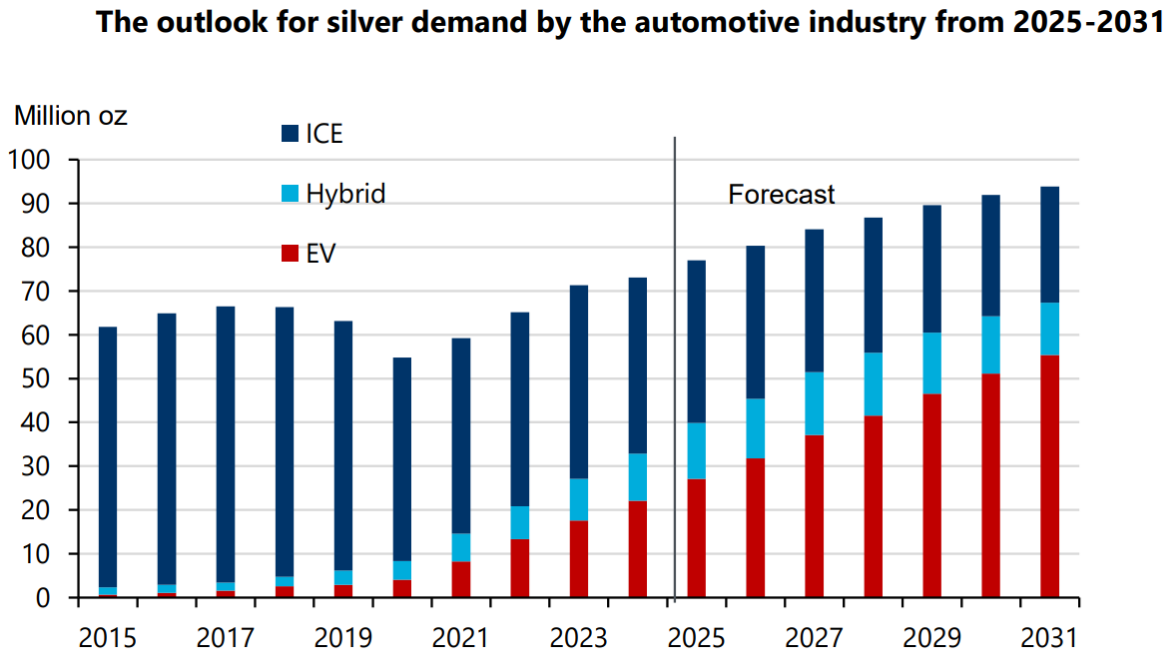
Image via The Silver Institute
EVs are expected to overtake combustion vehicles as the primary source of automotive silver demand by 2027 and account for 59% of that market by 2031.
AI, Data Centers, and Electronics
Every server, semiconductor, and power management system in a data center contains silver. As AI adoption grows and governments invest heavily in digital infrastructure, demand for the materials that power it all grows too.
The Silver Institute estimates that global IT power capacity increased roughly 53 times between 2000 and 2025, from under 1 gigawatt to nearly 50 gigawatts.
That scale of expansion means more hardware, and more hardware means more silver consumption.
This is a demand vector that many silver price prediction models are only beginning to fully account for.
What the Numbers Say—Institution by Institution
Here's where major institutions currently stand on their silver price prediction for 2026:
The mainstream consensus clusters in the high $70s to low $80s. The LBMA survey average sits at $79.57/oz, and the Reuters poll lands at $79.50/oz.
But Bank of America's base case of $135/oz sits well above that range. UBS sees a potential spike toward $100 mid-year. The gap between these calls reflects genuine disagreement, not just different methodologies.
The LBMA survey range is perhaps the most telling detail in the entire silver price prediction picture right now. A single survey of professional analysts produced a spread of $42 to $165. It reflects how many moving parts are in play.
“Trade Silver with an ASIC-regulated broker. Fast AUD funding via PayID. ”
The Two Scenarios Every Silver Trader Should Have a View On
No silver price prediction comes with a guarantee. Where prices go next depends on a few key conditions. Here's what both sides of the argument look like.
The Bull Case for Silver in 2026
Industrial demand from EVs, AI, and solar keeps growing faster than mines can supply it
Fed rate cuts push real yields lower and weaken the dollar, boosting silver on two fronts at once
China tightens silver export controls further, squeezing a global supply that's already stretched thin
Gold keeps outperforming silver, and a catch-up move in silver could be sharp when that gap closes
Inflation fears bring more retail investors back to precious metals, adding fresh buying pressure
The Bear Case for Silver in 2026
Solar makers scale copper substitution, cutting into the fastest-growing source of silver demand
A global slowdown hits industrial consumption hard, since silver is not recession-proof the way gold is
The Fed holds rates higher for longer, weighing on both investment demand and industrial activity
Leveraged positions unwind fast, as they did between January and April 2026, when silver fell over 35%
COMEX inventories recover, taking the physical squeeze premium out of the market
Both cases are credible right now. The bull case drivers can flip quickly if conditions change. A clear risk plan matters just as much as any view on the silver price prediction itself.
Trading Silver on Mitrade — What Your Options Look Like
Mitrade gives you access to silver through CFDs, short for "contracts for difference." Rather than buying physical silver or shares in a mining company, a CFD lets you trade directly on XAG/USD price movements.
You can position for prices to rise or fall, which is particularly useful in a market as two-sided as silver currently is.
Leverage is part of how CFD trading works. Your deposit acts as a margin, meaning it covers a fraction of your total market exposure. That structure can work in your favor when your read on the market is right.
But silver's price history should give any trader pause before sizing up too aggressively. This is a metal that swung 147% higher in 2025 and then shed over 35% of its value in a matter of weeks after the January 2026 peak.
Any silver price prediction gives you a directional view, but it won't protect you from what happens between now and the target.
Stop-loss levels, position sizing, and knowing your maximum acceptable loss on any single trade matter far more than picking the right forecast.
On Mitrade, those tools are available to you. Using them consistently is what separates traders who last in a volatile market from those who don't.


Conclusion
Silver's structural story is a compelling one. Persistent supply deficits, surging industrial demand, and a monetary tailwind from expected rate cuts all point in the same direction.
But any silver price prediction has to account for the other side of that coin. Silver's dual identity as both a precious metal and an industrial commodity is what makes it exciting and what makes it unpredictable.
The forecast range this year runs from $42 to over $300. That spread alone tells you everything you need to know about approaching this market with clear eyes and a solid plan. Sign up with Mitrade today to trade your ideas on silver.
1. What Is the Silver Price Prediction for the End of 2026?
Mainstream forecasts range from $79–$90/oz, with J.P. Morgan at $81/oz and Commerzbank targeting $90/oz by year-end. Bank of America's base case sits higher at $135/oz. These are estimates, not guarantees.
2. Why Did Silver Fall So Hard After Its January 2026 Peak?
Silver hit $121.67/oz in January 2026 before falling sharply. A stronger dollar following the Fed chair nomination, profit-taking after an extraordinary rally, and the Iran war dampening industrial metal sentiment all contributed.
3. What Is the Biggest Structural Risk to the Silver Price Prediction Right Now?
Solar manufacturers cutting silver content per panel through copper substitution is the most silver-specific downside risk. Combined with a stronger dollar and higher-for-longer rates, it's the bear case most analysts point to.
4. Why Has Silver Been in a Supply Deficit for Five Consecutive Years?
Around 70% of silver is mined as a byproduct of other metals, so supply can't respond quickly to higher prices. The Silver Institute's World Silver Survey 2026 projects the deficit to widen to 46.3 Moz this year.
5. Can I Trade Silver on Mitrade?
Yes. Mitrade offers silver trading as a CFD on XAG/USD, with the option to go long or short. CFD trading involves leverage, so both gains and losses are amplified. Disciplined risk management is essential.
Disclaimer: The content presented above, whether from a third party or not, is considered as general advice only. CFD trading involves significant risk of loss. Past performance does not guarantee future results. This article serves informational purposes only and does not constitute financial advice. Consider your risk tolerance before trading.


