


Warren Buffett and His Successor, Greg Abel, Have Piled More Than $82 Billion Into This Perennial Winner (No, Not Alphabet!)
Key Points
Warren Buffett retired as Berkshire Hathaway’s CEO on Dec. 31, effectively turning over his company’s $360 billion investment portfolio to Greg Abel.
Abel scooped up more than $4.5 billion worth of Buffett’s favorite stock during the June-ended quarter.
Share buybacks have been one of the many stepping stones to success for Berkshire Hathaway’s long-term investors.
- 10 stocks we like better than Berkshire Hathaway ›
For the first time in well over half a century, the trillion-dollar conglomerate built by Warren Buffett, Berkshire Hathaway (NYSE:BRKA)(NYSE:BRKB), entered the year in uncharted territory. The Oracle of Omaha's well-telegraphed retirement as CEO on Dec. 31 meant his understudy, Greg Abel, would take the reins and oversee Berkshire's $360 billion investment portfolio.
Abel didn't waste much time making his presence felt. During the first quarter, he jettisoned 16 stocks from the portfolio and more than tripled Berkshire's stake in Google parent Alphabet (NASDAQ:GOOGL)(NASDAQ:GOOG). During the June-ended quarter, Abel oversaw an additional $17 billion in Alphabet stock purchases, making it his company's No. 3 investment holding.
Missed Nvidia in 2009? This Rare Signal Is Flashing Again. In 2009, a "Double Down" signal flashed for a little-known chipmaker called Nvidia. For the first time in years, that same "Total Conviction" signal is flashing for a company 1/100th the size of Nvidia. Continue »

Warren Buffett retired as Berkshire's CEO on Dec. 31. Image source: The Motley Fool.
But Alphabet isn't the company Warren Buffett or Greg Abel has sunk their teeth into deepest. It's not iPhone maker Apple (NASDAQ:AAPL), either. Collectively, Berkshire's bosses have spent more than $82 billion buying a stock that's rallied more than 6,000,000%!
It's Abel's turn to pile into the Oracle of Omaha's favorite stock
Typically, Berkshire Hathaway's quarterly Form 13F filing is highly anticipated by investors. A 13F provides a snapshot of which stocks Wall Street's savviest money managers purchased and sold in the latest quarter.
However, what's interesting about the stock Buffett and Abel have spent more than $82 billion buying is that you won't find it in Berkshire's quarterly 13Fs. Rather, you'll need to peruse the company's quarterly operating results. On the final page before the executive certifications, you'll find detailed buying activity of the stock Buffett held nearest and dearest to his heart...Berkshire Hathaway.
BERKSHIRE IS BUYING STOCKS AGAIN FOR THE FIRST TIME SINCE 2022:
— amit (@amitisinvesting) August 8, 2026
- Bought $25B of stock, sold $3.7B
- Bought Taylor Morrison Home for $6.8B
- Invested $10B in Alphabet $GOOGL during Q2, now a top 5 holding
- Even bought $4.5B of their own stock back
berkshire’s back
Prior to mid-July 2018, Buffett could only repurchase his company's stock if shares fell to or below 120% of its book value. With shares not retracing to this mark, the Oracle of Omaha didn't spend a dime on share buybacks.
On July 17, 2018, Berkshire's board amended the buyback rules to give Buffett and now-late right-hand man Charlie Munger more freedom to execute share repurchases. The new rules allowed for unlimited buybacks as long as Berkshire had at least $30 billion in combined cash, cash equivalents, and U.S. Treasuries on its balance sheet, and Buffett perceived shares to be intrinsically cheap.
For 24 consecutive quarters (July 2018-June 2024), Berkshire's chief investor bought back his company's stock totaling around $78 billion.
Following a 21-month hiatus (June 2024-February 2026) in which no capital was allocated to buybacks, Abel has picked up where his predecessor left off. After repurchasing $234 million worth of Berkshire Hathaway stock in March, Abel green-lit $4.53 billion in buybacks in the June-ended quarter.
Since mid-July 2018, more than $82 billion has been spent to retire nearly 13% of the company's outstanding shares.
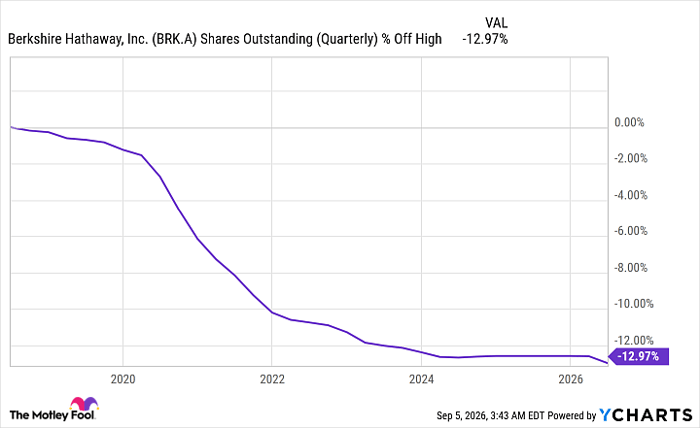
BRK.A Shares Outstanding (Quarterly) data by YCharts
The beauty of stock buybacks is twofold. First, they incentivize long-term investing. As Berkshire's share count declines over time, existing investors become incrementally larger stakeholders. Since Berkshire doesn't pay a dividend, buybacks are a logical way to reward its long-term shareholders.
Secondly, a steady diet of share buybacks by companies (e.g., Berkshire Hathaway) with neutral or growing net income can increase earnings per share and make them more fundamentally attractive to value-seeking investors.
As long as Berkshire Hathaway's shares remain below a 50% premium to book value, Abel will likely be a buyer of the stock Warren Buffett holds nearest and dearest to his heart.
Should you buy stock in Berkshire Hathaway right now?
Before you buy stock in Berkshire Hathaway, consider this:
The Motley Fool Stock Advisor analyst team just identified what they believe are the 10 best stocks for investors to buy now… and Berkshire Hathaway wasn’t one of them. The 10 stocks that made the cut could produce monster returns in the coming years.
Consider when Netflix made this list on December 17, 2004... if you invested $1,000 at the time of our recommendation, you’d have $421,997!* Or when Nvidia made this list on April 15, 2005... if you invested $1,000 at the time of our recommendation, you’d have $1,413,876!*
Now, it’s worth noting Stock Advisor’s total average return is 978% — a market-crushing outperformance compared to 213% for the S&P 500. Don't miss the latest top 10 list, available with Stock Advisor, and join an investing community built by individual investors for individual investors.
See the 10 stocks »
*Stock Advisor returns as of September 9, 2026.
Sean Williams has positions in Alphabet. The Motley Fool has positions in and recommends Alphabet, Apple, and Berkshire Hathaway. The Motley Fool has a disclosure policy.
Recommended Articles


